

The House of Representatives of Antigua and Barbuda has approved amendments to the citizenship-by-investment program that call for an increase in the mandatory period of physical presence in the country, regular independent audits, and stricter oversight of intermediaries.
The main change will be an increase in the minimum period of physical presence in the country for new citizens from five to 30 days. These days may be spent in Antigua and Barbuda cumulatively over the first five calendar years after obtaining citizenship, rather than annually. The requirement also applies to family members included in the application.
Until now, an investment citizenship holder could lose their citizenship if they did not spend at least five days in the country during the first five years. The amendments replace this requirement with 30 days.
The changes also provide for an annual independent financial audit of the Citizenship by Investment Unit (CIU) and an operational audit every two years. The regulator will have the authority to set common standards for the five Eastern Caribbean states offering investment citizenship, vet agents, and revoke the licenses of intermediaries that do not meet the established requirements. ECCIRA is expected to begin operations in September 2026.
The reform is taking place amid increasing pressure from the European Union. In a letter dated June 25, 2026, the European Commission proposed that Antigua and Barbuda gradually phase out its citizenship-by-investment program by June 1, 2028. Brussels also demanded that individuals subject to EU sanctions be excluded from the program and that background checks on applicants of all nationalities be strengthened.
The government of Antigua and Barbuda emphasizes that it does not intend to shut down the program without securing comparable sources of revenue. Authorities cite revenue from the investment citizenship program as a vital component of non-tax revenue, which funds infrastructure, schools, healthcare facilities, and post-disaster recovery efforts.
The latest detailed statistics published by the CIU cover January–June 2024. During this period, 739 applications were received. The official report takes into account the country of birth of the principal applicant, so these figures cannot be directly equated with the number of passports issued. A single application may also include a spouse, children, and other dependents.
The largest number of applications in the first half of 2024 came from natives of:
China—90 applications, or 12.18%;
the United States—81, or 10.96%;
Nigeria—67, or 9.07%;
Lebanon—50, or 6.77%;
Turkey—44, or 5.95%;
Pakistan—32, or 4.33%;
the United Kingdom—25, or 3.38%;
Iraq – 22, or 2.98%.
Over the past six months, 19 applications were received from Ukrainian nationals, accounting for 2.57% of the total. The same number of applications were submitted by Egyptian nationals. India, Canada, and Morocco each accounted for 21 applications.
From the program’s launch through June 30, 2024, Antigua and Barbuda received 5,203 applications. Chinese nationals accounted for 1,117 applications, or 21.47%; Nigerians—496; the U.S. – 347, Lebanon – 342, Russia – 222, and Syria – 208. However, no new applications from natives of Russia and Belarus were registered in the first half of 2024.
The program has been in effect since 2013 and offers several participation options. The minimum non-refundable contribution to the National Development Fund is $230,000; investment in approved real estate starts at $300,000; and direct investment in a business starts at $1.5 million. Another option involves a contribution of at least $260,000 to the University of the West Indies Campus Fund. Government fees and background check costs are paid separately.
Extending the mandatory stay to 30 days does not change the minimum investment thresholds but increases participants’ actual expenses for airfare and accommodation. At the same time, regular audits and unified regional oversight are intended to increase the program’s transparency and help Caribbean nations maintain visa-free travel with European countries.
Antigua and Barbuda, Caribbean region, CITIZENSHIP, INVESTMENT, MIGRATION

Iraq is forming a new package of cooperation with American energy companies that is expected to increase oil and gas production, accelerate the processing of associated gas, and attract private capital to modernize the country’s oil and gas infrastructure.
Iraq’s Oil Minister Basim Mohammed estimated the total value of agreements between the Iraqi oil ministry and U.S. companies at approximately $200 billion. According to him, the projects should significantly expand production capacity and increase investment in the use of associated gas. Iraq’s current oil production capacity is estimated at about 4.8 million barrels per day.
At the same time, the declared $200 billion should not be viewed exclusively as the volume of already financed projects. The package includes contracts, preliminary agreements, memorandums, technical studies, and potential investment programs, the final parameters of which will be determined following negotiations.
During the visit of Iraqi Prime Minister Ali Faleh al-Zaidi to the United States, the Iraqi delegation held talks with representatives of Halliburton, Shell, Honeywell, Weatherford, and Baker Hughes. The parties discussed the development of oil and gas fields, the introduction of modern technologies, and increasing the efficiency of the energy sector.
Separate talks were held with Chevron. Iraq proposed that the company expand its activities in the southern fields and participate in oil refining, petrochemical, and gas infrastructure projects.
Chevron, for its part, expressed interest in developing the southern fields, laying pipelines to regional ports, and creating oil storage facilities. Iraqi authorities stated their readiness to speed up the allocation of land plots, the issuance of permits, and the creation of the necessary infrastructure.
Halliburton received a contract from Basra Oil Company to provide integrated management services for the Bin Omar and Sindbad fields in southern Iraq. The agreement provides for integrated asset development management, as well as support for the design, procurement, and construction of infrastructure.
In fact, Iraq is seeking to move from separate service contracts to a long-term presence of American companies in production, processing, oilfield services, digital field management, and the construction of export infrastructure.
For Baghdad, American capital is important not only as a source of financing. Large U.S. companies can provide access to enhanced oil recovery technologies, modern drilling and compressor equipment, automation of production processes, and international project management standards.
An additional task is the diversification of export routes. Iraq is interested in developing pipelines, oil storage facilities, and new outlets to regional ports in order to reduce dependence on a limited number of supply routes.
What opportunities are opening up for Ukraine
The scale of Iraqi projects creates opportunities not only for American operators. A significant part of the work will be carried out by international EPC contractors, oilfield service companies, and equipment suppliers that form their own global procurement chains.
For Ukrainian companies, the most realistic path is not the independent development of oil fields, but participation in the projects as suppliers, engineering partners, and subcontractors of American operators.
One of the main areas could be pipe and metallurgical products. Field development and export infrastructure construction projects will require casing, tubing, and trunk pipelines, sheet metal products, tanks, metal structures, and elements of industrial buildings.
Ukrainian manufacturers could also supply pumping and compressor equipment, shut-off valves, electric motors, transformers, cable products, switchgear, and modular substations.
A separate niche is connected with the processing of associated gas. Iraq needs gas gathering networks, compressor stations, gas purification and treatment units, small power plants, and electricity transmission equipment. American agreements provide for increased investment specifically in gas projects.
Ukrainian engineering companies can participate in the design of pipelines, tank farms, compressor and pumping stations, industrial facilities, and power supply systems.
There are also prospects for the IT sector. This concerns the implementation of SCADA systems, automated oil and gas metering, digital field modeling, equipment condition monitoring, and industrial cybersecurity.
Another area could be the technical diagnostics of pipelines, protection of metal from corrosion, inspection of existing infrastructure, and preparation of projects for its modernization.
The development of the oil and gas sector will also create demand in related industries. The construction of industrial facilities will require cement, road materials, specialized machinery, mobile buildings, warehouse equipment, water supply systems, and transport logistics.
Additional opportunities may arise for Ukrainian food producers. Large projects are accompanied by the creation of workers’ settlements, logistics centers, and new service enterprises, which increases demand for flour, vegetable oil, poultry meat, cereals, and ready-made food products.
A trilateral model could be optimal, in which an American company acts as the operator or general contractor, a Ukrainian enterprise supplies equipment, materials, or engineering solutions, and an Iraqi partner provides registration, local logistics, and interaction with government agencies.
Working through American operators and international EPC contractors allows Ukrainian enterprises to obtain more transparent technical requirements, safety standards, and quality control procedures.
At the same time, Ukrainian companies will need to undergo supplier prequalification, confirm that their products comply with API, ASTM, or the requirements of a specific customer, prepare English-language technical documentation, and provide after-sales service for the equipment.
For a systematic entry into the market, it would be advisable to form a separate catalog of Ukrainian manufacturers of oil and gas and energy equipment. It should specify production capacities, international certificates, experience in export deliveries, and readiness to work through American general contractors.
The next stage could be a trilateral business mission Ukraine–USA–Iraq with the participation of manufacturers of pipes, energy equipment, engineering, and digital companies.
The most logical venues for such events are Baghdad, Basra, and Houston, where Iraqi customers, oilfield service companies, and the main decision-making centers of the American energy industry are concentrated.
Maxim Urakin, founder of the Experts Club information and analytical center, commenting on the structure of Ukraine’s foreign trade, noted the need to move to a more complex export model.
“Ukraine needs to increase not only the physical volume of supplies, but also the share of products with high added value,” Urakin emphasized.
In his opinion, in order to reduce the trade deficit, Ukraine needs to develop processing industries, machine-building, the food industry, and technological exports.
Applied to Iraq, such a strategy means a transition from predominantly traditional commodity supplies to the export of pipes, metal structures, equipment, software solutions, and engineering services.
Iraq is already a profitable market for Ukraine with a large positive trade balance. However, participation in energy and infrastructure projects would make the relationship more long-term and increase the share of industrial products in Ukrainian exports.
According to the Experts Club information and analytical center, in January–June 2026 Iraq ranked 53rd among Ukraine’s largest trading partners.
Trade turnover between the countries amounted to $151.123 million. Ukraine exported goods to Iraq worth $151.051 million, while imports of Iraqi products amounted to only $72 thousand.
The positive trade balance for Ukraine reached $150.979 million. Thus, virtually the entire bilateral trade turnover was formed by Ukrainian exports. The data are presented in the table accompanying the Experts Club analysis published on July 16, 2026.
For comparison, at the end of 2025, Ukraine’s trade turnover with Iraq was estimated at $392.836 million. Ukrainian exports amounted to $392.513 million, imports to $323 thousand, and the positive balance reached $392.190 million.
The trade figures confirm that Iraq remains a profitable sales market for Ukrainian companies. At the same time, the almost one-sided trade structure indicates a low level of mutual investment and industrial cooperation.
Iraq’s new agreements with the United States may become an opportunity to change this model. Even limited participation of Ukrainian enterprises in energy projects with a total declared value of up to $200 billion can significantly increase exports of high value-added products.
With the proper organization of trilateral cooperation, Iraq can gradually turn from a predominantly commodity market into a long-term industrial, energy, and infrastructure partner of Ukraine.

Two professionals may have the same education, similar experience, and work with the same tech stack or product. However, one is offered a role within a local team, while the other is entrusted with presentations, client calls, and coordination with offices in other countries. The salaries for these positions also differ.
At first glance, it seems that the employer pays a premium for English proficiency. In reality, they’re paying for a broader range of tasks that the person can perform without constant assistance from colleagues.
English doesn’t create professional value out of thin air. A weak specialist doesn’t become strong just because they speak fluently. But for a competent professional, the language opens up a part of the market that would otherwise remain inaccessible.
Companies rarely evaluate language proficiency in isolation from the job itself. What matters to them is whether an employee can independently lead a meeting, clarify requirements, explain risks, present solutions, or agree on the next steps.
The difference becomes particularly noticeable in export-oriented industries, international service companies, IT, consulting, marketing, logistics, and sales. In these fields, English changes not only the way people communicate but also the scope of their responsibilities.
A specialist without working English may excel at their part of the project but require an intermediary for every call. Someone else must translate the client’s request, verify the response, explain the context, and handle the complex conversation. For a business, this means extra time and dependence on people who aren’t always available immediately.
When an employee communicates directly, the chain of communication becomes shorter. They receive information faster, lose less in translation, and can take responsibility for the outcome of a broader scope of work. It is precisely this autonomy that often comes at a monetary cost.
Studies of the Ukrainian IT market regularly show a link between a higher level of English and higher incomes. But such data should be interpreted with caution.
People with better English skills are more likely to work at international companies, have more experience, hold senior positions, and perform tasks that involve direct communication. Therefore, you can’t simply take the average salary difference and conclude that moving from B1 to B2 will automatically add a certain amount to your monthly income.
The market doesn’t work that way, though it would be convenient: learn some conditional phrasal verbs, and receive a pay raise notice from accounting.
It’s more accurate to talk about expanding your options. Stronger English allows you to apply for jobs where candidates without it won’t even be considered.
These often include international projects, leadership roles, client-facing positions, and roles paid in foreign currency.
Language barriers aren’t always obvious at the start. A Junior or Middle specialist can work successfully for years on a Ukrainian-speaking team, reading documentation and using a translator for correspondence.
The problem arises when taking the next step. To transition into management, presales, a product role, or work with a major client, it’s no longer enough to simply perform one’s own tasks well. You need to lead conversations, ask tough questions, justify decisions, and respond without a long pause to prepare.
In such cases, a manager might choose not the most technically skilled candidate, but the one they feel more comfortable entrusting with external communication. This isn’t always fair from a professional competence standpoint, but it makes sense from the company’s risk perspective.
In this situation, the language barrier doesn’t diminish the value of the work already done. It limits the types of tasks for which a person is willing to pay more.
The phrase “English is required” is too vague. For one role, it’s enough to read technical documentation and exchange brief emails. For another, you need to moderate daily meetings, negotiate budgets, or deliver bad news to a client.
Therefore, the goal should be defined in terms of work tasks, not just a CEFR level.
For example:
Two job openings requiring B2 may demand completely different levels of language confidence. In one, predictable internal communication is sufficient. In the other, the person deals daily with accents, objections, and unprepared questions.
The greatest return comes not from abstract improvement in English, but from overcoming a specific limitation.
If a professional is already seeing job openings they’re not applying for because of fear of the interview, the goal is clear. If a manager is ready to promote an employee once they can handle a client independently, that’s also clear. If the job doesn’t require English and that isn’t likely to change anytime soon, the financial return may be significantly lower.
That is precisely why the program should be built around real-world tasks: interviews, business calls, presentations, correspondence, or negotiations. The online school My English by Business Language, which works with adults in Ukraine and Ukrainians abroad, helps you systematically prepare for these situations.
English does not guarantee a promotion and does not replace professional competence. It does something else: it eliminates situations in which a highly skilled professional is denied a more senior role simply because part of the work is conducted in another language.
For someone whose field is connected to the international market, this is no longer just a decorative line on a resume. It is part of professional competence and, therefore, one of the factors influencing income.
English and Income, Language Proficiency, Specialist’s Salary
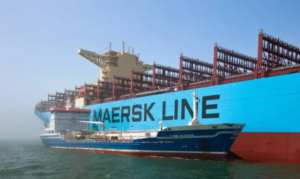
The international transportation and logistics group A.P. Moller—Maersk has temporarily suspended maritime container shipping through the terminal of Chornomorsk Fish Port LLC in the Odesa region.
The decision was made amid a deteriorating security situation and intensified Russian attacks on Ukrainian port infrastructure. However, this does not mean a complete suspension of Maersk’s operations in Ukraine.
“Due to the current situation affecting our operations, the feeder operator is unable to continue providing services to Ukraine via the Black Sea Fishing Port,” Maersk’s Ukrainian division reported.
The service has been suspended until further notice. The company did not explicitly cite the Russian attacks as the reason for this decision; however, the announcement came after a series of strikes on ports and civilian vessels in the Odesa region.
The vessel MEDKON MIRA V.629S, which was scheduled to deliver imported containers to Chornomorsk, will be redirected to the Romanian port of Constanta for unloading.
It is also planned to reroute shipments destined for Chornomorsk that are already in Port Said, Egypt, or en route there, to Constanta. Customers for whom unloading in Romania is not suitable are advised to submit a request to change the destination.
“Chornomorsk Fish Port” is not a term referring to a fishing harbor in the everyday sense, but rather the official name of a separate enterprise and a multifunctional cargo terminal in the village of Burlachya Balka near Chornomorsk.
The company was previously known as “Illichivsk Sea Fishing Port,” and in 2018 it adopted its current legal name—LLC “Black Sea Fishing Port.”
Despite its historical name, the enterprise operates a full-fledged container terminal. It has deep-water berths, Liebherr container handlers, mobile cranes, storage yards, and truck and rail weighing facilities.
The Black Sea Fishing Port is an independent operator and should not be confused with the state-owned seaport of Chornomorsk. The main deep-water port of Chornomorsk and other ports in the Greater Odesa region continue to operate, according to Ukrainian authorities.
The company has suspended only maritime shipments through this specific terminal. Maersk continues to offer cargo delivery to Ukraine via land and multimodal routes, including through Romania and Poland.
Rerouting containers through Constanța may increase transit times and shipping costs. After unloading in Romania, cargo will need to be transported to Ukraine by road or rail.
For Ukrainian importers, this means additional costs for land logistics, changes to documentation, and a possible delay in receiving goods.
At the same time, this decision enhances Constanta’s role as a regional transshipment hub for Ukrainian cargo.
Prior to Maersk, Kernel, a major Ukrainian producer and exporter of agricultural products, had suspended operations at one of its facilities in Chornomorsk following a series of attacks.
However, Ukrainian authorities have not imposed a general ban on ships calling at ports in the Greater Odesa area. Decisions to change routes are made by individual carriers and shipowners with the safety of crews, vessels, and cargo in mind.
A.P. Moller — Maersk is a Danish transportation and logistics group founded in 1904. The company provides maritime container shipping services and manages port terminals, warehouses, and land-based logistics infrastructure.
Maersk operates in approximately 130 countries, serves over 100,000 customers, and has a fleet of more than 700 container ships and a network of 67 terminals in 42 countries. The group employs more than 100,000 people. Thanks to its scale, Maersk is one of the key players in global container trade, and changes to its routes can significantly affect the timing, cost, and availability of international shipments.

According to Fixygen, Telegram founder Pavel Durov announced the launch of Gram Wallet, a built-in non-custodial crypto wallet, which is planned to be integrated directly into the messenger app.
According to Durov, the service is set to launch in the summer of 2026. Users will be able to make instant cryptocurrency transfers within Telegram without having to install a separate app or switch to a third-party service.
The non-custodial model ensures that access to digital assets and keys remains with the user, rather than with a centralized operator. This distinguishes the new product from the custodial Crypto Wallet service, which is already available on Telegram and enables the purchase, sale, and transfer of cryptocurrencies through an operator-managed infrastructure.
The technical specifications of the new wallet have not yet been fully disclosed. In particular, it is unknown which cryptocurrencies will be supported in the initial phase, in which countries the service will become available, and how network fees will be paid when transferring assets to an external blockchain.
The main advantage of Gram Wallet could be its direct integration with Telegram’s audience of over a billion users. Users will not need to create a separate account on a cryptocurrency service, learn a new interface, or search for a compatible wallet on their own.
Transfers of digital assets could potentially be linked to regular messaging, payments for digital goods, purchases in mini-apps, creator rewards, and peer-to-peer transactions.
For Telegram, the launch of the wallet marks a further shift from a traditional messenger toward a super-app model that combines communication, digital services, commerce, and payments.
The messenger already features mini-apps, paid subscriptions, digital gifts, the Stars system, and services for creators. Having a built-in wallet can shorten the path between selecting a product or service and making a payment.
This is particularly important for mini-app developers. The fewer extra steps a user needs to take to make a payment, the higher the likelihood of a purchase, subscription, or service payment.
The built-in wallet could increase interest in Telegram from games, marketplaces, educational platforms, booking services, financial apps, and digital content creators.
Even if only a relatively small portion of the audience begins using the new service, Telegram is poised to gain one of the largest cryptocurrency wallet user bases in the world.
The TON blockchain and its associated cryptocurrency ecosystem stand to benefit the most from the launch. Telegram previously selected TON as the primary infrastructure for blockchain features, tokenization, and the integration of digital assets into mini-apps.
Growth in the number of wallet users could increase the number of active addresses, transactions, and applications on the TON network. At the same time, the practical use of the network’s native token for paying fees, digital goods, and services could grow.
The Fragment trading platform, collectible gifts, digital usernames, anonymous numbers, and other products related to the Telegram and TON infrastructure could receive an additional boost.
Formally, TON is developing as an independent blockchain ecosystem. Telegram abandoned its initial proprietary cryptocurrency project following a conflict with U.S. regulators in 2020. However, TON’s tight integration with the messenger effectively grants the blockchain access to Telegram’s audience.
For Telegram itself, the crypto wallet could become a tool for retaining users within the app. The more transactions users can perform without leaving the messenger, the higher the audience engagement and the platform’s appeal to businesses.
In the long term, Telegram will be able to generate additional revenue from commissions on partner services, mini-app advertising, the sale of digital goods, and the expansion of its in-app economy.
At the same time, the mass rollout of a non-custodial wallet creates additional risks. Users are solely responsible for safeguarding their keys and confirming transactions. Losing access or transferring funds to scammers usually makes it impossible to recover assets.
Telegram will need to strengthen its defenses against phishing, counterfeit tokens, fraudulent investment projects, and scam mini-apps.
Regulation may pose a separate challenge. Requirements for cryptocurrency wallets, customer identification, and cross-border transfers vary by country. Therefore, certain features may be rolled out gradually or may not be available in some jurisdictions.
The statement about commission-free transfers requires further clarification. Internal transactions between Telegram users may not incur a separate fee, but withdrawing assets to external networks is usually subject to a blockchain fee.
Overall, the launch of the Gram Wallet could be one of the most important milestones in Telegram’s development. The messaging app will be able to bring together its audience, payments, and mini-apps within a single environment, while TON will significantly expand the practical use of its blockchain infrastructure.
The project’s success will depend on the simplicity of the interface, security, the geographic scope of the launch, and Telegram’s ability to comply with the requirements of national regulators.

Iraq has estimated the total value of contracts and agreements concluded with American energy companies during Prime Minister Ali al-Zaidi’s July visit to the United States at approximately $200 billion.
Iraqi Oil Minister Basim Mohammed Khudair announced this on July 21. According to him, the projects are expected to increase the country’s production capacity, expand associated gas processing and bring American technologies into the oil and gas industry. The minister estimated Iraq’s current production capacity at 4.8 million barrels of oil per day.
The announced package includes seven key arrangements related to field development, oil and gas asset management, energy infrastructure modernisation and the search for new export routes.
At the same time, the $200 billion estimate does not yet mean that the entire amount has already been formalised as binding capital investment. The package includes contracts, framework agreements, memoranda and preliminary arrangements. The final volume of investment will depend on the results of technical studies, commercial negotiations, the agreement of financing terms and the receipt of regulatory approvals.
Chevron expands its presence in Iraq
The American company Chevron has become one of the central participants in the new energy cooperation.
The company is negotiating its participation in the operation of the West Qurna-2 field, one of Iraq’s largest oil assets, as well as the development of the Nasiriyah field. The parties previously signed preliminary documents concerning Nasiriyah, the Balad field and several exploration blocks in Dhi Qar Province.
During a meeting with Chevron’s management, the Iraqi prime minister called on the company to accelerate investment in oil and gas production and the construction of oil refineries, petrochemical plants, pipelines and storage facilities.
The Iraqi side stated that it was prepared to allocate land plots and expedite administrative approvals for major energy projects. Chevron, in turn, expressed interest in fields in the south of the country and in developing infrastructure for the storage and export of raw materials.
The agreements concerning West Qurna-2 and Nasiriyah remain predominantly preliminary. Before final contracts are concluded, Chevron must examine the projects’ geological, technical and commercial data.
Halliburton to manage the Bin Umar and Sindbad fields
The American oilfield services company Halliburton has received a contract from the state-owned Basra Oil Company for the comprehensive management of the development of the Bin Umar and Sindbad oil and gas fields in southern Iraq.
The contract provides for integrated field management services, as well as support for the design, procurement and construction of the necessary infrastructure.
The involvement of Halliburton is expected to help Iraq increase oil and gas recovery from existing assets, introduce modern reservoir management methods and reduce technological losses.
Another agreement has been concluded with the American company HKN Energy for the development of the Himrin field in the north of the country. The Iraqi government approved the project as part of a broader programme to attract American companies to the oil and gas and electric power sectors.
Iraq seeks alternative oil export routes
One of Baghdad’s strategic objectives is to reduce its dependence on routes through the Persian Gulf and the Strait of Hormuz.
Recent regional crises have demonstrated the vulnerability of Iraq, most of whose oil exports pass through southern terminals. Shipping restrictions and export disruptions have a direct impact on production, budget revenues and the state’s ability to finance infrastructure projects.
Iraq is considering expanding supplies through the Turkish port of Ceyhan and creating a route to the Mediterranean Sea through Syria. The Iraqi and Syrian sides previously discussed transporting oil to the port of Baniyas, including the possibility of restoring existing infrastructure or constructing a new pipeline system.
Chevron is also exploring the possibility of participating in export pipeline and storage projects. If implemented, they would connect the oil fields of southern and northern Iraq with alternative maritime terminals and reduce the country’s dependence on the Strait of Hormuz.
However, such projects will require interstate agreements, large-scale investment and security guarantees. The restoration of pipelines through Syria is complicated by the condition of the infrastructure and the need to ensure the protection of the route along its entire length.
Baghdad turns towards American capital
The current arrangements reflect a broader shift in Iraq’s energy policy towards the United States.
In recent years, Chinese companies have secured a significant share of the country’s new oil and gas projects. Major assets have also been managed by Russian and European operators.
Ali al-Zaidi’s government has announced its intention to give priority to reputable American companies in the energy, telecommunications and technology sectors. To facilitate their entry into the market, the authorities have begun reviewing certain administrative requirements and strengthening the security of oil facilities.
For Iraq, such cooperation is expected to provide access to investment, technologies, oilfield services equipment and political support from Washington. For American companies, the country is attractive because of its large oil reserves, underdeveloped gas sector and need to modernise its infrastructure.
Production growth constrained by OPEC+ agreements
Iraq intends to increase its oil production capacity, but actual production volumes depend on more than investment alone.
The country participates in OPEC+ agreements and is required to comply with the established restrictions. In July, the group’s countries again reaffirmed their commitment to the current arrangements, including the need to compensate for previously exceeding production quotas.
The Iraqi Ministry of Oil previously announced plans to increase production capacity to more than 6 million barrels per day by 2028–2029. Achieving this goal will require the development of new fields, the rehabilitation of existing assets, the expansion of export infrastructure and agreement on a higher quota within OPEC+.
The development of the gas industry remains a separate priority. Iraq is seeking to expand the processing of associated gas, which continues to be flared at fields, and reduce the electric power sector’s dependence on imported fuel.
The authorities plan to increase the utilisation of produced gas to the highest possible level and virtually eliminate its flaring by the end of the decade.
Implementation of agreements will take several years
The package of projects with American companies could become one of the largest investment shifts in the history of Iraq’s oil and gas industry.
However, a significant share of the arrangements remains at a preliminary stage. To proceed to full implementation, the parties must determine the commercial terms, allocation of risks, investment payback periods and security guarantees.
OPEC+ quotas, bureaucratic procedures, the condition of pipeline infrastructure and regional instability remain additional constraints.
If even part of the announced projects is implemented, Iraq will be able to increase oil and gas production, expand processing, reduce its dependence on a single export route and strengthen its position as one of the largest energy producers in the Middle East.
ENERGY, INVESTMENT, IRAQ, OIL, USA



