

In June 2026, Express Insurance paid out more than 11 million UAH to customers for claims related to military risks, which is 26 times higher than the figure for the same period in 2025.
According to the insurer’s website, the company settled 26 insurance claims in June of this year, more than five times the figure for the same period last year. Meanwhile, the average payout per claim also increased more than fivefold—to 424,100 UAH.
The largest number of insurance claims related to military risks in June was settled in Kyiv, which correlates with the increased intensity of airstrikes on the capital over the past few months.
The largest payout during the reporting period was an insurance claim of more than 1.2 million UAH for a 2024 Mercedes-Benz damaged as a result of military operations.
In total, during the first half of 2026, Express Insurance settled 50 insurance claims related to military risks, totaling 15.5 million UAH—nine times more than during the same period in 2025.
“The trend in payouts in this area reflects the reality facing Ukrainian car owners. Damage to vehicles resulting from military operations is no longer an isolated occurrence but an integral part of insurance practice. And while many drivers previously viewed coverage for military risks in a comprehensive auto insurance policy as an optional feature, today’s insurance claims statistics convincingly demonstrate its practical necessity,” the insurer’s statement notes.
Express Insurance LLC was founded in 2008 with the participation of “Ukravto Group,” a leader in the Ukrainian automotive market. The company specializes in auto insurance. The company has more than 300 insurance agents throughout Ukraine and is actively expanding its network of partner service stations. To date, the number of partner service stations exceeds 100.
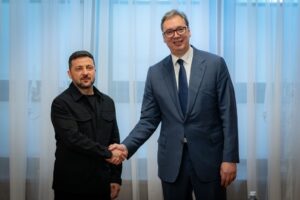
According to Serbian Economist, Serbian President Aleksandar Vucic reaffirmed that the country’s accession to the European Union remains Belgrade’s strategic goal and expressed hope to host Ukrainian President Volodymyr Zelenskyy on a bilateral visit.
Vucic made these remarks in an interview with Rainer Novak, editor-in-chief of the Austrian newspaper Die Presse, published on July 23.
“The European path is our strategic goal. There are no other paths for us. This means that we must cooperate closely with all candidate countries,” said the Serbian president.
According to him, it is in the European Union that he sees his country’s future.
Speaking about relations with Ukraine, Vučić stated that he sees no reason to abandon cooperation with Kyiv. He reiterated that Serbia supports Ukraine’s territorial integrity and provides it with financial, medical, energy, and humanitarian aid.
“I hope we will be able to welcome him to Serbia on a bilateral basis,” said Vučić, referring to Zelenskyy.
Vucic also announced that Serbia is ready to participate in the reconstruction of one of Ukraine’s smaller cities. In addition, the parties are discussing the development of a road and rail route from Trieste through Croatia, Serbia, Romania, and Moldova to Ukraine.
The Serbian president had previously reaffirmed his support for Ukraine’s sovereignty and territorial integrity, but did not sign the final declaration, which condemned Russian aggression and called for increased sanctions pressure on Moscow.
Commenting on criticism of cooperation with Kyiv, Vučić stated that Ukraine had not taken any action against Serbia and had not recognized Kosovo’s independence.
“We cannot oppose someone just because someone else opposes them. I see no reason why we should not cooperate with Ukraine,” he said.
At the same time, Vučić emphasized the need to take into account Serbia’s relations with Asian countries and Russia and reaffirmed the country’s military neutrality.
Serbia was granted EU candidate status in March 2012, and membership negotiations began in January 2014. In recent years, the opening of new negotiation chapters has effectively stalled, despite Belgrade’s statements that it is ready to meet the technical criteria for membership.

PJSC “Respect Insurance Company” (Odesa) collected UAH 52.641 million in net premiums in January–June 2026, which is 33.8% more than in the same period of 2025.
According to the company’s interim report, published in the disclosure system of the National Securities and Stock Market Commission (NSSMC), its gross premiums for this period totaled 52.781 million UAH (+33%, respectively). A total of 140,000 UAH was ceded to reinsurers (2.1 times less).
During this period, the company paid out 5.548 million UAH, which is 0.7% less than during the same period a year ago. Meanwhile, administrative expenses totaled 62,000 UAH, which is 4.3 times less than in the first six months of 2025.
Respect Insurance Company’s operating profit for the first half of the year amounted to 17.129 million UAH (3.2 times higher), and net profit was 18.834 million UAH (2.7 times higher).
According to data from the National Securities and Stock Market Commission as of the first quarter of 2026, LLC “Asset Management Company YUG-Invest” (the “Industrial” Closed-End Undiversified Venture Capital Investment Fund) held 67.935% of the insurer’s shares, “Ulyublene Misto” LLC held 9.646%, and “Bereg Stroy Service 2017” LLC held 9.242%.
“Respect” Insurance Company has been operating in the Ukrainian market since March 1995. The company’s main risk portfolio is related to the transportation sector.

Shareholders of PJSC “Ukrainian Fire and Insurance Company” (Kyiv) approved at an extraordinary meeting on July 21, 2026, the amount of annual dividends for common registered shares, based on the results of operations in 2025, totaling 40 million UAH, or 2.50 UAH per share.
As reported by the company in the disclosure system of the National Securities and Stock Market Commission (NSSMC), the decision to pay dividends was adopted by the annual remote general meeting of shareholders (minutes dated May 8, 2026).
The dividends are planned to be paid in several installments (proportionally to all shareholders within a total 6-month period from the date of the decision). The first installment, in the amount of 16 million UAH, is due by August 5, 2026; the second installment, in the amount of 16 million UAH, is due by October 13, 2026; and the third installment, in the amount of 8 million UAH, is due by November 6, 2026.
PJSC “UPSK” was registered in 1993. It specializes, in particular, in motor vehicle insurance, financial risk insurance, travel insurance, property insurance, cargo insurance, and baggage insurance.
According to the company, Oleksandr Mikhailov owns 99.999% of its shares.
According to data from the National Bank of Ukraine (NBU), the company ranks 16th among Ukraine’s non-life insurers in terms of premiums collected in 2025.

Nova Post in Poland has begun collaborating with Orlen Paczka—a network of approximately 6,500 pickup points and 8.5 parcel lockers—according to a company announcement posted Thursday on LinkedIn.
“We are constantly improving our logistics solutions to support business growth and ensure convenience for customers at every stage of delivery,” the company emphasized. Nova Post had previously partnered with InPost, Poland’s largest network, which operates over 35,000 pickup points, more than 27,000 of which are parcel lockers.
For its part, Orlen Paczka noted that the partnership with Nova Post is another step toward opening up its infrastructure to companies operating in the international market.
According to the press release, the service is available for the delivery of S, M, and L-sized packages weighing up to 20 kg.
Jakub Karon, CEO of Nova Post in Poland, said in an interview with Wiadomości Handlowe in June of this year that the company had a total of 122 branches throughout Poland, including 30 company-owned branches, 16 franchise branches, 31 mini-branches, and 45 PUDO branches, and its plan for 2026 is to open approximately 300 more branches. He emphasized that the Polish parcel locker market is oversaturated, so Nova Post currently has no plans to build its own network and will instead expand in this market through partnerships.
In 2021, the Polish conglomerate Orlen launched the Orlen Paczka postal service with its own pickup points and parcel lockers. In 2024, the service entered into a strategic partnership with Allegro, Poland’s largest marketplace.
As reported, last year the NOVA Group handled 522 million shipments, 29 million of which were in Europe. The group, which currently ranks 30th globally in parcel volume among express delivery and postal services, aims to enter the top 20 by 2030 and increase the number of shipments to 2 billion.
Vyacheslav Klimov, co-owner of Nova Poshta, noted during the “Dialogues with NV” event dedicated to European integration that Nova Post Europe, part of the NOVA Group, plans to double its network of branches in Europe by 2026 and keep its strategic focus on ensuring the fastest possible delivery times.
In the first half of 2026, 239 new service points were opened in Europe, bringing the total number of Nova Post’s own service points abroad to more than 950. Moldova and Poland led the expansion in the first half of the year, with 112 and 80 new service points, respectively. In addition, five Nova Post partner pickup points opened in New York in June.
In the first half of 2026, Nestlé in Ukraine increased its sales in the country by 19.3% in value (in hryvnia) and by 10% in volume, to 56,000 metric tons, while the entire Ukrainian FMCG market in the categories where the company operates grew by 15% in value and 6% in volume during this period, according to Roman Yanovich, CEO of Nestlé in Ukraine and Moldova.
“This is a signal to invest,” he said, commenting on these results at a briefing in Kyiv on Thursday, and explained that overall, the Nestlé Group increased its global sales by 3.6% in the first half of this year, meaning that Ukraine is a growth driver for the company.
According to him, in the first half of 2026, the company invested 5 billion UAH in its operations in Ukraine, of which 200 million UAH went toward developing factories in Ukraine and 4.8 billion UAH toward developing product categories.
“Having invested 5 billion hryvnia in the first half of the year, we plan to invest an amount comparable to last year’s—10 billion hryvnia—by the end of 2026 to ramp up production and maintain the growth momentum we’ve achieved,” said the CEO.
He clarified that investments in factory development are expected to total 1 billion hryvnia based on this year’s results.
According to the CEO, in the confectionery category, sales growth for all players in the Ukrainian market in January–June of this year was 18% in hryvnia and 6% in volume; for prepared foods, 12% and 2%, respectively; for instant coffee, 16% and 4%; infant formula—20% and 7%, other children’s foods—20% and 10%, and animal feed—20% and 10%.
According to him, the market for coffee capsules is growing particularly rapidly—by 30% in value and 16% in volume. This market is small but has the potential to double or triple in size, Yanovich noted.
The CEO noted that Nestlé currently holds approximately half of the Ukrainian ketchup market under the “Torchin” brand and the cocoa market under the Nesquik brand, as well as one-third of the sauce market under the “Torchin” brand.
He added that as part of global campaigns, products under the Felix and ProPlan brands in the pet food category and KitKat in the confectionery category are currently being actively promoted in Ukraine, while local campaigns focus on the “Svitloch,” “Torchin,” and “Mivina” brands, as well as Dolce Gusto coffee capsules and Nesquik.
In addition, during the briefing, company representatives announced plans to expand this year’s culinary product line—which already includes more than 100 items—by approximately 20%. The “Asian line” is growing at the fastest rate—20–25%—while the category of instant noodles in cups is seeing triple-digit growth.
According to Yanovich, there is potential for improvement in the “Svitloch” brand and the coffee business, where the company aims to move up from second place to first, a position currently held by Jacobs.
The CEO stated that due to the increase in enemy shelling of warehouses, logistics is currently the top priority; therefore, the company has developed a plan to deliver goods directly to the supermarket chain without involving its distribution centers in the event of a critical situation.
He cited a labor shortage as another problem, which forced one of the company’s facilities to raise salaries by 30%. At the same time, Yanovych noted that although the company had considered options for hiring foreign workers, it is still trying to recruit staff specifically from among Ukrainians.
Yanovich also reported that in the first half of 2026, charitable donations totaled over 120 million hryvnia, and since the start of the full-scale war, the company has provided charitable aid totaling over 2 billion hryvnia.
Nestlé began operations in Ukraine in 1994 with the opening of a representative office. In 1998, it acquired a controlling stake in CJSC “Lviv Confectionery Factory ‘Svitloch,’” and since 2018, it has owned 100% of the company’s shares. In May 2003, Nestlé Ukraine LLC was founded in Kyiv, and by the end of that year, Nestlé had acquired 100% of the shares in Volyn Holding.
In 2010, Nestlé SA acquired Technocom LLC in Kharkiv, a manufacturer of instant foods under the “Mivina” brand. In 2012, Nestlé Business Service (NBS Europe) was established in Lviv; it is one of Nestlé’s seven service centers worldwide and provides support services to Nestlé divisions in more than 40 countries.
During the war, Nestlé invested EUR43 million in the construction of its fourth factory in Ukraine—in Smolygiv, Volyn Oblast—for the production of pasta, which opened in April 2025, and plans to increase its investment in the facility to EUR70 million by the end of 2027.
Nestlé’s business in Ukraine encompasses the following segments: coffee and beverages, confectionery, prepared foods (cold sauces, seasonings, soups, instant foods), infant and specialized nutrition, ready-to-eat breakfasts, and pet food.
FMCG, INVESTMENT, NESTLE, SALES, UKRAINE



