
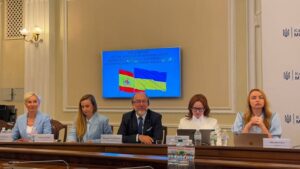
Ukraine and Spain plan to accelerate the implementation of joint investment and trade projects in the fields of infrastructure, energy, transportation, industry, agricultural processing, defense technologies, and digitalization through the newly established Ukrainian-Spanish Business Council.
The first joint meeting of the Ukrainian and Spanish members of the council took place in Kyiv as part of the Ukrainian-Spanish Business Forum. More than 100 companies from both countries participated in the events, including 47 representatives of Spanish businesses.
Kyiv also hosted the fifth meeting of the Ukrainian-Spanish Joint Intergovernmental Commission on Economic and Industrial Cooperation. The commission was co-chaired by Oleksiy Sobolev, Acting Minister of Economy, Environment, and Agriculture of Ukraine, and Carlos Cuervo, First Vice President of the Government and Minister of Economy, Trade, and Entrepreneurship of Spain.

The parties discussed the transition from general dialogue to the development of specific projects, the involvement of Spanish companies in Ukraine’s reconstruction, the localization of production, and technology transfer.
“Ukraine is open to partnerships right now. An investor who comes today will have the opportunity to join the reconstruction effort and become part of Ukraine’s future European market,” said Hennadiy Chizhikov, President of the Ukrainian Chamber of Commerce and Industry.
In the transportation sector, the parties discussed the development of air, rail, and road transport, the creation of multimodal routes, and the application of Spanish expertise in high-speed rail construction.
In the energy sector, the main areas identified are solar and wind power generation, energy storage systems, energy efficiency, and the development of decentralized power generation. In industry and the defense and technology sectors, the parties intend to transition from conventional product supply to joint production, localization, and the creation of joint ventures.
In the agro-industrial sector, discussions focused on investments in food processing, storage, and logistics, as well as the production of finished goods for export to countries in the Mediterranean, North Africa, and Latin America. Specific areas of cooperation identified include water resource management, healthcare, tourism, science, and innovation.
The Spanish business delegation included, among others, representatives from the infrastructure company ACCIONA, the aerospace corporation Airbus, the technology and defense companies Indra, Grupo Oesía, Escribano, and Integrasys, the satellite operator Hispasat, and the railway company RENFE.
The Ukrainian side was represented by about 20 companies and associations operating in transportation, logistics, aviation, agriculture, the food industry, energy, mechanical engineering, construction, digital technologies, and professional services.
The Ukrainian-Spanish Business Council is intended to serve as a permanent mechanism for direct interaction between companies, chambers of commerce and industry, and the governments of the two countries. Its work will include identifying partners, compiling a portfolio of investment projects, establishing sector-specific working groups, and monitoring the implementation of agreements.
The Ukrainian side of the council is headed by Mykhailo Bno-Ayriyan, a representative of MHP. Its members include MHP, Metinvest, Nova Poshta, SkyUp Airlines, Epicentr Agro, DSV Logistics, Zammler Ukraine, WhiteBIT, Farmak, and other Ukrainian companies and industry organizations.
The next practical step in this cooperation will be a business mission by Ukrainian companies to Valencia on September 28–29, 2026.
The visit will take place as part of the EUROCHAMBRES 2026 Congress, during which a Ukrainian-Spanish business forum and one-on-one meetings between Ukrainian companies and potential Spanish partners are also planned.
According to 2025 figures, trade between Ukraine and Spain totaled nearly $2.8 billion, of which approximately $1.73 billion was accounted for by Ukrainian exports. Spain remains one of the largest European buyers of Ukrainian agri-food products.
According to calculations by the Experts Club information and analytical center, published on July 16, Ukraine exported $1.09 billion worth of goods to Spain in January–June 2026. Imports of Spanish products totaled about $512 million, and total bilateral trade amounted to approximately $1.60 billion.
Ukraine’s trade surplus with Spain reached $578.1 million, the largest among all 50 of the country’s leading trading partners.
Thus, Spain is a particularly advantageous major trading partner for Ukraine: Ukrainian exports to this market are more than double the value of imports of Spanish goods.

Residents of Ukraine’s capital purchased 11,484 thousand new passenger cars from January through June of this year, and this regional market for new passenger cars remains by far the largest, according to a report by “Ukravtoprom” on its Telegram channel.
As previously reported, according to the association’s data, nearly 33,000 passenger cars were sold in Ukraine during the first half of the year, meaning Kyiv’s share accounts for 35% of total sales.
The Kyiv region ranked second in sales volume with 3,276 units, followed by the Dnipropetrovsk region with 2,273 units, the Kharkiv region with 1,852 units, and the Lviv region with 1,810 units.
In total, these regional markets accounted for 63% of new passenger car sales in Ukraine.
The best-selling model in these markets during the first half of the year was the Renault Duster compact crossover.
As reported, according to data from “Ukravtoprom,” sales of new passenger cars in January–June of this year rose by 0.5% compared to the same period in 2025, with vehicles equipped with traditional engines (gasoline and diesel) accounting for nearly 62% compared to 56.5% last year, while the share of electric vehicles fell to 8.3% from 18.9%.
According to the results for 2025, the top five regions by sales were Kyiv, Kyiv Oblast, Dnipropetrovsk Oblast, Odesa Oblast, and Lviv Oblast, followed by Kharkiv Oblast.
At the same time, Lviv Oblast recorded the highest number of registrations of used passenger cars imported from abroad last year.

The indirect cost of housing construction in Ukraine in the second quarter of 2026 rose by 2.21% compared to the previous quarter and by 7.21% compared to the same period last year, according to the indicators of indirect housing construction costs in Ukraine’s regions approved on July 16 by the Ministry of Community Development.
The relevant document establishes indirect indicators of housing construction costs, calculated as of July 1, 2026. According to the document, the average figure in Ukraine is 27,200 UAH/sq. m, whereas at the beginning of the year it was 25,700 UAH/sq. m, compared to 23,800 UAH per square meter as of January 1, 2025, and 21,200 UAH per square meter in 2024.
According to the ministry’s data, the indirect cost of constructing 1 square meter of housing in Kyiv as of July 1, 2026, rose to 31,800 UAH; in the Kyiv region—to 27,100 UAH; in the Lviv region—to 27,000 UAH; in the Zakarpattia region—to 23,600 UAH, in the Ivano-Frankivsk region—to 24,400 UAH, in the Odesa region—to 26,000 UAH, and in the Dnipropetrovsk region—to 26,300 UAH. High figures were also recorded in the Kharkiv and Donetsk regions—28,600 UAH/sq. m and 28,500 UAH/sq. m, respectively.
Region Name Cost per 1 sq. m of total apartment area in a building (including VAT), UAH Region Name Cost per 1 sq. m of total apartment area in a building (including VAT), UAH
Ukraine 27,211 Mykolaiv 27,171
Vinnytsia 26,239 Odesa 26,069
Volyn 26,157 Poltava 24,195
Dnipropetrovsk 26,382 Rivne 26,727
Donetsk 28,582 Sumy 25,528
Zhytomyr 23,919 Ternopil 25,506
Transcarpathian 23,622 Kharkiv 28,601
Zaporizhzhia 26,354 Kherson 24,758
Ivano-Frankivsk 24,469 Khmelnytskyi 26,188
Kyiv 27,177 Cherkasy 26,802
Kirovohrad 23,127 Chernivtsi 25,188
Luhansk 26,103 Chernihiv 27,244
Lviv 27,063 Kyiv 31,802
Data: Ministry of Community and Territorial Development of Ukraine
It is noted that the figures do not include territories temporarily occupied by the Russian Federation or parts of territories where hostilities are (were) taking place, in accordance with the current list of such territories.
In accordance with the law, these figures are used to determine the volume of state investments in housing construction for citizens in need of improved living conditions, as well as to determine the amounts of preferential housing loans.

Over the most recent available period—from October 2025 to March 2026—approximately 15,800 housing purchase and sale agreements were concluded in Kyiv, according to data from the National Bank of Ukraine, citing the National Information Systems. This is the highest figure among the country’s regions.
By comparison, approximately 19,100 transactions were registered in the capital from January through September 2025. In the Kyiv region, 17,000 contracts were signed during this period; in the Dnipropetrovsk region, 16,800; and in the Kharkiv region, 14,000.
The NBU notes that in the fourth quarter of 2025, overall activity in Ukraine’s housing market was the highest since 2022; however, in the first quarter of 2026, the number of transactions declined significantly. Cumulatively over the last four quarters, housing sales increased by 11% year-over-year.
The NBU’s figures cover housing purchase and sale agreements in both the primary and secondary markets; therefore, they should not be equated solely with sales of apartments in new construction projects.

The removal of Ukrainian officials’ electronic declarations from the state registry does not mean that previously published information has completely disappeared from the public domain, notes Opendatabot.
Many documents were publicly available for several years before the mechanism for hiding them was introduced in late 2023. During that time, the data may have been saved by journalists, civil society organizations, analytical services, and online archives.
However, the publicly available portion of the declarations no longer contains residential addresses, tax identification numbers, or a number of other direct personal identifiers.
The mechanism to restrict access was introduced to protect military personnel, law enforcement officers, and other officials amid a full-scale war. A government agency may appeal to the National Agency for Corruption Prevention (NAZK) if it believes that the publication of a document poses a threat to the declarant or their family.
As of July 2026, more than 445,000 declarations for the years 2015–2026 have been removed from public access.
Source: https://opendatabot.ua/analytics/hidden-declarations-2026
Nibulon Joint Venture LLC invested $22.5 million in the modernization and digitization of agricultural production between 2023 and 2025, including securing EUR12.8 million in long-term financing from the Danish Export and Investment Fund (EIFO), the company’s press service reported.
As part of the modernization, the company upgraded its fleet of agricultural machinery, implemented digital solutions for managing production processes, and adopted a new soil cultivation model, which reduced the number of passes by machinery across the field—a practice that leads to soil compaction—and also lowered fuel consumption and production costs.
The company reported that as a result of the modernization, fuel consumption decreased by 10 liters per hectare, the use of crop protection products was reduced by up to 50%, seed usage was reduced by 10–20%, and nitrogen use efficiency (NUE) increased by 30%.
The report notes that the implemented measures led to a 50% increase in gross yield and a 65% increase in agricultural machinery productivity.
According to published data, the agricultural division’s EBITDA in 2025 amounted to $329/ha. At the same time, approximately 40% of the agricultural holding’s land bank is located in southern Ukraine, which has been hardest hit by climate change following the destruction of the Kakhovka Hydroelectric Power Plant. The financial results also include $4.6 million in losses from sunflower crop failures due to drought.
The company also reported that, as part of its efforts to adapt to climate change, it is reviewing its crop rotation structure and testing alternative drought-resistant crops, including sorghum, chickpeas, lentils, and flax.
In addition, during the 2025/26 marketing year, the agricultural holding launched a pilot project for contract farming of corn and sunflowers on an area of approximately 100 hectares, and is also working with seed material for other specialty crops.
It is also noted that the company is developing an irrigation model for the southern regions of Ukraine, which involves irrigating approximately 1,000 hectares of agricultural land.
Currently, Nibulon’s agricultural division cultivates 52,000 hectares of land, comprises 14 branches across four clusters, and operates 41 units of farm equipment.
Prior to the war, Nibulon Joint Venture LLC cultivated 82,000 hectares of land across 12 regions of Ukraine and exported agricultural products to more than 70 countries worldwide. In 2021, the grain trader exported 5.64 million metric tons of agricultural products—the highest volume in its history. After the war began, the company was forced to relocate its headquarters from Mykolaiv to Kyiv. In addition to 23 grain elevator complexes, Nibulon has its own road and rail transport capabilities, as well as a fleet built at its own shipyard. During wartime, this fleet continues to provide river transport services.
The company is also actively developing its own humanitarian demining unit to restore safety on leased lands and assist Ukraine’s agricultural sector. Nibulon is a certified mine action operator.
AGRICULTURAL PRODUCTION, EIFO, INVESTMENT, MODERNIZATION, NIBULON



