
The Ukrainian company Kovlar Group has been recognized as the leader of Ukraine’s fire protection industry based on the assessment by experts of the Ukrainian Business Award, according to a report on the website of the Ammokote brand.
According to the report, the organizers of the award noted the company’s stable development in 2025 and its contribution to the formation of Ukraine’s fire protection industry. The assessment was carried out taking into account the company’s financial indicators, market position and business reputation.
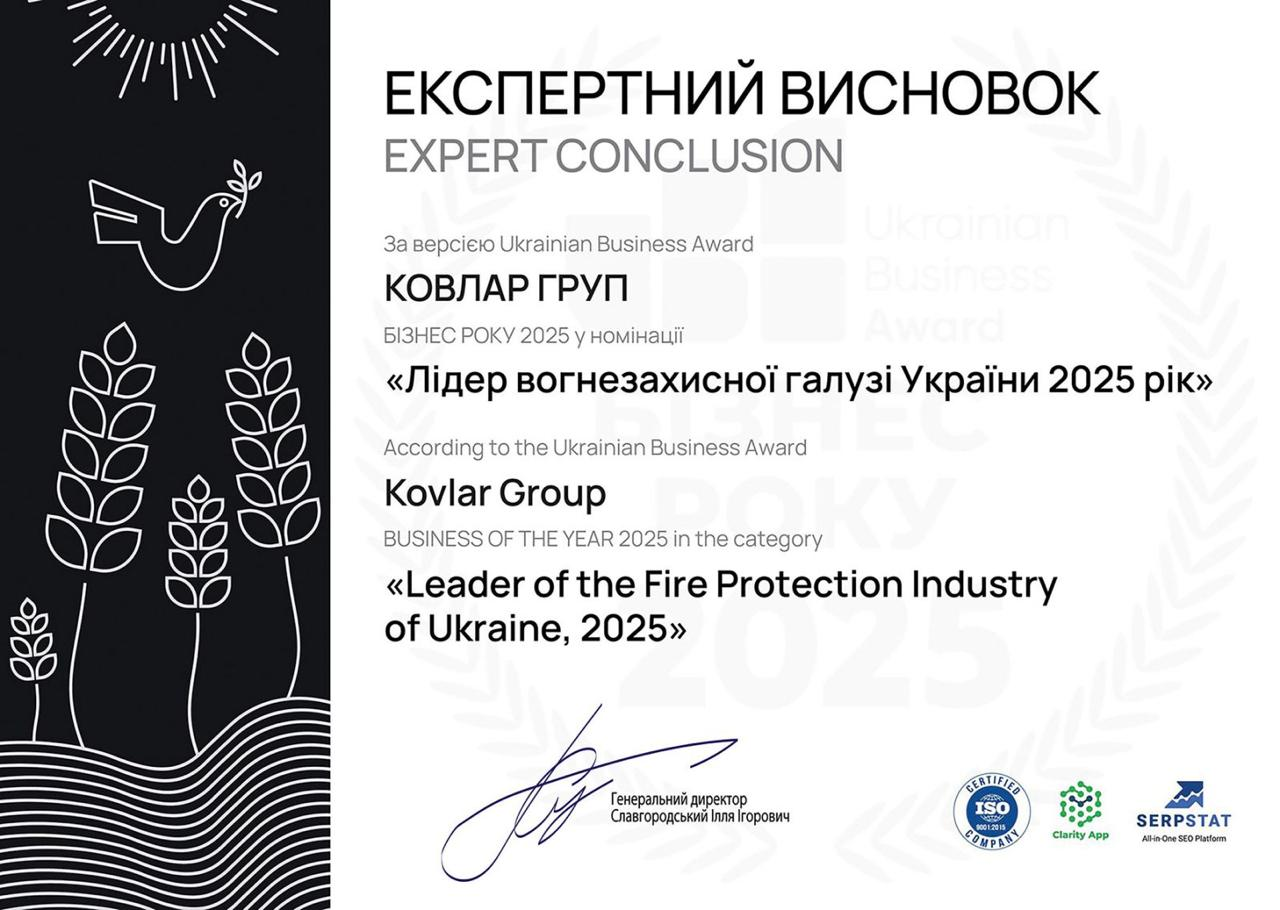
Ukrainian Business Award positions itself as a business award that recognizes companies that develop the economy, introduce innovations and form new industry standards.
According to the company, Kovlar Group offers more than 20 types of fire protection products for steel, concrete and wooden structures, cable systems and engineering communications. The products are manufactured under the Ammokote trademark and, according to the company, in certain segments account for up to 80% of the Ukrainian market.
The company notes that the development of domestic production of fire protection materials is of particular importance for Ukraine in the context of the restoration of industrial, residential, social and critical infrastructure. Fire protection of building structures, cable lines, engineering communications and industrial facilities is one of the key elements of safety in modern construction.

Kovlar Group works in the field of passive fire protection and manufactures Ammokote products for the fire protection of metal structures, engineering communications and air ducts, wooden and concrete structures, cables and cable lines. The company also provides services for the design of fire protection works, application of fire protection materials, equipment rental, materials expertise and regulatory and methodological support.
The company’s head office is located in Kyiv at the address: 27 V. Hetmana Street. The company’s website also indicates regional areas of work in Kyiv, Vinnytsia, Dnipro, Zaporizhzhia, Lviv, Kharkiv and Rivne.
Contact phone: +38 (067) 323-24-30
E-mail: info@kovlargroup.com
ammokote.com

According to Serbian Economist, the U.S. State Department presented a report to Congress on Washington’s policy toward the Western Balkans, in which it effectively announced a shift from the former model of international intervention and “nation-building” to a more pragmatic policy of partnership, stability, energy, security, and economic cooperation.
The document is titled “United States Policy to Promote Regional Stability and Prosperity in the Western Balkans”.
It states that the era of U.S.-led “nation-building” is over, and Washington’s new policy in the region will be built not around “rescue or reconstruction,” but around stability and mutually beneficial partnerships.
For Serbia, this is an important signal: Washington views the Western Balkans as a region of direct importance to U.S. security and economic interests. The report notes that the U.S. intends to cooperate with Serbia in a way that advances American interests, and plans to launch an official strategic dialogue with Belgrade in 2026.
Stability is cited as one of the top priorities. The State Department notes that unresolved disputes and ongoing political disagreements continue to undermine regional stability. In the case of Serbia and Kosovo, Washington states that it will continue to support the normalization of relations with the aim of reaching a negotiated and sustainable agreement acceptable to both sides.
Regarding Bosnia and Herzegovina, the U.S. reaffirms its commitment to the Dayton Peace Agreement, the country’s sovereignty, and its territorial integrity. At the same time, Washington states that in 2025, American diplomacy helped resolve the most serious crisis in BiH since the 1992–1995 war, preserving the constitutional order and legal integrity of the state.
Special emphasis is placed on the energy sector. The State Department describes the region’s dependence on Russian energy resources as a strategic vulnerability and proposes diversification through U.S. LNG, nuclear technologies—including small modular reactors—and renewable energy. For Serbia, this is directly linked to issues regarding the NIS, gas infrastructure, the future nuclear program, and the modernization of the electricity sector.
The report also addresses competition with Russia and China. Washington believes that Moscow and Beijing are exploiting instability, corruption, and weak governance in the region to expand their influence. According to the U.S. assessment, Russia relies on energy leverage and ethno-political tensions, while China strengthens its position through loans, trade, infrastructure projects, and ties with elites.
The economic component of the new strategy is particularly important for Serbia.
The region is described as an area with a favorable geographic location, transport corridors, natural resources, a growing technology sector, and a skilled workforce. The U.S. intends to reduce regulatory barriers, improve contract enforcement, develop procurement procedures, and promote projects that benefit American companies and the region’s economies.
For Serbia, this strategy opens up opportunities but also creates pressure. The opportunities relate to potential strategic dialogue with the U.S., investments in energy, infrastructure, technology, and defense cooperation. The pressure stems from the expectation that Belgrade will reduce its dependence on Russian energy resources, take a more cautious approach to Chinese capital, and play a more active role in ensuring regional stability.
Thus, the new State Department report reflects a shift in U.S. policy: the Western Balkans remain important to the U.S., but now primarily as a region of strategic corridors, energy, markets, security, and great power competition. For Serbia, this could be an opportunity to strengthen its dialogue with Washington, but only on the condition that economic cooperation is not constantly blocked by unresolved political issues.
https://t.me/relocationrs/2898
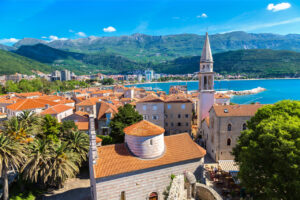
According to Serbian Economist, foreign demand for real estate in Montenegro is becoming more diversified: citizens of Serbia and the U.S. are stepping up their activity, while the share of Russian buyers is gradually decreasing, as evidenced by market data and surveys of local experts.
Just a few years ago, Russian buyers were one of the key groups of foreign investors in Montenegrin real estate, especially along the coast—in Budva, Tivat, Kotor, Herceg Novi, and Bar. However, after 2022, their activity began to decline due to sanctions, issues with bank transfers, capital movement restrictions, uncertainty regarding residency status, and changes in the geopolitical landscape.
Against this backdrop, the importance of buyers from Serbia is growing. For Serbian citizens, Montenegro remains a familiar and accessible market: there is no language barrier, strong family and business ties, and the coast is traditionally viewed as a destination for vacationing, purchasing a second home, and renting. Serbian buyers are particularly active in the segment of apartments for seasonal living and properties that can be rented out to tourists.
American demand has also become more noticeable. Buyers from the U.S. are attracted by relatively lower prices compared to EU and Mediterranean markets, the possibility of obtaining a residence permit through real estate, the development of tourism infrastructure, and the growing recognition of Montenegro as a European destination for relocation, remote work, and investment.
According to market surveys, the most active foreign real estate buyers in Montenegro currently include citizens of Serbia, Turkey, the U.S., Russia, and Germany. However, activity among Russian and German buyers has declined significantly.
Ukrainian buyers also maintain a presence in the Montenegrin market, although their role is not dominant. For Ukrainian citizens, Montenegro remains a logical destination for relocation, purchasing a home for residence, seasonal vacations, and investments. According to market participants, Ukrainians are more likely to consider real estate in coastal cities and in Podgorica, focusing on both personal residence and the possibility of renting out the property. Market estimates indicate that in 2024–25, Ukrainian citizens accounted for approximately 10% of foreign real estate purchases in Montenegro.
Real estate prices in Montenegro continue to depend heavily on location. On average across the market, new residential real estate in 2026 is estimated at approximately 2,200 euros per square meter, but prices are significantly higher along the coast. In popular coastal cities, standard apartments typically sell in the range of €1,700–3,500 per square meter, while in more liquid and tourist-oriented locations, prices range from €3,000 to €5,000 per square meter.
In Tivat, especially near Porto Montenegro, apartment prices often range from €3,500 to €5,500 per square meter, and premium properties can cost even more. In Budva, new-build properties are typically priced at around 3,000–4,200 euros per square meter, while completed properties are priced at around 2,800–3,800 euros per square meter. In Kotor, prices for high-quality properties can approach €3,500–4,000 per square meter, and may be higher in certain coastal and historic locations.
Inland areas and parts of Podgorica remain more affordable than the coast. In the capital, the average price in recent years has approached 2,000 euros per square meter, while in less touristy cities and northern regions, properties can be found at significantly lower prices.
For local residents, the growth in foreign demand has a double-edged effect. On the one hand, it supports construction, employment, services, rentals, and tax revenues. On the other hand, it drives up housing prices, especially in coastal cities, where the purchasing power of the local population is significantly lower than that of foreign investors.
https://t.me/relocationrs/2905

Schneider Electric, a global leader in energy technologies, today announced that it has been named a Leader in the IDC MarketScape: Worldwide Carbon Accounting and Management Applications 2026 Vendor Assessment.
The study evaluated 17 global vendors based on capabilities and strategic vision.
The IDC report highlights the following key strengths of the company:
• AI-native architecture: Schneider Electric’s Resource Advisor+ platform, powered by the Sera AI agent, automates data extraction and normalization, emissions factor mapping, reporting, and CSRD compliance processes, while also supporting supplier engagement and scenario analysis.
• Integration of an in-house developed platform: building the Resource Advisor+ platform in-house ensures seamless data exchange and compatibility across products, enabling context, analytics, and management actions to be shared across the entire platform and throughout the client’s ecosystem.
Resource Advisor+ is an AI-native platform for energy consumption management and sustainable development, developed by Schneider Electric. SE Advisory Services, Schneider Electric’s global consulting practice. Launched in early 2026, the platform integrates energy data, carbon emissions tracking, supplier engagement, and reporting into a single environment built on a Responsible AI approach, which ensures the effective and optimized use of artificial intelligence.
Resource Advisor+ is supported by specialized teams at SE Advisory Services, comprising over 4,000 consultants worldwide and more than 17,000 specialists across Schneider Electric’s various business units. The combination of software and consulting expertise is a key element of how SE Advisory Services helps clients move from ambitious sustainability goals to measurable results.
The platform’s supply chain management capabilities are built around supplier engagement, training, and practical decarbonization actions. Suppliers receive support through structured data collection, benchmarking, and progress monitoring, as well as a transparent maturity assessment model that helps identify specific next steps. Specialized training modules include built-in mechanisms for launching decarbonization projects or engaging with expert teams. Energize and Catalyze, SE Advisory Services’ flagship supply chain decarbonization initiatives, support suppliers in accessing renewable energy, achieving large-scale emissions reductions, and accelerating progress toward science-based climate targets, while delivering measurable business value.
Learn more: resourceadvisor.com
Related resources:
About Schneider Electric
Schneider Electric is a global leader in energy technology, driving efficiency and sustainability through the electrification, automation, and digitalization of industry, business, and residential spaces. The company’s technologies enable buildings, data centers, factories, infrastructure, and power grids to function as open, interconnected ecosystems, enhancing productivity, resilience, and sustainability.
The company’s portfolio includes smart devices, software-defined architectures, AI-based systems, digital services, and professional consulting services. With 160,000 employees and 1 million partners in over 100 countries, Schneider Electric consistently ranks among the world’s most sustainable companies.
Learn more at https://www.se.com/ua/uk/

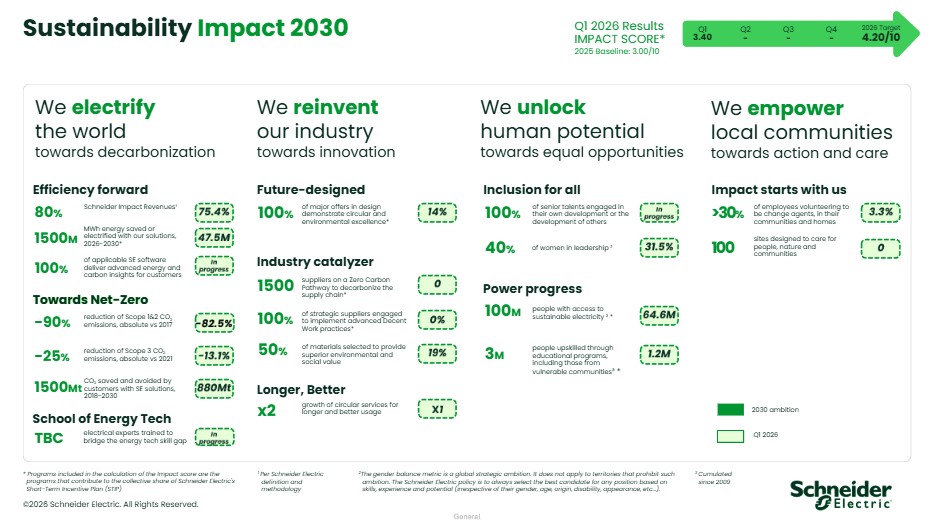
Schneider Electric, a global leader in energy technologies, today released its results for the first quarter of 2026 as part of its new Impact 2030 sustainability roadmap.
Building on years of leadership and a unique approach to sustainability, Impact 2030 structures the company’s ambitions around four strategic pillars—electrifying the world, transforming industry, unlocking human potential, and supporting local communities—which are implemented through targeted programs and measured using clear performance metrics.
In the first quarter of the new cycle, the Impact Score reached 3.40/10, marking a strong start toward the 2026 annual target of 4.20/10 (where 10/10 corresponds to the 2030 ambition). This metric reflects early progress in key programs, combining results in the company’s operations with scalable impact for customers, suppliers, and communities.
Schneider Electric further reduced carbon emissions in its own operations: Scope 1 and 2 emissions decreased by 82.5% compared to 2017. In the first quarter, the company also helped customers save or electrify 47.5 million MWh of energy through energy management, automation, and digital solutions. These efforts resulted in a reduction and avoidance of 20 million metric tons of CO₂ equivalent for the quarter.
Achieving large-scale results also requires rethinking approaches to product design and manufacturing. In the first quarter, the company continued to implement the Future Designed framework: 14% of key products in the development phase already demonstrate high levels of circularity and environmental efficiency.
In the supply chain, the company accelerated the rollout of the Zero Carbon Pathway initiative, developing a long-term model for engagement with suppliers. In the first quarter, more than 1,100 suppliers joined the program, many of whom have already completed training and received practical tools to decarbonize their operations.
Supporting equal opportunities remains a key priority for the company. In the first quarter, more than 2.8 million people gained access to sustainable electricity through Schneider Electric’s community solutions, and 113,000 people received training and upskilling in programs related to energy, electrification, and automation. In total, more than 1.2 million people have been trained since 2009.
“Impact 2030 creates a framework for systemic transformation by engaging all stakeholders,” said Esther Finidori, Director of Sustainability at Schneider Electric. “We expect positive results to grow with each quarter as our ambition translates into tangible, consistent, and measurable progress.”
Detailed results and key sustainability indicators for Q1 2026 are available in the report.in Schneider Electric’s quarterly report, published alongside the Group’s first-quarter financial results.
Recognition:
Related resources:
About Schneider Electric
Schneider Electric is a global leader in energy technologies, driving efficiency and sustainability through the electrification, automation, and digitalization of industry, business, and residential spaces. The company’s technologies enable buildings, data centers, factories, infrastructure, and power grids to function as open, interconnected ecosystems, enhancing productivity, resilience, and environmental sustainability.
The company’s portfolio includes smart devices, software-defined architectures, AI-based systems, digital services, and professional consulting services. With 160,000 employees and 1 million partners in over 100 countries, Schneider Electric consistently ranks among the world’s most sustainable companies. Learn more at https://www.se.com/ua/uk/
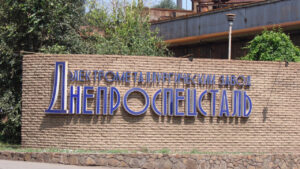
PJSC “Electrometallurgical Plant ”Dniprospetsstal” (Zaporizhzhia) increased its net loss by 3.9 times in the January-March period of this year compared to the same period last year, reaching UAH 510.751 million.
According to the company’s interim report, available to the Interfax-Ukraine agency, revenue from ordinary activities for this period decreased by 21.4%—to UAH 957.475 million from UAH 1.217961 billion.
The uncovered loss as of the end of March 2026 amounted to UAH 6.775516 billion.
According to the 2025 report, the company’s net loss last year increased by 22.1% compared to 2024—to UAH 711.015 million from UAH 582.427 million. At the same time, revenue from ordinary activities for this period decreased by 6.2%—to 5.330967 billion UAH from 5.686039 billion UAH.
74.6% of the company’s total sales volume is supplied to the Ukrainian market, while 25.4% is exported. The most important export markets (based on the share of sales in exports): Western Europe – 43.9%, North and South America – 26.6%, Eastern Europe – 25.5%, with the remainder distributed among the Far and Middle East.
As of December 31, 2025, the company’s workforce numbered 2,814 people (in 2024 – 3,147 people).
“Dniprospetsstal” is Ukraine’s sole manufacturer of long products and forgings made from special steel grades: stainless, tool, high-speed, bearing, structural, as well as heat-resistant nickel-based alloys.
According to the National Securities and Stock Market Commission (NSSMC) as of the fourth quarter of 2025, its shares are held by Wenox Holdings Ltd. – 47.1128%, Boundryco Ltd. – 11.0131%, Gazaro Ltd. – 16.5197%, Crascoda Holdings – 6.6826%, and Middleprime Limited – 9.7901% (all based in Cyprus).
It was previously reported that in May 2008, the international investment and consulting group EastOne sold its approximately 30% stake in Dniprospetsstal, which had previously been held under the group’s mandate. Meanwhile, the plant’s new shareholders are linked to VS Energy International, whose beneficiaries include several Russian entrepreneurs.
According to the report, in May 2023, pursuant to a decision by the National Security and Defense Council of Ukraine (NSDC) dated May 12, 2023, personal economic sanctions were imposed on the ultimate beneficial owner of Dniprospetsstal.
The company’s authorized capital is UAH 49.720 million.



