

According to Serbian Economist, the housing market in neighboring Romania continues to see price growth at the start of 2026, although the pace now appears more moderate than during the post-pandemic surge. According to Eurostat, the annual growth in housing prices in Romania at the end of 2025 was about 6.7%, which was higher than the EU average.
Bucharest remains the main market hub, but high prices persist in the largest regional cities as well. According to Romania Insider, in February 2026, two districts in the capital had already surpassed Cluj-Napoca in terms of price per square meter, while Cluj itself remained at approximately €3,300 per square meter. For Bucharest, research and market surveys indicate a city benchmark of €2,236 per square meter in February 2026.
In terms of transactions, the start of 2026 was uneven. In January, 24,598 real estate transactions were registered nationwide, which was below the level of January 2025, and apartment transactions fell by 25% nationwide and by 22% in Bucharest, according to Storia’s analysis based on ANCPI data. By February, the market had already picked up noticeably: the number of transactions rose to 44,427, and Bucharest once again became the country’s largest housing market.
The key trend at the start of 2026 is that the market remains active, but buyers have become more cautious. In its 2026 review, CBRE notes that Romanian buyers dominated the transaction mix at the end of 2025 and accounted for about 31% of the total investment volume for the year, while broader market reviews describe demand as “cautiously positive”: buyers remain active but are taking longer to make decisions and are focused on properly valued properties in good locations.
From a pricing perspective, the market can no longer be called cheap, even by regional standards. Colliers noted at the end of 2025 that prices in Romania’s largest cities had risen by 60–90% over six years, and in Cluj by approximately 100%, while in Bucharest the number of building permits had fallen by 45% over three years, further limiting supply.
Another important consideration for buyers and investors is that the Romanian market is becoming more demanding regarding transaction structures and financing. According to Legal 500, the sector is entering a more “disciplined” phase in 2026, where decisions are more strongly influenced by borrowing costs, the regulatory environment, and the quality of documentation. The OECD also expects only a moderate acceleration in economic growth for Romania in 2026 following a weak 2025, which means the housing market will increasingly depend on household incomes and mortgage availability, rather than just on the momentum of growth.
As for foreigners, no recent official statistics specifically regarding homebuyers by nationality at the beginning of 2026 could be found in open sources. Therefore, it is more accurate to distinguish between the market presence of foreigners and the market of foreign buyers. According to OECD data, in 2024, 52,000 new immigrants in Romania received residence permits valid for more than 12 months, and the largest groups of immigrants in the country in 2024–2025 were linked to Ukraine, Italy, Spain, Moldova, and Turkey. This is not the same as homebuyers, but it shows which foreign groups are currently most prominent in the country and potentially drive part of the demand for renting and buying real estate.
There has also been a noticeable increase in labor migration from Asia. The OECD notes that among new arrivals in 2023–2025, the largest groups were citizens of Nepal, Sri Lanka, and Turkey, while the Romanian labor market has also been actively attracting workers from India and Bangladesh in recent years. For the housing market, this is particularly important in the rental, dormitory, and affordable housing segments in major cities, rather than in the premium segment of apartment purchases.
First Ukrainian International Bank (FUIB, Kyiv) reported a net profit of UAH 1.38 billion for January–March 2026, down 11.3%, or UAH 174.9 million, from the same period in 2025.
According to the bank’s financial statements, its pre-tax profit in the first quarter of 2026 increased by 33.1%, or UAH 685.3 million, to UAH 2.76 billion.
FUIB’s net interest income for the reporting period increased by 32.3%, or UAH 1.28 billion, to UAH 5.25 billion, while net fee and commission income rose by 69.6% to UAH 0.91 billion.
At the same time, impairment losses in the first quarter of this year increased nearly fourfold—to UAH 0.98 billion from UAH 0.26 billion in the corresponding period of last year—while the bank’s operating expenses rose by 12.3%—to UAH 2.71 billion.
On April 15, the bank’s general meeting of shareholders approved a resolution to replenish the reserve fund by UAH 402.6 million using retained earnings, and not to distribute the remainder of the net profit for 2025.
Since the beginning of the year, PUMB’s total assets have decreased by 2.4%, or UAH 5.56 billion, to UAH 225.47 billion, while total liabilities have decreased by 3.5%, or UAH 6.99 billion, to UAH 192.47 billion.
At the same time, the bank’s equity increased by 4.5%, or UAH 1.43 billion, to nearly UAH 33.0 billion, with retained earnings reaching UAH 23.33 billion.
The financial institution’s total loan portfolio has increased by 9.8%, or UAH 9.64 billion, since the beginning of the year, reaching UAH 107.78 billion. The corporate loan portfolio grew by 9.7% to UAH 82.04 billion, while the retail portfolio grew by 10.3% to UAH 25.75 billion.
FUIB is the largest privately owned bank in Ukraine; its ultimate beneficiary is Rinat Akhmetov.
According to the National Bank, as of January 1, 2026, PUMB, with net assets of UAH 231.03 billion, ranked 5th among the country’s 60 banks, and its net profit for 2025 amounted to UAH 8.05 billion.

According to its 2025 results, the IMK agricultural holding reduced its physical sales volume of agricultural products by 31.2%—to 768,100 tons— but minimized the revenue decline to 10% thanks to a significant increase in global prices, according to the company’s annual report on the Warsaw Stock Exchange.
According to the document, the holding’s total revenue amounted to $190.4 million compared to $211.2 million in 2024.
Corn made the largest contribution to the result, with its share in the revenue structure increasing from 51.1% to 58.2%. Despite a 21.6% decline in sales volume (to 524,300 tons), revenue from this crop rose slightly to $110.8 million thanks to a 31% jump in the selling price to $211 per ton.
A similar situation was observed in the sunflower segment: while physical sales fell by 30.7% to 80.5 thousand tons, revenue remained stable at $46.9 million due to a 45.5% increase in the price—to $582 per ton.
The situation with wheat proved to be the most challenging, with revenue from it plummeting by 42.7% to $32.1 million due to a twofold drop in sales volumes.
At the same time, the cost of sales in 2025 remained virtually unchanged at $179.8 million (a 1% increase).
The report highlights a significant increase in the cost of raw materials and supplies, up 36% to $134.5 million, as well as in fuel and energy costs, up 36% to $17.9 million.
IMK specializes in growing grain and oilseed crops and grain storage operations. The company cultivates approximately 115,000 hectares of land in the Poltava, Chernihiv, and Sumy regions. IMK’s grain storage capacity totals 554,000 tons. The holding company owns its own fleet of trucks, grain railcars, and high-performance agricultural machinery. The group’s shares have been listed on the Warsaw Stock Exchange since May 2011. The company is ranked among the TOP 100 largest landowners in Ukraine.
IMK’s net profit for 2025 rose by 24% to $67.5 million, while consolidated revenue fell by 10% to $190.4 million. The agricultural holding’s normalized EBITDA increased by 11% to $95.8 million. The company’s total debt for the past year decreased to $17.9 million.
Starting May 1, Ukrzaliznytsia (UZ) is fully implementing an automated service for scheduling freight car repairs with the aim of minimizing human error, improving the efficiency of rolling stock utilization, and reducing downtime.
“In fact, from now on, the entire process—from repair planning to final billing—will take place online within a single system,” UZ notes on Facebook.
The company explains that to have cars repaired at its facilities, three online stages must be completed, including the already operational planning and contract stage, during which information on available capacity, rates, and terms is published in the system, and the car owner submits an electronic application with an annual repair plan. After that, the parties conclude a contract online using a qualified electronic signature (QES).
In the second stage (application submission and repair), which began on May 1, the client makes an advance payment, submits the application independently by selecting the production unit to receive the service, after which the railcars are sent for repair. All work is performed according to an automatically generated queue.
In the third stage (completion and billing), after repairs, the system generates certificates of completion and necessary documents with a QES. These become available in the customer’s electronic account, after which final billing takes place.
“Thus, customers receive a fully digital process without paper documents: the contract, requests, repair tracking, and all settlements—all in one service. A personal account is automatically created for each customer, and contracts can be renewed online,” the post concludes.
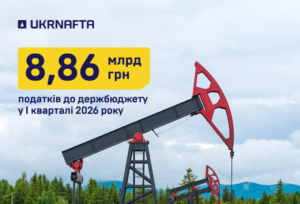
“Ukrnafta” paid 8.86 billion UAH in taxes, fees, and customs duties to the state budget in the first quarter of 2026.
“In total, since the company came under state management, the amount of taxes, fees, and customs duties paid for 2023–2026 has exceeded UAH 106 billion,” noted Bohdan Kukura, Chairman of the Board of JSC Ukrnafta. “This is the company’s systematic contribution to supporting the economy and financing the state’s needs, particularly those of the Armed Forces. I thank the team for their consistent work and results.”
As of the end of 2025, Ukrnafta, as part of the Naftogaz Group, paid 28.8 billion UAH in taxes and fees to the state budget.
JSC “Ukrnafta” is Ukraine’s largest oil producer and operates the country’s largest national network of gas stations—UKRNAFTA. In 2024, the company entered into an asset management agreement with Glusco. In 2025, it finalized a deal with Shell Overseas Investments BV to purchase the Shell network in Ukraine. In total, it operates nearly 700 gas stations.
The company is implementing a comprehensive program to resume operations and modernize the format of gas stations in its network. Since February 2023, it has been issuing its own fuel vouchers and “NAFTACard” cards, which are sold to legal entities and individuals through Ukrnafta-Postach LLC.
The largest shareholder of Ukrnafta is Naftogaz of Ukraine with a stake of 50% plus one share.
In November 2022, the Supreme Commander-in-Chief of the Armed Forces of Ukraine decided to transfer to the state the share of corporate rights in the company that belonged to private owners, which is now managed by the Ministry of Defense.

Dniprometiz-TAS LLC (Dnipro), owned by Ukrainian businessman Serhiy Tihipko, reported a net loss of UAH 46.820 million for January-March of this year, compared to a profit of UAH 3.938 million in the same period last year.
According to the company’s interim report, which is available to the Interfax-Ukraine agency, revenue from ordinary activities for the specified period amounted to UAH 802.933 million, compared to UAH 778.319 million for the first three months of 2025.
At the same time, the company’s retained earnings as of the end of March 2026 amounted to 224.955 million UAH.
According to the annual report, Dniprometiz-TAS reported a net profit of UAH 8.961 million in 2025 and UAH 13.963 million in 2024, with revenue from ordinary activities amounting to UAH 3.453737 billion (UAH 3.285688 billion).
As reported, Dniprometiz-TAS reduced its net profit by 2.9% in the first nine months of 2025 compared to the same period last year—to 11.727 million UAH, while net revenue increased by 7.5%—to 2.607402 billion UAH.
In 2024, Dniprometiz-TAS increased its net profit by 47.7% compared to 2023—to UAH 14.197 million from UAH 9.610 million, while net revenue rose by 22.7%—to UAH 3.285688 billion. At the same time, the company’s retained earnings as of the end of 2024 amounted to 263.048 million UAH.
“Dniprometiz” reported a 2.6-fold decrease in net profit for 2023 compared to 2022—to UAH 9.658 million from UAH 24.733 million. Over the past year, net revenue increased by 8.2%—to UAH 2.677836 billion.
Dniprometiz reported a six-fold decrease in net profit for 2022 compared to the previous year—to UAH 25.572 million, while net revenue grew by 1.1%—to UAH 2.474397 billion.
“Dniprometiz-TAS” manufactures metal products from low-carbon steels. The company’s production capacity is 120,000 tons of products per year.
At the general meeting on April 29, 2025, the issue of increasing the company’s authorized capital through an additional contribution by a shareholder was considered. A decision was made to increase the authorized capital by UAH 100 million: from UAH 83,479,696 to UAH 183,479,696 through an additional contribution by T.A.S. Overseas Investments Limited (Cyprus) in the amount of UAH 100 million.
T.A.S. Overseas Investments Limited (Cyprus) owns a 98.6578% stake in Dniprometiz LLC.
The authorized capital of Dniprometiz-TAS LLC remains at UAH 83.480 million.



