

The Ukrainian government has officially approved the country’s participation in the World Specialized Exhibition EXPO 2027 Belgrade, which will take place in the Serbian capital from May 15 to August 15, 2027.
The Cabinet of Ministers of Ukraine adopted the relevant resolution on September 21. Deputy Prime Minister for Humanitarian Policy and Minister of Culture Tetiana Berezhna has been appointed General Commissioner of the Ukrainian national pavilion.
The costs of Ukraine’s participation are to be covered by funds from the EXPO 2027 organizer, donor and sponsor funding, charitable contributions, and other permitted sources. The Ministry of Economy and Environment will coordinate the preparation of the Ukrainian exhibition, and the Ministry of Foreign Affairs will officially notify the Serbian government of the appointment of the Commissioner-General.
Berezhna already has experience organizing Ukraine’s participation in world expos. She served as Commissioner-General of the Ukrainian pavilion at EXPO 2025 in Osaka.
The Belgrade expo will be held under the slogan “Play for Humanity: Sport and Music for All.” Organizers expect more than 4 million visitors over the 93 days of the expo.
EXPO 2027 will be the largest specialized expo in terms of the number of participants in the history of such events. According to the latest data from the organizers, 143 international participants have confirmed their participation. For comparison, the previous record for specialized EXPO events was held by Astana 2017, which featured 117 participating countries.
Among the largest countries that have confirmed or already registered their participation in the Belgrade exhibition are are the United States, China, Russia, India, Germany, France, Italy, Spain, Japan, South Korea, Turkey, Brazil, Mexico, Argentina, Saudi Arabia, the UAE, Israel, South Africa, and Egypt.
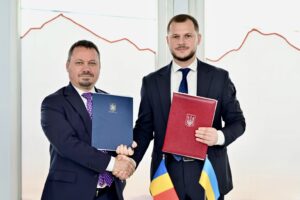
Ukraine and Romania, within the framework of the Carpathian Economic Forum (C8 Summit), signed a memorandum of understanding based on an updated Strategy for the Development of Border Infrastructure between the two countries, which takes into account the needs related to the transportation of cargo and passengers.
According to a statement from Ukraine’s Ministry of Recovery, Infrastructure, and Transport, the document was signed by Minister Mykola Kalashnyk and Ionel Scriostanu, State Secretary of Romania’s Ministry of Transport and Infrastructure.
Under the memorandum, the countries are expected to work on modernizing and developing road border crossing points (BCPs) and access roads, strengthening rail connections, as well as simplifying border control procedures and expanding opportunities for transshipment of Ukrainian cargo in Romanian ports.
Among other things, there are plans to increase the throughput capacity of existing border crossing points and develop new routes; specifically, the updated Strategy identifies 17 border crossing points, 10 of which are new proposals.
“The signed memorandum outlines specific directions for this work. It is important for us to increase the border’s throughput capacity and create stable and predictable routes for Ukrainian businesses to the European Union and Romanian ports,” the press release quotes Ukraine’s Minister of Recovery, Infrastructure, and Transport as saying.
The ministry emphasized that the next step will be to move toward implementing the relevant projects and securing funding for their execution.

According to Fixygen, PJSC “Ukrainian Financial Housing Company” (“Ukrfinzhilia”), the operator of the state mortgage program “eOselya,” is working to prepare an issuance of securitized securities on international capital markets following the end of the war unleashed by Russia, with a potential volume of approximately EUR1 billion, said Chairman of the Board Yevhen Metzger.
“We are preparing and are indeed the company that will likely be the first to carry out securitization. We have JP Morgan advising us and guiding us into open capital markets,” he said during a discussion on the prospects of Ukraine’s stock market organized by the Kyiv International Economic Forum last week.
Metsger noted that to this end, “Ukrfinzhilye” will form mortgage pools worth the equivalent of $2–3 billion.
The head of “Ukrfinzhilye” clarified that it remains to be determined which markets to enter, as the American and European markets have significant differences. “We must be prepared for both scenarios,” he added.
According to him, the path for issuing securitized securities was paved by the Law on Securitization and Covered Bonds (No. 15172), which was developed jointly with the National Securities and Stock Market Commission and the European Bank for Reconstruction and Development (EBRD).
Metsger noted that there are many investors in the international market active in the housing finance sector, such as the Belgian fund Revive.
“Let’s be frank. We hope that securitization or the issuance of mortgage Eurobonds will be possible after the war. I do not believe that we will be able to do this now—this year, next year, or during the war,” the head of “Ukrfinzhylia” emphasized.
He added that it is also necessary to adopt subordinate legislation and regulations that will allow for proper preparation for the issuance of securitized securities.
“That is why we are moving forward; we hope to use this year and next year productively to prepare for securitization,” Metzger concluded.
“Ukrfinzhylia, ” securitization, INVESTMENTS, mortgages, еОселя
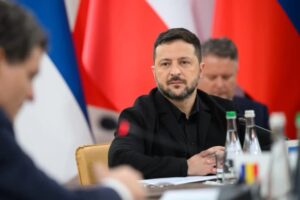
According to “Serbian Economist”, Ukrainian President Volodymyr Zelenskyy visited the Serbian pavilion at the first Carpathian Economic Forum in Bukovel, which is taking place on September 18–19 as part of the summit of the new regional format, the Carpathian Eight (C8). This was reported by the Serbian Chamber of Commerce and Industry.
Serbia is represented at the forum by the Serbian Chamber of Commerce and Industry, the Serbian Development Agency, Expo 2027 Belgrade, as well as Serbian companies, including Mind Park and Millennium Team. The main goal of Serbia’s participation is to present the country’s investment opportunities and establish new contacts with companies, investors, and financial organizations in the region.
The forum itself has become a major business platform: according to the Office of the President of Ukraine, approximately 1,400 people from 25 countries are participating, including representatives of nearly 400 companies from the C8 countries. The forum’s total investment portfolio includes 95 projects valued at over 42.5 billion euros in the energy, industrial, transportation and logistics, technology, agricultural, real estate, and other sectors.
Serbia is particularly interested in projects in the energy, rail and road transportation, logistics, industry, and cross-border trade sectors. At the summit, Aleksandar Vučić stated that trade between Serbia and Ukraine grew by 42% in the first half of 2026.
The new C8 format brings together Serbia, Ukraine, Romania, Poland, Slovakia, the Czech Republic, Austria, and Hungary. Its participants aim to develop infrastructure and energy links, investment projects, and closer integration of the Carpathian and Danube regions.
C8, FORUM, INVESTMENT, SERBIA, UKRAINE
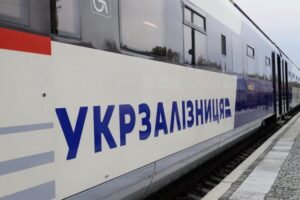
A number of Ukrzaliznytsia trains across the country are running with delays of 2 to 16 hours, according to train schedule information posted on the company’s website on Monday.
According to the latest updates as of 10:43 a.m., the train with the longest delay is train 121/122 Mykolaiv Pass. – Kyiv-Pass. – 16 hours 33 minutes, as well as train 109/110 Mykolaiv Pass. – Lviv – 12 hours 37 minutes, while trains 233/234 Kryvyi Rih-Holovnyi – Chernivtsi and 293/294 Kryvyi Rih-Holovnyi – Rakhiv are running with a delay of 11 hours 58 minutes.
As for other trains, the 3/4 Dnipro-Holovnyi–Uzhhorod is delayed by 10 hours 24 minutes, and the 285/286 Lviv–Dnipro-Holovnyi and 41/42 Truskavets–Dnipro-Holovnyi are running with a delay of 7 hours 36 minutes.
“Ukrzaliznytsia” notes that train delays are calculated automatically, so changes may occur. Among other things, it is noted that during emergencies, evacuations, and detours, train delays may increase, while they may decrease when a train accelerates.
The company’s website reports that, in total, approximately 50 trains are running with delays across Ukraine.

The Ukrainian Grain Association (UGA) is urging the Verkhovna Rada and the government to repeal the 10% export duty on soybeans and rapeseed, the association reported.
According to the association’s estimates, in the 2025/26 marketing year, Ukraine exported 2.7 million metric tons of soybeans, compared to 3.8 million metric tons in the previous season, and 1.82 million metric tons of rapeseed, compared to 3.2 million metric tons. The UGA considers the introduction of the export duty to be one of the key reasons for the decline in exports of these crops.
The association notes that the additional 10% export duty diverts a portion of revenue from the production chain and increases the financial burden on agricultural producers, especially small and medium-sized ones, for whom selling their harvest at a competitive export price is crucial for covering loan payments, land rent, fuel, fertilizers, plant protection products, and labor costs.
The UZA also notes that the government has streamlined the procedure for confirming farmers’ eligibility for duty exemptions on their own-grown produce through the State Agrarian Register. However, in the association’s view, this mechanism does not address the systemic problem, as a significant portion of Ukrainian soybeans and rapeseed passes through the commercial distribution chain.
According to the UZA, export restrictions create imbalances in the domestic market and limit producers’ ability to choose the most economically viable sales channel. The association considers it important to maintain the ability to export products to markets where there is demand and where producers can obtain competitive prices.



