
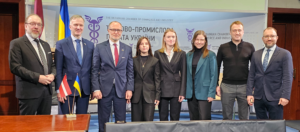
Latvia and relevant Ukrainian business and defense associations are deepening their cooperation in the defense industry sector. This was announced during the Latvian-Ukrainian Defense Forum 2026, which took place on March 23 in Kyiv at the premises of the Ukrainian Chamber of Commerce and Industry. The event culminated in the signing of a memorandum of understanding between the Latvian Ministry of Defense and a number of Ukrainian organizations, which provides for long-term cooperation, technology exchange, and state support for Ukrainian companies planning to enter or expand their operations in the Latvian market.
The forum was attended by government officials, diplomats, business representatives, and industry associations from both countries. The event was opened by Gennadiy Chizhikov, President of the Ukrainian Chamber of Commerce and Industry; Andris Spruds, Minister of Defense of Latvia; Serhiy Boev, Deputy Minister of Defense of Ukraine; and Andrejs Pildegovičs, Ambassador of Latvia to Ukraine. As the organizers noted, the forum was aimed not only at providing political confirmation of support for Ukraine but also at establishing practical mechanisms for cooperation between manufacturers, investors, and government institutions of the two countries.

On the Ukrainian side, the Ukrainian Council of Arms Manufacturers, the National Association of Defense Industries of Ukraine, the Federation of Employers of Ukraine, and “Technological Forces of Ukraine” joined the agreements. According to the Latvian side, the document is intended to serve as a tool for building a joint defense industry ecosystem that will combine the combat experience of Ukrainian manufacturers with Latvia’s technological and institutional potential. The Latvian Ministry of Defense emphasized that the memorandum provides for targeted state support for Ukrainian companies planning to launch or expand their operations in Latvia.
“The combat experience of the Ukrainian defense industry and Latvia’s technological potential are a powerful combination for joint development. The memorandum is not merely declarative but practical in nature and is intended to serve as a platform for creating innovative solutions that will strengthen the security of both countries and the capabilities of their armed forces,” noted Latvian Defense Minister Andris Spruds.
The Latvian Ministry of Defense also emphasized that the country aims to become a stable base for Ukrainian companies in Europe, while simultaneously developing its own industrial potential.
Gennadiy Chizhikov, President of the Ukrainian Chamber of Commerce and Industry, for his part, emphasized that deepening cooperation in the defense sector “strengthens our countries and industries.”
“The implementation of the agreements will take place with the participation of the Latvian Investment and Development Agency, as well as the Latvian Ministry of Economy and Ministry of Defense. This involves, in particular, promoting Ukrainian business in the Latvian market and supporting the development of a broader defense industry ecosystem,” he added.
The practical part of the forum included a bilateral business session and a panel discussion featuring Oleksandr Kamyshin, Advisor to the President of Ukraine on Strategic Issues; Vadym Yunyk, co-founder of Baltic Forces Hub; Ihor Fedirko, CEO of the Ukrainian Defense Industry Council; representatives of the Federation of Employers of Ukraine, Latvian business organizations, LIAA, DAIF Latvia, the Latvian Embassy in Ukraine, and private companies in the defense and technology sectors. This composition of participants indicates that the parties are striving to translate political support into concrete production, investment, and cooperation decisions.
Further confirmation of the practical nature of the visit came from the fact that the Latvian Investment and Development Agency had announced as early as the beginning of March a trade mission of Latvian defense and security companies to Kyiv for March 23–25, coinciding with the working visit of the Latvian Minister of Defense. The program included direct contacts with representatives of the Ukrainian defense sector and B2B meetings with potential partners. The forum in Kyiv thus became part of a broader effort to institutionalize Latvian-Ukrainian cooperation in the defense industry against the backdrop of the war and the growing role of this sector in the economies of European countries.
The event was organized by the Latvian Ministry of Defense, the Latvian Investment and Development Agency, and the Latvian Embassy in Ukraine, while the Ukrainian Chamber of Commerce and Industry served as a co-organizer, and the Ukraine Facility Platform acted as a partner for the forum. Given the content of the signed agreements, this is no longer merely a matter of Latvia’s political solidarity with Ukraine, but an attempt to establish a sustainable bilateral cooperation mechanism.
Interfax-Ukraine is the forum’s media partner.

The IBC Investment and Construction Congress will take place on March 26, 2026, at the Parkovy Exhibition and Convention Center in Kyiv and will bring together over 6,000 participants—developers, investors, architects, business owners, and top management.
According to the organizers, the congress will focus on issues related to development, investment, architecture, urban renewal, and new opportunities for market growth.
The official opening of the event is scheduled for 11:00 a.m. Participants will include Natalia Kozlovska, Deputy Minister of Community, Territorial, and Infrastructure Development of Ukraine; Vitali Klitschko, Mayor of Kyiv; and Natalia Gavatyuk, Deputy Head of the Kyiv Regional State Administration.
According to the organizers, the congress will focus on strategic market development vectors, issues of urban environment restoration and transformation, new investment opportunities, as well as key partnerships and solutions for the industry.
The IBC program will run from 9:00 AM to 9:00 PM. The event will also feature the Real Estate Market Awards 2026, “Interior of the Year: Real Estate,” and a concert program.
The congress will be held in-person in the main “Chasha” hall on the third floor of the Parkovy Exhibition and Convention Center.
Details on participation and registration are available on the organizers’ website: www.ibc-ua.info

Lithuania is investing €15 million to strengthen the rehabilitation system and modernize the healthcare system in Ukraine.
According to the Central Project Management Agency (CPVA), which is implementing the program, the project is funded by the Lithuanian Cooperation and Humanitarian Aid Development Fund and the Lithuanian Ministry of National Defense, as reported to Interfax-Ukraine.
The program covers three strategically important rehabilitation centers—in Lviv, Dnipro, and Zhytomyr. Specifically, in Dnipro, the university hospital will receive a 34-bed inpatient rehabilitation ward with 18 rooms featuring modern physical and occupational therapy facilities, as well as a shelter for 80 people.
In Zhytomyr, the rehabilitation ward of one of the military hospitals will be modernized: 11 two-bed rooms, a shelter for 200 people, and solar panels for energy self-sufficiency during massive attacks will be added.
The project also supports the development of the UNBROKEN rehabilitation center in Lviv and its expansion from 70 to 120 beds through the construction of a third floor and a specialized rehabilitation pool.
“Today, international support for Ukraine continues, but it needs visibility. It is critically important for partners to see that their aid not only reaches its destination but is also visible, valuable, and important to Ukrainian society,” the CPVA notes.

The median total monthly income of tractor drivers (excluding bonuses) in Ukraine rose to 31,600 UAH by the end of 2025, which is 12% higher than in 2024, according to Agrohub, citing the results of the annual HR360 Benchmarking survey.
According to the study, the median salary of a tractor operator, including bonus payments, currently stands at 36,300 UAH per month. The overall growth in the payroll fund (PPF) in this segment was 5%, partly due to a labor shortage: the number of employees per 10,000 hectares decreased from 27 to 25.
Harvesting remains the most expensive operational activity in the agricultural sector. In 2025, the average pay for this work increased by 5%—to 383 UAH/hour. In second place in terms of income is spraying, at 320 UAH/hour (+8%); in third place is sowing, where rates rose by 14% to 271 UAH/hour. Rolling remains the least expensive operation—142 UAH/hour (+17%).
Analysts noted that there remains a severe shortage of multi-tasking specialists in the market. Only 0.5% of tractor operators are capable of simultaneously performing seeding, spraying, and harvesting. At the same time, each worker is responsible for an average of 3,700 hectares of cultivated land.
An analysis of compensation models shows the dominance of a combined form (fixed + piece-rate component + bonus), used by 76% of agricultural companies. Within this compensation structure, the fixed component accounts for 36%, the variable component for 53%, and the bonus component for 11%. Purely piece-rate pay remains in 21% of companies, while a fixed rate is found in only 2% of cases.
The age structure of the workforce shows a trend toward a younger workforce: the share of tractor operators under 25 has risen from 6% to 10% over the past three years. At the same time, the category of employees aged 55+ has decreased from 18% to 14%. The majority of employed specialists (52%) are people under the age of 45.
“The market is gradually shifting toward more complex compensation models. It is becoming critically important for companies not only to hire a tractor operator but also to retain them. That is why employers are increasing the fixed portion of income, which is a more effective tool in the competition for labor than simply raising piece-rate rates,” noted Dmytro Lebedev, Head of Agrohub HR360 Benchmarking.
The study also noted limited use of drones for spraying and desiccation—currently, just over 1% of all acreage is treated using UAVs. Meanwhile, agricultural holdings perform 89% of field work with their own equipment, while 11% is outsourced.
The Agrohub HR360 Benchmarking study of tractor operators’ incomes and job functions was conducted from January to October 2025 among 7 holding companies (41 field operations), employing 3,634 specialists.

The introduction of export duties on rapeseed and soybeans last September caused a redistribution of income from agricultural producers to processors, resulting in total losses for farmers of approximately $200 million, the American Chamber of Commerce (ACC) reported during a press briefing in Kyiv on Wednesday.
According to published data, due to a 7% drop in domestic prices relative to global markets, Ukrainian farmers lost $130 million in profits. Small and medium-sized producers, who are unable to export their products independently, were hit the hardest. An additional $50 million was collected from farmers and exporters in the form of duties paid to the state budget.
“The export duty that was introduced is effectively a redistribution of income among producers in favor of processors. Instead of stimulating processing, we have ended up with a mechanism to cover the losses of the processing industry at the expense of crop production,” the ACC noted.
Representatives of the business association emphasized that in the six months since the law took effect, not a single new processing facility has been declared or built in Ukraine. At the same time, existing capacity of 23 million tons already exceeds the total oilseed production volume, which stands at about 20 million tons.
According to ACC estimates, Ukraine’s foreign exchange earnings from oilseed exports during this period decreased by $1 billion. Specifically, revenue from rapeseed exports fell by $700 million (with partial compensation from increased exports of oil and meal, the net loss amounts to $400 million – IF-U). For soybeans, the decline is estimated at $240 million, and for sunflowers, at $345 million.
Experts argue that the arguments of the bill’s initiators regarding the successful experience with sunflower seed tariffs were flawed due to the different physical nature of the crops. As a light product, sunflower seeds are more profitable to process locally, whereas rapeseed and soybeans are heavy crops that are more practical to transport by large vessels to consumption centers. The ACC also highlighted the negative legislative precedent, as protests from leading industry associations—including the Ukrainian Agribusiness Club (UAC) and the Ukrainian Agrarian Council (UAC)—were ignored during the law’s adoption. Furthermore, this decision has strained relations with European partners and contradicts the processes of European integration.
For his part, Oleg Nivievsky, a professor at the Kyiv School of Economics (KSE), noted that the total losses incurred by agricultural producers due to the law over a full marketing year could amount to approximately 17 billion UAH. According to his calculations, the rapeseed duty will generate 6.2 billion UAH for the budget but will result in net economic losses of 80–170 million UAH due to reduced farmer incomes. The situation is even worse for soybeans: with budget revenues of 4.1–4.7 billion UAH, farmers will lose 9.1–9.3 billion UAH, resulting in net losses for the country of 200–500 million UAH.
“This is a bad signal for the market, indicating that processing is uncompetitive without state subsidies. A similar logic of ‘utilizing capacity’ is already being applied to the export of scrap metal and timber, which sets an extremely negative precedent,” emphasized Nivievsky, adding that the state’s total economic losses from duties on both crops could reach 280–670 million UAH.
As reported, pursuant to Law No. 4536-IX of July 16, 2025, a 10% export duty on rapeseed and soybeans was introduced in Ukraine effective September 4, 2025. The document provides for a gradual reduction of the rate by 1% annually, starting January 1, 2030, to 5% by 2035. At the same time, the law includes a preferential regime for direct producers and cooperatives, who are exempt from paying the duty when exporting their own-grown products.

The state-owned enterprise “Forests of Ukraine” plans to establish over 30,000 km of firebreaks in preparation for the 2026 fire season, the enterprise announced on Facebook.
According to the report, the work is carried out twice a year—in the spring and early fall. Foresters pay particular attention to protecting young coniferous trees, as well as areas along railways and highways.
To carry out this work, the state-owned enterprise “Forests of Ukraine” plans to purchase over 100 cultivators, disc harrows, and 42 special forest plows in 2026 to replace outdated equipment.
The total length of the firebreak network within the state forest fund is 140,000 km. Throughout the fire-hazardous season, the enterprise ensures regular maintenance of these firebreaks, including the removal of dry vegetation and debris to maintain their barrier function.
As reported, the state-owned enterprise “Forests of Ukraine” recorded the first forest fires in the Zakarpattia, Lviv, and Volyn regions in March of this year. The main causes of the incidents were the burning of dry grass in areas bordering the forest fund. The State Forest Guard has already switched to an enhanced patrol regime.
“Forests of Ukraine” reminded the public that burning dry vegetation is punishable by fines ranging from 3,060 UAH to 150,000 UAH, and in some cases carries criminal liability.



