
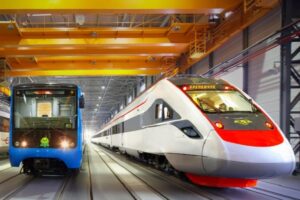
PJSC “Kryukiv Railway Car Building Works” (KRCBW, Poltava region) incurred a loss of UAH 184.5 million in 2025, whereas a year earlier it had reported a net profit of UAH 81.1 million, according to information in the agenda of the company’s annual general meeting of shareholders, scheduled for April 20.
“Based on the results of the company’s financial and operational activities for 2025, the loss amounts to UAH 184,540,916. Taking into account income from the revaluation of actuarial liabilities, as calculated by an independent actuary in the amount of 59.97 million UAH, approve the total loss for 2025 in the amount of 124,569,816 UAH,” the draft resolution of the meeting states.
The loss is planned to be covered by profits from future periods.
As reported, KVSZ allocated the net profit received in 2024 to cover losses from previous years and did not pay dividends.
Last year, KVSZ completed the delivery of 66 passenger cars to Ukrzaliznytsia ahead of schedule, specifically 15 SV-type cars, 31 compartment cars, four inclusive cars, and 16 open-seating cars.
At the same time, the plant noted that against the backdrop of stagnation in the freight car manufacturing market, the results regarding the delivery of such cars were “disappointing.” Specifically, 121 cars were sold in the first quarter of 2025, but thereafter, sales were minimal.
KVBZ manufactures passenger and freight cars, regional diesel trains, high-speed interregional locomotive-hauled trains, spare parts and bogies for freight cars, and escalators.
According to data from the National Securities and Stock Market Commission (NSSMC) as of the fourth quarter of 2025, 25% of the shares in PJSC “KVBZ” were owned by the Estonian companies AS Skinest Finants and Osauhing Delantina, and 20% by Transbuilding Services Limited, registered in England.
Another 25% was owned by OW Capital Management GmbH, controlled by Russian citizen Gamzalov. However, in early 2026, the High Anti-Corruption Court seized this block of shares, with a nominal value of 21.5 million UAH, for the state’s benefit.
In 2024, the plant sold 1,096 freight cars, which is nearly 10% higher than sales in pre-war 2021. The first 15 passenger cars from a contract for 66 units were also delivered to Ukrzaliznytsia. Net profit amounted to 81.08 million UAH, compared to a loss of 143.76 million UAH in 2023.

From March 23 to 25, traffic will be partially restricted on several bridges and overpasses in Kyiv. During this period, specialists from the Kyivavtoshlyakhmist municipal enterprise will be repairing sections of the road surface.
According to Kyivavtodor, on March 23, repair work will be carried out on: the Northern Bridge; the overpass on Mykoly Vasilenko Street near the “Beresteiska” metro station; the Vozduhoflootsky overpass across the railroad tracks on Vozdushnykh Sil Avenue; the bridge across the Lybid River on Vozdushnykh Sil Avenue; the flyover on Zhilyanska Street; the overpass across Beresteisky Avenue on Vozdushnykh Sil Avenue.
On March 24, work will be carried out on: the North Bridge; the Vozduhoflootsky overpass across the railroad tracks on Vozdukhnykh Sil Avenue; the bridge across the Lybid River on Vozdukhnykh Sil Avenue; the overpass across Berezestsky Avenue on Vozdukhnykh Sil Avenue.
March 25 – on: the E.O. Paton Bridge; the overpass on Kyoto Street; the Northern Bridge.
During the work, traffic will be partially and gradually restricted. In the event of deteriorating weather conditions, the schedule of the work may be changed.
The municipal corporation apologizes for the temporary inconvenience and asks that you take the restrictions into account when planning your route.

According to Serbian Economist, Romania has prepared a strategic study on the creation of a 781.9-km railway corridor from Constanța to the Hungarian border, which will combine modernized sections with speeds of 160–200 km/h and new double-track sections designed for speeds of up to 250 km/h. This is reported by Romanian business publications.
According to the study, the most suitable route is the Constanta–Bucharest–Brasov–Sighisoara–Târgu Mureș–Cluj-Napoca–Zaleu–Oradea–Hungarian border corridor. The project is estimated at €14.93 billion, with an average investment cost of approximately €19 million per kilometer.
The first phase involves the construction of a new double-track line between Bucharest and Cimpina with a design speed of 250 km/h, while the Cimpina–Brasov section is proposed to be upgraded to 200 km/h. The second phase covers the new Brasov–Cluj-Napoca line via Targu Mures, the third—Cluj-Napoca–Oradea via Zalau, and both of these new lines are also designed for 250 km/h. The fourth phase includes upgrading the Bucharest–Fetești section to 200 km/h and constructing a new double-track section between Fetești and Constanța for speeds of 250 km/h.
The document examines the technical, investment, operational, and institutional parameters of the project and recommends phased financing after 2027 through European funds, the state budget, and, potentially, public-private partnership mechanisms.
https://t.me/relocationrs/2476

In 2025, Promarmatura PJSC (Dnipro) increased its net profit by 36.5% compared to the previous year—from UAH 3.274 million to UAH 4.468 million.
According to the company’s announcement in the information disclosure system of the National Securities and Stock Market Commission (NSSMC) regarding the remote general meeting of shareholders to be held on April 20, the agenda includes seven items.
The meeting is scheduled to review the CEO’s report on the results of operations for 2025 and make a decision based on the review of this document.
The meeting will also hear the auditor’s conclusions and approve measures based on the review of this report. In addition, shareholders will approve the results of financial and economic activities for the past year and the distribution of profits.
The draft resolutions, copies of which are available to the Interfax-Ukraine agency, propose not to distribute the net profit earned from financial and economic activities in 2025.
” “The net profit earned by the company in 2025, amounting to UAH 4,468,000, shall not be distributed, but shall remain at the company’s disposal and be allocated in full to the fulfillment of its statutory objectives. Annual dividends based on the company’s performance for 2025 shall not be accrued or paid,” the draft resolutions state.
As reported, based on its 2024 results, Promarmatura PJSC saw its net profit decrease by a factor of 3.48 compared to the previous year—to UAH 3.274 million, while net revenue for this period decreased by 11.8%—to UAH 188.732 million. The company’s retained earnings as of the end of 2024 amounted to UAH 128.660 million.
In 2023, the plant reported a net profit of UAH 11.407 million, compared to a net loss of UAH 29.995 million in 2022.
Promarmatura was established in December 1994 and operates in the pipeline valve market.
According to the National Securities and Stock Market Commission (NSSMC) data for the fourth quarter of 2025, 50% of the shares of the private joint-stock company are owned by two individuals—Ukrainian citizens Igor Mezebovsky and Alexander Chelyadin.
The company’s authorized capital is UAH 7.218 million.

According to Fixygen, PJSC “Novovolynsk Foundry” (Volyn Oblast) reported a net profit for 2025, the amount of which has not yet been disclosed.
According to the company’s announcement in the information disclosure system of the National Securities and Stock Market Commission (NSSMC) regarding the holding of a remote general shareholders’ meeting on April 24, the agenda includes 11 items.
Specifically, the meeting plans to review the reports of the management board, supervisory board, and auditor for 2025 and adopt the corresponding resolutions. The meeting also plans to approve the results of financial and operational activities for 2025 and distribute profits.
In addition, plans include adopting a resolution to change the composition of the supervisory board, electing additional members, approving the chairman of the management board appointed by a resolution of the supervisory board dated May 19, 2025, and granting preliminary consent for significant transactions.
The draft resolutions, copies of which are available to the Interfax-Ukraine agency, propose that the net profit earned by the pharmaceutical company in 2025 be allocated to the modernization and renewal of fixed assets, the development of the enterprise, and the replenishment of working capital. Shareholders will also determine the main areas of activity and approve the work plan for 2026.
In addition, it is proposed to adopt a resolution on changing the composition of the supervisory board: to establish a membership of five people and to elect two shareholders—Natalia Chernyavskaya and Artem Prokopyuk—as members of the supervisory board for a term ending April 24, 2028.
As reported, NLZ increased its net profit by 36.7% in 2024 compared to 2023—to UAH 240.363 million from UAH 175.856 million. Retained earnings at the end of the year amounted to UAH 575.365 million.
The plant specializes in the production of high-quality steel and cast iron castings for the machine-building industry.
According to the National Securities and Stock Market Commission’s data for the fourth quarter of 2025, LLC “Dnister-M” (Lviv Oblast) owns 86.6392% of the shares of PJSC “Novovolynsk Foundry.”
The company’s authorized capital is 1,568,060 UAH, and the par value of a share is 0.25 UAH.

The Cabinet of Ministers has allocated an additional 7.7 billion hryvnias to fund housing programs for internally displaced persons (IDPs) from temporarily occupied territories, Prime Minister Yulia Svyrydenko announced.
“6.6 billion hryvnias for ‘e-Recovery’ for IDPs from temporarily occupied territories. These funds will provide housing for over 3,300 families who have combatant status or are persons with disabilities resulting from the war,” Svyrydenko wrote on her Telegram channel.
She noted that the state provides housing vouchers worth 2 million hryvnias per person or family whose homes remain in the temporarily occupied territory.
Another 1.1 billion hryvnias has been allocated for the construction of social rental housing.
“It will be provided to Mariupol residents who lost their homes due to the war. Housing will be available to 505 families of displaced persons from Mariupol,” she added.



