

The Arab Council of Ukraine and the Khmelnytskyi Regional Council have agreed to develop the region’s cooperation with the countries of the Arab world, particularly in the economic, investment and humanitarian spheres.
According to Mohammad Farajallah, Secretary-General of the Arab Council in Ukraine, Violeta Labazuk, Chair of the Khmelnytskyi Regional Council, met with Khusam Raad, Chair of the Committee on Foreign and Diplomatic Relations of the Arab Council in Ukraine, advisor to the Honorary Consul General of Ukraine in Syria, and representative of the Muslim community in the Khmelnytskyi region.
The parties discussed opportunities to expand the international ties of the Khmelnytskyi region and establish contacts with representatives of businesses and public organizations from Arab states.
Particular attention was paid to the prospects of attracting investment, implementing joint projects, developing trade and economic cooperation, and humanitarian initiatives.
During the meeting, the parties also discussed opportunities to present the economic and investment potential of the Khmelnytskyi region to potential partners from Arab countries.
The Arab Council of Ukraine stated its readiness to facilitate the establishment of direct contacts between representatives of the region and business circles of Arab states, as well as to support initiatives aimed at developing interregional and international cooperation.
The parties agreed to continue their interaction and work out specific areas of possible cooperation.
The Arab Council of Ukraine is a public organization whose activities are aimed at developing relations between Ukraine and Arab countries and strengthening business, public, cultural and humanitarian ties.
ARAB COUNCIL OF UKRAINE, Arab countries, COOPERATION, INVESTMENT, Khmelnytskyi region, LABAZIUK, UKRAINE, АБУ АЛРУБ
According to the results of a survey conducted by Active Group in collaboration with Experts Club in August 2025, Ukrainians identified priority areas for the development of foreign economic relations.
The majority of respondents – 81.3% – believe that Ukraine should first and foremost develop economic cooperation with the countries of the European Union. The United Kingdom also received a high level of support – 66.5%, while the United States came in third with 62.7%.
Citizens also pay significant attention to Asian countries: 36.2% of respondents support expanding relations with Southeast Asian countries (Japan, South Korea, etc.), and 31.7% with China. At the same time, 29.5% pointed to the importance of deepening cooperation with countries in the Arab and Muslim world.
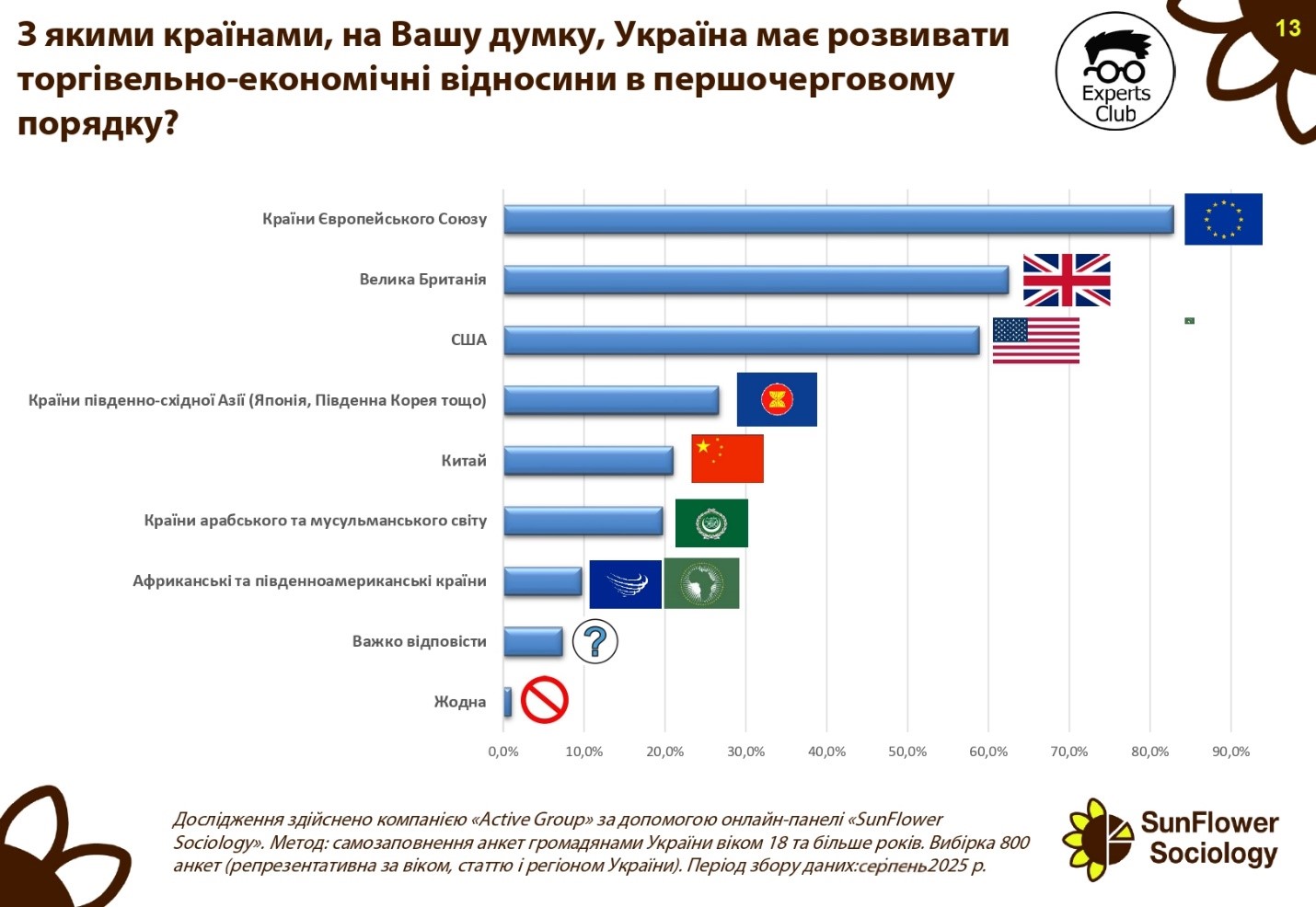
To a lesser extent, respondents are focused on partnerships with African and South American countries — this direction was supported by 14.8% of Ukrainians. Another 8.3% of respondents were undecided, and 1.0% believe that Ukraine does not need any new economic partnerships.
“These data clearly demonstrate the European and transatlantic orientation of Ukrainians in terms of economic priorities. The EU, the UK, and the US form the basis of foreign economic trust, while Asia and the Arab world are perceived as promising but secondary partners,” commented Active Group Director Oleksandr Pozniy.
According to Experts Club co-founder Maksim Urakin, the survey results confirm the real economic structure of Ukraine’s trade.
“The EU is already Ukraine’s main trading partner, accounting for over 40% of trade turnover, but if we analyze individual countries, China remains the leader. The high levels of support for cooperation with the UK and the US reflect society’s trust in Ukraine’s political and economic partners during this difficult period. At the same time, interest in Asia and the Arab world indicates the need to diversify markets and seek new opportunities in the future,” he stressed.
The survey was conducted using self-completed questionnaires among 800 Ukrainian citizens aged 18 and older. The sample is representative in terms of age, gender, and region.
ACTIVE GROUP, Arab countries, CHINA, EU, EXPERTS CLUB, GREAT BRITAIN, JAPAN, Pozniy, SOCIOLOGY, SOUTH KOREA, TRADE, UKRAINIAN ECONOMY, URAKIN, USA



