

The national postal operator, JSC “Ukrposhta,” plans to complete the installation of parcel lockers in its branches during the third quarter of this year, bringing the total number of express pickup lockers to 600, according to the company’s CEO, Ihor Smiliansky
“We are already seeing … demand, to the point where we don’t have enough lockers. That’s why we’re currently purchasing additional parcel lockers; we can see that people like this service,” Smilyansky said in a comment to the Interfax-Ukraine news agency.
The domestic parcel locker service currently covers 15 regions of the country, where 376 of the 600 express pickup lockers have been installed. It was noted that during the second quarter, the first 70 Ukrposhta parcel lockers were put into operation in Kyiv as part of a project to expand the self-service network.
As for street-based parcel lockers, he said that by the end of 2026, “Ukrposhta” plans to increase their number to several thousand.
Last week, the national postal operator announced that, in partnership with the Ukrainian company “Modern-Expo,” it is launching the production and installation of 1,000 new street-based parcel lockers, primarily in Kyiv, Odesa, Lviv, Dnipro, and other major cities across the country.
As previously reported, Ukrposhta posted a net profit of 296.7 million UAH for the second quarter of 2026, compared to a net loss of 108 million UAH in the same period of 2025.
According to the report, Ukrposhta has 7,200 customer service locations, including 2,000 mobile post offices that serve 21,300 settlements.

The network of branches of Ukrainian banks decreased by 38 branches in the second quarter of this year, following a reduction of 23 branches in the first quarter, and now stands at 4,754 branches, according to statistics from the National Bank of Ukraine (NBU).
According to the data, Oschadbank closed the most branches in the second quarter—10—reducing its network to 1,115, though it retained its lead in terms of total number of branches.
Due to the liquidation of Motor-Bank, all six of its branches ceased operations in the second quarter.
PrivatBank and Ukreximbank each closed five branches, bringing the networks of these state-owned banks to 1,050 and 18 branches, respectively.
From April through June, TAScombank (83 branches) and Kominbank (39) each closed three branches, while Ukrsibbank (214), Bank Credit Dnipro (31), and Oksi Bank (9) each closed two.
During the second quarter, Raiffeisen Bank (282), A-Bank (196), Poltava-Bank (70), Globus Bank (32), Radabank (32), Alliance Bank (30), Ukrainian Capital Bank (14), and the European Industrial Bank (6).
At the same time, Accordbank (177) opened five new branches, MTB Bank (47) opened two, and PUMB (220) opened one.
According to the National Bank, as of early July of this year, the largest branch networks in Ukraine were operated by the state-owned Oschadbank (1,115) and PrivatBank (1,050). They were followed, by a significant margin, by Raiffeisen Bank (282), PUMB (220), and Ukrsibbank (214).
The top five by number of branches also included Ukrgasbank (206), A-Bank (196), Akordbank (177), Sens Bank (137), and Credit Agricole Bank (124).
As of early July, the five banks with state ownership maintained a network of 2,526 branches, accounting for 53.1% of the total number of branches.
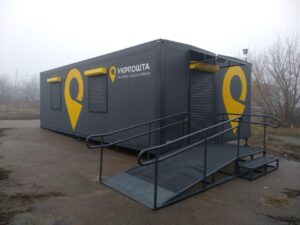
JSC “Ukrposhta” has completed the installation of 38 modular branches in 16 regions, including Kharkiv, Kherson, Zaporizhzhia, Sumy, Chernihiv, Mykolaiv, and Dnipropetrovsk regions, the company’s CEO, Ihor Smilianskyi, announced on Telegram.
According to a press release published by Ukrposhta, the project was implemented thanks to financial support from the European Bank for Reconstruction and Development (EBRD), which allocated EUR 600,000 in the form of an investment grant from the Special Crisis Response Fund.
“At these branches, local residents can receive pensions and social benefits, order medications through the ‘Ukrposhta.Apteka’ service, receive and send packages and letters, pay for utilities, and use financial services,” Smiliansky noted.
The CEO of the postal operator noted that out of the 40 modular branches installed, two were destroyed during the project’s implementation in the Sumy and Donetsk regions.
It is noted that, depending on the number of residents in the community, the company installed two types of modules. Specifically, there are 25 branches with an area of 22 square meters and another 13 with an area of 45 square meters.
These branches are equipped with ramps for people with limited mobility, autonomous heating systems, and the ability to connect to backup power sources to operate during blackouts.
Smilyansky also added that the number of modular branches will continue to grow in the future, funded entirely by Ukrposhta’s own resources.
In total, during the full-scale invasion, 49 of the company’s permanent branches were completely destroyed, and another 648 facilities were damaged.
Over the past month, “Ukrposhta” has also recorded damage to one branch almost every day.
“In recent weeks, we have once again seen how important it is to quickly resume operations. The enemy destroyed our logistics hub in Kharkiv, and after the attack on Kyiv, only a crater remained where the branch in Troyeshchyna used to be. Every day, other facilities come under fire,” the CEO of Ukrposhta is quoted as saying in the press release.
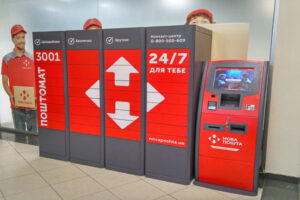
Nova Poshta, Ukraine’s leading express delivery service and a member of the NOVA Group, opened 2,600 new parcel lockers, 36 branches, and 329 parcel pickup and drop-off points in the first quarter of 2026, according to a company statement released on Tuesday.
It is noted that the new-format branches in residential complexes became the most popular: 21 of the 36 branches were opened there.
Most branches during the first quarter appeared in the Kyiv and Lviv regions, as well as in the frontline Zaporizhzhia region.
“During the first quarter, 19 branches changed their locations to make using Nova Poshta’s services even more convenient,” the release quotes Anna Fedchenko, head of Nova Poshta’s network development planning department.
According to Artur Kudelin, director of Nova Poshta’s parcel locker department, the company recently opened a parcel locker facility with 26 sections and 286 lockers.
“In addition, we are adding new stacks to existing parcel lockers—where there is sufficient demand and technical feasibility. We have already expanded 445 locations in this way,” said Kudelin.
It is noted that the company currently operates 36,700 parcel lockers nationwide.
Nova Poshta added that by the end of 2026, it plans to expand its network of parcel lockers by 6,000 units and open 300 mini-branches across the country.
In late March, in a comment to the Interfax-Ukraine agency, the company’s Director of Customer Service, Maksym Melezhik, announced plans to open approximately 300 branches in residential complexes by 2026.
Overall, Nova Poshta plans to expand its network of service points from 51,500 to 60,000 by 2026, including up to 40,000 parcel lockers, Melezhik shared during the Nova Summit in Kyiv.
In 2025, the company increased its revenue by 21% compared to 2024—to over 54 billion UAH, with its profit reaching 2.6 billion UAH compared to 2.5 billion UAH the previous year. The number of parcels and shipments delivered over the year grew by 7.4%—from 486 million to 522 million, including international shipments—by 52.6%, from 19 million to 29 million.

Nova Post Europe, part of the NOVA Group, plans to double its network of branches in Europe by 2026 and keep its strategy focused on ensuring maximum delivery speed, said Vyacheslav Klimov, co-owner of the express delivery leader Nova Post.
“I believe Nova Post is the only company capable of delivering a package from Berlin to Warsaw the next day. Accessibility—we already have more than 300 branches across Europe. And we will continue this expansion in 2026: by 2026, the network will double,“ Klimov said at the ”Dialogues with NV” event dedicated to European integration in Kyiv on Thursday, according to a correspondent for the Interfax-Ukraine news agency.
According to him, the company has achieved its greatest success in Moldova, and overall, Nova Post is already operating profitably in 5 out of 16 markets, even though the first European branch in Warsaw was opened only in October 2023.
“None of the 16 markets we’ve entered behave the same way. At least in our business, the essence of the European Union is that it is by no means a unified structure in terms of consumer habits: every country has local leaders—very tenacious and very strong. And in each of these markets, you have to make local decisions. That is, think globally, but work and think about how to satisfy the consumer exclusively locally,” Klimov emphasized.
He added that in the global market, no one cares about a company’s origin, so you can only win the competition by offering faster, more accessible, and more reliable services.
Among the obstacles to development, the founder of the NOVA Group cited the National Bank of Ukraine’s limit on financing business abroad at $1 million per month.
Klimov also views as a risk the fact that combining European requirements with Ukrainian bureaucratic procedures could create additional difficulties for the development of Ukrainian business; among other things, he is cautious about the requirements to establish a transport regulator in Ukraine.
Nova Post Europe processed 13 million international shipments in 2025 and plans to increase this volume by over 30% in 2026 and maintain this pace through 2030, Nova Post Europe CEO Oleksandr Lysovets previously stated in an interview with Forbes Ukraine. According to him, these plans will be supported by a new phase of European expansion with investments exceeding $5 million.
The main activity of Nova Poshta, the core asset of the NOVA Group, is express delivery of documents, parcels, and palletized oversized cargo. Its ultimate beneficial owners are Volodymyr Poperechnyuk and Klimov.

Carlsberg Ukraine (Zaporizhia), a producer of beer, non-alcoholic and alcoholic beverages, is closing its offices in Kharkiv, Odesa, and Donetsk, the company reported in the information disclosure system of the National Securities and Stock Market Commission (NSSMC).
According to the report, the company’s supervisory board made the decision on February 25, 2026.
The reasons given for the liquidation of the divisions are the lack of need for their further operation, lack of personnel, management, and property. In addition, the representative offices did not actually carry out activities corresponding to the purpose of their creation.
The functions of these separate divisions were to protect and represent the company’s interests in the respective regions.
According to data from Opendatabot, Carlsberg Ukraine increased its revenue by 15.5% to UAH 12.488 billion in 2024, net profit by 19.4% to UAH 2.18 billion, debt obligations by 34.9% to UAH 5.11 billion, and assets by 33.1% to UAH 13.84 billion. The company currently employs 1,310 people.
The closure of Carlsberg Ukraine’s separate representative offices does not mean a reduction or curtailment of the company’s activities in the regions.
The separate representative offices were established in the early 2000s during a period of active investment in production facilities in Kyiv, Lviv, and Zaporizhzhia. Today, given current operating models, there is no need to maintain separate legal representative structures.
At the same time, Carlsberg Ukraine continues to operate throughout Ukraine. Our production sites in Kyiv, Lviv, and Zaporizhzhia are operating as usual. The sales teams continue to ensure the company’s full presence in all regions of the country, providing continuous service to partners and customers.
The change in the number of representative offices does not affect the company’s strategic course for development and investment in Ukraine. Since the start of the full-scale invasion, the Carlsberg Group has already invested nearly DKK 400 million to support operational stability and the development of Ukrainian business. The company remains consistent in its long-term presence in the country.
We are transforming to work more efficiently, but we remain a reliable employer, a responsible business, and one of the largest taxpayers in Ukraine.
Carlsberg Ukraine is part of the Carlsberg Group, one of the world’s leading brewery groups with a broad portfolio of beer, cider, and non-alcoholic beverage brands. In Ukraine, we represent such brands as Lvivske, Carlsberg, Grimbergen, Kronenbourg 1664, Arsenal, Kvas Taras, Somersby, Battery, Seth&Riley’s Garage, and others. The Carlsberg Group began operations in Ukraine in 1996 and has been one of the largest international investors in the FMCG sector year after year, providing jobs for more than 1,400 people at breweries in Kyiv, Lviv, and Zaporizhia, and more than 23,000 jobs in related industries (agriculture, retail, hotel and restaurant business, media, logistics, etc.). During the full-scale war in Ukraine, Carlsberg Group decided to cease its business in Russia and exit the market. With the support of the Carlsberg Group, Carlsberg Ukraine has implemented more than 50 humanitarian projects worth over UAH 530 million, including the production of drinking water to meet the needs of the population.
More detailed information is available on the website https://carlsbergukraine.com/.



