

The Ukrainian Red Cross (URC) has launched mine risk education sessions for children at summer camps.
“The first sessions have already taken place in the city of Samar in the Dnipropetrovsk region at a local high school, where Ukrainian Red Cross specialists, together with inspectors from the Educational Safety Service, held an interactive session for children at the summer camp,” the URC reported on Facebook on Monday.
During the session, participants learned how to identify potentially dangerous objects, studied safety protocols, practiced practical scenarios, and reinforced the golden rule: “Don’t approach, don’t touch, call 101 or 102.”
Throughout the summer, similar informational sessions will be held at summer camps and children’s centers across all regions of Ukraine.

The European Commission may present legislative proposals as early as summer 2026 to restrict minors’ access to social media. This was announced by European Commission President Ursula von der Leyen while speaking at a democracy summit in Copenhagen.
According to Reuters, von der Leyen said that the European Commission is stepping up measures to protect children from the “addictive design” of digital platforms, including TikTok, Meta, Facebook, Instagram, and X. She linked excessive social media use by teenagers to risks related to sleep, mental health, anxiety, cyberbullying, and other threats to young people.
However, this does not involve an immediate shutdown of social media platforms or a temporary suspension of their services for all users. Primary sources mention a possible “social media delay” for children, meaning a delay or restriction on the age at which minors can independently use social media. Euronews reports that the European Commission may present plans for a Europe-wide ban or age restriction for children as early as this summer.
The European Commission has already established a special panel of experts on children’s online safety. According to official EC documents, by the summer of 2026, the panel’s co-chairs are to present von der Leyen with recommendations on protecting children online, including possible harmonized age restrictions for access to social media and other online services.
Digital age verification will be a separate element of the future policy. In April 2026, the European Commission held the second meeting of the special panel, dedicated to current rules for protecting minors online and EU initiatives in this area. Reuters also reported that the EU has already developed an age verification app designed to help restrict children’s access to inappropriate content and services.
The new proposals could become part of a broader EU digital policy, including the Digital Services Act and the future Digital Fairness Act. The EU is currently investigating major platforms regarding the protection of minors, advertising transparency, researchers’ access to data, and the use of mechanisms designed to capture users’ attention.

Why not all children can be removed from state custody
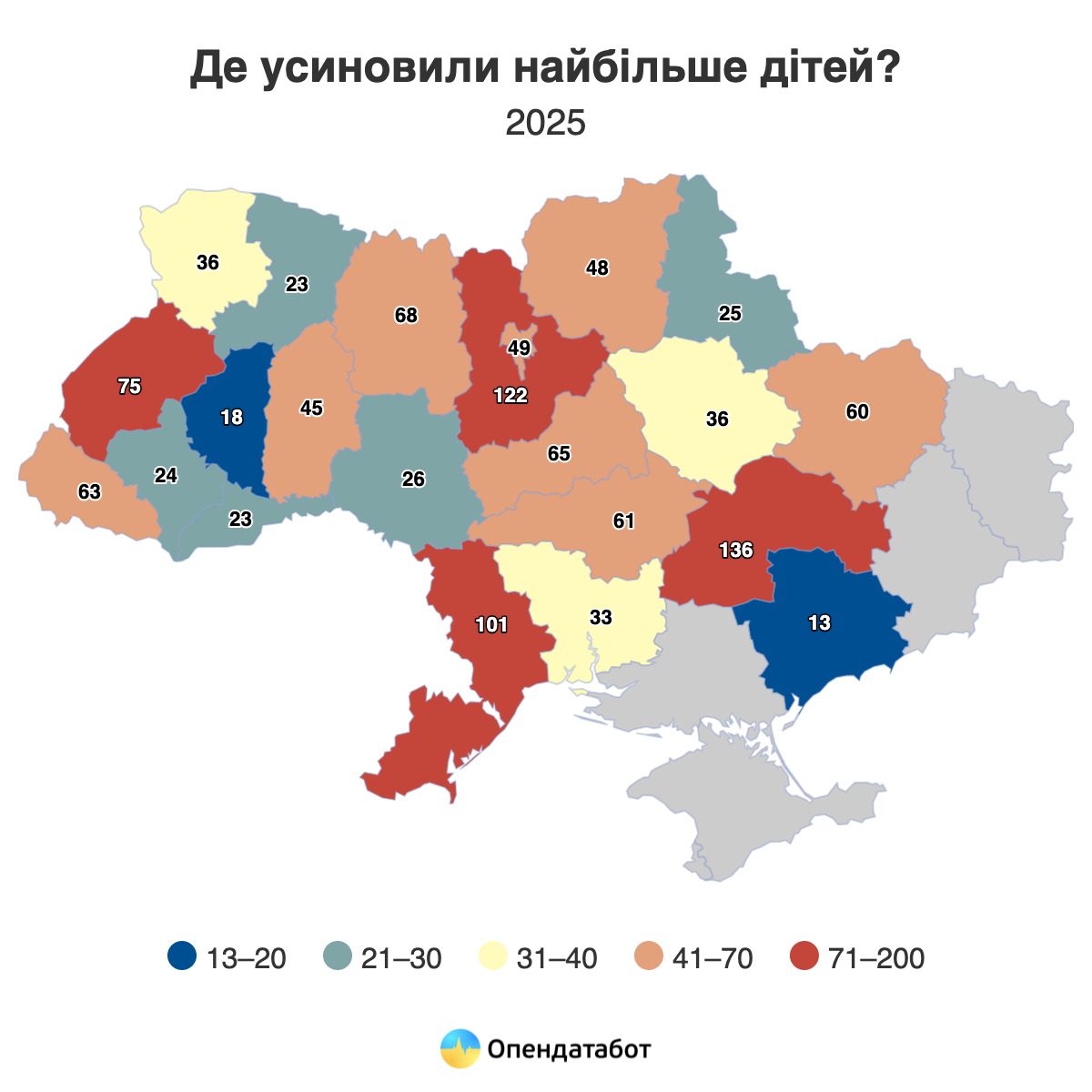
According to the State Service of Ukraine for Children’s Affairs, there were 59,350 orphans and children deprived of parental care in Ukraine as of the end of 2025. This is 4% fewer than in 2024. At the same time, 2,097 prospective adoptive parents are currently registered. On average, there are about 28 children per prospective adoptive parent; however, 1,150 children were placed with new families, and another 6,600 children were placed in foster care last year. The highest number of adoptions and, at the same time, the highest number of children in state care are in the Dnipropetrovsk region.
There were 59,350 orphans and children deprived of parental care in Ukraine as of the end of 2025. This is 4% fewer than in 2024. Overall, the number of such children decreases by an average of 3% each year.
One-third of all these children—20,705—are orphans, meaning those who have lost both parents. The other children are deprived of parental care for various reasons—and by no means all of them can be legally adopted.
“Of the 60,000 children in residential care facilities, only about 5,000 have the status that allows them to be adopted. The rest are so-called social orphans: they have parents or legal guardians, but for various reasons live in institutional facilities. Consequently, they cannot formally be adopted,” notes lawyer and adoptive parent Inna Miroshnychenko
The overall picture is that the number of people wanting to adopt a child is increasing year by year. However, 2025 was an exception: the number of applicants decreased by 13% over the year. In total, 2,097 prospective adoptive parents are currently registered in Ukraine. 77% of them, or 1,619 adoptive parents, are married couples. However, there are still 479 single individuals who wish to take on the responsibility of caring for a child.
Nearly half of all applicants are people between the ages of 40 and 50. Another 41% are under 40, and only 10% are over 50.
The largest number of candidates live in Kyiv (244) and the Kyiv region (224). There are also many adoptive parents in the Lviv and Dnipropetrovsk regions—191 and 182 candidates, respectively.
Despite this, the number of adoptions in 2025 decreased. Last year, 1,150 children found new families. This is 10% fewer than in 2024, when a record number of children were adopted since the start of the full-scale war—1,273 children.
“The adoption procedure itself is fairly clear, understandable, and not overly complicated in formal terms, but it takes a long time. Another major barrier is the territorial system for matching children: an applicant registers in their district and receives information only about children registered there. Previously, this problem was partially solved by the Ministry of Social Policy’s database, where one could view children who had not been placed locally; however, this tool is no longer operational, and as a result, applicants often simply cannot find ‘their’ child,” explains attorney and adoptive parent Inna Miroshnychenko.
The lawyer also notes that a significant portion of the children in the system are not single children but large family groups: three, five, sometimes even more brothers and sisters. They cannot be separated, whereas most prospective adoptive parents are willing to take in one child, at most two. Only a few are willing to take three or four at once.
“Many adoptive parents are looking for a physically healthy child, of whom there are very few in the system. It is important to understand that children end up in residential care facilities not because they have it easy: they may have health or developmental issues caused by difficult conditions in their biological families and in residential care facilities. Also, for most prospective adoptive parents, the child’s age is important—they mostly look for young children of preschool age. However, most of the children in the system who are available for adoption are older children, often teenagers,” comments Inna Miroshnychenko.
Dnipropetrovsk Oblast has led in the number of adoptions for three years in a row—136 children found new families last year. Next are Kyiv Oblast (122 children) and Odesa Oblast (101 children). At the same time, Dnipropetrovsk Oblast has the highest number of orphans and children without parental care—7,397 children.
In addition to adoption, children are also placed in foster care or under guardianship. Thus, 6,627 children found new families in this way in 2025. This is 7% less compared to 2024.
https://opendatabot.ua/analytics/orphans-adoption-2026


The level of emotional stress among Ukrainian children continues to rise amid the war unleashed by Russia: in 2025, it reached 37%, with the 10-13 age group being the most vulnerable, among whom 40% of children have shown increased emotional distress, reported Viktor Mykyta, Deputy Head of the Office of the President of Ukraine.
“The war unleashed by Russia is worsening the mental state of Ukrainian children every year… Experts have found that children who have active interests outside of gadgets—such as team sports, particularly soccer, active group activities, intellectual games, and so on—demonstrate the highest stress resilience,” Mykyta stated in a Telegram post.
According to the information, last year the level of stress among children rose by 10%, while in 2025 this figure has already reached 37%. The highest rates were recorded among children aged 10–13—40% of them are experiencing increased emotional tension.

The Director General of the Ukrainian Red Cross (URC), Maksym Dotsenko, and the Minister of Foreign Affairs of Ukraine, Andriy Sibiga, discussed assistance to communities and children.
“During the meeting, the parties focused on the practical results of humanitarian initiatives that have already been implemented and on further expanding cooperation in the context of full-scale Russian aggression against Ukraine,” the UCC reported on its official Facebook page.
Among the key topics of discussion were the health and recreation of Ukrainian children abroad. This primarily concerns the children of military personnel, deceased and missing defenders, as well as children from frontline regions.
With the assistance of the Ukrainian Red Cross, more than 700 children were able to recover and relax outside Ukraine last year. The first trips for children took place in early 2026, and the program continues to expand. In the near future, it is planned to organize recreation for children from regions subject to constant shelling, in particular the Sumy and Chernihiv regions.
During the meeting, the parties also discussed support for the energy sustainability of communities and assistance to the population during the winter period.
A separate vector of dialogue was the prospects for the development of humanitarian cooperation outside Ukraine.

A week-long program for a group of children from the Zaporizhzhya region of Ukraine has started in Kotor, Montenegro. According to Boka News, 36 children arrived in the city, many of whom lost their parents to the war. The visit was agreed between Kotor Mayor Vladimir Jokic and Ukrainian Ambassador to Montenegro Oleg Gerasimenko. The program is scheduled for November 3-10.
At the reception in the Bisanti Chamber, the mayor welcomed the children and said that a cultural and educational itinerary has been prepared for them: a walk through the Old Town and a visit to the Maritime Museum, a trip to Perast and a boat trip on Boka Kotorska Bay, as well as meetings with peers in local schools. A climb of the city walls, a day trip to Lovcen and a vacation on Plavi Horizonte beach are planned.
The teachers accompanying the group thanked the residents and authorities of Kotor for their hospitality, noting the importance of emotional relief and safety for the children. Publications in local media and social networks specify the number of the group and dates of stay



