

Ukraine’s Cyber Police have urged citizens not to use the services of dubious intermediaries who offer, via the internet, to exchange old paper driver’s licenses for modern documents without visiting Ministry of Internal Affairs service centers.
According to law enforcement officials, scammers post offers on social media and messaging apps, promising to issue a new license entirely online. To do this, they may demand an advance payment, as well as photos of the passport, driver’s license, and other documents.
As a result, citizens risk not only losing money but also receiving a counterfeit license, the details of which are not recorded in government registries, the Driver’s Cabinet, or the “Diya” app. Furthermore, copies of documents provided to scammers may later be used for other illegal activities.

The Cyber Police remind the public that paper-booklet-style driver’s licenses issued in Ukraine before 1991 remain valid within the country. There is no mandatory requirement to replace them. If you wish to obtain a modern-style license, you must contact a Ministry of Internal Affairs service center and complete the official procedure.
Law enforcement officials list the following as signs of potential fraud: communication exclusively via messaging apps; promises to issue a license entirely online; offers to “enter data into the database” without following the official procedure; demands to transfer an advance payment to a private bank card; and requests to send photos of a passport or other documents.
You should exercise particular caution if the person you’re communicating with claims to be an employee of the Ministry of Internal Affairs service center but suggests conducting all procedures via social media or a private chat.

Official government services are not provided through random social media pages and do not require you to share personal documents with unknown individuals, the Cyber Police emphasize.
If a citizen discovers a suspicious post or has already sent money or personal information to scammers, law enforcement recommends saving the correspondence, links, phone numbers, and other evidence, and then contacting the police or submitting an online report via the Cyber Police website.
Additional information on common scams is available on the “Kyber Brama” portal, and official information on driver’s license exchanges can be found on the website of the Ministry of Internal Affairs’ Main Service Center.
Source: Cyber Police of Ukraine.
CYBER POLICE, Driver, fraud, Ministry of Internal Affairs, UKRAINE

According to the Serbian business publication Parametar, trucking companies in Serbia, Bosnia and Herzegovina, Montenegro, and North Macedonia are demanding that the European Union propose a concrete solution by September 1, 2026, to the problem of restrictions on professional drivers’ stays in the Schengen Area. Otherwise, the carriers are prepared to stage coordinated protests again and block freight terminals at the borders with the EU.
The decision was agreed upon by representatives of transport associations from the four countries at a regional meeting in Skopje. However, September 1 is not automatically the start date for the blockade. The carriers intend to wait for negotiations with the European Commission and discussions on the EU’s new visa strategy, after which they will decide on further actions.
The carriers’ main complaint concerns the 90/180 rule. Third-country nationals who benefit from the visa-free regime may stay in the Schengen Area for no more than 90 days within any 180-day period. This restriction also applies to professional drivers from the Western Balkans.
Carriers consider this approach unfair, since drivers do not enter the EU as tourists but regularly cross the border while delivering international cargo and return to their home countries after their trips.
“Our drivers leave every two, three, or five days, depending on the route, and then return. They don’t want to leave their home countries; they want to work for our companies. But 90 days isn’t enough for professional work,” said Nejo Mandić, president of the Serbian Association of International Carriers.
According to estimates by regional transport organizations, the problem affects about 100,000 professional drivers in four countries. Stricter enforcement of the limit has become particularly noticeable following the introduction of the European Entry/Exit System (EES), which automatically records the entry and exit of third-country nationals.
There is already a precedent for this threat to carriers. In late January 2026, drivers from Serbia, Bosnia and Herzegovina, Montenegro, and North Macedonia simultaneously blocked more than 20 freight crossings into the Schengen Area. The borders between Serbia and Bosnia and Herzegovina with Croatia, between North Macedonia and Greece and Bulgaria, as well as the port of Bar in Montenegro, were blocked.
The economic impact was significant. Marko Čadež, president of the Serbian Chamber of Commerce and Industry, estimated at the time that the blockade affected about 93% of the four countries’ exports, with total losses amounting to approximately 92 million euros per day.
According to his assessment, individual companies faced fines and losses of 10,000–50,000 euros per day per company due to their inability to fulfill contractual obligations. Moreover, the problems were not limited to Balkan manufacturers—European companies with factories, suppliers, and customers in the region also suffered from the delays.
If a new regional blockade were to occur on a similar scale, economic losses could again amount to tens of millions of euros daily.
For Serbia, the most vulnerable sector is the industry oriented toward European supply chains. Automotive components, electrical equipment, rubber products, metal products, food, and other goods are often transported by truck on a scheduled basis and must reach the customer at a strictly defined time.
Even a brief halt in traffic leads to a buildup of cargo in warehouses, disruptions to production cycles, and the risk of penalties from European buyers.
A prolonged blockade is particularly dangerous for manufacturers of perishable goods. During the January protests, carriers reported that Lidl alone had planned to deliver approximately 120 truckloads of meat, dairy products, fruits, and vegetables from Europe to Serbia within a single week. The traffic blockade directly threatened these deliveries.
The transport companies themselves are suffering double losses: while a truck is idle, it continues to incur costs for leasing, driver salaries, insurance, and other payments, but generates no revenue. Industry associations also warn that the inability to fully utilize drivers on EU routes could lead to the loss of contracts to carriers from EU countries.
The economic damage will not be limited to the Western Balkans. A significant portion of businesses in Serbia, North Macedonia, and Bosnia and Herzegovina are directly integrated into the production chains of EU companies.
Delays in the supply of components could affect factories in Germany, Italy, Austria, Slovenia, Hungary, and other countries. The reverse flow of European goods to the Balkans is also coming to a halt.
In addition, an important land transport corridor connecting Central Europe, Turkey, and onward to the Middle East runs through Serbia and North Macedonia. During the January protests, Reuters noted that the blockade was disrupting traffic along precisely this strategic route.
Following the January protests, the European Commission acknowledged that the established regime creates problems for highly mobile professions, particularly international drivers, artists, and athletes. The EU’s new visa strategy, adopted in January, provides for the possibility of finding a more flexible mechanism for these categories of workers.
However, an automatic exemption for professional drivers from the 90/180 rule has not yet been implemented.
Carriers are insisting on either special status for international drivers or a system of professional visas or other permits that would allow them to stay in the Schengen Area for more than 90 days without the risk of detention, deportation, or a travel ban.
Thus, September 1 becomes a key date for the Western Balkans’ transport market. If Brussels proposes a workable mechanism for professional drivers, a new blockade can be avoided. If an agreement cannot be reached, carriers from the four countries have already agreed on the possibility of joint action.
The issue of restrictions on professional drivers’ stays in the Schengen Area also affects Ukraine.
Ukrainian long-haul truck drivers employed by carriers registered in Ukraine, when entering the Schengen Area under the visa-free regime, are also generally subject to the 90-day rule within an 180-day period, unless they hold a separate long-term status or a residence permit. In its visa strategy dated January 29, 2026, the European Commission explicitly acknowledged that the current system creates problems for mobile professions, specifically mentioning truck drivers who serve EU businesses.
At the same time, the EU-Ukraine Road Transport Agreement, in effect until March 31, 2027, simplifies access for Ukrainian carriers to the EU market and eliminates the need for a number of permits for bilateral and transit transport, but does not in itself constitute an exception to Schengen migration rules.
Therefore, Ukraine has a genuine interest in the very same solution demanded by carriers in the Western Balkans: to distinguish between a professional driver’s working hours on an international route and a regular tourist stay, or to establish a special regime for such drivers.

The number of drunk driving cases has decreased for the first time in five years.
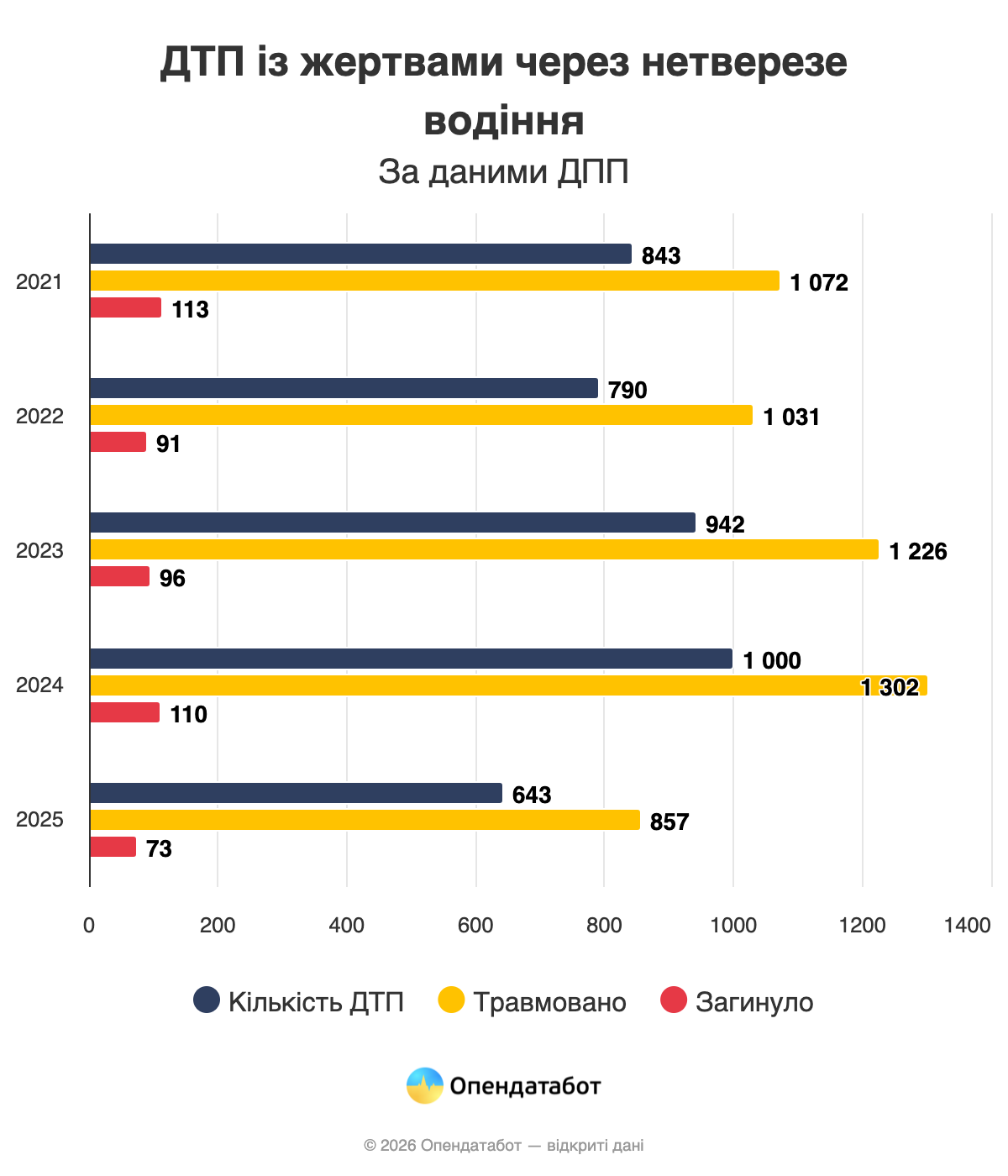
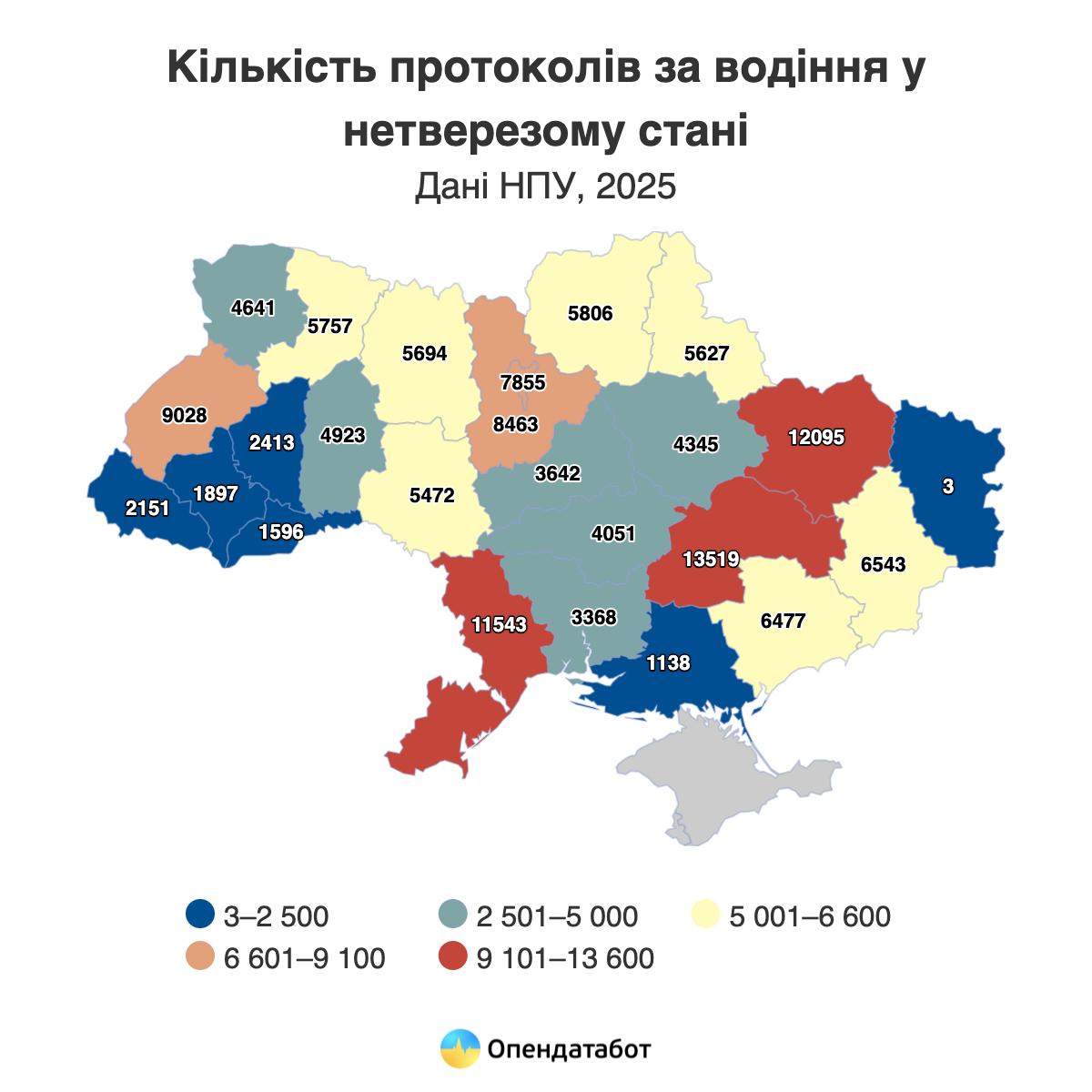
The National Police of Ukraine recorded more than 138,000 reports of drunk driving in 2025. The number of such reports has decreased for the first time in five years. The highest number of drunk drivers is in the Dnipropetrovsk, Kharkiv, and Odesa regions. Last year, the Prosecutor General’s Office of Ukraine opened more than a thousand criminal proceedings for drunk driving. In total, every 40th traffic accident with fatalities or injuries was caused by drunk drivers in 2025. 73 people were killed and 857 were injured in such accidents.
138,047 reports for drunk driving (Article 130 of the Code of Administrative Offenses) were recorded last year. This is 8% less than in 2024. Last year was an exception, as the number of drunk drivers has only been increasing in recent years.
However, this trend does not apply to the whole country: in four regions, the number of drunk driving cases has actually increased. There was a noticeable increase in Rivne region (+19%), followed by Khmelnytskyi region (+18%), Kharkiv region (+8.5%), and Zaporizhzhia region (+3%).
Overall, the highest number of drunk drivers was recorded in Dnipropetrovsk region — 13,519 cases. Kharkiv region also made it into the top three with 12,095 cases, followed by Odesa region with 11,543 reports.
The lowest number of reports was recorded in Kherson region with 1,138 cases, followed by Chernivtsi (1,596) and Ivano-Frankivsk (1,897) regions.
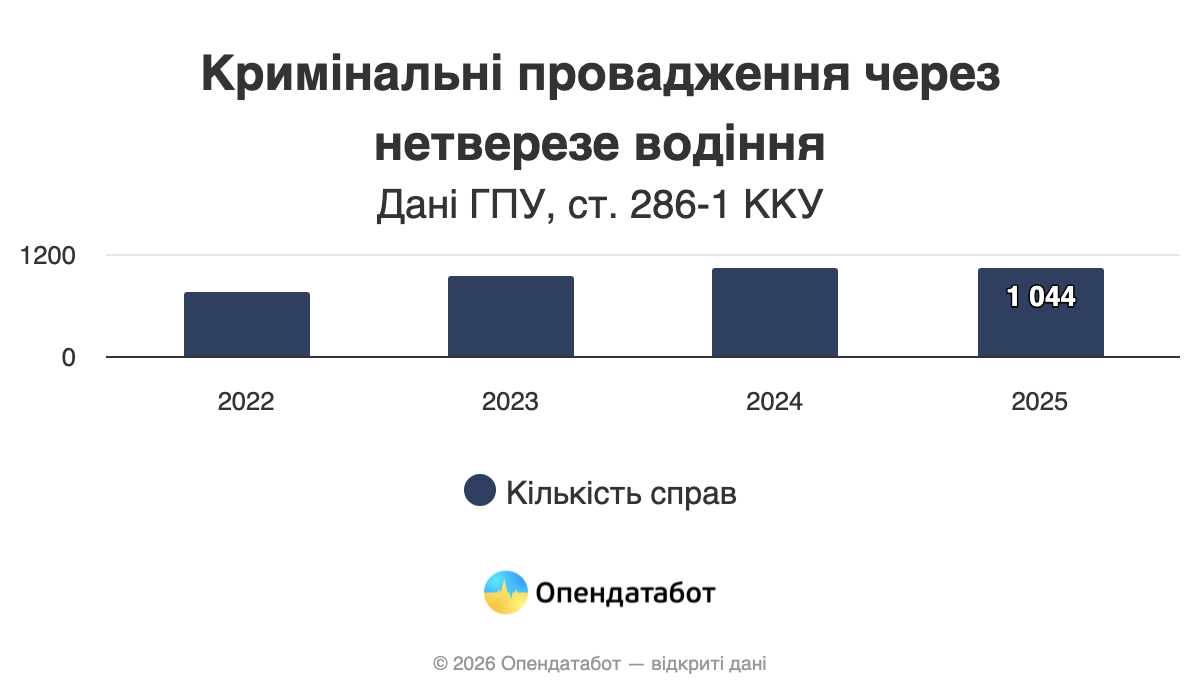
At the same time, in 1,044 cases of drunk driving, criminal proceedings were opened under Article 286-1 of the Criminal Code, according to data from the Prosecutor General’s Office. Last year, 59% of cases went to court.
A total of 643 traffic accidents with fatalities or injuries were caused by drunk drivers last year — such accidents also decreased by a third. Seventy-three people died and another 857 were injured as a result of these accidents. Every 40th traffic accident with fatalities and/or injuries was related to drunk driving, while in 2023 and 2024, this figure was every 25th accident.
https://opendatabot.ua/analytics/drunk-dtp-2025

The Ukrainian state postal service enterprise Ukrposhta (Kyiv) announced a tender for compulsory insurance of drivers against transport accidents on January 31, according to the ProZorro electronic public procurement system.
According to the system, the expected cost of the services is UAH 771.375 thousand.
The deadline for submitting bids is February 8.
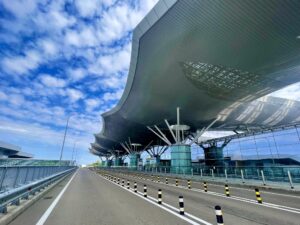
On September 26, Boryspil International Airport (Kyiv) announced a tender for compulsory insurance of drivers against transport accidents.
According to the electronic public procurement system Prozorro, the expected price offer was UAH 43,972 thousand.
Applications for participation in the tender are accepted until October 4.
As reported, the winner of a similar tender a year earlier was Guardian Insurance Company.
Boryspil International Airport accounts for over 68% of Ukraine’s passenger air traffic and is the only Ukrainian airport that serves long-haul flights. More than 50 airlines operate regular flights from the airport to more than 100 routes around the world.



