
The Cyber Police of Ukraine have warned of a new fraud scheme in which perpetrators distribute malicious applications disguised as free offline navigation apps that can gain access to users’ personal data and banking services.
According to the Cyber Police, potential victims are offered a navigation app that supposedly works without an internet connection, contains no advertising and is available free of charge. Advertisements for such applications are distributed primarily through social media.
After clicking on an advertisement, users are redirected to a third-party website where they are offered a program to download, including through a Telegram bot. Instead of the advertised navigation app, a malicious file may be installed on the smartphone.
During installation, the program requests permission to download applications from unknown sources, as well as access to certain smartphone functions. After obtaining these permissions, perpetrators can track the device owner’s actions, intercept messages and notifications, and obtain confidential information.
The malicious program’s access to SMS messages and system notifications poses a particular threat. The information obtained may be used to intercept verification codes and access the user’s accounts and financial services.
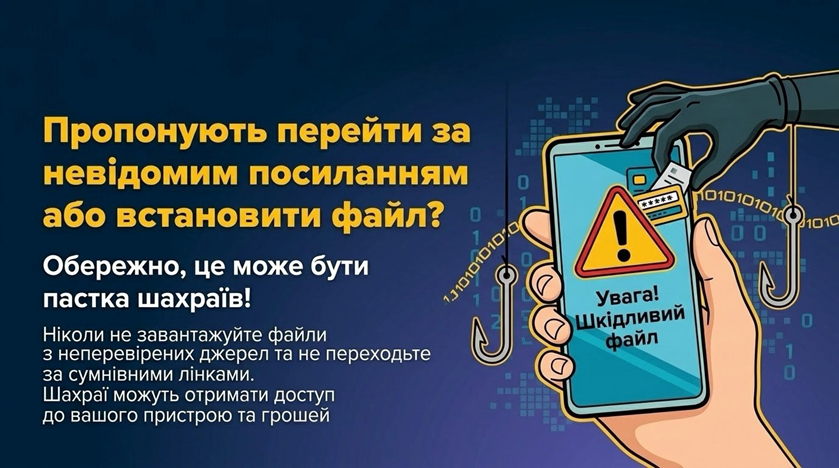
The Cyber Police recommend installing mobile applications exclusively from the official Google Play and App Store marketplaces and not downloading APK files through Telegram bots, unknown websites or advertising links.
Users are also advised to carefully check the permissions requested by an application. In particular, a navigation program should not gain access to SMS messages, notifications or device management functions without an objective need.
If a suspicious application has already been installed, specialists recommend temporarily refraining from using banking and other critically important services on that smartphone, disconnecting the device from the internet and changing the passwords for primary accounts from another secure device.
The suspicious program should be removed, and the permissions granted to it should be checked. If the application cannot be removed or continues to run in the background, seeking technical assistance is recommended.
If banking details have been disclosed or unknown transactions appear, users must immediately contact their bank to block possible unauthorized access to their accounts. Cases of fraud can be reported to the Cyber Police through their official online form.
The Cyber Police also recommend checking information about current fraud schemes on the government platform StopFraud.
Source: Cyber Police of Ukraine
APPLICATION, BANK, CYBER POLICE, CYBERSECURITY, fraud, smartphone
Ukraine’s Cyber Police have warned citizens about a scam involving fake electricity bills, which may be sent via email or messaging apps purportedly on behalf of the Ministry of Energy or other government agencies.
According to the statement, scammers may inform recipients of alleged outstanding balances, send payment invoices, or demand immediate payment. To make their messages more convincing, they use official logos, the names of government agencies, and formatting that resembles genuine communications.
The main goal of the attackers is to trick users into clicking a link to a phishing website. There, they may be asked to enter their credit card information, username, password, SMS verification code, or other personal information. Malware may also be distributed under the guise of a bill or document. As a result, scammers can gain access to bank accounts, email, social media, and other accounts.
The Cyber Police emphasize that the Ministry of Energy of Ukraine does not send electricity bills to consumers and does not collect utility payments. Bills are issued directly by the electricity suppliers with whom consumers have signed contracts.
Signs of a fraudulent message may include a demand for immediate payment via a link provided, information about a non-existent debt, a sender’s email address that does not belong to an official institution, a request to enter bank details or a password, as well as unknown attached files.
Grammatical errors, unusual phrasing, and attempts to create a sense of urgency should also raise red flags.
It is recommended to verify information about electricity payments only through your provider’s official website or app. The cyber police advise against clicking on links in suspicious emails and against entering personal or banking information on websites linked to via email or messaging apps.
If a user has already clicked on a suspicious link, entered banking information, or lost funds, they should contact their bank as soon as possible to block their payment instruments. It is also important to save the correspondence, links, phone number, and other evidence to report the incident to law enforcement.
Additional information about current fraud schemes and ways to protect yourself can be found on the “Cyber Brama” portal at stopfraud.gov.ua.

Ukraine’s Cyber Police have urged citizens not to use the services of dubious intermediaries who offer, via the internet, to exchange old paper driver’s licenses for modern documents without visiting Ministry of Internal Affairs service centers.
According to law enforcement officials, scammers post offers on social media and messaging apps, promising to issue a new license entirely online. To do this, they may demand an advance payment, as well as photos of the passport, driver’s license, and other documents.
As a result, citizens risk not only losing money but also receiving a counterfeit license, the details of which are not recorded in government registries, the Driver’s Cabinet, or the “Diya” app. Furthermore, copies of documents provided to scammers may later be used for other illegal activities.

The Cyber Police remind the public that paper-booklet-style driver’s licenses issued in Ukraine before 1991 remain valid within the country. There is no mandatory requirement to replace them. If you wish to obtain a modern-style license, you must contact a Ministry of Internal Affairs service center and complete the official procedure.
Law enforcement officials list the following as signs of potential fraud: communication exclusively via messaging apps; promises to issue a license entirely online; offers to “enter data into the database” without following the official procedure; demands to transfer an advance payment to a private bank card; and requests to send photos of a passport or other documents.
You should exercise particular caution if the person you’re communicating with claims to be an employee of the Ministry of Internal Affairs service center but suggests conducting all procedures via social media or a private chat.

Official government services are not provided through random social media pages and do not require you to share personal documents with unknown individuals, the Cyber Police emphasize.
If a citizen discovers a suspicious post or has already sent money or personal information to scammers, law enforcement recommends saving the correspondence, links, phone numbers, and other evidence, and then contacting the police or submitting an online report via the Cyber Police website.
Additional information on common scams is available on the “Kyber Brama” portal, and official information on driver’s license exchanges can be found on the website of the Ministry of Internal Affairs’ Main Service Center.
Source: Cyber Police of Ukraine.
CYBER POLICE, Driver, fraud, Ministry of Internal Affairs, UKRAINE
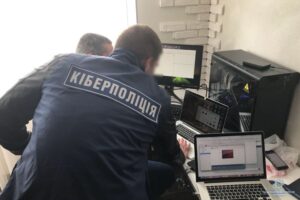
Employees of the Cyber Police Department together with the investigation department of the Kyiv region police and bank security officers have exposed a group of malefactors who issued credit cards and loans to servicemen who had been captured or considered missing, the press service of the National Police of Ukraine reported.
“It was established that three people received data on mobile numbers of military personnel with whom their relatives have lost contact or are in captivity. Attackers carried out the reissue of SIM-cards and checked whether the reissued numbers are financial. Then they gained access to online banking. From the accounts of defenders transferred the balance of money, as well as issued credit cards and embezzled loan amounts”, – was stated in the report.
According to preliminary data, the group managed to get access to mobile numbers of more than 20 servicemen in captivity or missing. The total amount of damage is more than 2 million hryvnias.
During a search in the homes of the defendants law enforcement officers seized bank cards, SIM-cards, cell phones, which were used in illegal activities.
Also police found grenades. They were sent for examination.
The organizer of the criminal group was detained. He is suspected under part 3 of article 190 (fraud) of the Criminal Code of Ukraine.
After the events will be provided legal qualification of the actions of all defendants.
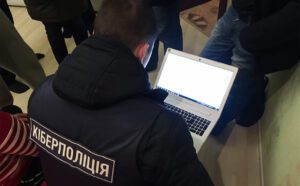
Employees of the Cyberpolice Department of the National Police of Ukraine prevented the theft of more than $720,000 from the account of a medical company, the press service of the cyberpolice said on Thursday.
“The defendants forged payment orders and tried to take possession of the money intended for the purchase of medical equipment for examining patients with COVID-19. Criminal proceedings were initiated on the fact of fraud,” the statement said.
It notes that a medical company contacted the Cyber Police Department and reported a fraudulent seizure of money intended for the purchase of medical equipment for examining patients with COVID-19.
“Law enforcers found that the attackers sent the phishing link to the partners of the victim company. Using phishing, offenders obtained login information to their email account. Then they forged a payment order, which was sent from a broken email box of partners from the People’s Republic of China. Therefore, the Ukrainian medical company transferred the money to the scammers’ account opened in the UK. Thus, the defendants tried to embezzle more than $723,000,” the law enforcement officers said.
They clarify that the cyber police officers, together with Kyiv police investigators and British colleagues, managed to block the money stolen from the company’s account.
“On this fact, criminal proceedings have been initiated under Part 3 of Article 190 (Fraud) of the Criminal Code of Ukraine. Attackers can face up to eight years in prison. Investigative actions continue,” the police said.
Chief of the National Police of Ukraine Ihor Klymenko has appointed Oleksandr Hrynchak as chief of the Cyber Police Department and Serhiy Kropyva as his deputy.
The respective decree was signed on October 19, a website of the National Police reported.
Prior police Colonel Hrynchak headed the section on combating crimes in information systems of the Economic Defense Department and worked as first deputy head of the Cyber Police Department.



