

According to Fixygen, the British fintech startup Revolut has launched the EURR, a stablecoin pegged to the euro, Bloomberg reports, citing a company statement. The issuer of the EURR is Bridge, a company owned by the American firm Stripe. Bridge will also own and manage the assets backing this stablecoin.
Initially, it will be available to a limited number of Revolut customers in Denmark, Poland, and Portugal, and later this year, the startup plans to expand access to other markets in the European Economic Area (EEA).
EURR will be integrated into the Revolut app and will allow users to exchange euros for cryptocurrency—and vice versa—directly on the blockchain.
The company calls this launch the first step in its stablecoin strategy, which includes the launch of tokens pegged to other currencies as well.
“Revolut started by eliminating hidden fees and barriers to currency exchange,” the company said in a statement. “Now we’re doing the same with cryptocurrency.”
The financial news and analysis platform Finance Magnates, citing official documents, reports that EURR was launched on August 20 and is marketed as Revolut Euro. According to the report, the stablecoin is available in the Revolut retail app and on the Revolut X cryptocurrency exchange. As of Tuesday, only 374 EURR were in circulation, backed by reserves of 374 euros.
Revolut was founded in 2015 in London by Mykola Storonskyi (a graduate of the Moscow Institute of Physics and Technology and the Russian Economic School) and Vladislav Yatsenko. The company serves over 80 million retail and 800,000 business customers worldwide. It operates as a bank in more than 30 countries.
In 2024, Revolut became Europe’s most valuable private tech company, with a valuation of $45 billion, and last year it reaffirmed this status by increasing its valuation to $75 billion.

Romania may set a goal of joining the eurozone in 2032, provided that public finances stabilize and the country meets the criteria for the monetary union, said Dragos Pislaru, the country’s acting minister of investment and European projects.
The statement was made in an interview with the Romanian television channel TVR Info. However, 2032 is not yet an officially approved date for Romania’s transition to the euro, but is viewed by Pislaru as a possible target.
According to the minister, the country’s top priority should be fiscal and budgetary consolidation and bringing public finances to a stable state by 2030.
“The goal is to put our finances in order by 2030. Therefore, I see an opportunity to align several objectives: fiscal and budgetary consolidation and the adoption of a coordinated national development plan for 2028–2034,” Pislaru stated.
He also emphasized the need for political stability, which would allow the government to consistently implement such a plan. Once Romania has achieved the necessary macroeconomic indicators, it will need to go through the phase of participating in the European Exchange Rate Mechanism II (ERM II).
“Romania could, say, join in 2030 plus two years, because two years must be spent in the waiting room. This is a monitoring period. The year 2032 could be an important target for joining the eurozone,” the minister noted.
Currently, Romania does not yet meet the key criteria for adopting the euro. According to the European Central Bank’s convergence report published in June 2026, the country is not participating in ERM II. To meet the exchange rate criterion, a country must remain in this mechanism for at least two years without significant fluctuations or devaluation of its currency against the euro.
Inflation also remains a significant problem. The 12-month average harmonized inflation rate in Romania as of May 2026 stood at 8.4%, while the reference level for joining the eurozone was 2.7%. The average long-term interest rate was 6.7%, compared to the maximum permissible level of 5.1% for this criterion.
In addition, Romania is continuing the process of reducing its excessive budget deficit. The EU has set a trajectory for Bucharest that should allow it to eliminate the excessive deficit by 2030. The European Commission projected that the deficit would be reduced to 6.2% of GDP in 2026 and 5.8% in 2027. Public debt, on the other hand, is projected to rise to 63.4% of GDP in 2027.
Thus, the scenario for adopting the euro in 2032 envisages a significant reduction in the budget deficit and inflation, stabilization of public debt, entry into ERM II, and at least a two-year stay in this mechanism before final accession to the eurozone.
The US dollar-to-euro exchange rate at the end of 2026 will be $1.16/EUR1; the Cabinet of Ministers approved this updated estimate in the draft amendments to Ukraine’s state budget (No. 15224), whereas it had previously projected it at $1.08/EUR1.
As noted in the explanatory note to the draft, these changes have affected the assessment of the maximum levels of public debt: it will decrease by only UAH 332.2 billion, although financing of the state budget through debt operations will be reduced by UAH 651.5 billion thanks to the attraction of €13.2 billion in new budgetary support from the European Union under the Ukraine Support Loan.
According to the draft, it is proposed to set the public debt ceiling at the end of this year at 10 trillion 145. 6 billion UAH and the ceiling for state-guaranteed debt at 464.6 billion UAH, with budget revenues of 5 trillion 195.9 billion UAH and expenditures of 6 trillion 407.1 billion UAH.
As reported, in the calculations for Ukraine’s 2026 state budget, the government for the first time included a separate indicator for the projected average annual euro-to-hryvnia exchange rate—49.4 UAH/EUR1—in addition to the traditional average annual dollar exchange rate, which the Cabinet of Ministers expects to be 45.7 UAH/$1 this year.
In recent years, the share of euro-denominated obligations in Ukraine’s national debt has grown significantly, as the EU has become Ukraine’s main donor, while financial support from the U.S. has declined.
Public and state-guaranteed debt for the first quarter of 2026 increased by 190.4 billion UAH, or 2.1%, to 9.233 trillion UAH, but decreased by $2.5 billion, or 1.2%, to $210.8 billion in dollar terms.
The share of debt in euros as of the end of March this year was 44.08%, while in dollars it was 22.74%, in hryvnia 20.94%, and in IMF Special Drawing Rights (SDR) 9.12%.
In its updated April Inflation Report, the National Bank of Ukraine projects an average annual dollar-to-euro exchange rate of $1.18/EUR1, which corresponds to the current rate, compared to $1.13/EUR1 in 2025.
The official hryvnia-to-dollar exchange rate currently stands at 43.8033 UAH/$1, and the hryvnia-to-euro rate at 51.5433 UAH/$1.
On February 1, Bulgaria ended its transition period for currency change, during which it was possible to pay in both Bulgarian levs and euros. Now, payments are made exclusively in euros, according to the Bulgarian service of Radio Liberty.
“At midnight on January 31, the one-month period during which the euro and the lev were in simultaneous circulation in Bulgaria ended. From February 1, merchants no longer accept payments in levs and must give change only in the single European currency,” according to a statement on the publication’s website.
People who still have cash levs can exchange them for euros at commercial banks and Bulgarian Post offices until June 30. After that date, commercial banks may set a certain exchange rate, but the Bulgarian National Bank will continue to offer cash lev-euro exchanges free of charge and without a deadline.
Retail chains will have to display prices for goods in both euros and levs for another six months, until August 8, “for transparency and to prevent speculative practices.”
Although the law prohibits sellers of goods and services from raising prices during the first six months of the euro’s introduction, hundreds of complaints about possible violations have already been received.
Bulgaria joined the eurozone on January 1, 2026, 18 years after joining the EU. January was a transition period when the lev and the euro were in circulation simultaneously.
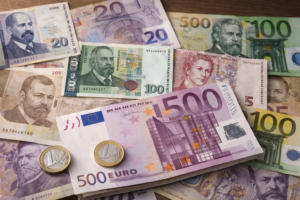
On January 1, 2026, Bulgaria officially switched to the euro and became the 21st country in the eurozone. For the Bulgarian economy, this step is largely institutional in nature: for many years, the lev was tightly pegged to the euro through the currency board, so the market did not expect a sharp change in the monetary regime. At the same time, the country will get a seat on the ECB’s governing bodies and deeper integration into the eurozone’s financial system, according to the Experts Club information and analytical center.
Maksym Urakin, founder of the Experts Club analytical center, believes that the effect of the transition will be determined by how quickly the authorities “knock down” inflation expectations among the population and businesses: “The euro itself does not make the economy richer overnight, but it reduces transaction costs and increases investor confidence. The key test in the first few months will be controlling price speculation and communicating clearly with consumers.”
The main domestic risk around which public debate in Bulgaria is centered is inflationary expectations and fears of price “rounding” in retail and services. Such fears traditionally accompany currency changes, even if the actual effect is usually limited in time and concentrated in the sector of daily household expenses.
After Bulgaria’s entry into the eurozone, six countries remain in the EU that do not use the euro: Sweden, Poland, the Czech Republic, Hungary, Denmark, and Romania.
According to Experts Club estimates, the expansion of the eurozone will be slow in the coming years, as each of these countries has its own “stop factors” — from political constraints to failure to meet convergence criteria and budget deficit problems.
In Poland, for example, the government has publicly stated that the country is “not yet ready” for the euro and considers the zloty to be an instrument of macroeconomic flexibility that has helped it weather past shocks.
In the Czech Republic, President Petr Pavel has called for more active movement towards the euro as a factor in trade and decision-making, but there is no political consensus on the timing in the Czech Republic.
In Hungary, Prime Minister Viktor Orbán, on the contrary, has stated several times that the country should not adopt the euro.
Sweden formally relies on the results of the 2003 referendum, when 55.9% of voters opposed the introduction of the euro.
Denmark, unlike the others, has a legally enshrined right not to introduce the euro (opt-out), confirmed by a referendum in 2000.
Experts Club notes that Romania is considered the next country after Bulgaria that is most likely to apply for the introduction of the euro. However, the actual timeline depends on inflation and the budget trajectory: the European Commission indicated in its convergence materials that Romania does not meet the conditions for adopting the euro, including the parameters of public finance sustainability and legal compatibility. The public guidelines in the Romanian discussion mention a target date of around 2029, but the timing may shift depending on economic indicators and fiscal adjustments.
On January 1, 2026, Bulgaria will adopt the single European currency, the euro.
“This is a historic step for the country and a boon for individuals and businesses in the euro area. The transition will lead to greater economic stability, smoother transactions, and stronger European integration. For Bulgaria, adopting the euro will help to better support long-term economic growth and strengthen its resilience,” according to a statement on the European Central Bank’s website.
The publication notes that “the changes may raise questions and concerns.” “However, the ECB and national authorities are working closely together to ensure a smooth transition for everyone through careful planning and a focus on price stability,” the European Central Bank assures.
Bulgaria is parting with its national currency, the lev, 19 years after joining the European Union. The press in the veteran eurozone countries points out that this will be convenient for tourists and travelers. However, there are concerns in Bulgaria itself, as the ECB acknowledges.
Expectations of benefits are overshadowed by concerns about possible price increases, as seen in Croatia, which joined the eurozone three years ago. These fears are all the more serious given that Bulgaria is one of the poorest countries in the EU.
Nevertheless, the European Commission (EC) considered that this Balkan country, which is becoming the 21st member of the eurozone, has met the relevant criteria: economic stability, public debt below 60% of GDP, and low inflation.
On June 4, 2025, the EC announced its conclusion that Bulgaria was ready to switch to the euro on January 1, 2026.
“Thanks to the euro, Bulgaria’s economy will become stronger, with more trade with eurozone partners, foreign direct investment, access to finance, quality jobs, and real incomes. And Bulgaria will take its rightful place in decision-making within the eurozone,” said EC President Ursula von der Leyen on this occasion.
The EU Council, in turn, announced on July 8, 2025, the approval of the last three legal acts necessary for the introduction of the euro in Bulgaria on January 1, 2026.
“This marks the culmination of a thorough accession process for Bulgaria, which has involved rigorous analysis and intensive preparation,” said Danish Economy Minister Stephanie Lose, who was chairing the EU Council at the time.
“One of the three legal acts sets the exchange rate between the euro and the Bulgarian lev at 1.95583 levs per euro. This corresponds to the current central rate of the lev in the Exchange Rate Mechanism II,” the EU Council said in a statement.
After Bulgaria joins the eurozone, six countries will remain in the EU that do not use this currency: Hungary, Denmark, Poland, Romania, the Czech Republic, and Sweden.
The European Monetary Union, or eurozone, began operating on January 1, 1999, when the single European currency, the euro, was introduced into non-cash circulation. Since March 1, 2002, the euro has been the sole legal tender in the eurozone. Eurozone countries transfer all monetary policy powers to the ECB, including decisions on the amount of money supply and the key interest rate.



