
According to Experts Club, Turkey has the highest net positive sentiment among Ukrainians among the Middle Eastern countries included in the study—44.9 percentage points. More than half of those surveyed—52.3%—view the country positively. At the same time, neutral attitudes prevail toward Saudi Arabia and Jordan, while Lebanon is the only country in this group with a negative balance. This is evidenced by the results of the third wave of the study “Ukrainians’ Attitudes Toward Countries Around the World,” conducted by Active Group in collaboration with Experts Club, according to the Experts Club Information and Analytical Center.
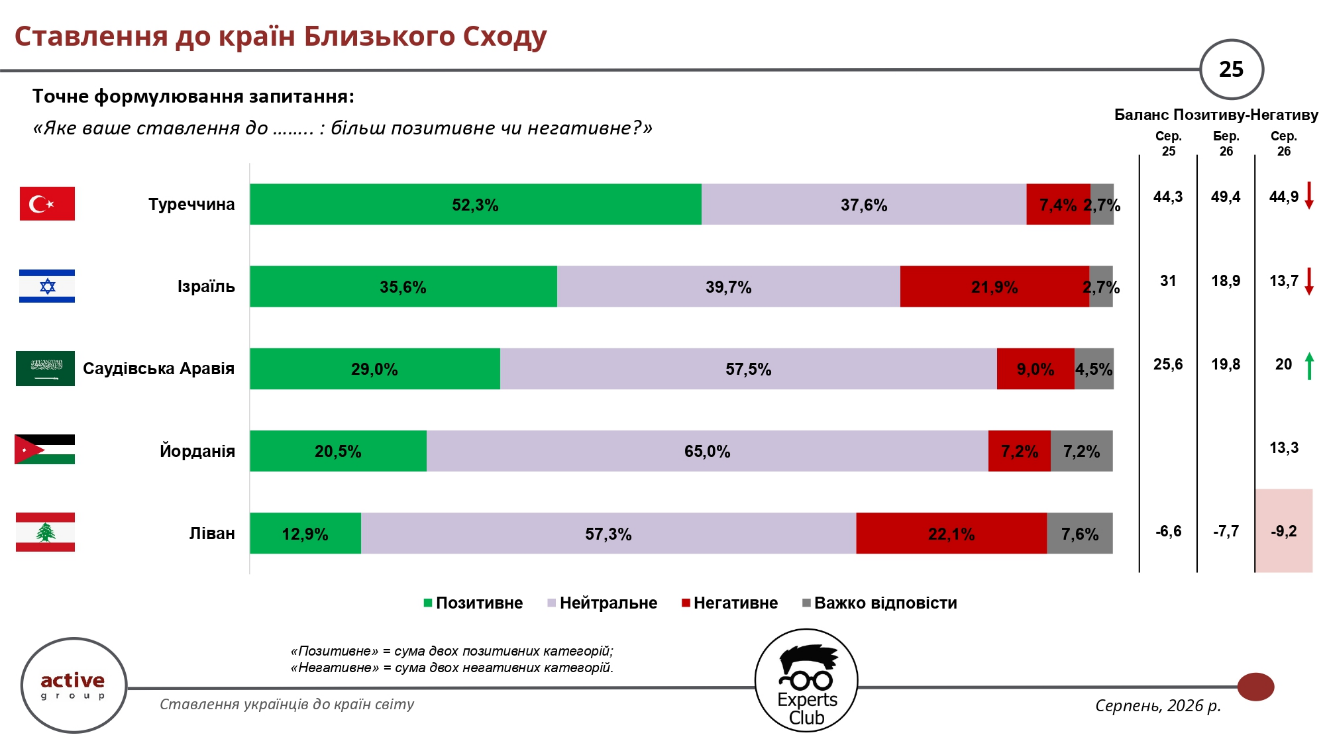
52.3% of respondents view Turkey positively, 37.6% neutrally, 7.4% negatively, and another 2.7% were undecided. The balance of positive and negative assessments stands at 44.9 percentage points, compared to 49.4 percentage points in March 2026 and 44.3 percentage points in August 2025. Thus, following a spring increase, the indicator has returned to roughly last year’s level.
Israel ranks second among the countries shown on the slide in terms of the share of positive assessments—35.6%. 39.7% of respondents view it neutrally, 21.9% negatively, and another 2.7% were undecided. The balance stands at 13.7 percentage points and continues to decline: in August 2025, it was 31 percentage points, and in March 2026, it was 18.9 percentage points.
Saudi Arabia is viewed positively by 29% of Ukrainians, while the majority—57.5%—hold a neutral stance. The share of negative assessments is 9%, and the balance is +20 percentage points, compared to 19.8 percentage points in March. Compared to August 2025, when it stood at 25.6 percentage points, the figure remains lower.
Regarding Jordan, 65% of respondents hold a neutral stance—the highest figure in this regional group. 20.5% of those surveyed view the country positively, 7.2% negatively, and another 7.2% are undecided. The balance of positive and negative assessments stands at 13.3 percentage points.
Lebanon has the lowest score. 12.9% of Ukrainians view the country positively, 22.1% negatively, and 57.3% neutrally. The balance stands at minus 9.2 percentage points and is gradually deteriorating: from minus 6.6 percentage points in August 2025 to minus 7.7 percentage points in March and minus 9.2 percentage points in August 2026.
Maksym Urakin, founder of the Experts Club information and analytical center, emphasized the importance of foreign governments maintaining constant communication with the Ukrainian public.
“The first recommendation is to regularly showcase specific achievements and concrete actions. Second, be open to questions and inquiries from the media and the public,” Urakin noted. He also recommended that diplomatic missions systematically inform Ukrainians about the concrete results of cooperation.
Oleksandr Pozniy, director of the research company Active Group, drew attention to the need to combine an information presence with the practical development of bilateral relations.
“We should focus not only on raising general awareness. First and foremost, business associations, the Ministry of Economy, and the Ministry of Foreign Affairs need to take action,” Pozniy noted.
In his view, economic and diplomatic institutions should more actively tap into the potential of markets where Ukraine can expand its cooperation.
Overall, the study shows that Ukrainians’ perceptions of Middle Eastern countries vary significantly. Turkey has a distinctly positive image, while neutrality dominates perceptions of Saudi Arabia and Jordan; assessments of Israel are more polarized, and negative assessments of Lebanon outweigh positive ones.
The survey was conducted in August 2026 using self-administered online questionnaires in the SunFlowerSociology panel among 800 Ukrainian citizens aged 18 and older. According to the organizers, the sample is representative by age, gender, and region, and the maximum theoretical statistical margin of error is 3.5%. This is the third wave of the study, following surveys conducted in August 2025 and March 2026.
ACTIVE GROUP, EXPERTS CLUB, ISRAEL, JORDAN, LEBANON, MIDDLE EAST, SAUDI ARABIA, SOCIOLOGY, TURKEY, UKRAINE

The Central Bank of Russia became the largest gold seller among the world’s central banks in August 2026, reducing its official gold reserves by approximately 6.2 tonnes, according to an Experts Club analysis based on data from the World Gold Council (WGC).
Among the notable gold sellers in August, the WGC highlights:
Russia – about 6.2 tonnes
Jordan – about 3.1 tonnes
Russia continued reducing its gold reserves after selling approximately 6 tonnes in July. In total, in January-August 2026, Russia’s official gold reserves decreased by approximately 56 tonnes.
Following the August sale, the amount of gold in Russia’s reserves stood at about 2,271 tonnes.
Jordan sold about 3.1 tonnes of gold in August. However, unlike Russia, the country remains a net buyer after the first eight months of the year: since the beginning of 2026, its gold reserves have increased by approximately 2 tonnes to 75 tonnes. Gold accounts for about 37% of Jordan’s international reserves.
At the same time, Turkey remains the largest gold seller for January-August, despite switching to purchases in August.
According to the WGC, Turkey has reduced its gold reserves by approximately 82 tonnes since the beginning of the year. The bulk of the sales occurred in the first quarter of 2026. In August, the trend changed, with the Turkish central bank purchasing about 2.9 tonnes of gold.
Russia ranks second among the largest sellers since the beginning of the year, with about 56 tonnes.
Thus, August showed a significant predominance of buyers over sellers: the world’s central banks collectively purchased 39 tonnes of gold on a net basis, compared with 23 tonnes in July.
The World Gold Council notes that the data cover officially reported changes in the reserves of central banks and other official institutions and may differ from the broader estimate of global central bank demand, which takes into account unreported purchases.
Central banks, EXPERTS CLUB, GOLD, gold reserves, JORDAN, RUSSIA, TURKEY, WORLD GOLD COUNCIL

A vessel with 1,000 tons of wheat flour for Palestine arrived from Turkey to Jordan as part of the presidential program Grain from Ukraine, the head of the Presidential Office, Andriy Yermak, said on his Telegram channel.
“President Volodymyr Zelenskyy’s Grain from Ukraine initiative in cooperation with the WFP sent the first of three shipments to Palestine, which will provide food aid to more than 100,000 families caught in the middle of the conflict between Israel and Hamas,” he wrote, noting that this shipment was the first to be delivered to Palestine under this initiative.
Yermak emphasized that Ukraine continued to provide vital assistance to innocent civilians suffering from food shortages and at risk of starvation.
“Ukraine has always been and will continue to be a donor of food security for the whole world. Over the course of the program’s existence, Ukraine has supplied essential foodstuffs to many countries, including Sudan, Ethiopia, Kenya and Yemen. Food security is one of the important points of the Formula for Peace, and I call on all countries to join our collective efforts to achieve it,” he wrote.
According to Yermak, other ships are also scheduled to depart in the coming months. “In total, Ukraine plans to deliver more than 7,000 tons of wheat flour to Gaza under the initiative with the support of donors, including Norway, Austria, Estonia, France and Iceland,” the head of the Presidential Office said.

Active Group and Experts Club have conducted a joint study on the attitudes of Ukrainians towards the countries of East Asia and the Middle East. The study was presented at the Interfax-Ukraine news agency in June 2024. The research was presented by Maksym Urakin and Oleksandr Poznyi. The results of the study are as follows:

The results of the survey are as follows:
Completely positive – 4.5%.
Mostly positive – 32.1 %.
Mostly negative – 11.2
Completely negative – 3.6
Difficult to answer – 48.6%.
Positive – Negative – 21.8
On April 19, 1992, diplomatic relations between Ukraine and Jordan were established. Since December 2000, the Honorary Consulate of Jordan has been operating in Kyiv.
A joint study by Active Group and Experts Club on the attitudes of Ukrainians towards the countries of East Asia and the Middle East was conducted in April-May 2024. It covers such countries as Turkey, Iran, Israel, Egypt, Jordan, Saudi Arabia, UAE, Afghanistan, Pakistan, Azerbaijan, Uzbekistan, Turkmenistan, Kyrgyzstan, Tajikistan, Kazakhstan, Georgia, Armenia, India, China, Republic of Korea, DPRK, Japan, Vietnam, Indonesia, Syria, and Iraq. Full information on the research is available on the website of the Club of Experts at

The auction house expects to gain $ 2-4 million for the sneakers, which played Jordan in one of the games of the final of the National Basketball Association (NBA) in 1998, and $ 100-200 thousand for the shirt in which Pele made his debut for the “New York Cosmos” in 1975.
The basketball player’s sneakers could become the most expensive in history, surpassing the $1.8 million Air Yeezy rapper Kanye West sold for in 2021.
In addition, with an estimate of $400,000 to $600,000, a warm-up jersey of basketball player Kobe Bryant is up for auction. He wore it on the day of the game, where he scored 81 points (the second highest score in NBA history).
In addition, at the auction Victoriam you can buy things tennis players Rafael Nadal and Roger Federer and basketball with the autographs of Bryant and the former U.S. president Barack Obama.
The auction ends April 11.
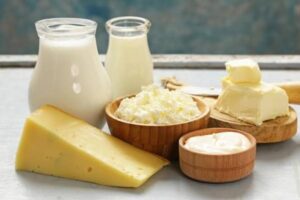
The competent authorities of Ukraine and Jordan have agreed on the form of a certificate for the export of milk and dairy products from Ukraine, Ukrainian Foreign Minister Dmytro Kuleba has said.
“This week we opened another market, namely, the export of Ukrainian milk to Jordan. The competent authorities of the two states agreed on the form of a certificate for the export of milk and dairy products from Ukraine. The concrete result of the joint work of diplomats and specialists of the State Service on Food Safety and Consumer Protection,” Kuleba said at an online briefing on Thursday.
He said that Ukrainian dairy products are of very high quality and therefore are in great demand abroad. According to Kuleba, this is the third certificate agreed between Ukraine and Jordan in 2021.
“The Ministry of Foreign Affairs continues to systematically open new foreign markets for Ukrainian exporters together with the State Service on Food Safety and Consumer Protection. Each new open market provides additional opportunities for Ukrainian companies, the strengthening of our national currency, the arrival of foreign currency to Ukraine, new jobs, taxes to the budget, the best salaries for our citizens,” he said.
The Foreign Minister said that not only exporting companies will benefit from the expansion of Ukrainian goods abroad, but every citizen of Ukraine involved in economic activity.



