

Poland needs new specialized terminals for transshipping Ukrainian grain, as existing storage capacity for large shipments is virtually exhausted, said Bartosz Penchkovsky, owner and CEO of the Polish logistics company Frontier Logistics.
“Right now, if we look across all of Poland, it effectively has no capacity to store large volumes of cargo—30,000 metric tons or more. All of this capacity is effectively occupied,” he said during the online discussion “Alternative Export Routes: Synergy Between Ukrainian and Polish Logistics Amid the Black Sea Blockade.”
According to him, in 2022–2023, Polish investors expanded the capacity of port and border terminals for transshipping Ukrainian cargo, which, in theory, could have facilitated the export of 6–8 million metric tons of goods per year. However, after the ports of Greater Odesa resumed operations in 2024–2025, a portion of Ukrainian cargo returned to the Black Sea ports, while Polish terminals shifted their focus to other types of cargo. In particular, Poland began receiving approximately 3–3.5 million metric tons of soybean meal from Latin America and other goods.
According to him, another “bottleneck” is access to specialized railcars for transporting grain.
Penchkovsky also noted that some border crossings have spare capacity, while others are overloaded.
He added that Poland’s logistics infrastructure has significant potential to increase the transshipment of Ukrainian agricultural products, provided there are investments in specialized terminals and more efficient use of existing border crossings.

From August 1 to 18, Ukraine exported 900,000 metric tons of agricultural products, which accounts for 31% of the volume that could have been exported had there been unimpeded access to logistics, said Minister of Agrarian Policy and Food Taras Vysotsky at a briefing in Kyiv on Thursday.
“The biggest drop was in grains. A total of 522,000 metric tons of grain were exported, which is only 20% of the required volume. Exports of oilseeds during this period totaled 163,000 metric tons, vegetable oil—128,000 metric tons, and meal—86,000 metric tons. In these sectors, export rates are in line with balance sheet figures,” Vysotsky noted.
According to him, alternative logistics routes can, in terms of volume, support the export of oilseeds and their processed products. As for grains, alternative routes can primarily be used to export products from border regions.
He added that due to changes in logistics, transportation costs have increased by approximately $50 per metric ton.
According to Vysotsky, exports of oilseeds and their processed products remain profitable, whereas for grains—with the exception of border regions—they are unprofitable.
Overall, via alternative routes from August 1 to 18, about 45% of agricultural products were exported via the Danube, 45% by rail, and another 7–8% by road.
As previously reported, according to data from the Ministry of Agrarian Policy, Ukraine exported 590,000 metric tons, or 30% of its needs, from August 1 to 12.
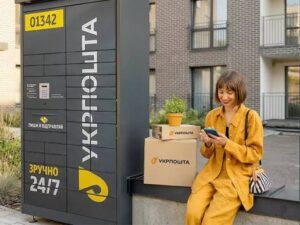
The national postal operator, JSC “Ukrposhta,” plans to complete the installation of parcel lockers in its branches during the third quarter of this year, bringing the total number of express pickup lockers to 600, according to the company’s CEO, Ihor Smiliansky
“We are already seeing … demand, to the point where we don’t have enough lockers. That’s why we’re currently purchasing additional parcel lockers; we can see that people like this service,” Smilyansky said in a comment to the Interfax-Ukraine news agency.
The domestic parcel locker service currently covers 15 regions of the country, where 376 of the 600 express pickup lockers have been installed. It was noted that during the second quarter, the first 70 Ukrposhta parcel lockers were put into operation in Kyiv as part of a project to expand the self-service network.
As for street-based parcel lockers, he said that by the end of 2026, “Ukrposhta” plans to increase their number to several thousand.
Last week, the national postal operator announced that, in partnership with the Ukrainian company “Modern-Expo,” it is launching the production and installation of 1,000 new street-based parcel lockers, primarily in Kyiv, Odesa, Lviv, Dnipro, and other major cities across the country.
As previously reported, Ukrposhta posted a net profit of 296.7 million UAH for the second quarter of 2026, compared to a net loss of 108 million UAH in the same period of 2025.
According to the report, Ukrposhta has 7,200 customer service locations, including 2,000 mobile post offices that serve 21,300 settlements.
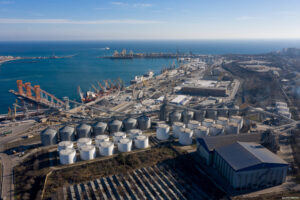
From August 1–13, Ukraine exported 790,700 metric tons of agricultural products, compared to 1.849 million metric tons during the same period in July—a decrease of 57.2%, according to the brokerage firm Spike Brokers.
According to the firm, the value of exports fell by 37.3% to $478.8 million, compared to $763.8 million during the corresponding period in July.
“The main factor limiting August’s pace is concentrated in the grain segment. At the same time, the geography of logistics is changing: the flow through seaports is significantly lower than in July, while road crossings and western rail corridors are operating at a higher intensity,” the report notes.
From August 1–13, 130,100 metric tons of agricultural products were exported via road border crossings, compared to 119,500 metric tons during the corresponding 13 days in July—an increase of 8.9%. Exports via Hungary saw the largest increase—32.9%—followed by Slovakia (28%), Romania (14.1%), and Poland (3.7%). The flow through Moldova was close to July’s level, declining by approximately 1.9%.
At the same time, as of August 12, 435,800 metric tons of grain cargo had been transported by rail, which is 46.9% less than during the corresponding period in July and 52.1% less than in August 2025. The average daily load for the first 11 days of August was 31.3 thousand metric tons—38% lower than in July and 49% less than a year ago.
The export component of grain rail shipments fell by 72% compared to July, to 201.7 thousand metric tons. Of this volume, 63% passed through border crossings, and 29% went through the ports of Odesa. During the reporting period, only 75,200 metric tons of grain were transported through the ports of Odesa, compared to 656,400 metric tons during the corresponding period in July (-88.5%).
At the same time, the average daily throughput of grain railcars through western border crossings during the first 11 days of August rose to 139.6 railcars, compared to 71.3 railcars in July—an increase of 96%.
According to Spike Brokers, the main growth came from the Romanian and Polish routes—up to 44.7 and 44.4 railcars per day, respectively. Transit to Slovakia increased to 26.9 railcars per day, while transit to Hungary decreased to 23.6 railcars.
As of August 12, there were 8,718 thousand railcars at border crossings, compared to 7,858 thousand previously. In particular, the number of grain cars rose from 369 to 693, or by 87.8%.
Railway exports of vegetable oil totaled 41.5 thousand metric tons, which is 0.9% more than the corresponding July figure, with 89% of the volume passing through land border crossings.
Spike Brokers notes that the sea-rail corridor remains the weakest link in the current logistics chain. As of August 13, the average daily unloading rate bound for the ports of Greater Odesa had dropped to 146 railcars, while 262 grain cars were en route to the ports. There were 1.32 thousand grain cars heading toward the Danube ports.
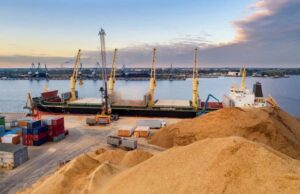
The suspension of the maritime corridor since late July has led to a drop in grain exports from Ukraine: from August 1 to 12, exports totaled 590,000 metric tons, or 30% of demand, Agriculture Minister Taras Vysotsky said at a briefing in Kyiv on Friday.
“From August 1 to 12, we exported 590,000 metric tons. That’s about 30% of the required volume. We expect to be able to reach 50% going forward… taking into account all the relevant impacts on international trade balances,” the minister said.
He clarified that of these 590,000 metric tons, about 40% were exported by rail, about 40% via the Danube region, about 10% by road, and the remaining 10% consisted of several ships that were still able to leave Ukrainian ports in early August.
“If we subtract those, we can say that as of today, 45% is exported by rail, 45% via the Danube region, and about 10% by road,” the minister stated.
At the same time, he emphasized that there is potential to partially increase exports, but even so, without the resumption of operations at the Black Sea ports, exports will amount to no more than 50% of demand.
According to Vysotsky, due to the drought, the Danube route is currently unable to operate at full capacity; reaching its full potential—about 1.5 million metric tons per month—will be possible closer to the end of the year.
The minister also reported that Ukraine currently has sufficient permanent storage facilities for grain, but in November, after the corn harvest, there may be a storage capacity shortfall of 8 to 11 million metric tons, which they hope to cover using temporary storage facilities and silo bags.
According to Vysotsky, a request for $10 million in funding for the temporary storage of 2–2.5 million metric tons has already been sent to international partners. In addition, a similar request to the World Bank for $25 million—covering more than 6 million metric tons of grain—is being finalized.
He noted that it is currently difficult to predict how quickly maritime exports can be resumed.
“We see that every day there are various rumors… gossip about different proposals (regarding a maritime ceasefire)… As always, we must rely first and foremost on ourselves. By ‘ourselves,’ I mean the military… As of today, the only way to enable exports is through military security… This is a very important area; the military is working on it, but so far, they cannot report any progress on their end. Therefore, as of today, exports from the ports of Greater Odesa are suspended. We are focusing on alternative logistics channels,” stated the head of the Ministry of Agrarian Policy.
Regarding the U.S. Department of Agriculture’s downward revision this week of its forecast for grain exports from Ukraine this marketing year by 2.21 million metric tons—to 37.77 million metric tons—Vysotsky noted that, overall, the figures remain within the range of the typical annual balance.
“We do not rule out that this could be the case. We are still only a month and a half into the marketing year. We understand that, provided there is some recovery during a certain period, we can make up the shortfall. Therefore, from our point of view, this balance is currently based on the annual cycle—no more, no less—rather than on an assessment of the current situation,” the minister said.
He noted that this year’s total harvest of grains and oilseeds is expected to exceed 80 million metric tons, of which domestic consumption and adequate carryover stocks will account for up to 20 million metric tons.
“The baseline volume of exports of grains, oilseeds, and processed products could reach up to 60 million metric tons. However, given how logistics are currently developing, we understand that there is a possibility this trend will continue throughout the year, and exports will amount to no more than 30 million metric tons,” Vysotsky said, outlining the worst-case scenario.

The national postal operator, JSC “Ukrposhta,” in partnership with the Ukrainian company “Modern-Expo,” is launching the production and installation of 1,000 new street-side mail kiosks, primarily in Kyiv, Odesa, Lviv, Dnipro, and other major cities across the country, the company’s CEO, Ihor Smilianskyi, announced on the company’s Telegram channel on Thursday.
According to him, these mail kiosks will be equipped with mailboxes that will allow users to both receive packages and send letters.
According to a press release from “Ukrposhta,” the company is inviting homeowners’ associations, property management companies, and representatives of residential complexes to collaborate.
It is anticipated that representatives of homeowners’ associations, property management companies, or residential complexes can submit an application on the national postal operator’s website to have the mail kiosks installed at the appropriate locations.
Ukrposhta explains that the company will prioritize residential complexes in major cities where there is no nearby brick-and-mortar post office, and where it is possible to place a parcel locker near the building’s entrance or in an open area of the residential complex in a location accessible to residents.
Other criteria include the availability of a solid, level surface; the ability to connect to a 220-volt power supply; and reliable mobile network coverage in the relevant area.
It is noted that coffee shops, stores, pharmacies, gas stations, and other businesses are also invited to collaborate.
“We will definitely contact you to inspect the location, agree on the installation site and terms of cooperation. And if everything is in order—we’ll sign a contract and install the parcel locker,” added Smiliansky.
Among other things, he also noted that the company will continue to purchase and install parcel lockers and expand its network through its partners’ parcel lockers.
Separately, the national postal operator announced that the cost of using parcel lockers remains unchanged—starting at 45 UAH. A customer’s package will be stored there for seven calendar days.
Ukrposhta also took the opportunity to reiterate its plans to install 1,000 parcel lockers nationwide, as well as 600 express pickup lockers directly in post offices.
As previously reported, Ukrposhta posted a net profit of 296.7 million UAH for the second quarter of 2026, compared to a net loss of 108 million UAH in the same period of 2025.
According to the report, Ukrposhta operates 7,200 customer service locations, including 2,000 mobile postal branches that serve 21,300 settlements.
DELIVERY, homeowners’ association, LOGISTICS, parcel locker, UKRPOSHTA



