
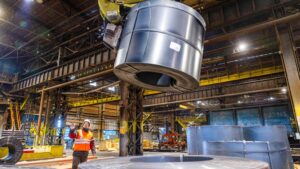
The Zaporizhzhia Metallurgical Plant “Zaporizhstal” reduced its rolled steel output by 19.1% in January–August of this year compared to the same period last year—to 1,488,700 metric tons from 1,839,300 metric tons.
According to the company’s press release, steel production for the first eight months of the year totaled 1,681,700 metric tons (compared to 2,105,500 metric tons in January–August 2025), while pig iron production totaled 1.816 million metric tons (compared to 2,339,200 metric tons).
In August, Zaporizhstal produced 42,400 metric tons of pig iron and 46,200 metric tons of steel, and shipped 45,000 metric tons of rolled steel, whereas in the previous month it produced 301,200 metric tons of pig iron, 284,900 metric tons of steel, and shipped 243,700 metric tons of rolled steel.
“The significant decline in production was the result of a hostile attack on August 11, 2026, which damaged the power facilities and infrastructure of Metinvest’s Zaporizhzhia enterprises, including the main and auxiliary blast furnace production facilities of the plant. This led to a complete shutdown of Zaporizhstal.” The
Russian army attacked the shut-down Zaporizhstal again on August 27, 2026, targeting equipment in the blast furnace shop, power and transportation infrastructure, and open areas. “This is yet another indication that Russian troops are systematically striking civilian industrial infrastructure and the people who work there,” the press release states.
As previously reported, in 2025, Zaporizhstal increased its rolled steel output by 15.2% compared to the previous year—to 2,794,600 metric tons from 2,426,700 metric tons. Steel production totaled 3,212,200 metric tons (compared to 2,890,800 metric tons in 2024), and pig iron production totaled 3,567,800 metric tons (compared to 3,106,300 metric tons).
In 2024, Zaporizhstal increased its rolled steel output by 18.1% compared to 2023—to 2,426,700 metric tons from 2,054,700 metric tons—and its steel output by 17.2%, to 2,890,800 metric tons, and pig iron by 14.2%, to 3,106,300 metric tons.
“Zaporizhstal” is one of Ukraine’s largest industrial enterprises, whose products are in high demand among consumers both in the domestic market and in many countries around the world.
“Zaporizhstal” is a joint venture of the ‘Metinvest’ Group, whose major shareholders are PJSC “System Capital Management” (71.24%) and Smart Steel Limited (23.76%). “Metinvest Holding” LLC is the management company of the “Metinvest” Group.
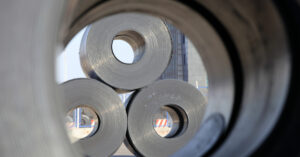
According to preliminary data, Ukrainian steelmakers reduced their production of total rolled steel by 15.6% in January–August of this year compared to the same period last year, down to 3.592 million metric tons.
According to information from the “Ukrmetallurgprom” association, 269,500 metric tons of rolled steel were produced in August, 382,700 metric tons in July, 599,800 metric tons in June, 537,800 metric tons in May, in April—460,800 metric tons, in March—544,500 metric tons, in February—390,300 metric tons, and in January—406,400 metric tons.
In 2025, Ukraine’s steel companies increased their production of general-purpose rolled steel by 4.8% compared to 2024, reaching 6.521 million metric tons.
In 2024, Ukraine increased its production of general-purpose rolled steel by 15.8% compared to 2023—to 6.222 million metric tons from 5.372 million metric tons. In 2023, total rolled steel production rose by 0.4% to 5.372 million metric tons, while in 2022, it fell by 72% to 5.350 million metric tons.
In 2021, before the war, 19.079 million metric tons of rolled steel were produced, or 103.5% of the 2020 level.
METALLURGY, PRODUCTION, ROLLED STEEL, UKRAINE, UKRMETALLURGPROM
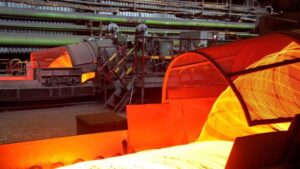
Ukrainian steelmakers reduced steel production by 12.5% in January–August of this year compared to the same period last year, down to 4.3 million metric tons.
According to data from the “Ukrmetallurgprom” association, 277,000 metric tons of steel were produced in August, 457,000 metric tons in July, 690,800 metric tons in June, 629,400 metric tons in May, in April—517,300 metric tons, in March—702,300 metric tons, in February—515,000 metric tons, and in January—511,100 metric tons.
In 2025, Ukraine’s steel companies reduced steel production by 2.2% compared to 2024—to 7.409 million metric tons.
In 2024, Ukraine increased steel production by 21.6% compared to 2023—to 7.575 million metric tons. In 2023, steel production fell by 0.6% to 6.228 million metric tons, and in 2022, it fell by 70.7% to 6.263 million metric tons.
In 2021, before the war, 21.366 million metric tons of steel were produced, or 103.6% of the 2020 level.
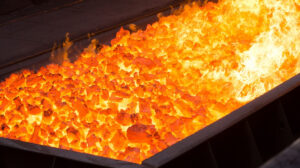
PJSC “Zaporizhkox,” one of Ukraine’s largest producers of coke and coke-chemical products and a member of the Metinvest Group, reduced its blast furnace coke production by 9.6% in January–August of this year compared to the same period last year, down to 535,900 metric tons.
According to the company, 38.1 thousand metric tons of coke were produced in August, compared to 63.4 thousand metric tons the previous month and 79.6 thousand metric tons in August 2025.
“The decline in production volumes in August 2026 compared to the same period in 2025 is due to a reduction in coal concentrate supplies to the plant. This is linked to the disruption of operations at Ukrainian Black Sea ports due to the aggressor country’s constant attacks on international merchant vessels, particularly those transporting raw materials for the Ukrainian metallurgical industry,” the press release explains.
As previously reported, in 2025, “Zaporizhkox” increased its output by 2.7% compared to 2024—to 898,300 metric tons, while in 2024, output rose by 2.1% to 874,700 metric tons from 856,800 metric tons in 2023.
“Zaporizhkox” operates a full technological cycle for the processing of coke-chemical products.
Metinvest is a vertically integrated mining group of companies. Its major shareholders are the SCM Group (71.24%) and Smart Holding (23.76%). Metinvest Holding LLC is the management company of the Metinvest Group.

Metinvest B.V. (Netherlands), the parent company of an international vertically integrated mining and metallurgical group, made a scheduled coupon payment on its 2027 Eurobonds.
As the group’s press service reported on Wednesday in response to a request from the “Interfax-Ukraine” agency, the payment was made on time, despite unprecedented challenges that have pushed the steel industry to the brink of survival.
“The aggressor’s blockade of Black Sea ports is limiting the volume of raw material and finished product shipments. At the same time, Ukrzaliznytsia has raised freight rates by 30%, which has increased the share of rail costs in the cost of metallurgical products by 2–3 times. And all of this is taking place against the backdrop of European restrictions, such as the introduction of CBAM and import quotas on Ukrainian steel into the EU, which have significantly reduced the group’s export opportunities,” the statement notes.
At the same time, it is noted that despite these critical obstacles, the group continues to diligently service its debt portfolio to preserve the ability to finance the restoration of its assets after the war and help the country recover more quickly from its aftermath. Since the start of the full-scale invasion, Metinvest has reduced its debt burden by $1 billion, the press service’s response emphasizes.
The current coupon payment dates for the 2027 Eurobonds are September 1. “Coupon payment dates are March 1 and September 1 of each year,” states the information regarding the 2027 bonds. The coupon rate is 7.650% per annum.
Metinvest is a vertically integrated group of mining and metallurgical enterprises. Its facilities are located in Ukraine—in the Donetsk, Luhansk, Zaporizhzhia, and Dnipropetrovsk regions—as well as in the European Union, the United Kingdom, and the United States.
The holding company’s main shareholders are the SCM Group (71.24%) and Smart Holding (23.76%). Metinvest Holding LLC is the management company of the Metinvest Group.
In July 2026, Ukraine’s steel mills produced 457,000 metric tons of steel, which is 21.3% less than in July of last year and 33.9% less than in June, when 691,000 metric tons were produced.
At the end of the month, Ukraine ranked 26th among 70 countries whose data is tracked by the World Steel Association (Worldsteel).
Overall, global steel production in July declined much less—by 0.3% year-over-year, to 149.2 million metric tons. Thus, the rate of decline in production in Ukraine significantly exceeded the global average. Worldsteel’s official data was published on August 24, 2026.
From January through July, Ukrainian steelmakers produced 4.023 million metric tons of steel, which is 5.6% less than during the same period in 2025. Based on the results of the first seven months, Ukraine ranks 24th in the global rankings.
The decline in July was particularly sharp compared to the previous month. While Ukrainian enterprises produced about 691,000 metric tons of steel in June, output fell by nearly 234,000 metric tons in July.
This also led to a decline in the country’s position in the global ranking: after seven months, Ukraine ranks 24th, while in July alone it dropped to 26th place.
By comparison, most of the largest producers increased their output in July. India increased production by 1.9%, the U.S. by 4.4%, South Korea by 6.4%, Turkey by 7%, Germany by 3%, and Vietnam by as much as 34.7%. China, on the other hand, reduced production by 3.6%. According to official data from Worldsteel, Russia increased its July production by 3.3%, to an estimated 5.7 million metric tons.
In the first seven months of 2026, global steel production totaled 1.081 billion metric tons, down 0.6% year-over-year. Ukraine, with a 5.6% decline, is also showing significantly weaker performance than the global market as a whole.
In 2025, Ukraine produced approximately 7.4 million metric tons of steel. According to World Steel’s latest annual table, the country ranked 23rd globally, down from 22nd in 2024.
The World Steel Association brings together leading steel producers, national and regional industry associations, and research organizations. The association’s members account for about 85% of global steel production.



