
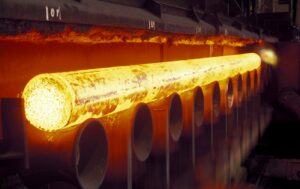
The Ukrainian steel industry is going through very difficult times, and the likelihood that the sector will survive to participate in post-war reconstruction is low—not only because of the war, but also due to restrictions imposed by the European Union, said Oleksandr Vodoviz, head of the office of the CEO of the Metinvest Group, according to a correspondent for Interfax-Ukraine.
“In the steel industry, half of the companies have gone bankrupt. And not because of the war… Is the steel industry ready to ensure recovery? Let’s hope we live to see that recovery, because the way things are going, we won’t make it. We need to take a sober look at the truth: the plants have been bombed; we’re not talking about millions of dollars in losses, but billions,” he said at the fourth “Economic Truth” export forum in Kyiv this week.
In addition to the need to rebuild metallurgical plants after the war, Vodoviz also highlighted a staffing problem that was already acute before the war, when European companies were poaching Ukrainian workers. According to him, despite the losses, Metinvest is currently retaining its staff, but this remains a pressing issue.
“Will we be able to ensure recovery? If we rebuild the plants and find the people,” he noted.
Vodoviz also stated that one of the main issues for the Ukrainian metallurgical industry right now is to secure the same level of export quotas to the EU as existed in 2025, at the very least.
According to him, Ukraine’s metallurgical sector does not question the strategic goal of integrating into the EU’s internal market, but recent actions by Brussels—the introduction of the CBAM carbon tax and restricted quotas, which, despite promises, in no way take into account the fact of the war in Ukraine and the losses incurred by the Ukrainian industry—cast doubt on the mutual progress toward this goal.
A Metinvest representative clarified that the quotas currently amount to 40% of last year’s exports.
“Our number one problem is, of course, the strikes on steel mills; all our steel enterprises have been destroyed, are in ruins, and are not operating. Four days ago, Zaporizhstal was struck again—seven missiles. And in this situation, we are trying to explain to the Europeans that they should grant us quota reductions,” Vodoviz described the situation.
As previously reported, “Ukrmetallurgprom” criticized the EU’s decision to restrict imports of Ukrainian steel products, which had been supplied to Europe duty-free for the first three years following Russia’s full-scale aggression. The association believes that Ukraine currently poses no threat to European producers because, due to the war, steel production in the country initially fell from 40 million metric tons to 7.5 million metric tons, and now almost all steel plants have been shut down due to shelling.
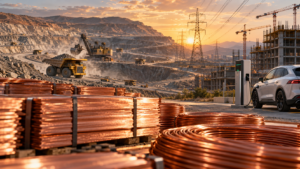
The global copper industry will need approximately $332 billion in new investment in mining projects by 2050 to prevent a large-scale shortage of the metal, which could reach 20 million tonnes per year, or 44% of projected demand. This is stated in the Transition Metals Outlook 2026 study by analytical company BloombergNEF (BNEF), published on October 20, 2026.
According to the forecast, the global copper market could face a deficit as early as 2028, as the expansion of mining capacity lags behind consumption growth. The main drivers of increasing demand will be the electrification of transport, modernization of power grids, industrial development, and infrastructure construction.
BNEF analysts expect global copper consumption to increase by 61% by 2050 compared with 2026, reaching almost 46 million tonnes.
At the same time, demand for copper associated with the electrification of the economy will grow by 89%, to 23.3 million tonnes. Thus, these areas will account for more than half of global metal consumption.
Electric transportation will become the fastest-growing segment. Copper use in electric cars, electric trucks, buses, and related infrastructure will increase by 244%, reaching 11.4 million tonnes by the middle of the century.
Copper is essential for the production of electric motors, inverters, batteries, high-voltage wiring, and charging stations. In addition, the metal is widely used in construction, industrial equipment, electrical grids, and consumer electronics.
According to BloombergNEF estimates, existing global copper ore reserves are sufficient to meet long-term needs, but the problem lies in the insufficient pace of developing new deposits and expanding existing operations.
The average period from the start of project development to the commissioning of a new copper mine is approximately 17 years. As a result, even with the necessary $332 billion in investment, the metal shortage could persist until at least 2043.
Additional challenges arise from declining copper grades in mined ore, rising production costs, and insufficient funding for geological exploration in previous years.
Without new capital investment, global copper supply could decline by 14.5%, from 30 million tonnes in 2026 to 25.7 million tonnes in 2050. The development of copper scrap recycling will partially offset the decline in primary production but will not be able to completely eliminate the projected shortage.
Chile, according to BloombergNEF’s forecast, will retain its status as the largest producer of primary copper. However, production in the country could decline from 5.8 million tonnes in 2026 to 4.8 million tonnes in 2050.
Despite the decline in absolute production volumes, Chile’s share of global primary copper production could increase from 24% to 28%, as reductions in other countries will be more significant.
Analysts warn that a prolonged copper shortage could lead to higher global prices and increased costs for energy equipment, electric transportation, and infrastructure projects. In certain segments, manufacturers may be forced to make greater use of alternative materials.
Martin Tengler, head of metals and mining research at BloombergNEF, noted that the situation regarding the supply of raw materials to the global economy has changed significantly compared with previous forecasts.
According to him, the development of new production capacity and improvements in battery technologies have reduced the risks of shortages of most energy transition metals. However, the main challenge is becoming ensuring the availability of the necessary materials in specific regions and at the required times.
At the same time, copper remains the main exception to the overall trend of improving forecasts.
According to Transition Metals Outlook 2026, nine of the ten metals and materials studied could potentially have sufficient production capacity by 2050, provided investment continues and depleted reserves are replaced.
In particular, global lithium consumption is expected to nearly triple, from 1.6 million to 4.8 million tonnes of lithium carbonate equivalent, while demand for graphite will more than double, from 3.3 million to 6.9 million tonnes.
At the same time, the increasing adoption of lithium iron phosphate batteries is reducing the expected need for nickel and cobalt compared with previous forecasts.
China continues to dominate the processing of energy transition metals. According to BloombergNEF, for eight of the ten materials studied, more than half of global processing capacity is concentrated in a single country, and for seven of these materials, that country is China.
The Experts Club analytical center has produced a video overview of the world’s largest copper-producing countries and a comparison of copper production from 1971 to 2025.
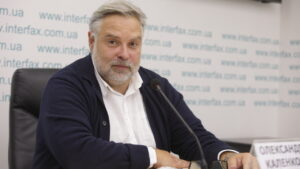
If the Cabinet of Ministers gives priority in rail transport to oil and fuel, then metal products should be given the same priority, said Oleksandr Kalenkov, president of the Ukrmetallurgprom Public Organization, in a post on the organization’s website.
According to him, the government is drafting a resolution that will give priority on railways, in ports, and at the border to two types of cargo: fuel and vegetable oil.
“There are no issues with fuel. Without it, businesses cannot operate, and the country will not survive the winter. But the fact that vegetable oil ended up second on the list—and metallurgy isn’t even on it—surprised me, to be honest,” Kalenkov wrote.
He added that the draft’s authors explain their choice by citing high added value and foreign exchange earnings. “I agree with that. But based on precisely these criteria, the metallurgical industry should have been among the first on the list. In 2025, our industry accounted for about 5.5% of GDP, 150 billion hryvnias in taxes, and $6 billion in foreign exchange earnings,” stated the head of “Ukrmetallurgprom.”
Kalenkov emphasized that today, steelworkers are operating under constant shelling and are on the brink of survival. Since July, seaports have been effectively closed. Now, the railway crossings on the western border and the Danube are our only route to customers. The cost of transporting raw materials has risen from $30 to $68 per metric ton of product.
“Europe needs Ukrainian steel. Our main advantage over Asian competitors lies in speed: we deliver in days or weeks, not months. Therefore, every day spent waiting in line at the border translates into lost revenue for the state. On behalf of the industry, we have officially appealed to the Prime Minister to include metal products in this pilot program under the same conditions as fuel and oil. If the state sets priorities based on added value and foreign exchange, the steel industry must be on that list,” concluded the president of the “Ukrmetallurgprom” Association.

In January–September 2026, Ukraine imported 34,270 metric tons of manganese ore worth $5.309 million, whereas during the same period in 2025, there were no imports of this raw material, according to statistics from the State Customs Service.
In the first nine months of this year, the physical volume of imports has already reached 92.6% of the total for all of 2025. Last year, Ukraine purchased 37,006 thousand metric tons of manganese ore abroad for $5.546 million, with all shipments taking place in November.
Imports in 2026 picked up significantly in August and September. While Ukraine imported approximately 10,900 metric tons of ore over the first seven months, imports rose to 23,099 metric tons over eight months and to 34,270 metric tons over nine months.
Thus, in September alone, the country imported 11,171 metric tons of manganese ore with an estimated value of $1.731 million. In August, imports totaled approximately 12,198 metric tons, meaning they declined by about 8.4% in September.
Ghana was the main supplier of manganese ore to Ukraine in 2025. In January–July 2026, it also accounted for virtually the entire volume of imports: 10,896 thousand metric tons worth $1.677 million. Another approximately 5 metric tons worth $3 thousand were imported from China. The geography of shipments for the full nine months requires clarification based on detailed customs statistics.
At the same time, Ukraine is increasing its own exports of manganese ore. In January–September 2026, 36,598 thousand metric tons of ore worth $6,393 million were shipped abroad.
Thus, the physical volume of exports over the nine-month period exceeded imports by only 2,328 thousand metric tons, and the trade surplus for this commodity group amounted to approximately $1,084 million.
The estimated average customs value of imported manganese ore was about $155 per metric ton, while that of exported ore was $175 per metric ton. However, without information on the chemical composition and quality of the raw materials, these figures cannot be used for a direct comparison of market prices.
The increase in imports is occurring as some Ukrainian ferroalloy plants resume operations following a production shutdown in 2023.
The Nikopol and Zaporizhzhia ferroalloy plants suspended ferroalloy smelting at the end of 2023 following the cessation of manganese ore mining at the Pokrovsk and Marganets mining and processing complexes. In the summer of 2024, the ferroalloy plants partially resumed production.
Manganese ore is the primary raw material for the production of ferromanganese and silicomanganese, which are used in ferrous metallurgy for deoxidizing and alloying steel. At the same time, foreign trade statistics alone do not allow us to determine what proportion of the imported ore was actually processed by Ukrainian enterprises.
In January–September 2026, Ukraine increased its manganese ore exports by 3.76 times compared to the same period last year—to 36,598 thousand metric tons from 9,739 thousand metric tons, according to data from the State Customs Service.
In monetary terms, exports nearly quadrupled—to $6.393 million compared to $1.615 million over the first nine months of 2025. Thus, foreign exchange earnings increased by 296%, while the physical volume of shipments rose by 276%.
As of the end of the first nine months of this year, Ukraine has already exceeded the volume of manganese ore exports for the entire year 2025 by 64.3%. Last year, 22,281 thousand metric tons of this raw material were shipped abroad, worth $3.599 million.
At the same time, export revenue for January–September 2026 exceeded the total for all of last year by 77.6%.
The estimated average customs value of exported manganese ore for the first nine months of this year was approximately $175 per metric ton, compared to $166 per metric ton for the same period in 2025. Thus, the increase in foreign exchange earnings was driven primarily by growth in the physical volume of exports.
September was the busiest month of the current year, with Ukraine shipping 8.44 thousand metric tons of manganese ore abroad. This is 2.4 times more than in August and nearly 4.9 times more than in September of last year.
In 2025, Slovakia was the largest foreign market for Ukrainian manganese ore, accounting for 99.22% of export revenue. Poland accounted for another 0.78% of revenue.
The recovery in exports is taking place against the backdrop of a gradual resumption of manganese concentrate production in Ukraine. Specifically, the Pokrovsk Mining and Processing Plant produced 63.9 thousand metric tons of concentrate in 2025 following a shutdown in 2024.
In its previously approved production plans for 2026, the plant projected a 3.44-fold increase in concentrate output—to 220,000 metric tons. Actual fulfillment of this annual plan currently requires confirmation based on the results of the reporting period.
The Pokrovsky Mining and Processing Plant is one of the leading producers of manganese ore in Ukraine. The company engages in open-pit mining of oxide, carbonate, and oxide-carbonate ores, as well as their beneficiation and the production of manganese concentrate and sinter. The main domestic consumers of these products are enterprises in the ferroalloy industry.
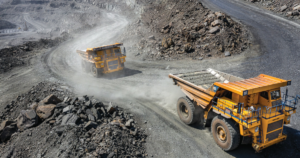
In January–September of this year, Ukraine’s mining companies reduced exports of iron ore raw materials (IORM) by 29.8% in volume terms compared to the same period last year—down to 16,948,958 metric tons from 24,145,038 metric tons.
According to statistics released by the State Customs Service (SCS), 1,174,008 thousand metric tons of iron ore were exported in September, 1,865,697 thousand metric tons in August, 1,875,428 thousand metric tons in July, in June—2,021,299 metric tons; in May—2,239,167 metric tons of raw materials; in April—2,163,837 metric tons; in March—2,300,467 metric tons; in February – 1,254,516 thousand metric tons, in January – 2,054,539 thousand metric tons.
Over the first nine months of 2026, foreign exchange earnings from mineral ore exports decreased by 29% to $1,286,304 million.
In addition, Ukraine imported 246 metric tons of raw materials worth $74,000 in January–September 2026, whereas in January–September 2025, it imported 107,000 metric tons worth $80,000.
As previously reported, Ukraine’s mining companies reduced ore exports in physical terms by 8% in 2025 compared to the previous year—to 30,995,363 metric tons from 33,699,722 metric tons, and foreign exchange earnings decreased by 16.6%—to $2 billion 337.765 million from $2 billion 803.223 million. Exports were primarily shipped to China (44.98% of shipments in monetary terms), Slovakia (17.15%), and Poland (16.09%).
In addition, in 2025, Ukraine imported $95,000 worth of raw materials totaling 130 metric tons from the Netherlands (46.32%), Italy (36.84%), and Norway (13.68%), whereas in the previous year it imported 2,042 metric tons worth $414,000
EXPORTS, IRON ORE, METALLURGY, mining and metallurgical complex, UKRAINE



