
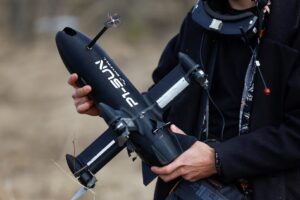
The US and Qatar are negotiating the possible purchase of Ukrainian interceptor drones designed to destroy Shahed-type strike UAVs, amid growing interest among allies in cheaper air defense systems, Reuters reports.
According to the agency, the talks concern, in particular, SkyFall’s P1-SUN interceptor. A company representative told Reuters that deliveries are only possible with the “green light” from the Ukrainian government and on condition that the export does not reduce Ukraine’s ability to defend itself.
Reuters notes that SkyFall’s production capacity allows it to produce up to 50,000 interceptors per month, and potential exports without harming Ukraine’s needs are estimated at 5,000-10,000 units.
The effectiveness of this class of air defense systems is confirmed by Ukrainian statistics: according to the Ukrainian military, in February, 70% of drones shot down in and around Kyiv were destroyed by interceptor drones.
The cost of interceptors is significantly lower than traditional air defense systems. Reuters reports that SkyFall sells the P1-SUN to the Ukrainian military for approximately $1,000 (depending on the configuration), while PAC-3 missiles for the Patriot system can cost up to $4 million per unit.
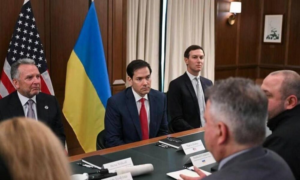
The United States and Ukraine discussed during talks an “ambitious goal” of agreeing on a draft peace agreement with Russia by March 2026, although the timeline could shift due to the lack of agreements on key issues, Reuters reported, citing sources familiar with the course of the consultations.
According to the agency, the framework under discussion envisages putting a possible agreement to a nationwide referendum in Ukraine and holding nationwide elections on the same day. Two Reuters sources said May was discussed as a benchmark, however several interlocutors called such a schedule “fantastic.”
Reuters separately points to practical and legal constraints: holding nationwide elections in Ukraine is prohibited during martial law, and election organizers previously assessed that preparing a vote under current conditions would require about six months and legislative changes. In addition, Kyiv, according to the agency’s sources, insists that a ceasefire regime is needed for the campaign in order to ensure the integrity of the vote.
In parallel, Ukrainian President Volodymyr Zelenskyy said the United States would like to find a solution to end the war “by summer,” and Foreign Minister Andrii Sybiha told Reuters that Kyiv seeks to speed up the negotiation process, calling the U.S. role key to reaching a final agreement.
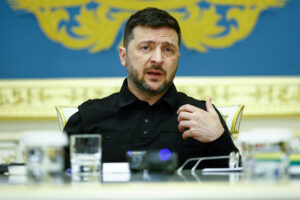
In an evening address, Ukrainian President Volodymyr Zelensky announced that the Ukrainian negotiating team will hold a preparatory meeting tomorrow to agree on the framework for future negotiations and all organizational details, and on Monday, February 2, will travel to the United Arab Emirates to participate in trilateral negotiations scheduled for Wednesday and Thursday of next week.
“There was a report from our negotiating team. An agreement has already been reached on a trilateral meeting at the appropriate level. This meeting will take place next week, as planned, on Wednesday and Thursday. In the Emirates, as last time,” Zelensky emphasized.
Zelensky added that a meeting is scheduled for Monday to agree on the framework for the talks and prepare for the negotiations, and the team will set off on Monday evening.
“Many leaders and different countries are with us in this process, supporting Ukraine, and we are coordinating on a daily basis. In February, we will be quite active in foreign policy, and starting tomorrow, we will have contacts and meetings,” the president said in a statement.
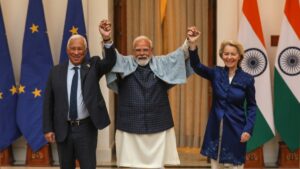
India and the European Union announced the conclusion of negotiations on a free trade agreement (FTA) following the summit in New Delhi.
According to the European Commission, trade liberalization will cover 99.3% for the EU and 96.6% for India (taking into account the partial liberalization of a number of items), with the EU eliminating tariffs on more than 90% of tariff lines and India on 86%.
The Indian side stated that the agreement provides access to the EU market for more than 99% of Indian exports in value terms, noting that the document will undergo legal review and final approval procedures.
According to EU profile materials, European agri-food exports will see a reduction in current high tariffs, including on alcoholic beverages—up to 30% for most wines, 40% for spirits, and 50% for beer. A number of Indian and industry sources also indicate that for certain categories, including passenger cars, tariffs may be reduced from 110% to 10% within an annual quota of up to 250,000 cars, and for premium wines – up to 20%.
EU-India trade in goods in 2024 amounted to around EUR 120 billion, with India being the EU’s ninth largest trading partner; for India, the EU is the largest trading partner in goods. The Indian Ministry of Commerce and Industry estimated bilateral trade in goods with the EU in the 2024-2025 financial year at $136.54 billion.
Source: https://expertsclub.eu/indiya-ta-yes-zavershyly-peregovory-shhodo-ugody-pro-zvt/
EU, FTA, INDIA, NEGOTIATIONS
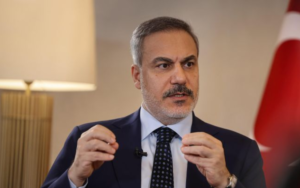
Peace talks between Russia and Ukraine may resume in Turkey, Turkish Foreign Minister Hakan Fidan said in an interview with broadcaster A Haber.
“Well, of course, we cannot go into details for reasons that you will understand, I mean, I think it (the talks – IF-U) could happen in Turkey, it could happen in other places. But this peace not only must happen, it will happen,” the minister said.
Fidan stressed that the war is now at its “darkest moment” and that both sides, according to him, are focused on destroying each other’s infrastructure. He noted that the use of drones and “kamikaze” drones makes it difficult to move around and conduct operations, and that the successes of the Ukrainian and Russian forces come at a high human cost.
On May 16, 2025, the first direct talks in more than three years between delegations from Ukraine and Russia began in Istanbul, aimed at finding ways to end the ongoing conflict.
The meeting is being held at the Dolmabahçe Palace, mediated by Turkey and attended by high-ranking US officials.
The Ukrainian delegation is led by Defense Minister Rustem Umerov. It also includes Deputy Foreign Minister Serhiy Kyslytsya, Deputy Head of the Security Service of Ukraine Oleksandr Polak, and other high-ranking representatives of law enforcement and diplomatic agencies.
The Russian side is represented by Presidential Aide Vladimir Medinsky. The delegation also includes Deputy Foreign Minister Mikhail Galuzin, Director of the Main Directorate of the General Staff (GUGS) Igor Kostyukov, and other officials.
Before the start of the bilateral talks, trilateral meetings were held: first between Turkey, the US, and Ukraine, and then between Turkey, Russia, and Ukraine. Turkish Foreign Minister Hakan Fidan and US Secretary of State Marco Rubio are also participating in the talks.
Reactions and expectations
Ukrainian President Volodymyr Zelensky expressed disappointment at the absence of Russian President Vladimir Putin from the talks, saying that the Russian delegation “has no authority to make decisions.” He stressed that Ukraine is committed to achieving a 30-day ceasefire, while Russia insists on broader negotiations, including issues of territorial concessions and renouncing NATO membership.
The United States and European countries support the initiative to establish a 30-day ceasefire. US President Donald Trump said that significant progress is only possible if he meets with President Putin in person.
International support
China has expressed support for direct talks between Russia and Ukraine, calling on all sides to reach a fair and lasting peace agreement.
Turkey, represented by President Recep Tayyip Erdogan, continues to play an active role in mediating between the parties to the conflict, providing a platform for talks and facilitating dialogue.
Despite low expectations, the start of negotiations in Istanbul is seen as an important step towards a possible peaceful settlement.



