
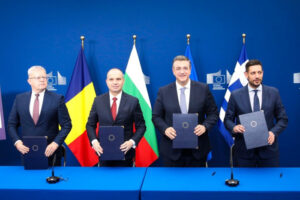
Bulgaria, Greece, and Romania have agreed to prepare a joint application for European funding for a high-speed railway line along the “Western Axis” Athens-Thessaloniki-Sofia-Bucharest, according to the Bulgarian publication Sega.
According to the publication, the initiative was discussed at a meeting between representatives of the three countries and the European Commission in the context of the development of the North-South transport corridor, which is intended to connect the Baltic, Black and Aegean Seas. The meeting was hosted by Bulgarian Deputy Prime Minister and Minister of Transport Grozdan Karadzhov.
Greek Transport Minister Konstantinos Kiranakis said that by 2027, it is planned to provide high-quality passenger rail service between Thessaloniki and Sofia, while the Bulgarian side recalled that rail service on this route was interrupted in 2017.
Karadzhov also noted that the countries intend to synchronize planning, design, and permitting procedures to avoid delays and bureaucratic obstacles. Among Bulgaria’s priorities, he highlighted the acceleration of the project for a new bridge across the Danube between Ruse and Giurgiu, as well as the preparation of projects for new bridges in the Nikopol-Turnu Măgurele and Silistra-Kelerashi areas; the restoration of ferry connections on the Danube, including the Ruse-Giurgiu line, was also mentioned.
According to Sega, Romanian Transport Ministry representative Ionut Cristian Savoiu named among Romania’s priorities the modernization of the existing Giurgiu-Ruse bridge, the construction of a new Danube bridge, and the development of road and rail lines, as well as improvements on the Vidin – Calafat – Craiova section for better connectivity with Ukraine and Moldova.

Ukrzaliznytsia received 2,000 tons of high-tech R-65 rails from Japanese manufacturer Nippon Steel, with another 1,000 tons expected to be delivered by the end of January, according to a press release from the Ministry of Community and Territorial Development on Thursday.
According to the release, this cooperation was made possible within the framework of the third phase of the emergency recovery program through the Japan International Cooperation Agency (JICA).
“This was the result of systematic interaction and successful agreements with Japanese partners on the part of the Ministry in early 2025. Ukraine currently does not have its own rail production, so attracting partner support is necessary and crucial for the functioning of the Ukrainian railway,” the ministry emphasized.
It is noted that the cooperation currently involves the transfer of 3,000 tons of rails for a total amount of about $4 million.
The ministry specified that railway workers use mobile complexes to weld rails directly on the tracks and thermally join joints, resulting in the creation of a so-called “velvet track” without joints, which increases its service life and ensures smooth train movement.
“We are sincerely grateful to the Government of Japan for its strategic support, which allows us not only to maintain the network, but also to carry out major repairs in accordance with the highest international standards, ensuring reliable connections even in the most difficult times,” said Marina Denisyuk, Deputy Minister of Community and Territorial Development, in a press release.
The Ministry of Development recalled that support from the Japanese government and JICA has continued since the beginning of the full-scale invasion by the Russian Federation. In particular, during this period, almost 25,000 tons of rails have been delivered, which has made it possible to renovate more than 193 km of tracks on strategic routes of the Lviv, South-Western, Dnipro, Southern, and Odesa railways.
In addition, railway workers also received 24 units of construction and loading/unloading equipment from Komatsu, Toyota, and Sonalika, 22 of which were track equipment, and the total cost of equipment and materials supplied during the first two phases of the program exceeded $42 million, the agency noted.
“The delivered equipment, namely wheel excavators, loaders, and bulldozers, has already worked more than 13,000 motor hours on emergency repair work,” the agency emphasized.
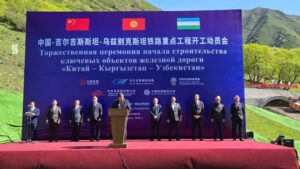
In the Suzak district of the Jalal-Abad region of Kyrgyzstan, construction has officially begun on major railway facilities for the China-Kyrgyzstan-Uzbekistan railway.
As part of the construction of this railway, three tunnels with a total length of over 10 km are planned to be built, including: Tunnel No. 1 Naryn (Jaman-Dawan) – 12.5 km; Koshtoba (Kazarman) tunnel – 13.2 km; Fergana mountain tunnel – 12.2 km. The total length of this railway project is 532.53 km.
CHINA, CONSTRUCTION, KYRGYZSTAN, RAILWAY, tunnels, UZBEKISTAN
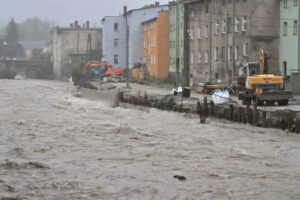
Railroad operators in the Czech Republic and Poland have temporarily canceled a number of flights due to flooding, including, according to Czech RegioJet, a temporary suspension of traffic on the section between Ostrava and Olomouc, Czech Republic, which is used by the company’s trains from Prague to Przemysl and Chop.
“We ask all passengers to postpone their current trips between Ostrava and Olomouc or Przeworów. We will inform you about further developments,” the company said on its website.
For its part, Ukrzaliznytsia clarified that as of now, both RegioJet trains from Prague to Chop and Przemysl are still in the Czech Republic and have no chance of catching their connecting Ukrainian flights.
“Therefore, we remind you that we are ready to accept passengers with tickets for today’s trains for any of our flights of the same destination in the next day to any available seats without exchanging tickets,” the Ukrainian railroad operator said.
As for passengers from Ukraine traveling to their connection in the Prague direction, Ukrzaliznytsia recommended contacting the Czech or Polish railway operator to clarify the schedule of the next flights.
“There is a high probability that passengers should plan to spend the night in the city of connection,” UZ said.
Minister of Infrastructure of Ukraine Oleksandr Kubrakov during the forum in Lugano (Switzerland) on Tuesday, July 5, presented a number of planned projects for the development of the country’s railway export infrastructure.
According to the information in the presentation that Kubrakov presented, in particular, among the projects: construction of new and modernization of existing railway lines (both 1435 and 1520 mm) in the direction of the border with the EU and the seaports of the Danube; modernization of rolling stock for freight traffic; modernization of equipment for changing the gauge.
The total cost of these projects is $1.5 billion.
Hungary has included the railway in the list of possible transit routes for Ukrainian citizens, Ukrainian Foreign Minister Dmytro Kuleba said.
“A week ago, Peter Szijjarto and I agreed that Hungary would allow transit to Austria for Ukrainians traveling by train. The Hungarian government has fulfilled the agreement and included the railway in transit routes just when the visa-free regime is being restored. We are expanding the freedom of travel of Ukrainians,” Kuleba wrote in Twitter on Thursday.



