

Greece has more than 2.2 million vacant homes, accounting for 34.5% of the country’s total housing stock—one of the highest rates in Europe, according to a study by the Parliamentary Budget Office based on data from the 2021 ELSTAT census.
The study’s authors note that the problem in the Greek housing market is linked not only to a lack of new construction but also to the low utilization rate of existing housing stock. While the total number of residential properties increased by 3.5% between 2011 and 2021, the number of homes available for long-term rent decreased by 10.4%, and those listed for sale fell by 33.1%. The number of inactive vacant properties—those not offered for either rent or sale—rose to 1.81 million.
The category of vacant housing includes not only potential properties for purchase or rent, but also second homes, summer cottages, older housing stock, properties in rural areas and on islands, as well as real estate taken off the market due to legal, inheritance, or technical issues. Among the reasons why housing does not return to the market, the study cites inheritance disputes, unclear ownership status, legal complications, high renovation costs, low energy efficiency, and limited demand in certain regions.
For investors, this market structure creates opportunities primarily in the segments of older housing stock, redevelopment, and renovation. Properties that remain vacant due to owners’ reluctance to invest in modernization may enter the market at a discount; however, their investment appeal depends on the total cost after renovation and the potential market price upon sale or long-term lease.
Government support for renovation could be an additional factor. Greece is preparing a housing modernization program worth approximately 500 million euros, which is intended to help return some of the vacant properties to the housing market. According to Greek media reports, the program provides subsidies for repairs and energy efficiency, and eligibility checks are to be conducted via the gov.gr platform.
At the same time, investors should factor in the risk of price adjustments. According to the study’s authors, if the share of vacant and inactive housing returns to 2001 levels within approximately six years, real housing prices in Greece could fall by 15.5–24.6%. This does not imply an automatic collapse of the entire market; however, overvalued properties and locations with limited demand may prove to be the most vulnerable.
The Greek real estate market continues to appreciate for now, but the pace of growth is slowing. According to the Bank of Greece, apartment prices rose by 5.7% year-over-year in the first quarter of 2026, following increases of 8.1% in 2025 and 9.1% in 2024. In Athens, growth in the first quarter was 5.2%, and in Thessaloniki, 6.4%.
Relying solely on short-term rentals and the Golden Visa program as the sole rationale for a transaction remains a risk. Research indicates that the impact of short-term rentals on the market as a whole may be limited; however, in central areas of Athens and Thessaloniki, as well as popular tourist destinations, they are increasing pressure on the long-term housing market. Therefore, a high-quality asset is not a property purchased solely for a residence permit or Airbnb purposes, but rather a property with a clear legal history, an estimated renovation cost, and sustained demand once it is brought to market.

According to Experts.news, the gap between what buyers most often want to purchase and what sellers are offering is widening in the Ukrainian housing market, as noted in the NBU’s June Financial Stability Report.
According to the regulator, the average size of a purchased apartment remains at 48 square meters, and that of a house at about 70 square meters. At the same time, the supply continues to be dominated by more spacious apartments: their average size exceeds 65 square meters.
The discrepancy is also evident in the age of the properties. Buyers more often choose older and, consequently, more affordable apartments. In Kyiv, the median age of purchased apartments has risen to 33 years, and in the western regions, to 39 years. In real estate listings, by contrast, nearly two-thirds of apartments are offered in buildings constructed less than 15 years ago.
The NBU notes that such discrepancies between supply and demand are holding back market activity. Buyers are more interested in smaller and cheaper housing, while sellers and developers more often offer newer and more spacious properties.
This trend is also significant for developers. In the western regions and the suburbs of Kyiv, budget-friendly projects are more common, while business-class projects predominate in the capital. However, demand during wartime indicates that the average buyer is more often looking for a compact and more affordable option.
In the second half of 2025, residential construction picked up: in most regions, the planned floor area of apartment buildings where construction had begun increased significantly. Across Ukraine as a whole, this figure rose by one and a half times over the year, and in Kyiv—by more than double.
However, the NBU notes that developers continue to finance the completion of existing complexes and new projects largely with their own funds. Banks are reluctant to lend to the construction sector due to high risks.
The main takeaway for the market: further recovery in sales will depend not only on household income but also on how closely supply aligns with actual demand—in terms of square footage, price, age of the property, and level of risk for the buyer.

According to Experts.new, following a period of relative calm, housing prices in Ukraine have begun to rise again, as stated in the National Bank of Ukraine’s June Financial Stability Report.
According to the NBU, housing prices have risen over the past six months. In the primary market, advertised prices increased roughly in proportion to the hryvnia’s devaluation, as real estate prices in Ukraine are traditionally quoted in U.S. dollars. In the secondary market, the increase was faster—5–10 percentage points higher than the devaluation.
An additional factor was the sharp rise in the cost of construction due to a surge in fuel prices. This intensified upward pressure on prices for new construction and limited developers’ ability to keep prices at previous levels.
At the same time, the NBU notes that housing prices remain historically low relative to household incomes. In the first quarter of 2026, the housing price-to-income ratio stood at 8.7x for the primary market and 8.6x for the secondary market.
The situation is different in the rental market. Due to winter attacks on energy infrastructure and the associated risks, the growth in rental rates has slowed. In Kyiv, the south, and the center of the country, rental costs have remained virtually unchanged since last fall. Price increases continued mainly in the western regions.
The price-to-rent ratio for secondary housing rose slightly in the first quarter to 10.4x, but still did not exceed the long-term average.
For buyers, this means that housing remains relatively affordable by historical standards, but uncertainty, security concerns, and the state of the energy infrastructure continue to limit demand. For investors, the situation is less clear-cut: rising purchase prices coupled with nearly stable rents reduce the short-term appeal of buying housing for rental purposes, especially in Kyiv and the central regions.
In the medium term, market dynamics will depend on the hryvnia exchange rate, the cost of construction, security, the state of the energy sector, and the resumption of mortgage lending.
HOUSING, NBU, PRICE, REAL ESTATE, rent

Turkey’s residential real estate market continues to show nominal price growth, but taking inflation into account, housing is in fact continuing to become cheaper, according to market data.
According to analysts, the average price per square meter of housing across the country has reached 40.486 thousand Turkish lira, or about $872. The average cost of a residential real estate property is estimated at approximately 5.02 million lira, or about $108.1 thousand.
In nominal terms, housing prices increased by 23.8% year-on-year. However, after adjustment for inflation, the real dynamics moved into negative territory and amounted to about 6.5%.
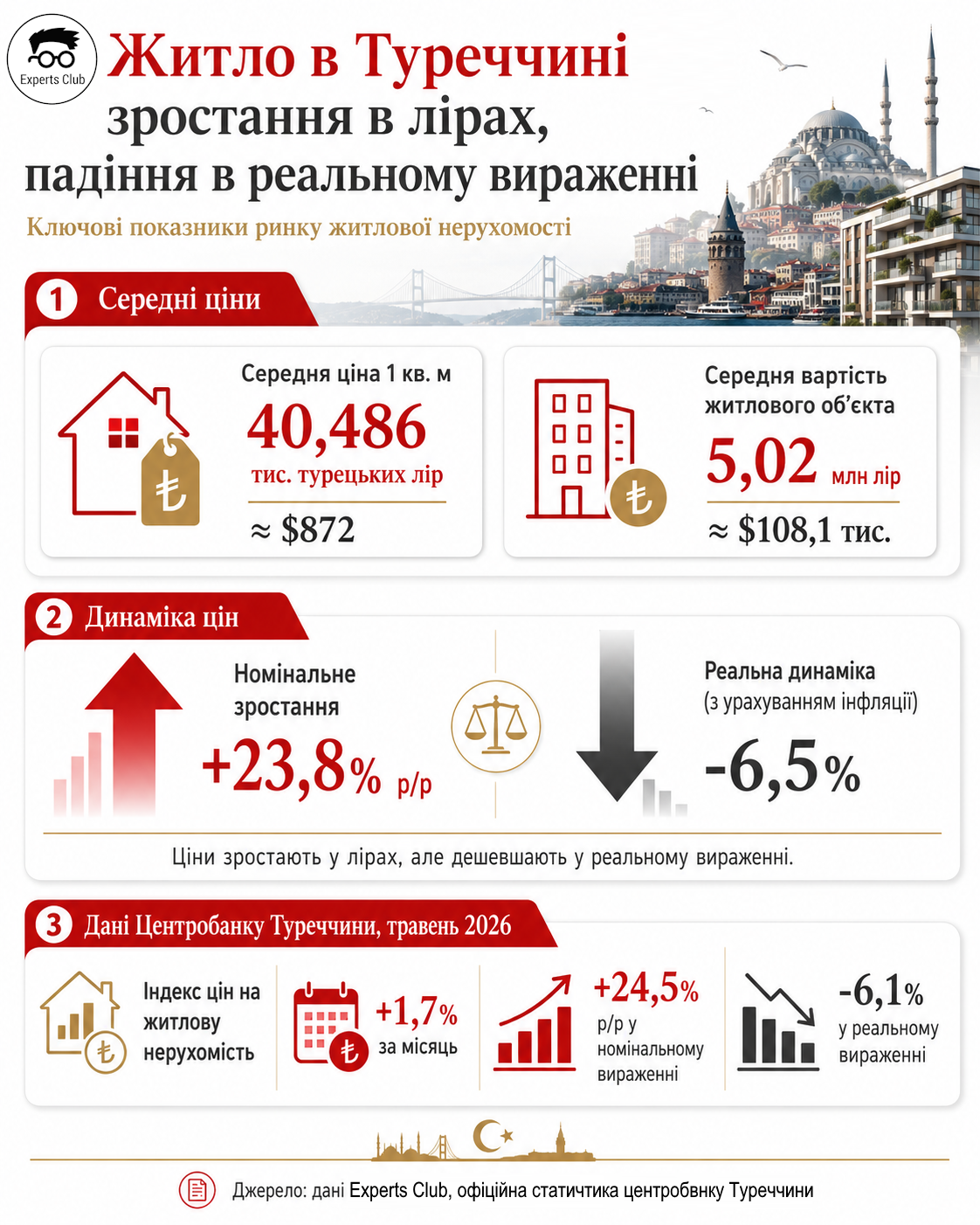
Official statistics from the Central Bank of Turkey confirm this trend. In May 2026, the residential real estate price index increased by 1.7% month-on-month and by 24.5% year-on-year in nominal terms, but declined by 6.1% in real terms.
This means that, for buyers and investors, price growth in lira is not the same as growth in the value of the asset. Against the background of high inflation, real estate may look more expensive in the national currency, but lose purchasing value in real terms.
The average payback period for housing through rental income in Turkey is currently estimated at approximately 13 years. However, the situation differs significantly by region. In large cities and resort locations, housing prices have often grown faster than rental rates, so the yield of such properties is becoming lower.
This gap is especially noticeable in popular tourist regions, including Muğla and parts of the coast, where the cost of land and housing remains high, while rent does not always keep pace with sale prices. In such locations, buying real estate increasingly requires not only calculating potential income, but also assessing the liquidity of the property, maintenance costs and currency risks.
For foreign buyers, the situation has become less clear-cut. After the boom of 2021-2023, the Turkish market no longer looks like a market of guaranteed rapid growth. High interest rates, inflation, the weakening of the lira, changes in residence permit rules and cooling demand from foreigners are making investment decisions more complex.
At the same time, Turkey remains one of the largest real estate markets in the region. Demand is supported by domestic buyers, tenants in large cities, tourist regions, as well as interest in housing as a way to protect savings from inflation. However, the market is becoming more selective: liquidity is being maintained primarily by quality properties in strong locations.
For investors, the main conclusion is that Turkish real estate can no longer be assessed only by nominal growth in lira. It is more important to look at dynamics in foreign currency, real yield adjusted for inflation, maintenance costs, rental demand and resale prospects.
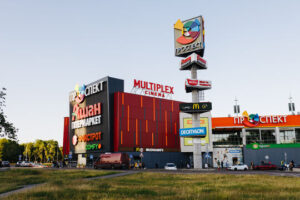
The Arricano Group plans to upgrade the generators at all of its shopping malls in Ukraine, with investments in the project totaling over UAH 50 million, according to Anna Chubotina, CEO of Arricano Real Estate LLC.
“We understand that each facility must have several generators—in case one fails, another must be able to meet the significant power needs of all tenants. Currently, our confirmed investments in generator upgrades will total over UAH 50 million across all projects, including those in Zaporizhzhia and Kryvyi Rih,” she said at the RAU Expo 2026 conference in Kyiv on Thursday.
According to Chubotina, Arricano is considering the possibility of installing a solar power plant at one of its shopping centers in Kyiv. The company plans to implement this project with its own investments next year.
She emphasized that it is important to increase both energy independence and energy efficiency of facilities, which will reduce the burden on shopping center tenants.
“On the one hand, we must ensure the uninterrupted operation of the shopping center, and on the other, reduce the burden on our tenants. Whoever can find this balance will continue to operate successfully,” explained the company’s CEO.
Arricano expects to resume active construction of the Lukianivka shopping and entertainment center in Kyiv after the full-scale war ends, Chubotina noted.
“Currently, our facility is undamaged. It is a priority to resume this project and our plans for the reconstruction of regional facilities once the war ends,” she said.
Arricano Real Estate PLC (Cyprus), through its Ukrainian subsidiaries, owns four shopping centers in Ukraine: the Prospekt shopping center and the RayON shopping center in Kyiv, the CITY MALL shopping center in Zaporizhzhia, and the Soniachna Galereya shopping center in Kryvyi Rih. The company also owns a 49.9% stake in the Sky Mall shopping center (Kyiv) and land plots for the future construction of three properties currently in the design phase. The company is also constructing the Lukianivka shopping center in Kyiv.
ARRICANO, ENERGY INDEPENDENCE, generators, REAL ESTATE, SHOPPING CENTERS

Viking Park LLC (Lviv) raised UAH 3.6 million from the placement of its debut bonds, the company reported in its issuance results report.
According to information published in the disclosure system of the National Securities and Stock Market Commission, the bond offering via a public offering took place from April 16 to April 30, 2026. The face value of the bonds is UAH 1,000, with a total value of UAH 100 million.
The total number of bonds actually placed was 3,627.
According to the company’s website, Viking Park LLC conducts development activities under the Viking Development brand. Its portfolio includes over 30,000 square meters of completed residential space in Lviv. Among its projects are the Viking Park, Viking Hills, Viking Gardens, and Helga residential complexes. According to information on the “LUN” real estate portal, since 2019 the developer has commissioned 13 buildings comprising two complexes, while another nine buildings in three residential complexes are currently under construction.
According to data from the YouControl analytical system, the owners of Viking Park LLC are listed as Teplokom LLC (88%) and ZNVKIF “Mira-Capital” JSC (12%). The ultimate beneficiary is Ernest Ishchuk.
As of the end of 2025, the company increased its net profit by 4.4% to UAH 4.8 million, while net revenue decreased by 18.4% to UAH 168.7 million. Assets nearly doubled to UAH 1.8 billion.