
Ukraine’s postwar reconstruction should involve not only the rebuilding of destroyed infrastructure and enterprises, but also a structural transformation of the economy—specifically, a shift from a raw materials-based model to the production of high-value-added goods. This was stated by expert Stakovychenko Igor, according to the publication “Glavred.”
In his assessment, the reconstruction could serve as an opportunity for the technological modernization of Ukrainian industry, increasing productivity, and strengthening the competitiveness of domestic enterprises in international markets.
“Ukraine’s post-war reconstruction is not just the largest infrastructure project in the history of the independent state. It is a chance to change the structure of the national economy, to transition from a raw materials-based model to the production of high-value-added goods,” Stakovichenko noted.
According to a joint assessment by the Ukrainian government, the World Bank, the European Commission, and the UN, released in February 2026, the country’s needs for recovery and reconstruction over the next decade amount to nearly $588 billion.
Transportation infrastructure, the energy sector, housing, industry, and the agricultural sector will require the largest investments. At the same time, recovery efforts must continue even before the war ends, despite security risks.
Among the main challenges for the economy, experts highlight not only physical destruction but also a shrinking labor force, a shortage of skilled workers, logistical constraints, and insufficient access to financing. Under these conditions, restoring production capacity alone will not guarantee its effective operation.
Promising areas for development could include agricultural processing, energy, information technology, and the defense industry. In particular, the modernization of energy infrastructure creates opportunities for the development of distributed generation and improved energy efficiency, while defense technologies could serve as the foundation for establishing new high-tech manufacturing facilities.
At the same time, the private sector will remain a key factor in the country’s recovery. International financial assistance is necessary to overcome the consequences of the war; however, long-term economic growth will also require private investment, job creation, and the expansion of export capacity.
To attract capital, Ukraine must ensure the protection of property rights, access to credit, a predictable tax policy, a reduction in administrative burdens on entrepreneurs, and an effective judicial system.
According to Stakovichenko, the key criterion for successful reconstruction should not be the number of restored facilities or the amount of funds disbursed, but rather the economy’s ability to create new industries, jobs, and added value.
Thus, post-war reconstruction could serve as a tool for Ukraine’s transition to a more modern economic model focused on technology, productivity, and competitive manufacturing.
ECONOMY, INDUSTRY, INVESTMENT, RECONSTRUCTION, UKRAINE, СТАКОВИЧЕНКО
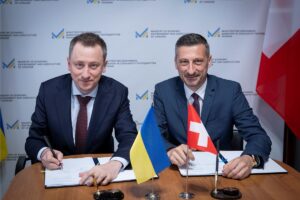
On October 15, 2026, the Swiss city of Aarau hosted the “Wiederaufbau Ukraine” Export Forum, an economic forum dedicated to engaging Swiss companies in Ukraine’s reconstruction, developing bilateral trade, and implementing joint investment projects.
According to the Embassy of Ukraine in Switzerland, the event was organized by the Aargau Chamber of Commerce and Industry (AIHK). The forum was attended by representatives of the Ukrainian diplomatic mission, Swiss government agencies, the business community, and experts in international trade.
Representatives of the Swiss State Secretariat for Economic Affairs (SECO) and Switzerland Global Enterprise (S-GE) presented opportunities in the Ukrainian market, the experience of Swiss companies operating in Ukraine, and government mechanisms for supporting private investment.
In particular, Silvio Girou, SECO’s representative on infrastructure financing, and Xavier Cornu, a consultant at Switzerland Global Enterprise specializing in Europe and the CIS countries, addressed the participants.
The main focus was on engaging Swiss companies in the reconstruction of Ukraine’s infrastructure, expanding industrial cooperation, and utilizing financial instruments to support business. The forum also served as a platform for establishing direct contacts between Swiss entrepreneurs and representatives of organizations that facilitate international investment projects.
The event took place against the backdrop of the expansion of Switzerland’s government program to support the reconstruction of the Ukrainian economy.
According to the 2025–2028 cooperation program with Ukraine, the Swiss government has allocated over CHF1.5 billion to finance reconstruction, reforms, and sustainable development projects. Of this amount, CHF500 million is earmarked to support Swiss private-sector projects in Ukraine.
Specifically, on October 2, 2026, the Swiss Federal Council approved funding for eight additional projects by Swiss companies totaling CHF135 million. These projects relate to energy, public transportation, and water supply.
The projects were selected on a competitive basis with the participation of representatives from the Ukrainian and Swiss governments. Companies receiving funding must provide their own contribution of at least 10% of the project’s implementation cost.
In addition, on October 9, 2026, a bilateral agreement between Ukraine and Switzerland on cooperation in the reconstruction process entered into force. The document establishes a legal framework for expanding the participation of Swiss companies in the recovery of Ukraine’s economy and infrastructure.
A separate area of support involves financing investments in the creation and modernization of production facilities in Ukraine. In May 2026, SECO announced a call for proposals with a budget of up to CHF 50 million for Swiss companies already operating in the Ukrainian market. Support for an individual project ranges from CHF 3 million to CHF 10 million, provided that the company finances at least half of the project’s cost. The selection of such projects will continue until spring 2027.
According to the Embassy of Ukraine in Switzerland, developing cooperation with local chambers of commerce and industry and business associations creates additional opportunities to attract the investments, technologies, and equipment needed for the country’s reconstruction.
Switzerland Global Enterprise is the official Swiss organization for promoting exports and the international activities of businesses. It helps companies enter foreign markets, find business partners, and evaluate investment opportunities. SECO is responsible for implementing Switzerland’s economic policy and participates in financing international development and reconstruction programs.
The international forum “Rebuilding Ukraine: Security, Opportunities, Investment” will take place on October 22–23, 2026, in Bucharest, Romania, at the ROMEXPO exhibition center, Pavilion C2. The event will bring together representatives of government agencies from Ukraine, Romania, and other European countries, as well as international financial organizations, investors, the business community, and experts.
The forum is organized by the Romanian think tank New Strategy Center in partnership with the Romanian Chamber of Commerce and Industry. The academic partner of the event is the University of Agronomic Sciences and Veterinary Medicine in Bucharest (USAMV).
According to the updated program, 31 thematic panel discussions are scheduled over the course of two days, focusing on attracting international capital for Ukraine’s reconstruction, the development of transportation and energy infrastructure, industrial cooperation, defense technologies, food security, and cross-border cooperation.
One of the forum’s key focuses will be a discussion of Romania’s role as a regional logistics and investment hub for Ukraine’s reconstruction. In particular, participants will examine the prospects for developing transport corridors between Ukraine, Romania, and Moldova, expanding the capacity of Danube ports, and creating new rail and road routes between the Baltic and Black Seas.
Special attention will be given to investment opportunities in Ukrainian regions. The program includes special presentations on projects in the Kyiv, Zakarpattia, Ivano-Frankivsk, Vinnytsia, Chernivtsi, Odesa, and Kherson regions. Representatives of local authorities, regional development agencies, and the business community will discuss attracting foreign investors, implementing infrastructure projects, and developing cooperation with Romanian partners.
On October 22, the main focus will be on economic recovery, financing, and investments. Participants will examine mechanisms for attracting private capital, opportunities offered by international development banks, support programs for Ukrainian businesses, and prospects for the restoration of residential and industrial infrastructure.
Among the announced participants for the first day are Gennadiy Chizhikov, President of the Ukrainian Chamber of Commerce and Industry; Marina Khlistun, Executive Director of UkraineInvest; Kateryna Glazkova, Executive Director of the Union of Ukrainian Entrepreneurs; and representatives of the European Investment Bank, the German development bank KfW, Japan’s JBIC, Poland’s BGK, and other international financial institutions.
As part of the discussion on financing reconstruction, a remote address by a representative of the Ukrainian government is scheduled. Separate panels will be dedicated to the development of the agricultural sector, ensuring global food security, the modernization of the energy sector, and the development of renewable energy sources.
Also on October 22, there will be a presentation of the “Together for Ukraine” platform, initiated by the New Strategy Center to foster cooperation and support for Ukraine.
Human capital issues will be the subject of a separate discussion featuring Ella Libanova, director of the M.V. Ptukha Institute of Demography and Social Studies of the National Academy of Sciences of Ukraine. Participants will discuss challenges related to the return of Ukrainian citizens from abroad, staffing the economy, and training specialists for reconstruction.
On October 23, the forum’s program will focus on security challenges, the development of the defense industry, energy resilience, and cross-border cooperation.
In particular, panel discussions are planned on international security guarantees for Ukraine, the prospects for ending Russian aggression, the use of unmanned systems, and the development of joint production of defense products by Ukrainian and European companies.
Participants in the discussion on security guarantees will include Igor Zhovkva, Advisor to the President of Ukraine on Foreign Policy; Kiril Petkov, former Prime Minister of Bulgaria; and representatives from the United States, Japan, and European think tanks.
A separate session will be dedicated to the reintegration of veterans and the utilization of their professional potential in economic recovery. Among the participants listed is Ruslan Prykhodko, Ukraine’s Deputy Minister for Veterans’ Affairs.
The energy segment on the second day will include discussions on preparing the Ukrainian power grid for the winter season, protecting critical infrastructure, cooperation in the Black Sea region, and prospects for involving international companies in energy projects. Among the announced participants are representatives of Naftogaz of Ukraine, OMV Petrom, ROMGAZ, Japan’s JICA, and other energy companies and organizations.
Issues related to the participation of Romanian businesses in Ukraine’s reconstruction will play a significant role in the program. A special panel will be dedicated to financial instruments, institutional support, and opportunities for implementing joint investment projects.
The forum’s concluding discussions will address the prospects for post-war security in Europe, the development of defense-industrial cooperation, Russia’s international responsibility, and mechanisms for compensating Ukraine for damages caused by the war.
The organizers note that the forum’s goal is to create a practical platform for dialogue between Ukrainian and international companies, financial institutions, and representatives of government agencies and local authorities. Particular emphasis is placed on identifying specific investment opportunities and forming partnerships aimed at Ukraine’s long-term economic recovery.
The New Strategy Center is an independent Romanian think tank specializing in security, defense, foreign policy, energy, and regional cooperation. The organization hosts international conferences and expert events dedicated to strategic challenges in the Black Sea region and Central and Eastern Europe. This forum continues a series of events on Romania’s role in Ukraine’s recovery, organized by the New Strategy Center in 2023 and 2025.
The detailed forum program and information about the participants are available on the event’s official website.
Open4Business is a media partner of the event.
Bucharest, INVESTMENT, RECONSTRUCTION, ROMANIA, UKRAINE, ЧИЖИКОВ
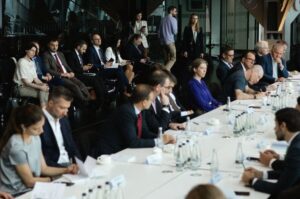
DTEK and Dragon Capital have established an investment hub to attract funding for Ukraine’s energy sector, whose funding needs are estimated at $100 billion, the energy holding company announced.
“The hub brings together representatives from the public and private sectors to develop concrete and practical solutions that will help attract more investment into Ukraine’s energy sector,” commented DTEK CEO Maksym Timchenko, whose remarks were quoted in a statement posted by the energy holding company on its Telegram channel on Friday.
It is noted that more than $100 billion may be needed to rebuild Ukraine’s energy sector and create new facilities, and the Investment Hub is intended to facilitate the attraction of these funds.
“The main goal is to make Ukraine’s energy system more modern and resilient in order to strengthen the country’s energy security,” DTEK emphasized.
As previously reported, DTEK invested 101.7 billion hryvnias in Ukraine’s energy sector from 2022 to 2025.
In total, Rinat Akhmetov’s SCM Group, which includes DTEK, has invested over $4.3 billion in Ukraine since the start of the full-scale war, of which approximately $1 billion has gone toward rebuilding facilities destroyed by Russia.
SCM is currently launching a global initiative called “Invest in Ukraine,” calling on international businesses to invest in Ukraine today, without waiting for the war to end.
The international forum “Rebuilding Ukraine: Security, Opportunities, Investment” will take place on October 22–23, 2026, at the ROMEXPO Exhibition Center in Bucharest, Romania.
The forum is organized by the New Strategy Center and the Romanian Chamber of Commerce and Industry. The event is expected to bring together representatives of government institutions from Ukraine, Romania, and other countries, as well as international financial organizations, businesses, investors, local authorities, and experts.
According to the preliminary program, the forum will last two days. The main topics of discussion will include infrastructure and transport connectivity, security and defense, financing mechanisms and business opportunities, energy, agriculture and sustainable development, the recovery of Ukrainian regions and cross-border cooperation, as well as human capital.
The forum is scheduled to open on the morning of October 22. George Scutaru, CEO of the New Strategy Center, and Mihai Daraban, President of the Romanian Chamber of Commerce and Industry, are scheduled to deliver opening remarks.
One of the first plenary discussions will be a panel titled “Business Bridges for Economic Recovery: The Strategic Role of Chambers of Commerce and Industry.” Among the confirmed participants are Gennadiy Chizhikov, President of the Ukrainian Chamber of Commerce and Industry; the heads of the chambers of commerce and industry of Romania, Poland, Italy, and Moldova; and Adrian Zuckerman, former U.S. Ambassador to Romania.
A separate segment of the program will be dedicated to the Romania-Ukraine-Moldova strategic transport and investment corridor. Representatives of the Ukrainian government, the Verkhovna Rada, UkraineInvest, and Romanian authorities are scheduled to participate in the discussion. At the same time, international mechanisms for financing reconstruction will be discussed with representatives from KfW, Poland’s BGK, and other financial institutions.
A significant portion of the forum will have a practical investment focus. Separate sessions are scheduled to present investment opportunities in the Kyiv, Zakarpattia, Ivano-Frankivsk, Vinnytsia, Chernivtsi, Odesa, and Kherson regions. The broader concept of the forum also includes the participation of the Mykolaiv region.
On the first day, discussions are also planned on the role of business associations in mobilizing capital for reconstruction, food security and Ukraine’s agricultural potential, the development of the Danube logistics hub, attracting private capital to reconstruction efforts, Black Sea security, unmanned systems, the restoration of housing and cities, Ukraine’s energy transition, and the return of human capital.
Among the announced participants in the finance panel are representatives from the European Investment Bank, the Japan Bank for International Cooperation, the Romanian Commercial Bank (BCR), Poland’s BGK, and Romania’s Investment and Development Bank.
The second day, October 23, will begin with a plenary discussion on ending Russian aggression against Ukraine, international pressure, negotiations, and security guarantees. The program also includes panels on Ukraine’s experience with unmanned systems, the reintegration of veterans, the restoration of the power grid, the role of
the Danube as a strategic transport corridor, and the development of connections between Poland, Ukraine, and Romania.
Separate discussions will address sanctions and post-war reparations, energy cooperation in the Black Sea region, the participation of Romanian companies in Ukraine’s reconstruction, joint production of dual-use goods, and the use of EU programs to develop cross-border cooperation.
According to the program, simultaneous interpretation into Ukrainian, English, and Romanian will be provided at the forum.
The organizers emphasize that the program published as of September is preliminary; therefore, the list of participants, panel titles, and their schedules are subject to change.
Advance registration is required to participate in the forum. The contact person on the Ukrainian side is Kateryna Dadiverina, tel. +40 721 616 747, e-mail: ecaterina.dadiverina@newstrategycenter.ro.
For questions regarding partnerships, sponsorship packages, and exhibition booths, please contact the New Strategy Center: Ana-Maria Shaer, tel. +40 753 103 310, email: ana.schaer@newstrategycenter.ro.
Detailed information and the latest forum program are available on the official website of Rebuilding Ukraine: Security, Opportunities, Investment.
The “Rebuilding Ukraine: Security, Opportunities, Investment” forum’s media partners are, as usual, Interfax-Ukraine and Open4Business.
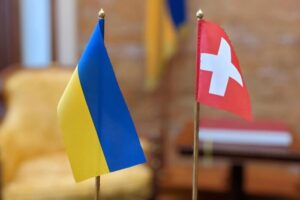
On September 10, 2026, the Switzerland-Ukraine Municipal Cooperation Forum was held in Basel, focusing on the development of partnerships between Ukrainian and Swiss cities and the implementation of joint projects to rebuild and strengthen the resilience of communities, according to the Embassy of Ukraine to the Swiss Confederation and the Principality of Liechtenstein.
The forum brought together representatives of central and local authorities from Ukraine and Switzerland, as well as relevant organizations from both countries. It was jointly organized by the Swiss government, the cities of Basel, Bern, and Zurich, the Verkhovna Rada of Ukraine, the Embassy of Ukraine in Switzerland, the Ukrainian Association of Switzerland, and the Support and Recovery Platform.
Konradin Kramer, President of the Government of the Canton of Basel-Stadt; Iryna Venediktova, Ambassador of Ukraine to Switzerland; Vitaliy Bezgin, Minister of Community and Territorial Development of Ukraine; and Jacques Herber, the Swiss Federal Council’s delegate for Ukraine, delivered welcoming remarks to the participants.
Under the slogan “Building Partnerships. Achieving Results,” participants discussed the transition from inter-municipal contacts to specific investment and infrastructure projects. The main areas of cooperation identified were energy supply and energy efficiency, water infrastructure, local governance, and the development of public services.
The forum’s program included two panel discussions—one on the political foundations of municipal partnerships in reconstruction and the other on practical models for implementing such projects. Separate City Labs working sessions were held, during which representatives of Ukrainian and Swiss cities jointly developed specific proposals for further cooperation.
Municipal partnerships are one of the areas of Switzerland’s long-term support for Ukraine. The Swiss cooperation program with Ukraine for 2025–2028 specifically provides for support to local and regional authorities in the reconstruction and modernization of urban infrastructure and the provision of basic services, particularly in the areas of transportation, energy, water supply, healthcare, and education.
Swiss cities are already participating in practical projects in Ukraine. In particular, Basel is transferring up to 25 trams to Lviv as part of a program that Switzerland is funding with CHF 2.5 million from 2024 to 2028. Previously, Bern also donated trams to Ukraine.
Switzerland views the development of direct ties between cities as one of the mechanisms for Ukraine’s reconstruction. The country’s national program notes that Vinnytsia, Odesa, Sumy, and Kharkiv, among others, have previously expressed interest in partnerships with Swiss cities.
Holding the forum in Basel is intended to facilitate the transition from general agreements between communities to specific joint projects that can leverage Swiss technology, municipal expertise, and funding for the reconstruction of Ukraine’s infrastructure.



