

In Romania, a new electronic road toll system called TollRo will take effect on October 1, 2026, for freight vehicles with a maximum allowable weight exceeding 3.5 metric tons, according to the National Company for Road Infrastructure Administration of Romania (CNAIR).
The new system will apply to vehicles intended for freight transport with a maximum authorized mass exceeding 3.5 metric tons. For the purposes of TollRo, mixed-use vehicles will be treated as freight vehicles.
Unlike the traditional vignette system, the fee for heavy freight transport will be based on actual use of the road infrastructure.
The amount of the fee will depend, in particular, on the distance traveled, the vehicle category, and its environmental characteristics. Thus, for international carriers that regularly transit through Romania, the cost of using the road network will increasingly depend on the specific route and the truck’s specifications.
To administer the charges, Romania has established the STRR electronic toll collection system, which will operate via the national SETRE platform.
The introduction of TollRo is also significant for Ukrainian international trucking companies, as Romania is one of the key road routes for Ukrainian exports and imports to the EU, as well as for the transit of goods to Central and Southeastern Europe.
Accordingly, transportation companies using trucks weighing more than 3.5 metric tons in Romania must take the new road toll model into account when calculating transportation costs after October 1.
CNAIR clarifies that August 31, 2026, was the deadline for establishing the necessary STRR and TollRo infrastructure, while the actual collection of the new tolls, in accordance with the law, begins on October 1.
The next step will be the integration of the Romanian system with similar systems in other European Union countries. According to Romanian law, interoperability via the European Electronic Toll Service (EETS) is scheduled to become operational on January 15, 2027.
The transition to distance-based tolling is in line with a general trend in the EU, where road tolls for heavy commercial vehicles are increasingly linked to actual infrastructure use and the environmental performance of vehicles.
Official information about the system’s launch and its operating rules is available on the SETRE National Electronic Registry platform.

In Romania, a new payment system for using national roads will take effect on October 1, 2026: the cost of the vignette for passenger cars will depend on the vehicle’s environmental standard, while a per-kilometer TollRo system will be implemented for trucks weighing more than 3.5 metric tons.
Romania’s National Road Infrastructure Management Company (CNAIR) has confirmed that the new vignette and TollRo rates will take effect on October 1, 2026. The new model is based on the principle that vehicles that pollute the environment more or use the road infrastructure more intensively pay more.
Three rate categories are being introduced for passenger cars and minibuses with up to nine seats. Electric vehicles and Euro VI-compliant cars will pay 254 lei per year, Euro IV–V vehicles will pay 292 lei, and Euro III and older vehicles will pay 330 lei. A one-day vignette will cost 22, 26, and 29 lei, respectively. For a 10-day period, the fee will be 30, 35, or 39 lei; for 30 days, 48, 55, or 62 lei; and for 60 days, 76, 87, or 99 lei, depending on the vehicle’s emissions class.
As a result, for owners of new vehicles, the annual fee will remain virtually unchanged and will even decrease slightly compared to the current rate, while for older vehicles, it will increase significantly. Specifically, owners of vehicles meeting the Euro III standard or lower will pay approximately 25% more for an annual vignette than under the current system.
Previously purchased vignettes for passenger cars will remain valid until their expiration dates.
For commercial vehicles with a maximum permitted weight exceeding 3.5 metric tons, the TollRo system will be introduced on October 1. Unlike the traditional vignette, the fee will be calculated based on the actual distance traveled by the truck, its technical specifications, and its emission level.
CNAIR confirms that the new system will apply specifically to trucks weighing over 3.5 metric tons.
At the same time, Romania is abolishing a number of individual tolls for crossing bridges over the Danube. Starting October 1, tolls will no longer be collected at the Fetești-Cernavodă bridge complex—one of the main road routes leading to Romania’s Black Sea coast—as well as on the Giurgiu-Vadu Oi bridge.
The toll on the Giurgiu-Ruse bridge when traveling from Romania to Bulgaria is also being eliminated. However, the toll in the opposite direction—from Ruse to Giurgiu—is collected by the Bulgarian side and remains in effect. The toll for crossing the Calafat-Vidin bridge will also remain in effect.
CNAIR reported that drivers who have purchased toll passes in advance for the bridges where tolls are being abolished will be able to request a refund for unused trips.
The new system is part of a broader reform of road tolls in Romania. Starting January 15, 2027, Romania’s electronic toll collection system is set to become compatible with the European Electronic Toll Service (EETS), which will allow for its integration with similar systems in other EU countries.

Ukraine and Romania, within the framework of the Carpathian Economic Forum (C8 Summit), signed a memorandum of understanding based on an updated Strategy for the Development of Border Infrastructure between the two countries, which takes into account the needs related to the transportation of cargo and passengers.
According to a statement from Ukraine’s Ministry of Recovery, Infrastructure, and Transport, the document was signed by Minister Mykola Kalashnyk and Ionel Scriostanu, State Secretary of Romania’s Ministry of Transport and Infrastructure.
Under the memorandum, the countries are expected to work on modernizing and developing road border crossing points (BCPs) and access roads, strengthening rail connections, as well as simplifying border control procedures and expanding opportunities for transshipment of Ukrainian cargo in Romanian ports.
Among other things, there are plans to increase the throughput capacity of existing border crossing points and develop new routes; specifically, the updated Strategy identifies 17 border crossing points, 10 of which are new proposals.
“The signed memorandum outlines specific directions for this work. It is important for us to increase the border’s throughput capacity and create stable and predictable routes for Ukrainian businesses to the European Union and Romanian ports,” the press release quotes Ukraine’s Minister of Recovery, Infrastructure, and Transport as saying.
The ministry emphasized that the next step will be to move toward implementing the relevant projects and securing funding for their execution.
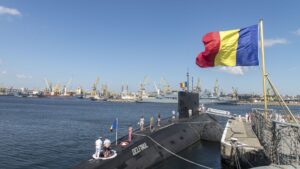
The Romanian Navy has begun testing the new Black Talon drone countermeasure system at the military port of Constanța on the Black Sea. The system, developed as part of a long-standing collaboration with the U.S. Navy, is scheduled to enter operational service by the end of October 2026.
Black Talon is designed to detect, track, and monitor unmanned aerial vehicles near critical port infrastructure. According to the Romanian military, the system includes a high-performance 3D radar, electro-optical equipment, and passive electromagnetic radiation detection devices. The system provides a 360-degree field of view and can target detected objects.
The threat detection radius is approximately 10 km. One of the primary countermeasures is electronic jamming—Black Talon is capable of disrupting the communication channel between a drone and its operator, allowing the threat to be neutralized without necessarily destroying the drone physically.
Currently, Romanian military personnel are undergoing training to operate the new equipment. Following Constanta, plans are in place to equip the military ports of Mangalia, Tulcea, and Braila with similar systems. The U.S. side is to provide three more systems. Thus, protection will cover Romania’s military ports on both the Black Sea and the Danube, particularly near the Ukrainian border.
At the same time, the Romanian Navy is preparing to deploy the Sentinel system to monitor threats from the sea and underwater. It will use sonar capable of detecting unmanned underwater vehicles, combat divers, and mini-submarines. According to Navy officials, Black Talon and Sentinel can be integrated to form a comprehensive surveillance system covering the air, surface, and underwater spaces around the military ports.
The commander of the Constanta military port, Rear Admiral Ciprian Mandaki, announced on September 16 that the program has been implemented jointly with the U.S. Navy for several years and has now entered the operational phase. Black Talon is primarily intended to protect critical military infrastructure from aerial drones.
The強化 of security in Constanța follows a serious incident on June 5, 2026, when a maritime drone was detected in the civilian section of the port, near Pier No. 78. At approximately 10:30 a.m., the drone self-detonated. There were no casualties, as the area had already been cordoned off by Romanian intelligence services, the coast guard, and the military. The Romanian Ministry of Defense officially reported that the drone did not belong to the Romanian military and was of a type used in the war in Ukraine. The investigation into the incident was handed over to the prosecutor’s office.
Following this incident, Romanian authorities ordered the acceleration of measures to protect port infrastructure. At the same time, the Black Talon program itself had been launched earlier and was being developed as part of Romania’s cooperation with the United States in the field of maritime security.
For Ukraine, the strengthening of security at Romanian ports is of particular importance due to the proximity of Constanța and the Danube ports to the Ukrainian border and their role in the region’s Black Sea and Danube transportation infrastructure.

On September 11, 2026, in the Romanian city of Turda, located in Transylvania near Cluj-Napoca, the ancient Roman castrum of Potaissa—one of the most significant military fortresses of Roman Dacia—was officially opened to the general public. Prior to this, following the completion of restoration work, the site had been accessible primarily to organized groups.
The castrum was built around 168–170 CE for the 5th Macedonian Legion, which was deployed to Dacia during the reign of Emperor Marcus Aurelius. The military base covered an area of about 23.4 hectares, measured approximately 573 by 408 meters, and was designed to house several thousand Roman soldiers.
In 2024, Potaissa was inscribed on the UNESCO World Heritage List as part of the serial site “Frontiers of the Roman Empire—Dacia.” The entire Romanian complex comprises 277 individual sites of the ancient Roman defensive system, stretching over 1,000 km.
The project to restore and adapt the castrum for tourism has been in the works since 2016; the agreement for European funding was signed in 2018, and the main work was completed in 2024. According to the Turda City Hall, the final cost of the restoration work amounted to 22.97 million lei excluding VAT, while the total investment, including other expenses, was estimated at approximately 30 million lei, or about 6 million euros. Most of the funding came from European funds.
For visitors, the remains of the Principia Legion command building, Roman roads, bastions, gates, and thermal baths have been restored and preserved. The tour of the ancient baths is organized in a particularly unusual way: a protective structure has been built over the archaeological remains, featuring a system of suspended walkways with a total length of about 230 meters, allowing visitors to view the ruins from above without damaging them.
At the same time, a significant portion of Potaissa still remains underground. Archaeologist Sorin Nemeti told Romania’s ProTV that of the nearly 24 hectares, about 1 hectare has actually been excavated to date. Archaeologists already have an idea of the complex’s underground layout, but a complete study of such a site could take many more decades. Thousands of artifacts related to the daily life of Roman soldiers have been discovered during the excavations.
For Ukrainian tourists, Potaissa is relatively close. From the Romanian side of the Porubne–Siret border crossing to Turda, it is about 338 km by road. The distance from Lviv is approximately 480 km, and from Kyiv—about 830 km by road. Travel time depends significantly on border crossing wait times.
The most practical route from Ukraine is by car via Chernivtsi and the Porubne–Siret border crossing, then through Suceava toward Transylvania and Turda. Without a car, you can take a bus via Suceava and Cluj-Napoca. The nearest major international airport is in Cluj-Napoca, about 39 km from Turda; buses run from the airport to the city, and the trip takes about 20–40 minutes. Since Ukrainian airspace is currently closed to civilian aviation, this option is primarily relevant for travelers arriving in Romania from other European countries.

In August 2026, Ukraine significantly reduced purchases of motor gasoline from the southern direction: imports from Romania decreased by approximately one third, while those from Greece fell by 40%, according to calculations by the Experts Club analytical center and data from the A-95 Consulting Group.
Supplies of Romanian gasoline amounted to 23.4 thousand tonnes compared with 34 thousand tonnes in July.
Imports from Greece decreased to 15 thousand tonnes from 24.9 thousand tonnes a month earlier.
Thus, total supplies from the two countries decreased over the month from approximately 58.9 thousand to 38.4 thousand tonnes.
“The main reason for the significant drop in imports from the south was the price factor. In August, when the market was no longer threatened by a shortage, companies reduced purchases of more expensive fuel from Romania and Greece,” the A-95 Consulting Group reported.
A similar trend was also observed in the diesel fuel market.
At the same time, the bulk of Ukrainian gasoline imports continued to arrive from the northwestern direction. In August, Lithuania supplied 51.8 thousand tonnes of gasoline, while Poland supplied 40.1 thousand tonnes.
These two countries accounted for about 60% of total imports.
Overall, gasoline supplies from abroad in August amounted to 152 thousand tonnes, which is 7% less than a year earlier. Since the beginning of 2026, Ukraine has imported 1.12 million tonnes of gasoline — 16% more than in January-August 2025.
The decline in purchases from the southern direction shows that after supply stabilized, Ukrainian traders began more actively redistributing flows in favor of cheaper European sources.



