
According to Experts Club, Italy and Spain have the highest levels of positive attitudes among Ukrainians among the Southern European countries included in the study—70.1% and 65.2%, respectively. At the same time, a significant portion of respondents hold a neutral stance toward Greece and Slovenia, while attitudes toward Serbia remain the most mixed. This is evidenced by the results of the third wave of the study “Ukrainians’ Attitudes Toward Countries Around the World,” conducted by Active Group in collaboration with Experts Club, reports the Experts Club Information and Analytical Center.
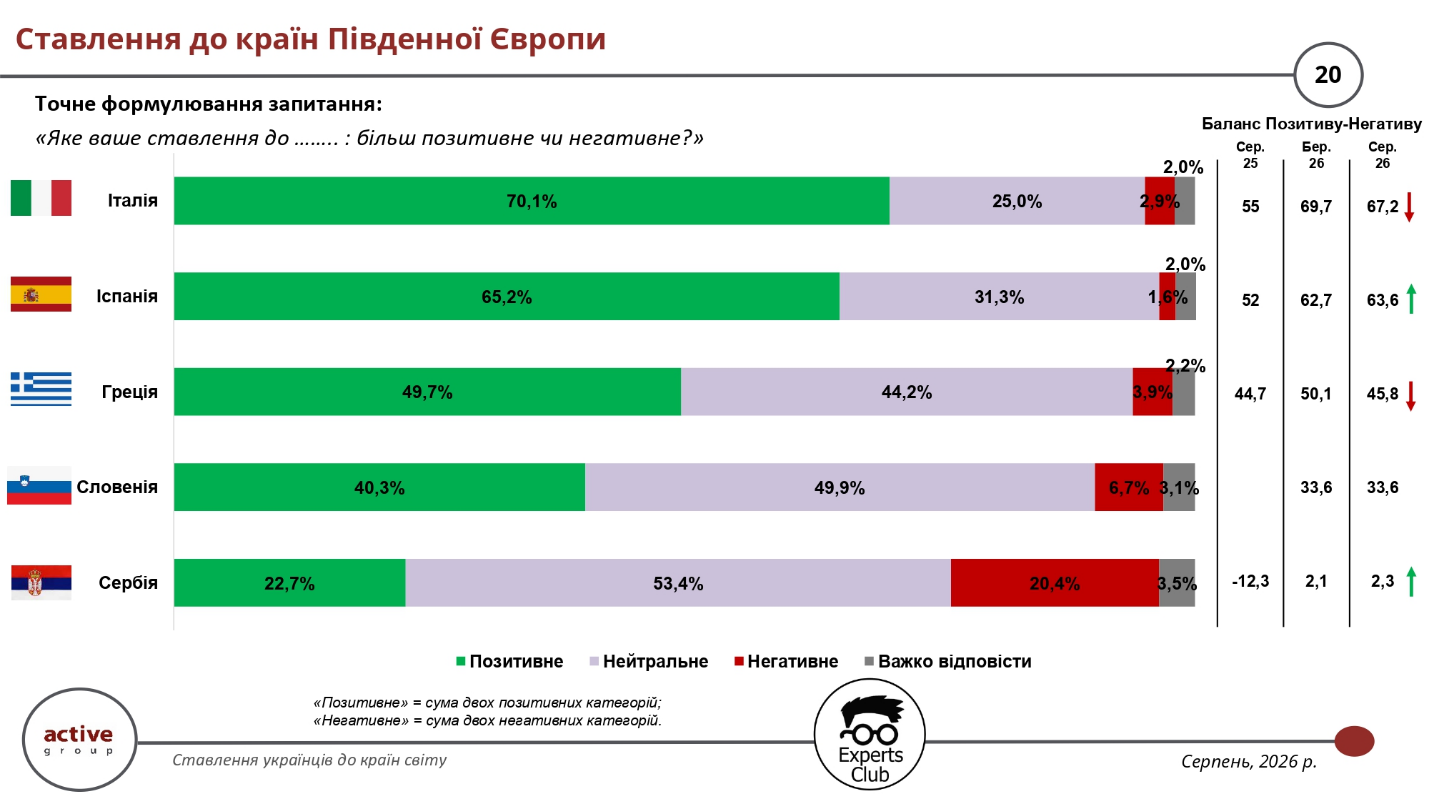
Italy has the best result in the regional group: 70.1% of respondents view it positively, 25% neutrally, 2.9% negatively, and another 2% were undecided. The balance of positive and negative assessments stands at 67.2 percentage points. In March 2026, it was slightly higher—69.7 percentage points—but compared to August 2025, when the figure stood at 55 percentage points, attitudes remain significantly more favorable.
Spain is viewed positively by 65.2% of respondents, neutrally by 31.3%, and negatively by only 1.6%. The balance stands at 63.6 percentage points, compared to 62.7 percentage points in March and 52 percentage points in August of last year. Thus, among the Southern European countries surveyed, Spain is the one showing consistent growth in the balance compared to previous waves.
49.7% of Ukrainians view Greece positively, 44.2% neutrally, and 3.9% negatively. The balance of positive and negative assessments stands at 45.8 percentage points, compared to 50.1 percentage points in March 2026 and 44.7 percentage points in August 2025. This indicates a relatively stable perception of the country, with positive and neutral assessments predominating.
Regarding Slovenia, 40.3% of respondents expressed a positive attitude, while nearly half—49.9%—took a neutral stance. 6.7% view the country negatively, and the balance stands at 33.6 percentage points, the same as in March 2026.
The most contrasting results in the group were recorded for Serbia. 22.7% of Ukrainians view it positively, 20.4% negatively, and the majority, 53.4%, hold a neutral position. The balance stands at plus 2.3 percentage points. At the same time, the trend has improved compared to August 2025, when the indicator was negative—minus 12.3 percentage points.
Maksym Urakin, founder of Experts Club, deputy director of the Interfax-Ukraine news agency, and candidate of economic sciences, emphasized the need for foreign partners to communicate more actively with Ukrainian society.
“The first recommendation is to regularly showcase concrete achievements and specific actions. The second is to be open to questions and inquiries from the media and the public,” Urakin noted.
According to him, sociological data can help diplomatic missions and businesses assess public perception and build bilateral relations more effectively.
Oleksandr Pozniy, director of the research firm Active Group, highlighted the need to combine public awareness with the development of practical economic cooperation.
“We need to do more than just raise general awareness. First and foremost, business associations, the Ministry of Economy, and the Ministry of Foreign Affairs need to take action,” Pozniy noted.
According to him, the most promising areas are those where Ukraine can deepen bilateral ties and increase exports.
In a broader context, the study shows that Ukrainians’ attitudes toward most Southern European countries remain positive or neutral. Italy and Spain score particularly high, while public opinions regarding Serbia are significantly more polarized, although the balance has improved over the past year.
The survey was conducted in August 2026 using self-administered online questionnaires in the SunFlowerSociology panel among 800 Ukrainian citizens aged 18 and older. The sample is representative by age, gender, and region, and the stated maximum theoretical margin of error for indicators at the 50% confidence level is ±3.5 percentage points. This is the third wave of the study, following surveys conducted in August 2025 and March 2026.
ACTIVE GROUP, EXPERTS CLUB, GREECE, ITALY, SERBIA, SLOVENIA, SOCIOLOGY, SOUTHERN EUROPE, SPAIN, UKRAINE



