

Starting July 1, 2026, Ukraine will begin accepting applications through the State Agrarian Registry (DAR) for participation in the open rapeseed export program, according to a press release from the Ministry of Economy, Environment, and Agriculture.
“The launch of the open export program for soybeans and rapeseed is another step toward creating transparent and clear rules for the agricultural sector. We have digitized the process as much as possible so that producers can quickly submit an application through the SAR, and the government has an effective tool for administering exports,” the press service quoted Taras Vysotsky, Deputy Minister of Economy, Environment, and Agriculture, as saying.
As noted in the announcement, legal entities and individual entrepreneurs who are agricultural producers may participate in the program. Applications will be submitted exclusively through the DAR system.
For rapeseed, applications will be accepted from July 1 of this year through April 1 of next year; for soybeans, from September 1 through June 1 of next year.
The program sets a maximum export volume of 5 metric tons of rapeseed per hectare of farmland and 3.5 metric tons of soybeans per hectare. During the application period, producers will have the right to adjust information regarding their planned or actual harvest once.
According to Vysotsky, the mechanism provides for maximum automation of the process without additional bureaucratic procedures or the need to obtain opinions from the Chamber of Commerce and Industry.
As previously reported, in May 2026, the Cabinet of Ministers amended the procedure for confirming the right of agricultural producers and agricultural cooperatives to be exempt from export duties when exporting their own soybeans and rapeseed. The new mechanism provides for automatic verification through the State Agrarian Register instead of obtaining opinions from the Chamber of Commerce and Industry.
agricultural producer, EXPORT, RAPESEED, SOYBEANS, State Agrarian Register
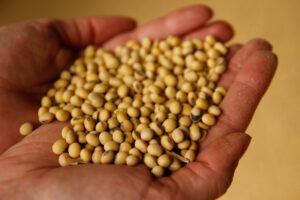
Soybean acreage in 2026 reached 2.1 million hectares, an increase of 5% compared to last year, Taras Vysotsky, Ukraine’s Deputy Minister of Economy, Environment, and Agriculture, told reporters on the sidelines of the Grain Ukraine 2026 international conference on Friday.
“This year, soybean acreage did not decrease; in fact, it increased by 5%. Several factors contributed to this simultaneously—the rising cost of fertilizers and fuel. Consequently, farmers have shifted their focus to crops that require fewer fertilizers, namely soybeans. It requires lower costs for cultivation, transportation, and export,” Vysotsky noted.
As reported, pursuant to Law No. 4536-IX of July 16, 2025, a 10% export duty on rapeseed and soybeans was introduced in Ukraine effective September 4, 2025. The document provides for a gradual reduction of the rate by 1% annually, starting January 1, 2030, to 5% by 2035. At the same time, the law includes a preferential regime for direct producers and cooperatives, who are exempt from paying the duty when exporting their own-grown products.
Experts from the American Chamber of Commerce (ACC) have argued that this could lead to a significant reduction in soybean acreage in 2026 due to this law.
According to the Ministry of Economy, as of June 2, 1.96 million hectares had been planted with soybeans, or 96% of the forecast, whereas last year, as of May 30, according to the Ministry of Agrarian Policy, soybean plantings totaled 2.23 million hectares.
agricultural sector, export duty, MINISTRY OF ECONOMY, planting season, SOYBEANS

The introduction of a 10% export duty on soybeans and rapeseed will reduce the profitability of these crops, leading to a 30% reduction in soybean acreage in 2026, experts from the American Chamber of Commerce (ACC) reported during a press briefing in Kyiv.
“Our forecasts indicate a possible 30% reduction in soybean acreage compared to the previous season. The export duty acts as an economic barrier, making the cultivation of this crop less attractive to producers. Farmers won’t take losses every year—if the financial result is negative, they’ll simply change their crop mix,” the experts explained.
The business association noted that under normal conditions, corn could be an alternative, but currently its investment appeal is also in question due to rising production costs.
“Prices for fuel and fertilizers have risen significantly, particularly due to the escalation of the situation surrounding Iran and the blockade of the Strait of Hormuz. This significantly increases farmers’ costs for growing corn, which, combined with the low profitability of oilseeds due to tariffs (on soybeans and rapeseed – IF-U), puts farmers in a difficult position ahead of the spring planting season,” the briefing participants emphasized.
Experts expressed confidence that if regulatory policy does not change, there is a risk that farmers will abandon rapeseed and soybean cultivation in the long term. This will lead to domestic processors, who lobbied for the introduction of tariffs to obtain cheap raw materials, eventually facing a physical shortage of those materials due to reduced production.
As reported, pursuant to Law No. 4536-IX of July 16, 2025, a 10% export duty on rapeseed and soybeans was introduced in Ukraine effective September 4, 2025. The document provides for a gradual reduction of the rate by 1% annually, starting January 1, 2030, to 5% by 2035. At the same time, the law includes a preferential regime for direct producers and cooperatives, who are exempt from paying the duty when exporting their own-grown products.

The introduction of export duties on rapeseed and soybeans last September caused a redistribution of income from agricultural producers to processors, resulting in total losses for farmers of approximately $200 million, the American Chamber of Commerce (ACC) reported during a press briefing in Kyiv on Wednesday.
According to published data, due to a 7% drop in domestic prices relative to global markets, Ukrainian farmers lost $130 million in profits. Small and medium-sized producers, who are unable to export their products independently, were hit the hardest. An additional $50 million was collected from farmers and exporters in the form of duties paid to the state budget.
“The export duty that was introduced is effectively a redistribution of income among producers in favor of processors. Instead of stimulating processing, we have ended up with a mechanism to cover the losses of the processing industry at the expense of crop production,” the ACC noted.
Representatives of the business association emphasized that in the six months since the law took effect, not a single new processing facility has been declared or built in Ukraine. At the same time, existing capacity of 23 million tons already exceeds the total oilseed production volume, which stands at about 20 million tons.
According to ACC estimates, Ukraine’s foreign exchange earnings from oilseed exports during this period decreased by $1 billion. Specifically, revenue from rapeseed exports fell by $700 million (with partial compensation from increased exports of oil and meal, the net loss amounts to $400 million – IF-U). For soybeans, the decline is estimated at $240 million, and for sunflowers, at $345 million.
Experts argue that the arguments of the bill’s initiators regarding the successful experience with sunflower seed tariffs were flawed due to the different physical nature of the crops. As a light product, sunflower seeds are more profitable to process locally, whereas rapeseed and soybeans are heavy crops that are more practical to transport by large vessels to consumption centers. The ACC also highlighted the negative legislative precedent, as protests from leading industry associations—including the Ukrainian Agribusiness Club (UAC) and the Ukrainian Agrarian Council (UAC)—were ignored during the law’s adoption. Furthermore, this decision has strained relations with European partners and contradicts the processes of European integration.
For his part, Oleg Nivievsky, a professor at the Kyiv School of Economics (KSE), noted that the total losses incurred by agricultural producers due to the law over a full marketing year could amount to approximately 17 billion UAH. According to his calculations, the rapeseed duty will generate 6.2 billion UAH for the budget but will result in net economic losses of 80–170 million UAH due to reduced farmer incomes. The situation is even worse for soybeans: with budget revenues of 4.1–4.7 billion UAH, farmers will lose 9.1–9.3 billion UAH, resulting in net losses for the country of 200–500 million UAH.
“This is a bad signal for the market, indicating that processing is uncompetitive without state subsidies. A similar logic of ‘utilizing capacity’ is already being applied to the export of scrap metal and timber, which sets an extremely negative precedent,” emphasized Nivievsky, adding that the state’s total economic losses from duties on both crops could reach 280–670 million UAH.
As reported, pursuant to Law No. 4536-IX of July 16, 2025, a 10% export duty on rapeseed and soybeans was introduced in Ukraine effective September 4, 2025. The document provides for a gradual reduction of the rate by 1% annually, starting January 1, 2030, to 5% by 2035. At the same time, the law includes a preferential regime for direct producers and cooperatives, who are exempt from paying the duty when exporting their own-grown products.

The agricultural holding “TAS Agro” increased its sunflower acreage to 24,000 hectares and its corn acreage to 9,800 hectares for the 2026 season, the company announced on its Facebook page.
“This decision is primarily due to the declining economic attractiveness of certain crops and competition from more profitable segments within the production structure. In the 2026 season, we are focusing on a more diversified crop structure and crops with more predictable economics of cultivation,” the press service quoted Vladimir Shil, chief agronomist at TAS Agro, as saying.
According to the report, sunflower acreage increased by 54.8%, and corn acreage by 28.9%. At the same time, the largest reduction occurred in soybeans—by 65.8%, to 5,200 hectares. Due to unfavorable weather in the fall of 2025, the area under winter wheat decreased by 8.7% to 21,000 hectares, while winter rapeseed plantings expanded to 15,300 hectares (+9.3%). In 2026, the agricultural holding will introduce oilseed flax (140 ha) into its crop structure for the first time and will maintain 165 ha of production areas for industrial hemp.
The TAS Agro agricultural holding was established in 2014. Its land bank includes 88,000 hectares in the Chernihiv, Sumy, Kyiv, Vinnytsia, Kirovohrad, and Mykolaiv regions. It specializes in crop production; the agriholding’s elevator capacity totals approximately 250,000 tons. The livestock business consists of a herd of 5,500 head of cattle, of which 2,500 head are milking cows.
The agricultural holding is part of the “TAS” group, founded in 1998. Its business interests span the financial sector (banking and insurance segments) and the pharmaceutical sector, as well as industry, real estate, and venture projects.
The founder of TAS and the beneficiary of the TAS Agro agricultural holding is Serhiy Tihipko.

In the short term, prices for Ukrainian soybeans will depend on the situation in the global energy market and oil prices, which determine market conditions in the biofuel sector, according to the analytical cooperative “Push,” established within the All-Ukrainian Agrarian Council (VAR).
Analysts noted that export prices for Ukrainian soybeans are now significantly higher than at the start of the season. While soybeans were sold for approximately $390–395 per ton in September–November, current prices at ports have reached $450–460 per ton for GMO soybeans and $475 per ton for non-GMO soybeans, which is $60–70 per ton higher than at the start of the season.
“If prices rise by another $10–15 per ton, we could effectively be looking at a nearly $100 increase for the season,” experts noted.
Despite the attractive price conditions, the pace of Ukrainian soybean exports is gradually slowing down. According to analysts, shipment volumes stand at about 48,000 tons, which is significantly lower compared to the start of the marketing year, due to the impact of a 10% export duty, a reduction in domestic stocks, and the high cost of Ukrainian products on global markets.
“Ukrainian soybeans continue to lead in price in key markets. For example, in the Turkish market, they cost nearly $500 per ton, while Brazilian soybeans trade at $470–480 per ton,” the experts explained.
At the same time, prices remain high in the domestic market due to limited supply. According to analysts’ estimates, soybean stocks may fall below 1 million tons in May, which would mean that last year’s harvest has been almost completely depleted.
“Processors will need to operate until the new harvest, so they may be willing to pay a high price. It is possible that processors could raise soybean prices above 21,000 UAH/ton,” the cooperative believes.
At the same time, short-term market conditions will largely depend on the situation in the global energy market. In particular, soybean prices traditionally correlate with oil prices, as soybean oil is widely used in biodiesel production.
Short-term price fluctuations or even price declines are possible in the market in March and the first half of April. At the same time, in the medium term, the market will remain stable due to limited crop stocks and steady demand from domestic processors, concluded “Pushk.”



