
The Swedish Parliament has approved stricter rules for obtaining citizenship: starting June 6, 2026, the minimum total period of residence in the country required to apply for a passport will increase from five to eight years.
The new rules apply to adult applicants. The Swedish Migration Agency notes that different timeframes will apply to certain groups, but the basic requirement is being increased to eight years. Stricter criteria for “an orderly life” are also being introduced: individuals who have committed crimes will have to wait longer before obtaining citizenship.
The reform is part of a broader policy by the Swedish government to tighten immigration rules. In addition to extending the residency requirement, authorities also plan to introduce mandatory requirements regarding knowledge of the Swedish language, basic social studies, and the financial independence of applicants. According to Reuters, the government had previously proposed requiring applicants to have an income of over 20,000 Swedish kronor per month, as well as passing language and social studies tests.
The U.S. Library of Congress, analyzing the Riksdag’s decision, notes that the new residency requirements will take effect on June 6, 2026. At the same time, the language test is set to take effect on October 1, 2027, or earlier if the government so decides, while the social studies test will be introduced on a date determined by the Cabinet.
One of the most controversial aspects of the reform is the lack of a full transition period. More than 100,000 people whose applications are already under review may be affected by the new rules. This means that some applicants who were counting on the previous five-year period may be denied or forced to wait longer.
For foreigners who were planning to naturalize in Sweden, the reform significantly extends the waiting period. This could have a particularly noticeable impact on labor migrants, refugees, foreign professionals, and families who have been living in the country for several years and made plans based on the previous rules.
In recent years, Sweden has been consistently tightening its immigration policy following a long period of a more liberal approach to accepting foreigners. Authorities explain the changes by the need to strengthen integration, raise requirements for language proficiency and self-sufficiency among migrants, and bolster trust in the institution of citizenship. Critics of the reform warn that the retroactive application of the new rules could create legal uncertainty and reduce the country’s appeal to skilled professionals.
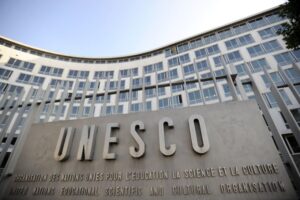
Ukraine will receive $1.3 million from Sweden through UNESCO in 2026–2027 to implement projects aimed at preserving cultural heritage—particularly at the Khortytsia National Reserve—and strengthening institutional capacity, Foreign Minister Andriy Sibiga announced.
According to him, Sweden is providing this support to protect Ukraine’s cultural heritage sites threatened by the war.
Sybiha noted that Russia’s brutal and aggressive war against Ukraine aims to destroy cultural heritage and undermine the country’s cultural identity.
“Sweden’s support will ensure the protection and preservation of Ukrainian cultural heritage sites threatened by Russia’s war against Ukraine. Protecting culture means preserving our identity and resilience, which is vital for the future of Ukraine and all of Europe. I thank Sweden for its support of Ukraine,” the minister noted in a post on social media.
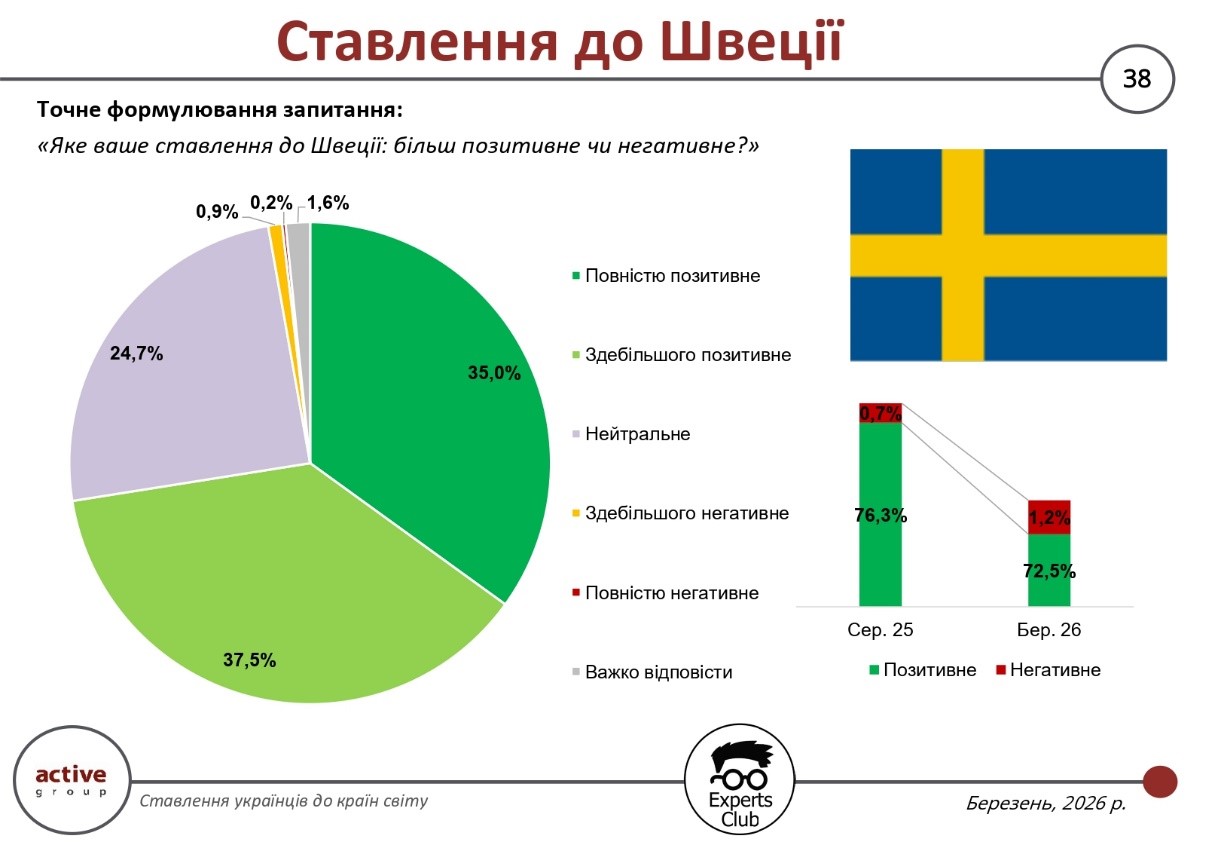
The results of a public opinion poll conducted in March 2026 by the research firm Active Group in collaboration with the Experts Club information and analytical center show a consistently high level of positive attitudes among Ukrainians toward Sweden. The overall share of positive assessments stands at 72.5%, which is, however, slightly lower than the August 2025 figure (76.3%). At the same time, the level of negative attitudes remains minimal—only 1.2% compared to 0.7% previously.
The breakdown of responses indicates a deeply positive foundation for perceptions of this country. The share of those who view Sweden “entirely positively” stands at 35.0%, while another 37.5% selected the “mostly positive” option. Together, these figures represent one of the highest levels of positive perception among the countries surveyed.
At the same time, 24.7% of respondents hold a neutral position, which may indicate a limited level of personal or informational contact with the country. Negative assessments remain marginal: 0.9% rated it “mostly negative” and only 0.2% rated it “completely negative.” Another 1.6% of respondents were undecided.
The slight decrease in the share of positive assessments likely resulted from a shift of some respondents into the neutral category, rather than an increase in criticism. This indicates that Sweden’s image remains consistently positive, albeit less emotionally charged compared to the previous period.
“Sweden remains a country with a very high level of trust among Ukrainians, and this is evident in the structure of the responses. At the same time, we observe a certain increase in the share of neutral assessments, which indicates not a change in attitude but a decrease in its intensity. This is a typical effect for countries that are not constantly in the center of media attention,” noted Oleksandr Pozniy, director of the research company Active Group.
Overall, the survey results confirm that Sweden is among the countries with the highest level of positive perception in Ukrainian society. At the same time, the dynamics of change indicate a gradual normalization of assessments, as the emotional component gives way to a more restrained and rational perception.
According to a study conducted by the Experts Club information and analytical center based on data from the State Customs Service, Sweden ranks 25th in total trade volume with Ukraine, with a figure of $1.13 billion. At the same time, imports from Sweden exceed Ukrainian exports many times over, resulting in a significant trade deficit of over $962 million.
The study was presented at the Interfax-Ukraine press center; the video can be viewed on the agency’s YouTube channel. The full version of the study can be found at this link on the Experts Club analytical center’s website.
ACTIVE GROUP, EXPERTS CLUB, Pozniy, SOCIOLOGY, SURVEY, SWEDEN, UKRAINE, URAKIN
According to a report by Relocation.com.ua, Sweden has established a timeline for gradually tightening its citizenship rules: most of the new requirements are proposed to take effect on June 6, 2026; mandatory language and social studies tests—in October 2027; and the mechanism for revoking citizenship in certain cases—on January 1, 2028. This is outlined in a report by KPMG Sweden, prepared based on government initiatives and investigative materials submitted to the Swedish Ministry of Justice.
Under the proposed changes, the standard residency requirement in Sweden before applying for citizenship will increase to eight years from the current five. For spouses of Swedish citizens, the period of cohabitation required to qualify for application will rise to seven years instead of three, provided that the Swedish spouse has held citizenship for at least five years.
At the same time, a requirement for financial self-sufficiency is being introduced for the first time. Applicants will be required to demonstrate a stable income from employment or business, and prolonged receipt of unemployment benefits may serve as grounds for denial. Exceptions are proposed for retirees and students with good academic standing.
Starting in October 2027, a mandatory state test is planned to be introduced, which will assess not only knowledge of the Swedish language but also understanding of the structure of Swedish society. As an alternative, high scores on the Swedish for Immigrants program may be accepted.
Another area of tightening concerns the so-called “good conduct.” Citizenship may be denied to individuals convicted of or suspected of serious crimes, as well as repeat offenders. Separately, the commission proposed allowing the revocation of citizenship for individuals with dual citizenship starting January 1, 2028, in cases of particularly serious crimes or the submission of knowingly false information when applying for a passport.
It is important to note that this currently refers specifically to the government’s package of proposals and the timeline for their anticipated implementation, rather than a fully completed legislative reform. As early as January 2025, the Swedish government stated that it wanted to make the process of obtaining citizenship more stringent and link it to deeper integration into society.
https://relocation.com.ua/sweden-tightens-citizenship-rules/
The Swedish government has announced the end of the “minimum citizenship” period and has prepared a package of changes that raises the requirements for applicants for a Swedish passport.
According to the government’s announcement, the basic residence requirement for applying for citizenship is planned to be increased from five to eight years. It is also proposed to introduce stricter requirements for “lifestyle,” self-sufficiency, knowledge of the Swedish language and the basics of society, as well as to reduce the use of the notification procedure so that more applicants fall under the new conditions.
In terms of financial criteria, the government explicitly states a benchmark – a requirement for self-sufficiency at a level of approximately SEK 20,000 per month. The majority of the changes are scheduled to come into force on June 6, 2026, with certain elements related to language tests possibly being introduced later.
According to Statistics Sweden (SCB), in 2024, there were 2,200,238 people living in the country who were born outside Sweden, accounting for about 20% of the population.
In terms of the structure of new arrivals, 116,197 people immigrated to Sweden in 2024. The largest group was immigrants from Ukraine (28,065 people), followed by “Sweden” (re-emigration, i.e., the return of those who had previously left) with 11,907 people. Among the most notable groups are also India (5,801), Germany (3,647), China (3,558), Syria (2,985), Poland (2,844), Pakistan (2,477), Turkey (2,107), Iran (1,972), as well as Russia (1,721) and Iraq (1,500).

On Thursday, the Swedish government decided to immediately allocate 1 billion Swedish kronor (over $110 million) to Ukraine for energy support in 2026, according to the SVT television portal.
“Swedish aid will be immediately directed to power plants, heaters, and spare parts needed to restore Ukraine’s energy supply,” said Minister for Development and Foreign Trade Benjamin Dows.
It is noted that next week, temperatures are expected to drop to minus 25 degrees in cities such as Kyiv and Kharkiv.



