
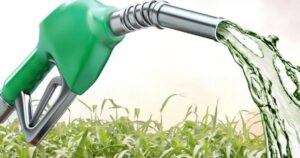
Ukraine is proposing that the European Union increase the existing duty-free export quota for Ukrainian bioethanol—currently set at 125,000 metric tons per year—to account for the volume of bioethanol that Ukraine imports from the EU as part of automotive gasoline, Minister of Agrarian Policy and Food Taras Vysotsky told reporters.
“We have calculated that Ukraine currently imports about 10,000 metric tons of bioethanol per month as part of gasoline… This proposal applies to the period of martial law, as the current security situation prevents Ukraine from blending gasoline with bio-components, so we have to import it,” the minister explained.
He noted that the requirement for a mandatory bioethanol content of at least 7% in A-92 and A-95 automotive gasoline took effect in Ukraine on July 1 of this year, while the quota of 125,000 metric tons was set last year, when gasoline was imported without any bioethanol content.
Vysotsky noted that the quota can be flexible: if, for example, 5,000 metric tons of bioethanol are imported in a given month, then an additional 5,000 metric tons of export quota becomes available; if 15,000 metric tons are imported in a given month, then 15,000 metric tons.
According to him, this could amount to an additional 120,000 metric tons of bioethanol over the course of a year.
In the opinion of the Minister of Agrarian Policy, this proposal from Ukraine is very likely to be accepted and implemented by European partners.
Bioethanol, EU, EXPORTS, QUOTA, UKRAINE
Ukraine has been named the Guest of Honor at the 24th Pisa Book Festival, which takes place October 2–4 in Pisa, Italy.
“This year’s guest country is Ukraine, which is presenting a rich and diverse program covering literature, history, and art, organized under the patronage of the Ukrainian Embassy in Rome,” the festival states on its website.
In particular, the festival will feature writer Andriy Kurkov, as well as writers and translators Olena Kostyukovych, Yaryna Hrush, and Olena Ponomariova.
As part of the program dedicated to Ukraine, an exhibition of Ukrainian illustrators titled “Yellow and Blue” is on display at Palazzo Blu through January 10, 2027.
In total, this year’s festival features 90 booths from Italy’s leading independent publishers, as well as professional meetings with editors, translators, and distributors.
Over 100 events are scheduled as part of the festival, which will welcome more than 200 guests.
The festival was founded in 2003 to support independent Italian publishers.
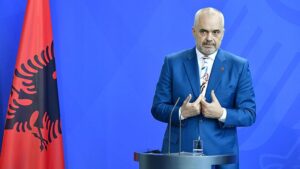
The European Union’s promises regarding Ukraine’s accession through the standard procedure are not true, Albanian Prime Minister Edi Rama said in an interview with the German newspaper *Welt am Sonntag*.
“What they are promising her (Ukraine) is a lie,” Rama emphasized, adding that under the standard enlargement rules and with all existing criteria met, the country will definitely not be admitted into the bloc, and “everyone knows this.”
At the same time, the Albanian prime minister cautioned Brussels against making concessions in the process solely for geopolitical reasons. Instead, he proposed granting full membership only based on the results of specific tasks and achievements (a results-oriented process).
At the same time, the Albanian prime minister called for accelerating his country’s European integration. Albania applied for EU membership back in 2009 and has held candidate country status since 2014.
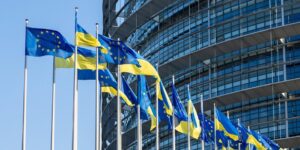
The European Union did not support Ukraine’s request for early disbursement of additional funding in 2026 and emphasized that the allocation of funds will depend directly on Kyiv’s implementation of agreed-upon reforms, according to the Financial Times, citing a letter from European Commissioners Valdis Dombrovskis and Marta Kos to Verkhovna Rada Chairman Ruslan Stefanchuk.
This summer, Ukraine estimated its additional defense needs at approximately $27 billion and approached the European Commission with a proposal to advance a portion of the funds from the two-year €90 billion Ukraine Support Loan program (€60 billion earmarked for defense, €30 billion for direct budget support). According to the program’s terms, up to €45 billion is to be made available to Ukraine in 2026, with the remaining €45 billion to follow in 2027.
According to the FT, European Commissioners have made it clear that access to funding is contingent upon fulfilling an agreed-upon list of commitments. Specifically, this involves the elimination of VAT exemptions for small international parcels, the introduction of taxation rules for digital platforms, and proper financial monitoring of politically exposed persons (PEPs)—changes to which have raised concerns in Brussels as a deviation from the anti-corruption agenda. According to the publication’s assessment, meeting these requirements will pave the way for Kyiv to receive approximately 34 billion euros in support as early as 2026.
At the same time, the European Commission emphasized that the rejection of the request for an early advance payment does not mean a curtailment of financial assistance. On October 1, the parties announced that they had agreed on sources of funding for budgetary and defense needs through the end of 2026, noting that there is no unfunded financial gap for the current year.
In addition, on October 2, the European Commission transferred another tranche of 2.9 billion euros to Ukraine as part of the Ukraine Facility program. The total amount of aid to Kyiv from the EU and its member states since the start of Russia’s full-scale invasion has reached 227.4 billion euros.
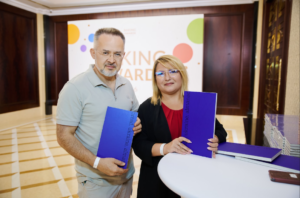
After several years of work, the publication “Bread. Ukraine. Almanac” has been released in Ukraine — a bilingual informational and historical art book dedicated to Ukrainian bread, its role in history, culture, everyday life and the modern food industry.
At the heart of the publication is an attempt to show that the concept of Ukrainian bread is much broader than the familiar product on the everyday table. For some, it is the taste of childhood and a family recipe; for others, it is palianytsia, regional baked goods or bread from a local bakery. At the same time, behind these familiar images stand the history of the development of agriculture, milling and breadmaking, folk traditions and the modern large-scale food industry.
The almanac traces how bread accompanied Ukraine and Ukrainians through different historical periods. It was preserved in family memory and rituals, became an image in cinema, poetry, photography and other forms of art, and with the development of industry turned into an important part of a large production complex.
A special place in the publication is devoted to the dramatic pages of Ukrainian history. The authors address the tragedy of the Holodomor, during which bread became a symbol of the very right of a person to life. It acquired a new symbolic meaning after the beginning of the full-scale war. One of the best-known examples was the word “palianytsia,” which in 2022 became a distinctive linguistic marker of Ukrainian identity.
At the same time, “Bread. Ukraine. Almanac” tells not only about the past. Considerable attention is paid to modern breadmaking, artisanal technologies, regional traditions and the development of the industry. In the book, bread appears simultaneously as an everyday product, a cultural phenomenon, the result of the work of the agricultural and food sectors, and part of the country’s economic history.
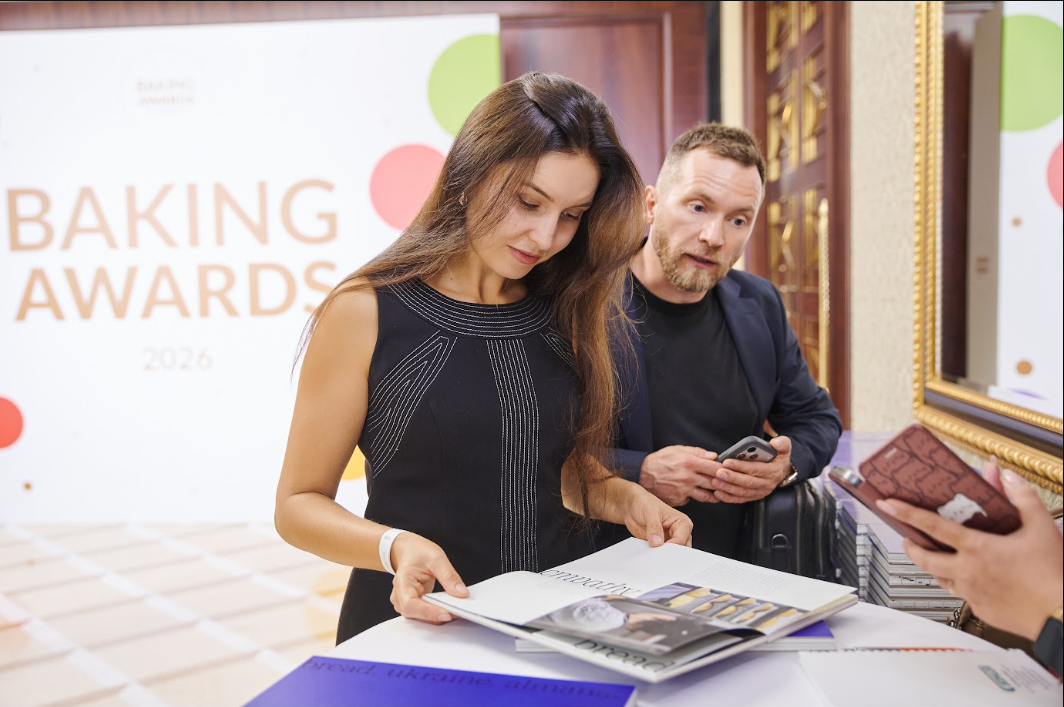
At the same time, the authors do not attempt to give a single definition to the concept of “Ukrainian bread.” The book is structured as a collection of different stories, each of which reveals a separate part of this topic — from old mills and family recipes to industrial bakeries, modern technologies and the artistic interpretation of bread.
This approach leaves the reader room for further exploration of the topic: after one piece, one can turn to an old Ukrainian film; after another, one can study regional baked goods, the history of milling, traditional technologies or modern Ukrainian breadmaking in greater detail.
“Bread. Ukraine. Almanac” has been prepared in Ukrainian and English, and is therefore intended not only for a Ukrainian but also for an international audience. The publication can be used as a presentation book about Ukraine, its history, gastronomic culture and one of the country’s most important industries.
The almanac is designed as a modern collectible art book. A distinctive color palette, unconventional layout, archival and contemporary visual materials create a separate visual language for the publication and emphasize its gift-book character.
The premiere of the almanac took place during Baking Awards 2026. The publication was presented by Yurii Duchenko, President of the All-Ukrainian Association of Bakers, and Rodion Rybchynskyi, Director of the “Flour Millers of Ukraine” Union.
The print run of “Bread. Ukraine. Almanac” is limited. Detailed information about the publication and the possibility of ordering it are available on the official “Bread. Ukraine” website.
The partners of the “Bread. Ukraine. Almanac” edition were the All-Ukrainian Association of Bakers and the “Flour Millers of Ukraine” Union. The industry organizations unite enterprises of Ukraine’s breadmaking and flour-milling industries and work to develop the domestic market, increase the competitiveness of Ukrainian products and expand their presence abroad. Among their areas of activity are strengthening Ukraine’s export potential, promoting Ukrainian flour, bakery products and other grain-processing products in foreign markets, developing international contacts and facilitating the participation of Ukrainian producers in specialized international events.
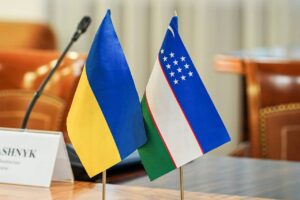
Ukraine and Uzbekistan are introducing a “transport visa-free regime,” which provides for the abolition of permits and related quotas for direct and transit international freight truck transportation between the two countries.
A corresponding protocol between the governments of Ukraine and the Republic of Uzbekistan amending the bilateral Agreement on International Road Transport was signed on September 30, 2026, according to the Ukrainian Embassy in Uzbekistan.
According to the diplomatic mission, the preparation of the document took nearly a year.
The main change will be the simplification of direct and transit freight transport by eliminating the need to obtain permits, as well as quantitative quotas for such transport. This regime, by analogy with other agreements in the field of international road transport, is referred to as “transport visa-free travel.”
For Ukrainian and Uzbek carriers, this will mean the removal of one of the administrative barriers to organizing freight transport between the two countries and transit through their territories.
The embassy expects that the liberalization of road transport will contribute to the restoration of Ukraine’s trade and economic ties with Uzbekistan, which were partially disrupted due to logistical problems following the start of full-scale Russian aggression.
The agreement takes on particular significance amid the restructuring of Ukraine’s foreign trade and the search for alternative transport corridors to Central Asia.
“The removal of bureaucratic barriers should soon facilitate the restoration of full-fledged trade and economic ties between Ukraine and the Republic of Uzbekistan,” the embassy noted.
The diplomatic mission also described the new agreement as one of the steps toward Ukraine’s return to Central Asian markets via new logistics routes.
The protocol, signed on September 30, amends the existing intergovernmental Agreement between Ukraine and Uzbekistan on international road transport. Specifically, it concerns the liberalization of direct and transit freight transport by road. The embassy’s statement does not provide for the abolition of other customs, border, or transportation procedures required for the international transport of goods.
Original source – Embassy of Ukraine in the Republic of Uzbekistan.



