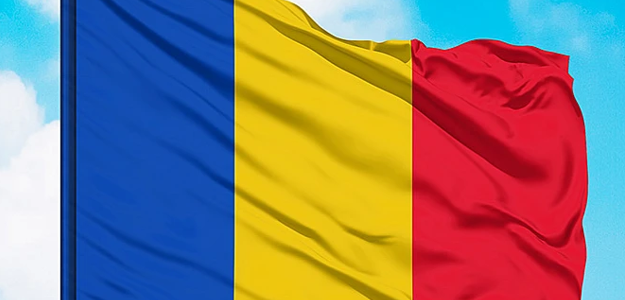
According to Experts Club, Ukrainians’ attitudes toward Romania remain predominantly positive or neutral; however, in August 2026, the share of positive assessments declined slightly compared to the previous survey wave. 45.2% of respondents view the country positively, 9.8% negatively, while 42.3% hold a neutral stance, reports the Experts Club Information and Analytical Center.
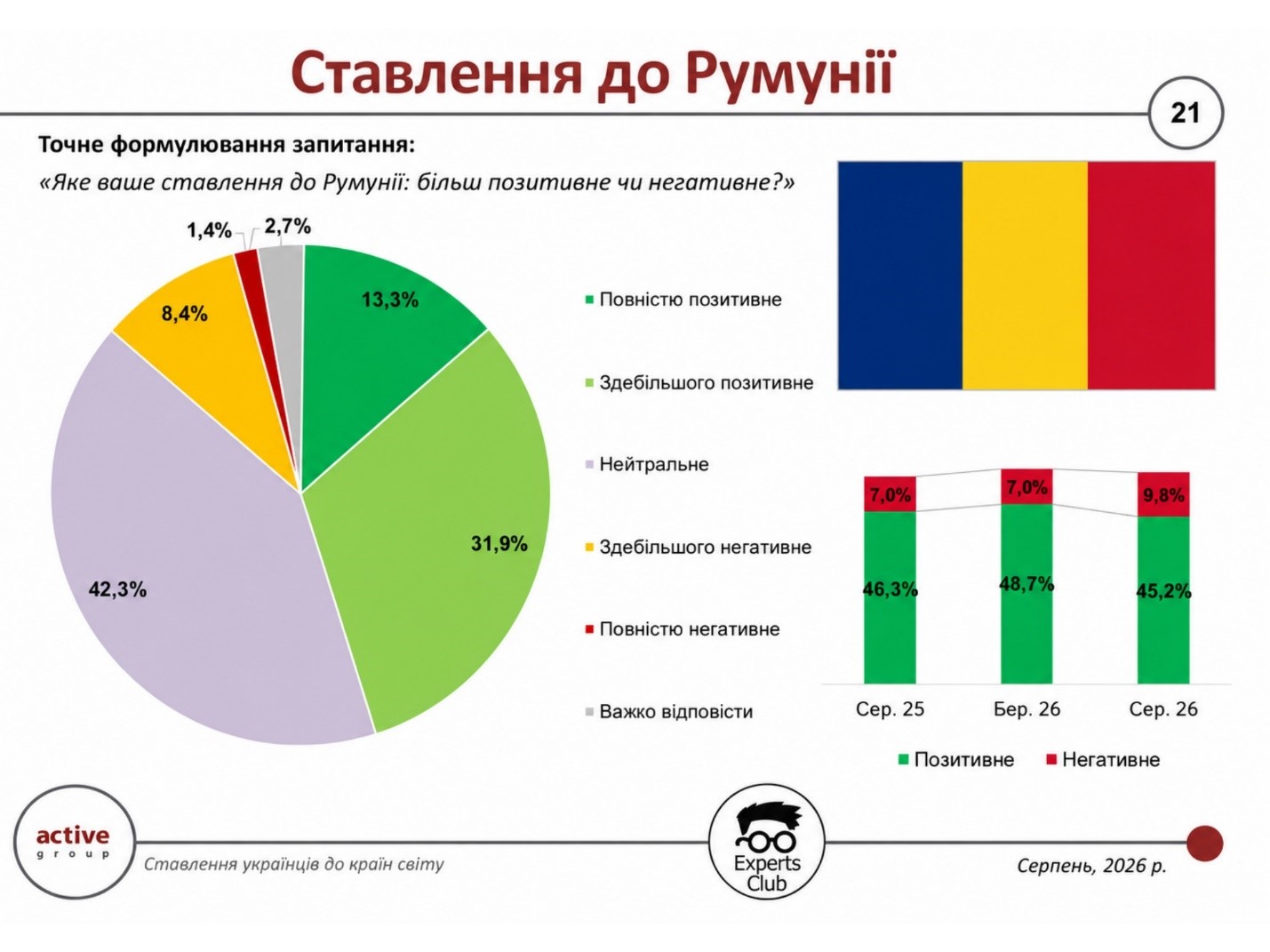
According to the results of the August survey, 13.3% of Ukrainians view Romania entirely positively, and 31.9% view it mostly positively. A neutral attitude was expressed by 42.3% of respondents. 8.4% view the country mostly negatively, 1.4% view it entirely negatively, and another 2.7% were undecided.
The balance of positive and negative assessments stands at plus 35.4 percentage points. Thus, positive responses outnumber negative ones by more than four to one, although respondents with a neutral attitude remain the largest single group.
Compared to March 2026, public perception of Romania has deteriorated slightly. In the previous survey wave, 14.9% of respondents rated the country entirely positively, and 33.8% rated it mostly positively—meaning the total share of positive responses was 48.7%. Seven percent of respondents had a negative view of Romania, and 42.2% were neutral.
Thus, over the course of five months, the positive attitude decreased by 3.5 percentage points—from 48.7% to 45.2%—while the negative attitude increased by 2.8 percentage points—to 9.8%. The share of neutral responses remained virtually unchanged: 42.2% in March and 42.3% in August. The balance between positive and negative assessments decreased from +41.7 to +35.4 percentage points, or by 6.3 percentage points.
These results indicate a moderate weakening of positive perceptions rather than a fundamental shift in attitude. The neutral group remains stable, and negative assessments, despite their increase, still lag significantly behind the positive ones.
Maksym Urakin, founder of the Experts Club information and analytical center and a candidate of economic sciences, commenting on the need to compare public assessments with the actual economic role of international partners, emphasized the deterioration of Ukraine’s overall foreign trade balance.
“For Ukraine, Romania is not an abstract foreign policy partner, but a neighboring country with which logistics, trade, the movement of people, the transit of Ukrainian goods, and humanitarian contacts are intertwined on a daily basis. Therefore, public perception here is shaped not only by political statements but also by concrete experiences of interaction. I would not yet interpret the current decline in positive assessments as a fundamental shift in attitude—the positive balance remains very significant,” Urakin noted.
In the case of Romania, the new wave of the survey shows that the country maintains a positive balance in public opinion, but this margin has narrowed compared to March. At the same time, the virtually unchanged proportion of neutral responses indicates that the main changes occurred specifically between the positive and negative segments.
The survey was conducted in August 2026 using an online self-administered questionnaire via the SunFlowerSociology panel among 800 Ukrainian citizens aged 18 and older. The previous wave also included 800 respondents, and the sample was representative by age, gender, and region.
ACTIVE GROUP, CENTRAL AND EASTERN EUROPE, EXPERTS CLUB, international relations, PUBLIC OPINION, ROMANIA, SOCIOLOGY, UKRAINE