
According to Experts Club, Moldova continues to be viewed predominantly positively by Ukrainians: in August 2026, 55.4% of respondents had a positive attitude toward the country, while 7.3% had a negative one. At the same time, more than a third of those surveyed—35.6%—hold a neutral view. Compared to March, the share of positive assessments has decreased slightly, reports the Experts Club Information and Analytical Center.
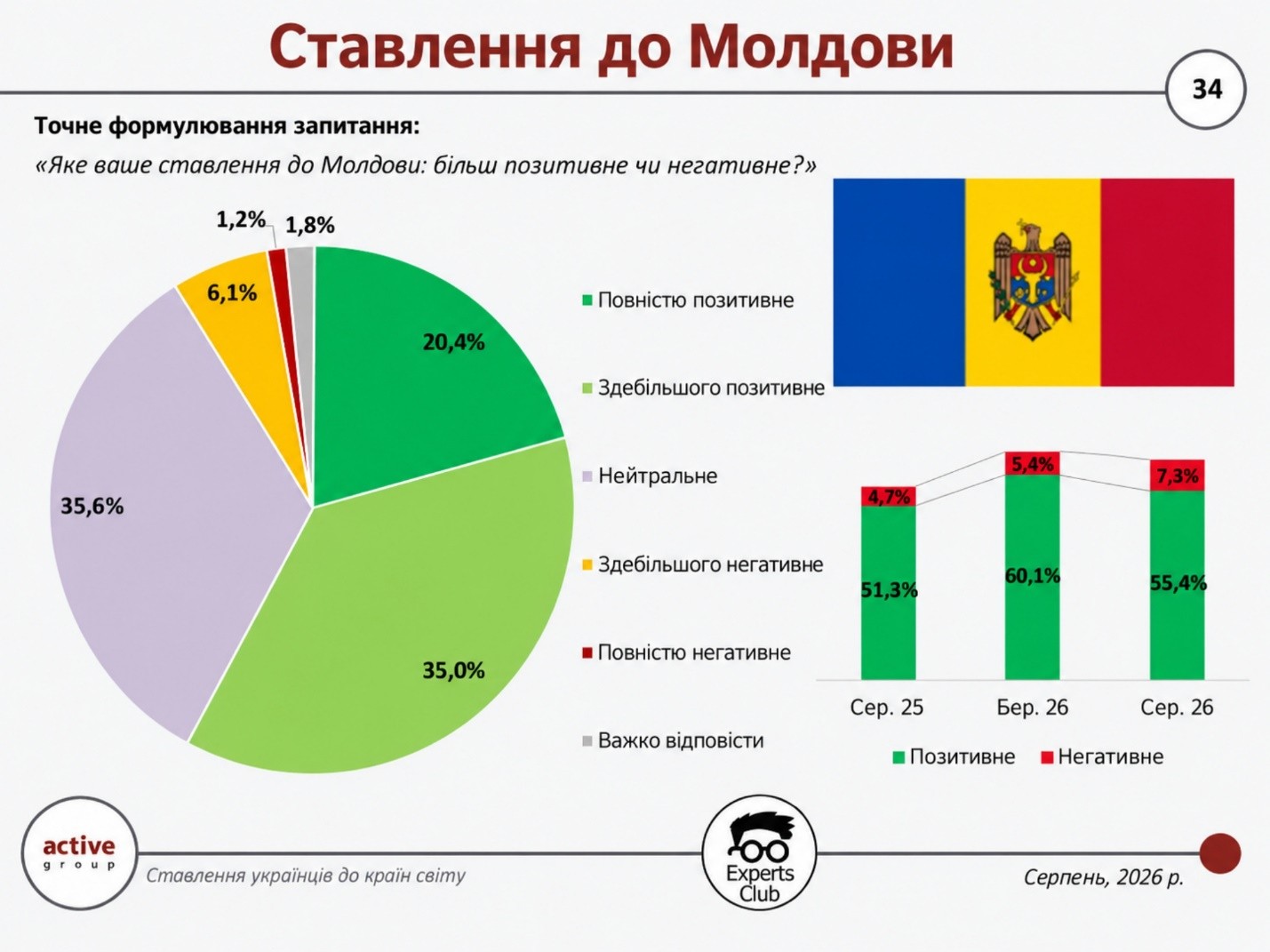
According to the results of the August survey, 20.4% of Ukrainians view Moldova entirely positively, and 35% view it mostly positively. A neutral attitude was expressed by 35.6% of respondents. 6.1% view the country mostly negatively, 1.2% completely negatively, and another 1.8% were undecided.
According to the rounded data in the table, the balance of positive and negative assessments is approximately plus 48.1 percentage points. Thus, positive attitudes toward Moldova outnumber negative ones by more than seven to one. Among the countries of Central and Eastern Europe, it is second only to the Czech Republic in terms of the balance of assessments.
In March 2026, 60.1% of respondents had a positive attitude toward Moldova: 22.8% viewed it entirely positively and 37.3% viewed it mostly positively. A neutral stance was held by 32.9% of respondents, 5.4% viewed the country negatively, and another 1.6% were undecided.
Thus, over the course of five months, the share of positive responses decreased by 4.7 percentage points—from 60.1% to 55.4%. Negative assessments increased by 1.9 percentage points, while the neutral segment grew by 2.7 percentage points. The balance between positive and negative attitudes decreased from approximately plus 54.7 to plus 48.1 percentage points, respectively.
At the same time, Moldova is of great importance to Ukraine not only as a neighboring country but also as a sales market. In the first half of 2026, Ukraine’s trade surplus with Moldova amounted to approximately $467 million, placing it third among partners with the largest trade surpluses, after Spain and Egypt.
Maksym Urakin, founder of the Experts Club information and analytical center and a candidate of economic sciences, emphasizes that it is important for Ukraine not only to maintain a presence in such markets but also to transform the positive trade balance into long-term economic results.
“To establish a foothold in these markets, it is not enough to simply produce a competitive product. We need long-term contracts, affordable insurance against military and commercial risks, export credit facilities, systematic trade diplomacy, harmonization of veterinary and phytosanitary procedures, as well as investments in ports, railways, border infrastructure, and overseas logistics centers. A trade surplus should not merely be a statistical difference between exports and imports, but rather a steady flow of foreign exchange earnings, taxes, investments, and jobs in Ukraine,” Urakin noted.
He also identifies Moldova as one of the markets where Ukraine already has a favorable starting position: “The most promising ‘growth points’ for Ukraine are a combination of markets with an already positive trade balance—Egypt, Moldova, and, to some extent, EU trade hubs—along with tools that reduce barriers: agreements, standardization, and logistics,” Urakin emphasized.
Thus, the latest round of the survey reveals a slight decline in positive attitudes toward Moldova, but no change in the overall picture: more than half of Ukrainians view the country positively, the negative segment remains small, and economic relations are characterized by a significant trade surplus for Ukraine.
ACTIVE GROUP, CENTRAL AND EASTERN EUROPE, EXPERTS CLUB, FOREIGN TRADE, international relations, MOLDOVA, PUBLIC OPINION, SOCIOLOGY, UKRAINE
Ukrainians’ positive attitude toward Bulgaria in August 2026 declined compared to the previous phase of the study: 42.7% of respondents view the country positively, down from 53.8% in March. At the same time, Ukrainians with a neutral attitude became the largest group—47.6%, according to the Experts Club Information and Analytical Center.
According to the results of the August survey, 11% of Ukrainians have a completely positive attitude toward Bulgaria, while 31.7% have a mostly positive attitude. A neutral stance is held by 47.6% of respondents. A mostly negative attitude was expressed by 6.8%, a completely negative attitude by 0.6%, and another 2.3% were undecided.
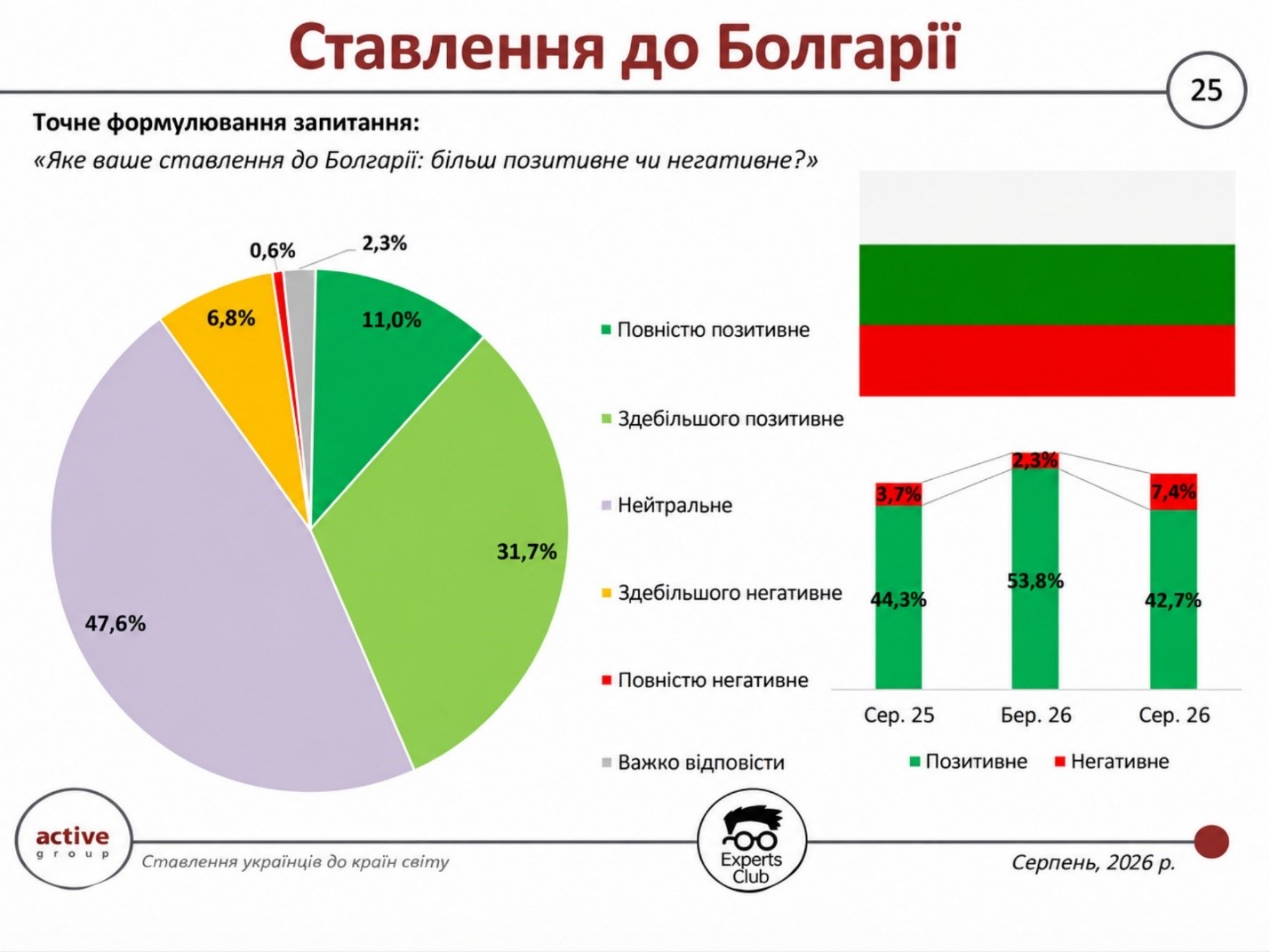
Thus, the combined share of negative assessments is 7.4%, and the balance between positive and negative attitudes is +35.3 percentage points. Despite a decline in positive ratings, favorable assessments of Bulgaria are nearly six times higher than negative ones. At the same time, nearly one in two respondents expresses neither a positive nor a negative attitude toward the country.
Compared to March 2026, the changes are quite noticeable. In the previous survey, 14.2% of respondents viewed Bulgaria entirely positively, and another 39.6% viewed it predominantly positively. The overall positive rating stood at 53.8%, the neutral rating at 42.4%, while negative assessments accounted for only 2.3%.
Over the course of five months, the share of positive responses fell by 11.1 percentage points—from 53.8% to 42.7%. Negative attitudes increased by 5.1 percentage points—from 2.3% to 7.4%—while neutral attitudes rose by 5.2 percentage points to 47.6%. The balance of positive and negative assessments fell from approximately plus 51.5 percentage points in March to plus 35.3 percentage points in August.
At the same time, the “mostly positive” category saw the sharpest decline—from 39.6% to 31.7%—while the share of entirely positive responses fell from 14.2% to 11%. Thus, the deterioration in the indicators occurred simultaneously due to growth in both the neutral and negative segments.
Maksym Urakin, founder of the Experts Club information and analytical center and a candidate of economic sciences, had previously drawn attention specifically to the significant share of uncertain or neutral perceptions of Bulgaria.
“This result indicates not so much indifference as the lack of an active Bulgarian presence in Ukraine’s information space,” Urakin noted. In his view, the problem lies not so much in an established negative image as in the country’s insufficient visibility to the Ukrainian audience. More active communication in the areas of economic, humanitarian, and other practical cooperation could help foster a more defined attitude.
The latest round of the survey partially confirms the validity of this assessment: the share of neutral respondents has once again approached half. At the same time, unlike in March, the share of negative responses has also increased, although it remains significantly lower than the share of positive responses.
The survey was conducted in August 2026 using self-administered online questionnaires from the SunFlowerSociology panel among 800 Ukrainian citizens aged 18 and older. The previous round of the survey in March also included 800 respondents; the sample was representative by age, gender, and region, with a maximum theoretical margin of error of ±3.5 percentage points for indicators at the 50% level.
ACTIVE GROUP, BULGARIA, CENTRAL AND EASTERN EUROPE, EUROPEAN UNION, EXPERTS CLUB, international relations, PUBLIC OPINION, SOCIOLOGY, UKRAINE, URAKIN
According to Experts Club, Ukrainians’ attitudes toward Romania remain predominantly positive or neutral; however, in August 2026, the share of positive assessments declined slightly compared to the previous survey wave. 45.2% of respondents view the country positively, 9.8% negatively, while 42.3% hold a neutral stance, reports the Experts Club Information and Analytical Center.
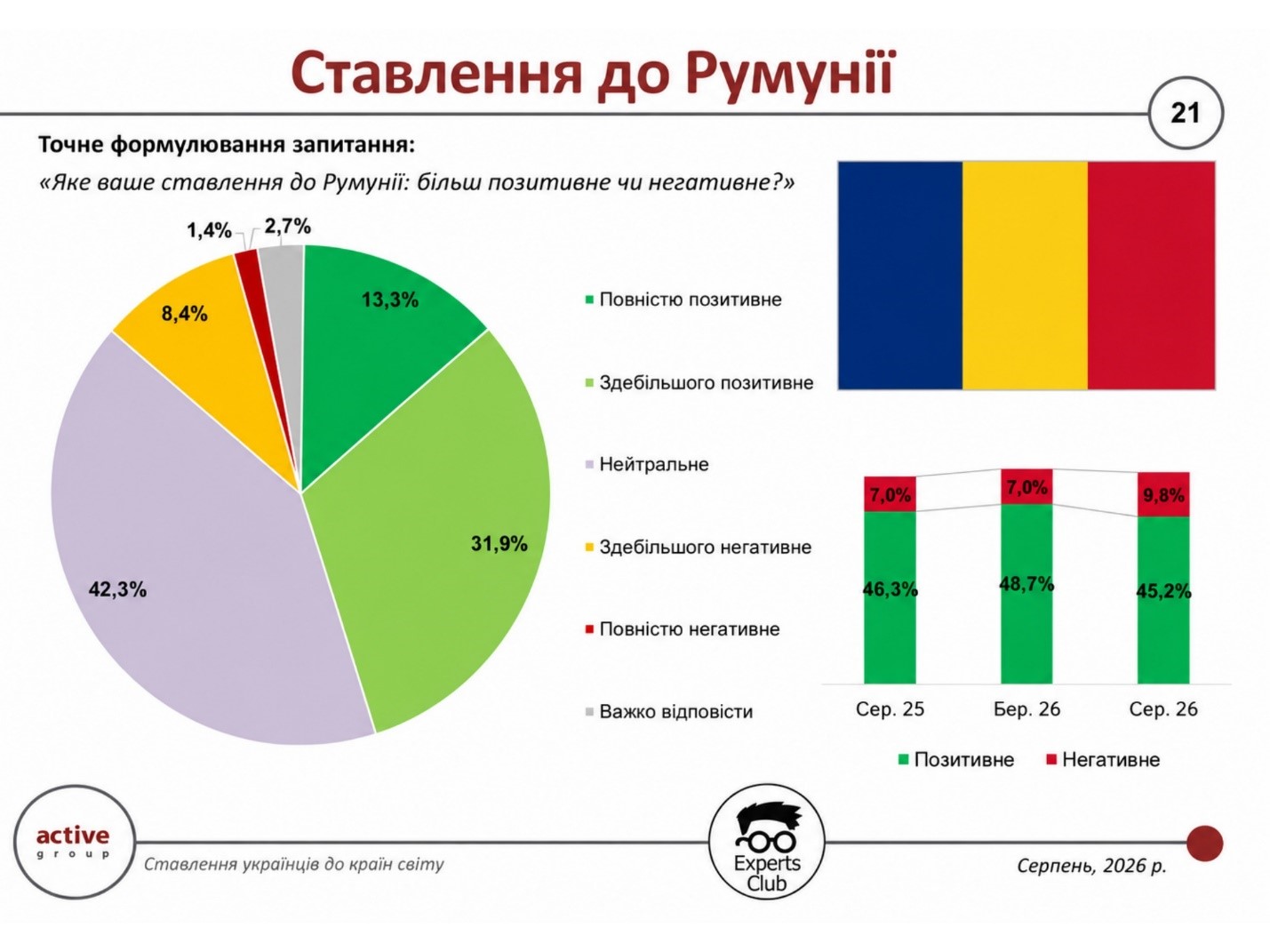
According to the results of the August survey, 13.3% of Ukrainians view Romania entirely positively, and 31.9% view it mostly positively. A neutral attitude was expressed by 42.3% of respondents. 8.4% view the country mostly negatively, 1.4% view it entirely negatively, and another 2.7% were undecided.
The balance of positive and negative assessments stands at plus 35.4 percentage points. Thus, positive responses outnumber negative ones by more than four to one, although respondents with a neutral attitude remain the largest single group.
Compared to March 2026, public perception of Romania has deteriorated slightly. In the previous survey wave, 14.9% of respondents rated the country entirely positively, and 33.8% rated it mostly positively—meaning the total share of positive responses was 48.7%. Seven percent of respondents had a negative view of Romania, and 42.2% were neutral.
Thus, over the course of five months, the positive attitude decreased by 3.5 percentage points—from 48.7% to 45.2%—while the negative attitude increased by 2.8 percentage points—to 9.8%. The share of neutral responses remained virtually unchanged: 42.2% in March and 42.3% in August. The balance between positive and negative assessments decreased from +41.7 to +35.4 percentage points, or by 6.3 percentage points.
These results indicate a moderate weakening of positive perceptions rather than a fundamental shift in attitude. The neutral group remains stable, and negative assessments, despite their increase, still lag significantly behind the positive ones.
Maksym Urakin, founder of the Experts Club information and analytical center and a candidate of economic sciences, commenting on the need to compare public assessments with the actual economic role of international partners, emphasized the deterioration of Ukraine’s overall foreign trade balance.
“For Ukraine, Romania is not an abstract foreign policy partner, but a neighboring country with which logistics, trade, the movement of people, the transit of Ukrainian goods, and humanitarian contacts are intertwined on a daily basis. Therefore, public perception here is shaped not only by political statements but also by concrete experiences of interaction. I would not yet interpret the current decline in positive assessments as a fundamental shift in attitude—the positive balance remains very significant,” Urakin noted.
In the case of Romania, the new wave of the survey shows that the country maintains a positive balance in public opinion, but this margin has narrowed compared to March. At the same time, the virtually unchanged proportion of neutral responses indicates that the main changes occurred specifically between the positive and negative segments.
The survey was conducted in August 2026 using an online self-administered questionnaire via the SunFlowerSociology panel among 800 Ukrainian citizens aged 18 and older. The previous wave also included 800 respondents, and the sample was representative by age, gender, and region.
ACTIVE GROUP, CENTRAL AND EASTERN EUROPE, EXPERTS CLUB, international relations, PUBLIC OPINION, ROMANIA, SOCIOLOGY, UKRAINE



