
Latvia continues to enjoy a high level of positive perception among Ukrainians: in August 2026, 68.3% of respondents viewed the country positively, while only 3.9% viewed it negatively. Compared to March, the share of positive assessments has decreased slightly; however, the country continues to rank among the nations with the highest levels of public favor, according to the Experts Club Information and Analytical Center.
According to the results of the August survey, 39.7% of Ukrainians view Latvia entirely positively, and 28.6% view it mostly positively. 26.6% of respondents hold a neutral position. 2.5% view the country mostly negatively, 1.4% view it entirely negatively, and another 1.2% were undecided.
The balance of positive and negative assessments stands at plus 64.4 percentage points. Thus, positive attitudes toward Latvia outnumber negative ones by more than 17 times. Overall, the countries of Northern Europe and the Baltic states maintained some of the highest levels of positive attitudes among Ukrainians in the August wave of the survey.
In March 2026, 71.6% of respondents had a positive attitude toward Latvia: 42.4% viewed it entirely positively and 29.1% viewed it mostly positively. A neutral stance was held by 24.5% of respondents, negative assessments accounted for about 2.6%, and another 1.4% were undecided.
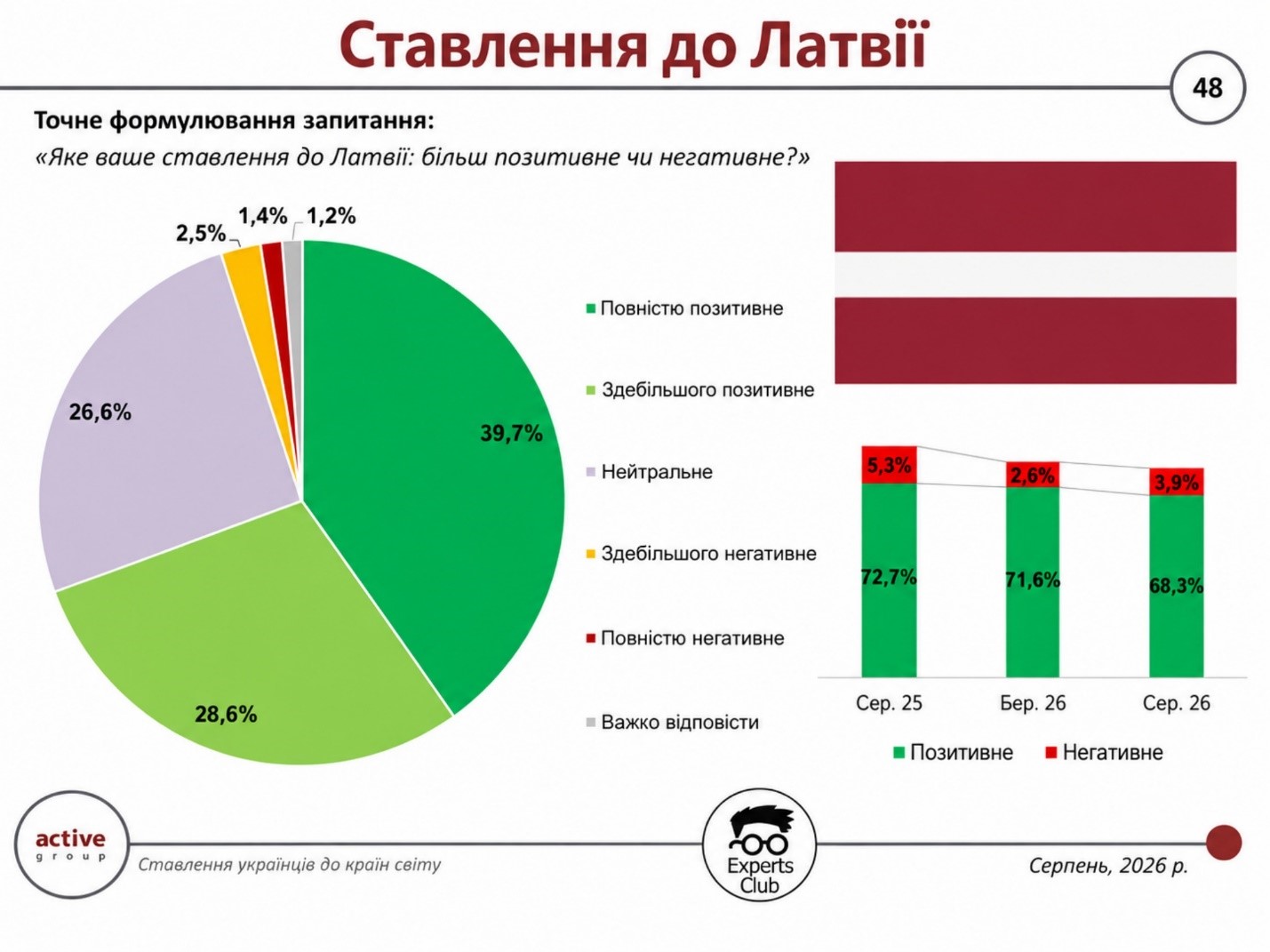
Thus, over five months, the share of positive assessments decreased by 3.3 percentage points—from 71.6% to 68.3%. The negative segment increased by approximately 1.3 percentage points, while the neutral segment rose by 2.1 percentage points. The balance between positive and negative attitudes decreased from approximately plus 69 to plus 64.4 percentage points.
At the same time, the most significant change occurred among respondents with the most strongly positive views: the share of entirely positive assessments decreased from 42.4% to 39.7%, while the share of mostly positive assessments remained close to previous levels—29.1% in March and 28.6% in August.
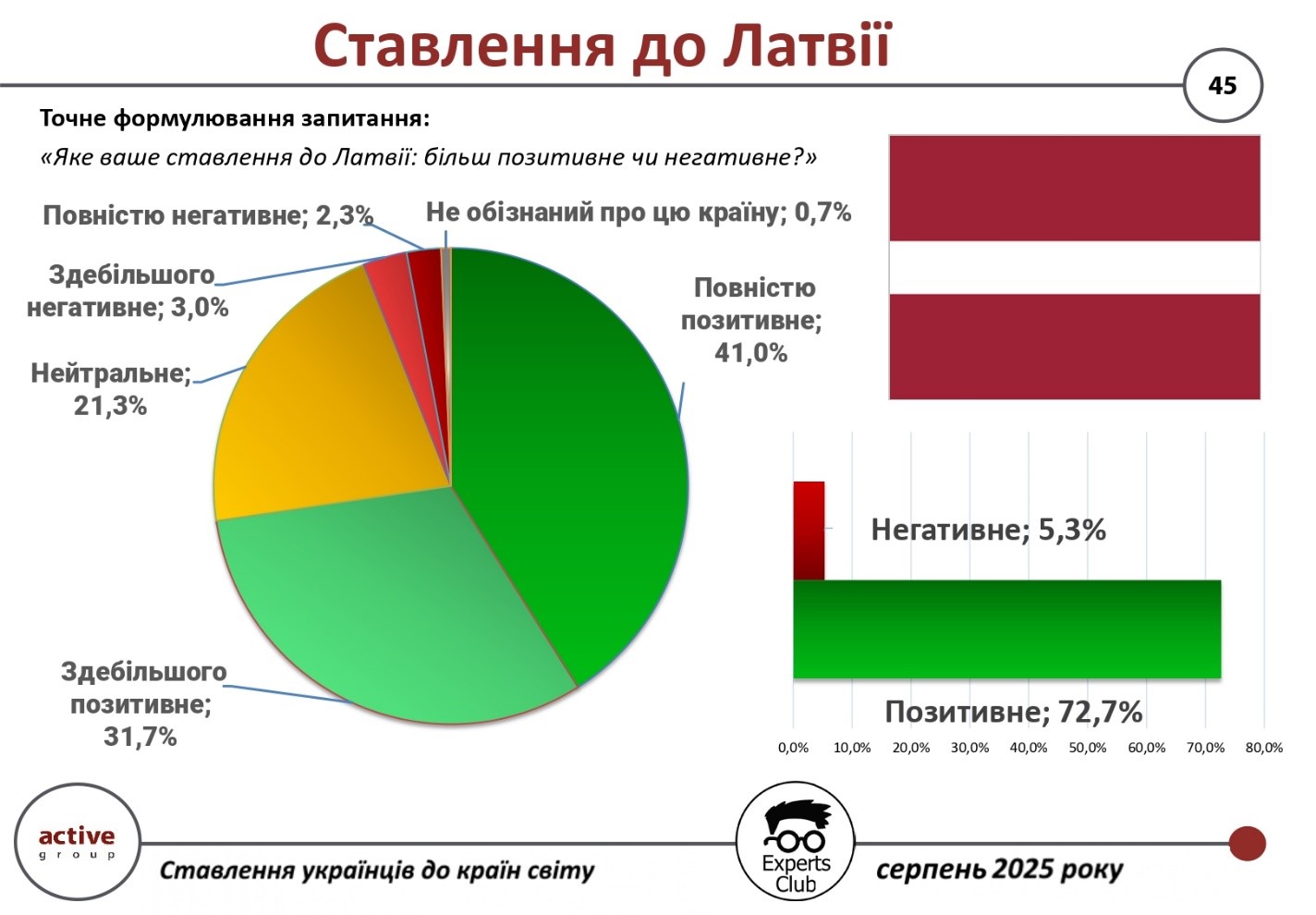
On an annual basis, the overall picture also remains stable. In August 2025, 72.7% of Ukrainians viewed Latvia positively, while 5.3% viewed it negatively. In other words, the current share of positive responses is slightly lower than a year ago, but the negative segment also remains smaller.
Oleksandr Pozniy, director of the research firm Active Group, commenting on the results of the previous survey wave regarding Latvia, attributed the high level of public support to the country’s consistent engagement with Ukraine.
“Ukrainians, in general, are very good at distinguishing between countries that demonstrate consistent support for Ukraine. At the same time, the level of positive attitude is shaped not only by political statements but also by concrete actions that people can experience firsthand. That is precisely why even small countries can have a very strong positive image,” Pozniy noted.
The latest wave of the survey shows a slight decline in positive assessments of Latvia, but no fundamental shift in public perception. More than two-thirds of Ukrainians continue to view the country positively, while the share of negative responses remains below 4%.
The survey was conducted in August 2026 using an online self-administered questionnaire via the SunFlowerSociology panel among 800 Ukrainian citizens aged 18 and older. The maximum theoretical margin of error for indicators at the 50% confidence level is ±3.5 percentage points.
ACTIVE GROUP, BALTIC STATES, EUROPEAN UNION, EXPERTS CLUB, international relations, LATVIA, Pozniy, PUBLIC OPINION, SOCIOLOGY, UKRAINE
By 2100, the population will decline in 18 European Union countries, with the sharpest declines expected in Latvia, Lithuania, and Poland, according to Eurostat data.
Under Eurostat’s baseline scenario, Latvia’s population will decrease by 33.9%, Lithuania’s by 33.4%, and Poland’s by 31.6% by the end of the century compared to 2025. A significant decline is also expected in Germany, Slovenia, Finland, and the Czech Republic, where the decline will be around 10%.
At the same time, population growth is projected only in nine EU countries by 2100. The population will increase by more than 25% only in Luxembourg and Malta—by 36.4% and 26%, respectively. Growth of 10–20% is expected in Sweden and Ireland.
Despite the overall population decline, Germany, according to Eurostat estimates, will remain the most populous EU country in 2100 with 74.7 million inhabitants. It will be followed by France with 67.2 million and Spain with 49.8 million people.
The statistical office notes that differences between countries will be significant both in terms of when peak population is reached and the scale of subsequent decline or growth.
The top of the ITCI-2025 ranking is once again dominated by countries with the most “neutral” tax structures: Estonia is in first place, Latvia is in second, and Lithuania is in fifth (plus Hungary in ninth and the Czech Republic in tenth).
The Tax Foundation notes that Estonia’s leadership is supported by four elements: a 20% corporate tax levied only on distributed profits; a flat income tax of 20% (without taxation of personal dividends in the same format); a property tax focused on land value; the territorial principle of taxation of foreign income applies.
Latvia has “caught up” thanks to the introduction of a corporate income tax model similar to Estonia’s and relatively effective labor taxation. Lithuania stands out with its low corporate tax rate (17%) and strong capital cost recovery rules.
The overwhelming majority of Ukrainians have a positive attitude towards Latvia, which indicates a consistently high level of sympathy for this country. These are the results of a sociological survey conducted by Active Group in collaboration with the Experts Club analytical center.
According to the results, 72.7% of respondents rated Latvia positively (41.0% — completely positive, 31.7% — mostly positive). A neutral attitude was expressed by 21.3% of respondents, while only 5.3% declared a negative position (2.3% — completely negative, 3.0% — mostly negative). Only 0.7% of respondents said they had no information about this country.
“The survey results show an extremely high level of trust and sympathy among Ukrainians towards Latvia. This country is perceived not only as a political ally, but also as a partner that consistently supports Ukraine in the international arena,” said Alexander Pozniy, head of Active Group.
In turn, Maksim Urakin, co-founder of Experts Club, drew attention to the economic indicators of bilateral trade.
“According to the results of the first six months of 2025, trade turnover between Ukraine and Latvia reached $263.9 million. Ukrainian exports amounted to $154.2 million, while imports amounted to $109.7 million.
The positive balance amounted to more than $44.5 million, which favorably distinguishes Latvia among Ukraine’s other trading partners in the EU,” the expert emphasized.
Thus, Ukraine and Latvia not only maintain a high level of mutual sympathy, but also demonstrate balanced and mutually beneficial trade and economic cooperation.
The full video can be viewed at: https://www.youtube.com/watch?v=YgC9TPnMoMI&t
You can subscribe to the Experts Club YouTube channel here: https://www.youtube.com/@ExpertsClub
ACTIVE GROUP, BALTIC STATES, EXPERTS CLUB, LATVIA, Pozniy, SOCIOLOGY, TRADE, UKRAINE, УРАКИН

Ukrainian tour operator Join UP! plans to launch franchising in the Baltic States and Kazakhstan in 2024, according to Marina Dayneko, head of the Join UP! sales office, in an interview with the Interfax-Ukraine news agency.
“Currently, more than 100 agencies are operating under this model in Ukraine, and four in Moldova, two of which opened this year. We are continuing to develop franchising in Poland and are currently signing agreements with both Polish and Ukrainian partners. This year, we are launching franchising in Kazakhstan and the Baltic states,” she said.
As reported, the travel company Join UP! LLC was established in 2013 with a registered capital of UAH 72.671 million. The ultimate beneficiaries are Yuriy and Oleksandr Alby. According to the OpenDataBot service, at the end of 2024, the tour operator’s revenue decreased to UAH 376,000 from UAH 16,639,000 in 2023, and its net loss decreased to UAH 217,451,000 from UAH 233,341,000, respectively.
The brand’s international expansion covers eight markets: the Baltic states, Kazakhstan, Moldova, Poland, Romania, and the Czech Republic. Preparations are underway to launch operations in Slovakia and Hungary. Last year, the brand also opened its first franchise agency on the international market in Katowice, Poland.
The Ministers of Internal Affairs of the Baltic States and Poland visited Ukraine, where they signed a multilateral agreement on cooperation in preventing cross-border crime and restoring the sphere of activity of the Interior Ministry of Ukraine after the end of hostilities.
Estonian Interior Minister Kristian Jaani said that his country will continue to fully support Ukraine, the press service of the Estonian Interior Ministry said on Friday. This applies to both direct political and practical support for Ukraine, including humanitarian support, as well as post-war reconstruction, the imposition of tough sanctions against Russia, Jaani said.
He said that Estonia would fully support granting Ukraine the status of a candidate country for membership in the European Union.
The minister noted that the total contribution of Estonian humanitarian aid is more than EUR16 million, including support for civil society and the private sector.
Marine rescue and sapper suits, folding beds, tents, generators, VoIP phones and much more have been sent to Ukraine through the Interior Ministry of Ukraine.
“At 48 hours’ notice, we are ready to send sappers,” Jaani said.



