
Sustainable development of the wood processing industry—the achievement of this operational objective of the Government Action Program—is now the responsibility of the Ministry of Agrarian Policy and Food, whereas until recently, forestry was overseen by the Ministry of Economy and Environment.
According to the Program, which the Cabinet of Ministers submitted to the Verkhovna Rada, the Ministry of Agrarian Policy and Food is tasked with approving the Strategy for the Development of Ukraine’s Wood Processing and Furniture Industries for the period up to 2030 and adopting an operational plan of measures for its implementation for 2026–2028 (2026).
Other tasks in this area include introducing, in 2027, uniform rules for the functioning of the timber market for all permanent forest users and forest owners; completing the corporatization of the state-owned enterprise “Forests of Ukraine”; and imposing a permanent moratorium on the sale of state-owned shares.
The forestry sector and the State Forest Resources Agency (State Forest Agency) were under the jurisdiction of the Ministry of Agrarian Policy until 2019, after which they were transferred to the jurisdiction of the merged Ministry of Energy and Environmental Protection (Ministry of Energy and Environment), and in 2020, following its split, they were transferred to the jurisdiction of the Ministry of Environmental Protection and Natural Resources, where they remained until the summer of 2025, when yet another merged ministry was created—the Ministry of Economy, Environment, and Agriculture.
People’s Deputy Olga Vasilevska-Smaglyuk criticized the possible decision to return the forestry sector to the jurisdiction of the Ministry of Agrarian Policy. “The key risk is a change in the very philosophy of forest management. Forests cannot be viewed merely as an economic resource that needs to be used more efficiently. After all, they are first and foremost natural capital, an ecosystem, and a component of the country’s environmental security,” she explained.
In her view, such a transfer could also slow down the corporatization of the state-owned enterprise “Forests of Ukraine,” the digitization of timber accounting, and the transition to European forest management standards.
CORPORATIZATION, FOREST, MINISTRY OF AGRARIAN POLICY, TIMBER, WOOD PROCESSING
The program of the Cabinet of Ministers of Ukraine calls for increasing timber harvesting to 15.5 million cubic meters in 2027, boosting production in the woodworking and furniture industries by 5%, and raising the share of high-value-added products in exports by 10%.
According to the program, in 2026 the government plans to adopt the Strategy for the Development of Ukraine’s Woodworking and Furniture Industries through 2030 and approve an operational plan of measures for its implementation in 2026–2028.
In 2027, the government plans to introduce uniform rules governing the timber market for all permanent forest users and forest owners, regardless of ownership status.
In addition, in 2026–2027, the government plans to implement the European Union Regulation on the Trade in Goods Related to Deforestation and/or Forest Degradation (EUDR), as well as a system for due diligence and geospatial traceability of timber origin based on state information systems.
Furthermore, the corporatization of the state-owned enterprise “Forests of Ukraine” is scheduled to be completed in 2027, along with the introduction of a permanent moratorium on the sale of state-owned shares.
According to the Ministry of Economy, Environment, and Agriculture, the total volume of timber harvested in Ukraine in 2025 amounted to 11.7 million cubic meters.
As previously reported, on August 17, the Cabinet of Ministers of Ukraine approved the Government Action Program. Verkhovna Rada Chairman Ruslan Stefanchuk stated that parliament will consider the Program in the near future in accordance with established procedure.
The Cabinet of Ministers of Ukraine has authorized that, for the duration of martial law and for 12 months following its end, timber harvested during sanitary logging be counted toward timber harvesting limits for main-use logging in mature and overmature stands in all forests, except for mountain forests in the Carpathian region, the press service of the Ministry of Economy, Environment, and Agriculture reported on Thursday.
“The adopted resolution will allow for more efficient use of forest resources under martial law and ensure additional volumes of timber to meet the needs of the economy, communities, and the defense sector. The document strengthens requirements for forest management, biodiversity conservation, and forest restoration. ‘We are establishing clear rules for forest users while ensuring a balance between the state’s economic needs and environmental responsibility,’ the press service quoted Taras Vysotsky, Deputy Minister of Economy, Environment, and Agriculture, as saying.
According to the statement, this decision will allow forest users to further meet the timber needs of the economy, the population, and the Armed Forces of Ukraine, while enabling state-owned forestry enterprises to increase the supply of marketable timber to the market.
At the same time, if the application of the new mechanism leads to a reduction of 30% or more in the main-use logging quota in mature and overmature stands, a mandatory recalculation of the quotas with a corresponding reduction is provided for. After logging, the forests will be subject to mandatory restoration in accordance with legal requirements.
In addition, the resolution clarifies the requirements for conducting sanitary measures and addressing the consequences of hostilities in forests, defines the specifics of certain types of logging, and introduces a mechanism for correcting technical errors in electronic logging permits.

The state-owned enterprise “Forests of Ukraine” has completed auctions for the first quarter of 2026, during which almost all forest products were contracted, prices for hardwood species continued to rise, and prices for coniferous species stabilized, the press service of the state-owned enterprise reported.
“Forests of Ukraine” noted that the auctions were held for the first time under the zero quota for firewood exports introduced by the Cabinet of Ministers. However, in the process of competitive struggle for resources, market participants once again reached higher price levels.
Thus, 381,000 cubic meters were put up for quarterly auctions for the sale of industrial wood (PV), and almost 100% was contracted. Compared to the fourth quarter, the average price of firewood rose from UAH 2,300/cubic meter to UAH 2,600/cubic meter. The main reason was the rise in the price of hardwood from UAH 2,300/cubic meter to UAH 3,000/cubic meter. At the same time, the market value of softwood did not change significantly and amounted to UAH 2,400/cubic meter.
It is noted that the supply of firewood for sale by the State Enterprise “Forests of Ukraine” was distributed almost equally between quarterly and semi-annual (forward) auctions. The forward contracts for the first half of the year took place earlier: 100% of the resource (741 thousand cubic meters) was sold, with an average sale price of UAH 2.4 thousand/cubic meter.
“The tool for hedging price risks by concluding long-term contracts has once again proven its effectiveness. At least in the first quarter, products under semi-annual contracts for firewood will be slightly cheaper,” the state-owned enterprise stated.
Of the 775,000 cubic meters of round timber put up for sale at quarterly auctions, more than 99.5% was sold. The average selling price increased from UAH 6,800/cubic meter in the fourth quarter to UAH 7,300/cubic meter.
At the same time, “Forests of Ukraine” considers it incorrect to talk about a general increase in prices for commercial timber, since birch rose in price from UAH 5,700/cubic meter to UAH 7,600/cubic meter, oak from UAH 22,000/cubic meter to UAH 28,000/cubic meter, and ash from 8,000 UAH/cubic meter to 11,000 UAH/cubic meter. At the same time, alder has become cheaper, falling from 6,700 UAH/cubic meter to 5,900 UAH/cubic meter, and pine from 5,900 UAH/cubic meter to 5,600 UAH/cubic meter.
About 25% of the resource (654 thousand cubic meters) was put up for forward trading in commercial timber for the first half of the year. The average selling price at forward trading was slightly lower than the quarterly price and amounted to UAH 7.2 thousand/cubic meter. At the same time, while oak and ash were indeed contracted at prices lower than those at quarterly auctions, the situation was reversed for coniferous species, the state-owned enterprise noted.
The Cabinet of Ministers has decided to extend restrictions on the export of timber and scrap metal until the end of 2026, Prime Minister Yulia Svyrydenko announced.
“The decision provides for a licensing regime with zero quotas for the export of unprocessed wood, fuel wood, as well as ferrous metal and copper scrap. This allows Ukraine to preserve strategic raw materials and direct them to domestic processing needs,” Svyrydenko wrote on Telegram following Wednesday’s government meeting.
According to her, scrap metal is a critically important raw material for the Ukrainian metallurgical and foundry industries.
“Despite the export duty, scrap exports have been growing, often in transit to third countries without creating added value for Ukraine. Domestic processing, on the contrary, provides jobs, tax revenues, and products necessary for defense and recovery. Also, the use of scrap in metallurgical production reduces CO2 emissions, which is important given the EU requirements,” the prime minister added.
As for timber, she said the government had extended some of the restrictions introduced at the end of October.
During the full-scale war, logging volumes have significantly decreased due to hostilities. At the same time, woodworking enterprises are facing a shortage of raw materials and are forced to idle, while for many rural communities, firewood remains a key resource for heating in winter,” she wrote.
Svyrydenko noted that the extension of restrictions on raw material exports supports Ukrainian production, reduces pressure on the environment, and strengthens the energy security of communities.
CABINET OF MINISTERS, EXPORTS, FOREST, RESTRICTIONS, SCRAP METAL
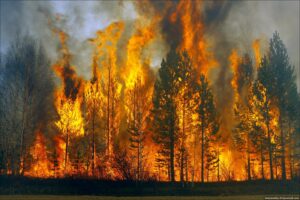
The area affected by forest fires in Ukraine has decreased fourfold this year. The area affected by fires in the forests of the State Enterprise “Forests of Ukraine” (excluding the Izyum Forestry) amounted to only 1.5 thousand hectares, compared to 6 thousand hectares in 2024. This was reported by the head of the enterprise, Yuriy Bolokhovets.
According to him, since the beginning of the year, forest fires in the European Union have destroyed more than a million hectares of forest, which is a record for the last twenty years. For example, in Ukraine’s neighbor Romania, 126,000 hectares of forest land have burned down. In Ukraine, military factors are added to the negative climatic factors – a significant proportion of fires are associated with rocket and drone strikes. However, the percentage of forest loss due to fires is an order of magnitude lower than in the EU.
The most problematic remains the Izyum Forestry, which this year included three de-occupied forestries in the Kharkiv region. Last year, almost 13,000 hectares of forest burned down here. After joining the State Enterprise “Forests of Ukraine,” the company notes that new firefighting equipment and tools were transferred to the forestry enterprises, and the salaries of forest protection workers were increased. As a result, the area affected by fires in the Izyum Forestry was reduced by almost 8 times to 1,800 hectares.
The State Enterprise “Forests of Ukraine” explains that the reduction in the area affected by fires was achieved thanks to the purchase of new firefighting equipment. This year, dozens of new forest firefighting modules were sent to most of the company’s branches, which are capable of reaching places that large fire trucks cannot access. Recently, new tenders were announced for the purchase of 50 modules to be installed in pickup truck beds and 20 trailer platforms with pre-installed forest firefighting modules.
The salaries of forest protection workers have also been increased by an average of 20%.
Over the past two years, the State Enterprise “Forests of Ukraine” has set up more than 100 new modern recreation centers, the presence of which significantly reduces the risk of fires caused by human factors. Another 50 have been opened this year. According to the company, these are full-fledged complexes for safe leisure in the forest with all the necessary infrastructure (children’s and sports grounds, water, electricity, changing rooms, barbecues, etc.).
In addition, foresters continue to make large-scale investments in firefighting infrastructure. This year, 38,800 km of mineralized strips were installed and 183,400 km of existing ones were maintained. The State Enterprise “Forests of Ukraine” maintains 3,500 fire reservoirs, equips them with piers, and installs water storage tanks so that even in hot weather, each reservoir has the necessary water supply.
Work is continuing on the purchase and installation of 30 new television surveillance systems and the construction of 24 new observation towers. The goal is to completely cover forest areas with a high risk of fire with a video surveillance system. In total, the company operates almost 500 such towers.
To prevent large-scale fires in the future, Lisy Ukrainy has refused to plant pure coniferous stands, creating exclusively mixed forests of coniferous and deciduous species, which are more resistant to climate change and less vulnerable to fires.



