
According to Experts.news, gasoline imports to Ukraine in September 2026 totaled 145,000 metric tons, which is 5% less than in August but 3% higher than in September of last year, the A-95 Consulting Group reported based on the results of a special study.
From January through September, Ukraine imported 1.26 million metric tons of gasoline—15% more than during the same period in 2025.
“The decline in gasoline supplies in September occurred against the backdrop of a seasonal drop in consumption. Demand was also weighed down by this year’s record-high retail prices, which prompted car owners to conserve fuel,” the A-95 Consulting Group reported.
Lithuania remained the largest source of gasoline supplies in September, accounting for 46,400 metric tons, or 32% of the total volume. Compared to August, supplies fell by 10.4%.
Poland ranked second with 36,800 metric tons, or 25% of Ukraine’s imports. A month earlier, 40,100 metric tons were supplied from that country.
Thus, the combined share of Lithuania and Poland in September fell from 60% to 57%. Supplies from the largest supplier—the ORLEN Group—from these two countries decreased from 78,800 to 67,800 metric tons. Despite the decline, ORLEN accounted for about 47% of all Ukrainian gasoline imports.
At the same time, the geography of supplies changed. Imports from Germany fell by 25% compared to August—to 13,600 metric tons. Of this volume, 8,300 metric tons, or 61%, were imported by the UPG network.
At the same time, the share of southern supplies increased. Gasoline shipments from Romania rose by 29%—from 23.4 thousand to 30.1 thousand metric tons. As a result, Romania moved into third place among supplier countries and accounted for over 20% of September’s imports.
Supplies from Greece, on the other hand, fell by 28%—from 15,000 to 10,800 metric tons. Imports from Moldova more than doubled—from 1,900 to 4,100 metric tons.
Thus, despite the decline in total imports in September, shipments remain higher than last year’s level, and in the first nine months of 2026, Ukraine imported 15% more gasoline than in the same period a year earlier.
Source: A-95 Consulting Group.
OKKO maintained its leadership among the largest importers of automotive gasoline into Ukraine, importing 51,000 metric tons of fuel in September 2026, according to data from a special study by the A-95 Consulting Group and calculations by the Experts Club analytical center.
Thus, OKKO accounted for about 35% of total gasoline imports in September, which amounted to 145,000 metric tons.
From January through September, the company imported 375,000 metric tons of gasoline—about 30% of the total volume of shipments to Ukraine since the beginning of the year, which reached 1.26 million metric tons.
Ukrnafta took second place among importers in September with a volume of 19,500 metric tons. WOG recorded virtually the same figure—19,000 metric tons.
UPG imported 15,900 metric tons of gasoline. Thus, the four largest companies—OKKO, Ukrnafta, WOG, and UPG—accounted for a total of 105,400 metric tons, or nearly 73% of all gasoline imports into the country for the month.
Next came BRSM-Nafta with 5,300 metric tons, Avantage with 3,400 metric tons, BVS and SOCAR with 2,600 metric tons each, KLO with 2,300 metric tons, and VST with 1,900 metric tons. Other companies collectively imported 21,300 metric tons.
In September, gasoline imports into Ukraine fell by 5% compared to August—to 145,000 metric tons. The A-95 Consulting Group attributes the decline in supplies to a seasonal drop in consumption and this year’s record-high retail gasoline prices, which encouraged drivers to conserve fuel.
At the same time, compared to September 2025, imports rose by 3%, and over the first nine months of this year—by 15%, to 1.26 million metric tons.
Source: “A-95” Consulting Group.
Ukrainian gas station chains are not yet fully passing on the increased costs resulting from Russian attacks to consumers, instead offsetting them by reducing their own profitability; however, the ability to keep prices in check in this way is limited, according to Serhiy Kuyun, director of the A-95 Consulting Group.
As the expert reported on his Facebook page, “A-95” specialists compared retail prices for gasoline and diesel fuel with their customs value over the past three years.
The resulting difference includes gas stations’ logistics and operating costs, as well as operators’ profits. According to “A-95” calculations, in 2026 this markup did not increase but actually decreased slightly compared to the previous year, despite a significant rise in fuel companies’ expenses.
Among the additional costs, Kuyun cites the restoration of damaged gas stations and the strengthening of their security. According to him, installing an anti-drone protective structure over a single gas station can cost about €100,000, while building a temporary shelter can cost 1–1.2 million UAH.
At the same time, personnel costs are rising. According to data from the State Tax Service cited by the expert, the official salaries of employees at the 40 largest gas station chains have increased by 20% over the past year. Additional expenses arise from the need to organize work schedules and staff rotations in frontline regions.
“In other words, the stability of the markup was achieved by reducing profits,” Kuyun noted.
According to his assessment, the most difficult economic situation has developed in the left-bank region of Ukraine. The cost of delivering fuel there is higher than in the western and southern border regions, while there is virtually no significant regional variation in retail prices.
National chains can partially offset the low profitability of such gas stations through more efficient stations in other regions. For small local operators in the east of the country, this option is often unavailable.
According to Kuyun, some local gas stations are currently operating with zero or negative profitability. The expert attributes this to why some gas stations damaged by Russian drones are not being rebuilt: investments in repairs may not pay off given the current economic situation.
A further negative factor is the decline in fuel sales. Kuyun attributes this both to the impact of attacks on Ukrainian industry and the resulting drop in consumption, as well as to the high cost of petroleum products on the global market.
According to the expert, for now, fuel retailers are effectively absorbing part of the rising costs using their own revenues, rather than passing them on entirely to the final price of gasoline and diesel fuel.
However, this situation cannot last indefinitely.
“It’s hard to say how much longer fuel retailers will be able to absorb these price increases using their own revenues. I think it won’t be long,” Kuyun noted.
Thus, future price trends at Ukrainian gas stations will depend not only on global oil and petroleum product prices and the exchange rate, but also on operators’ ability to offset rising costs related to logistics, security, infrastructure restoration, and personnel.
Source: Serhiy Kuyun — Facebook post.
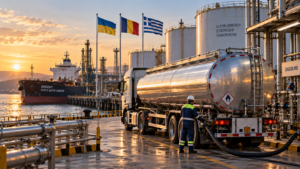
In August 2026, Ukraine significantly reduced purchases of motor gasoline from the southern direction: imports from Romania decreased by approximately one third, while those from Greece fell by 40%, according to calculations by the Experts Club analytical center and data from the A-95 Consulting Group.
Supplies of Romanian gasoline amounted to 23.4 thousand tonnes compared with 34 thousand tonnes in July.
Imports from Greece decreased to 15 thousand tonnes from 24.9 thousand tonnes a month earlier.
Thus, total supplies from the two countries decreased over the month from approximately 58.9 thousand to 38.4 thousand tonnes.
“The main reason for the significant drop in imports from the south was the price factor. In August, when the market was no longer threatened by a shortage, companies reduced purchases of more expensive fuel from Romania and Greece,” the A-95 Consulting Group reported.
A similar trend was also observed in the diesel fuel market.
At the same time, the bulk of Ukrainian gasoline imports continued to arrive from the northwestern direction. In August, Lithuania supplied 51.8 thousand tonnes of gasoline, while Poland supplied 40.1 thousand tonnes.
These two countries accounted for about 60% of total imports.
Overall, gasoline supplies from abroad in August amounted to 152 thousand tonnes, which is 7% less than a year earlier. Since the beginning of 2026, Ukraine has imported 1.12 million tonnes of gasoline — 16% more than in January-August 2025.
The decline in purchases from the southern direction shows that after supply stabilized, Ukrainian traders began more actively redistributing flows in favor of cheaper European sources.
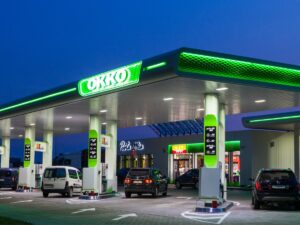
The OKKO network remains the largest importer of automotive gasoline into Ukraine: in August 2026, the company imported 46,100 metric tons of fuel, and 302,000 metric tons since the beginning of the year, according to data from the A-95 Consulting Group. OKKO accounts for about 27% of all Ukrainian gasoline imports since the beginning of the year.
The next group of largest suppliers consists of WOG, UPG, and “Ukrnafta.”
In August, WOG imported 20,200 metric tons of gasoline, UPG—20,000 metric tons, and “Ukrnafta” imported 19,400 metric tons.
Next are “BRSM-Nafta” with 7,000 metric tons, Amic with 3,400 metric tons, and “Avantage” with 3,100 metric tons.
Gaztrim and KLO each imported 2,400 metric tons, and Bars 2000 imported 2,200 metric tons.
Other market participants accounted for 26,100 metric tons.
In total, Ukraine imported 152,000 metric tons of motor gasoline in August.
The largest countries of origin for the fuel were Lithuania—51,800 metric tons—and Poland—40,100 metric tons. The ORLEN Group supplied more than half of August’s imports.
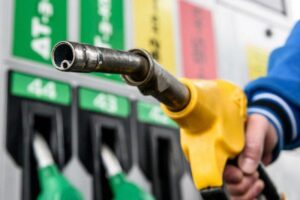
The rise in artisanal gasoline production within Ukraine was one of the factors behind the decline in official fuel imports in August 2026, according to the A-95 Consulting Group.
According to the group, imports of automotive gasoline in August totaled 152,000 metric tons, which is 7% less than a year earlier.
“In August, gasoline shipments were lower due to large carryover stocks and the growth of domestic illicit production, driven by the ability to add tax-exempt solvents,” A-95 reported.
Experts believe that government agencies—primarily the State Tax Service—need to strengthen oversight of this sector.
“This is not only a matter of losses to the state budget but also of the questionable quality of such fuel,” the group emphasized.
The use of components not subject to excise tax as motor fuel potentially allows producers to lower the cost of gasoline blends and gain an advantage over legal market participants who pay fuel taxes in full.
At the same time, there was no overall gasoline shortage on the Ukrainian market in August. Since the beginning of 2026, official import volumes have remained higher than last year’s: 1.12 million metric tons of gasoline were imported over eight months, which is 16% more than a year earlier.
The largest importers remain OKKO, WOG, UPG, and Ukrnafta, while the main supplier countries are Lithuania and Poland.
EXCISE TAX, FUEL, GASOLINE, TAX, UKRAINE



