
Georgia has the highest balance of positive and negative attitudes among Ukrainians among the countries of the Caucasus and Central Asia included in the study—48.5 percentage points. Azerbaijan scored 40.1 percentage points, while Uzbekistan’s score was 11.1 percentage points. These findings come from the third wave of the study “Ukrainians’ Attitudes Toward Countries Around the World,” conducted by Active Group in collaboration with Experts Club, according to the Experts Club Information and Analytical Center.
57.3% of Ukrainians surveyed view Georgia positively, 32.1% neutrally, 8.8% negatively, and another 1.8% were undecided. The balance of positive and negative assessments stands at 48.5 percentage points and has gradually increased over the three waves of the survey: from 45.6 percentage points in August 2025 to 47.5 percentage points in March 2026 and 48.5 percentage points in August of this year. The current figures for positive attitudes and the balance are confirmed by the published survey data.
A positive attitude toward Azerbaijan was expressed by 48.7% of respondents, a neutral one by 39.5%, a negative one by 8.6%, and another 3.1% chose the “difficult to answer” option. The balance stands at 40.1 percentage points. Compared to March 2026, it has risen from 37.8 percentage points, but remains lower than the August 2025 level of 51 percentage points. In terms of the share of positive assessments, Azerbaijan ranks second in this regional group after Georgia.
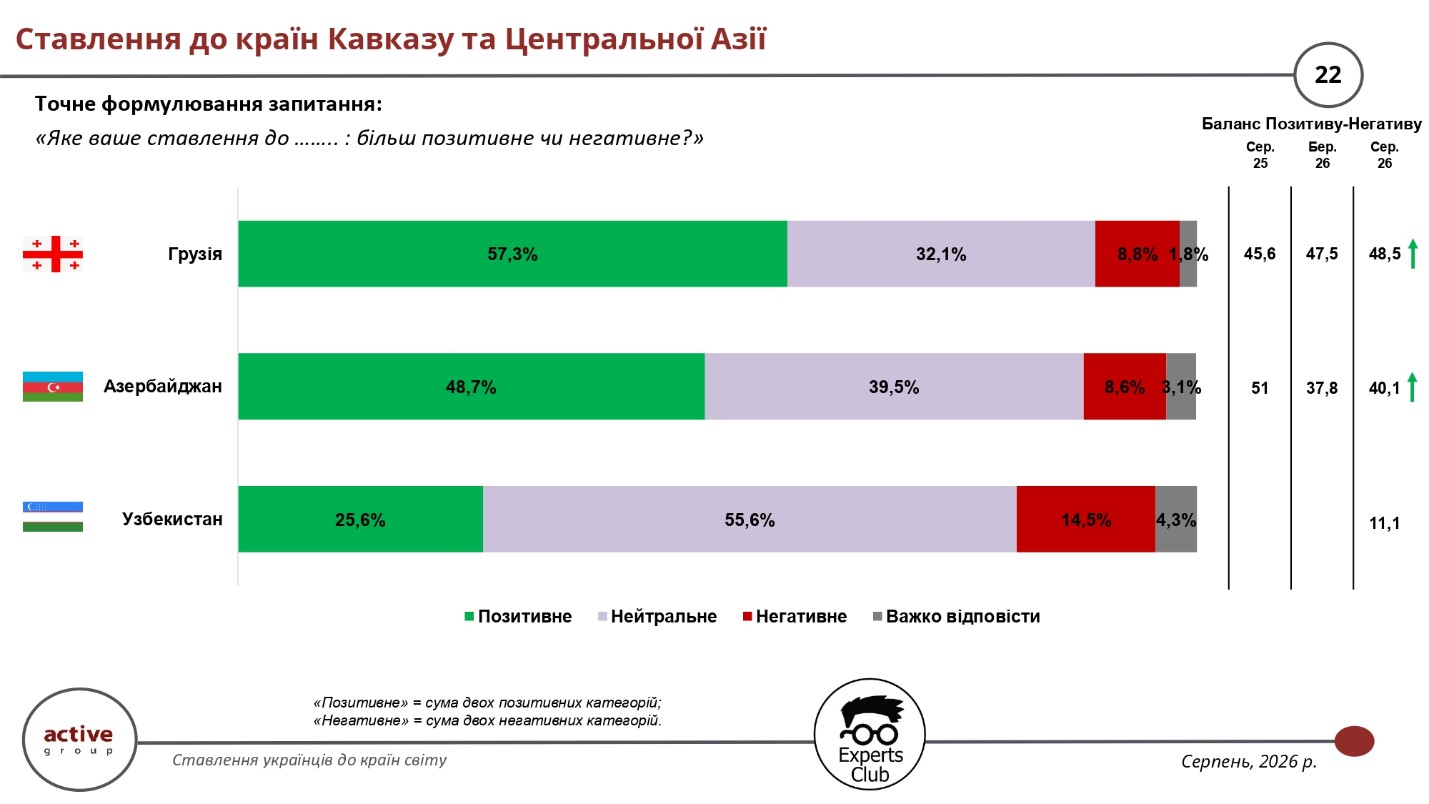
Attitudes toward Uzbekistan are characterized primarily by a high proportion of neutral assessments. 25.6% of respondents view the country positively, 55.6% neutrally, 14.5% negatively, and another 4.3% are undecided. The balance between positive and negative responses is 11.1 percentage points. In the study’s analytical materials, the high proportion of neutral responses is noted as a characteristic feature of perceptions of countries in the region that receive less media attention from the Ukrainian audience.
Thus, the balance remains positive for all three countries surveyed, but the structure of the assessments differs significantly. In the case of Georgia, the overwhelming majority of respondents express a positive attitude; positive assessments also prevail regarding Azerbaijan, while a neutral stance dominates in assessments of Uzbekistan.
Maksym Urakin, founder of the Experts Club Information and Analytical Center, deputy director of the Interfax-Ukraine news agency, and candidate of economic sciences, emphasized the importance of systematic communication between foreign partners and Ukrainian society.
“Second, we must be open to questions and inquiries from the media and the public. We also need to make use of our sociological data,” Urakin noted. According to him, it is important for embassies to regularly inform the Ukrainian audience about specific results of cooperation and to maintain full-fledged communication in the Ukrainian language.
Oleksandr Pozniy, director of the research company Active Group, drew attention to the need to develop the practical component of international economic cooperation.
“We should focus not only on raising general awareness. We need to expand cooperation with countries where we can achieve a positive trade balance,” Pozniy noted. He also highlighted the role of business associations, the Ministry of Economy, and the Ministry of Foreign Affairs in developing bilateral relations.
The survey was conducted in August 2026 using self-administered online questionnaires via the SunFlowerSociology panel. A total of 800 Ukrainian citizens aged 18 and older were surveyed. According to the organizers, the sample is representative in terms of age, gender, and region, and the maximum theoretical margin of error for indicators at the 50% confidence level is ±3.5 percentage points. This is the third wave of the survey, following surveys conducted in August 2025 and March 2026.
ACTIVE GROUP, AZERBAIJAN, Central Asia, EXPERTS CLUB, GEORGIA, international relations, Pozniy, SOCIOLOGY, the Caucasus, UKRAINE, URAKIN, UZBEKISTAN

Tbilisi is preparing to host the international conference AgriFuture Georgia 2026, which will bring together representatives of the agribusiness sector, technology companies, investors, producers, and experts to discuss new opportunities for agricultural development, the implementation of innovations, and the attraction of investment.
The event will serve as a platform for direct dialogue between agricultural producers, suppliers of modern technologies, financial institutions, and companies interested in developing agricultural projects in Georgia and the region.
One of the central themes of AgriFuture Georgia 2026 will be the transformation of agriculture driven by modern technologies. Participants will discuss the automation of production processes, the digitalization of agribusiness, and the application of innovative solutions in crop production, horticulture, and other areas of agricultural production.
Special attention will be given to investments in agriculture and the search for new financing models for agricultural projects. Representatives from the business and investment communities will have the opportunity to discuss promising investment areas, opportunities for scaling up existing operations, and launching new projects.
Another key focus of the conference will be the development of exports. For Georgian and regional producers, entering new markets remains one of the key drivers of further growth; therefore, participants will examine the requirements of international buyers, changes in demand patterns, and opportunities to enhance the competitiveness of agricultural products.
The organizers expect the conference to serve not only as a forum for discussion but also as a venue for establishing new business contacts. As part of AgriFuture Georgia 2026, agribusiness representatives will be able to interact directly with potential partners, technology providers, investors, and experts.
The practical application of technologies will play a special role in the program. Participants will be presented with solutions that enable agricultural enterprises to increase productivity, use land, water, and energy resources more efficiently, reduce production costs, and improve product quality.
The holding of AgriFuture Georgia 2026 reflects the growing interest of the business community in the modernization of Georgia’s agricultural sector. The country has favorable conditions for producing fruits, vegetables, nuts, grapes, and other agricultural products; however, the sector’s further development increasingly depends on technological modernization, access to financing, and producers’ ability to operate in international markets.
The conference is aimed at owners and managers of agricultural enterprises, farmers, producers and exporters of agricultural products, investors, representatives of the banking sector, suppliers of equipment and technology, trading companies, international organizations, and industry experts.
AgriFuture Georgia 2026 is set to become a platform where representatives from various segments of the agricultural sector can discuss specific projects and form new partnerships to develop agribusiness in Georgia and the region.
Open4Business – Information Partner of the AgriFuture Georgia 2026 International Conference

Georgia’s residential real estate market ended the summer of 2026 with rising sales and prices in Tbilisi and continued exceptionally high activity among foreign investors in Batumi, where foreigners accounted for more than half of all residential property transactions in August.
According to data from the Recov analytics platform, developed by Colliers Georgia, 3,388 apartment transactions were registered in Tbilisi in August 2026, an increase of 18.9% compared to the same month last year.
The market’s total transaction value grew even faster—by 35.2%, to $297 million.
New projects were the main driver of growth. The number of apartment transactions in new developments increased by 23.7%, including a 22.9% rise in the primary market and a 24.5% rise in the secondary market for new properties. Sales of apartments in the existing housing stock rose by 3.8%.
Colliers attributes a significant portion of the growth in new-construction sales to an expansion of supply, primarily in the Samgori and Didi Digomi districts.
At the same time, prices continued to rise. In August, the weighted average price of apartments in new buildings in Tbilisi rose year-over-year by 16.7% in the city center, 16% in the extended city center, and 10.4% in the suburbs.
Citywide, prices in the primary market rose by 11.9%, and in the secondary market for new projects, by 11%.
That said, Tbilisi remains a market dominated by local buyers. Georgian citizens account for the majority of transactions involving both new and existing apartments.
However, the share of foreign buyers continues to grow. In August, it reached 14%, up from 12% in July.
A completely different demand structure has emerged in Batumi. In August, foreign citizens accounted for 52% of apartment transactions, exceeding the share of Georgian buyers for the first time during the period under review. Back in July, the share of foreign buyers stood at 48%.
In total, 1,235 transactions were concluded in Batumi in August, which is 4.3% less than a year earlier. However, the market’s total value increased by 2.9% to $81 million.
The weighted average price of apartments in new buildings in Batumi rose by 1.2% year-over-year—to $1,386 per square meter.
Thus, Georgia’s two largest real estate markets are currently developing along different trajectories. In Tbilisi, domestic buyers drive the main demand, while Batumi has effectively become an international real estate investment market.
Among the most active foreign buyers of real estate in Georgia—particularly in Batumi—are citizens of Israel, Russia, Ukraine, EU countries, Turkey, and other post-Soviet states.
Recent detailed studies of the buyer demographic confirm a significant presence of Ukrainians.
According to data from Galt & Taggart for the first quarter of 2026, foreigners accounted for about 63% of apartment sales in the surveyed projects in Batumi, while Georgian citizens accounted for 37%.
The largest group consisted of buyers from European countries—about 18% of all sales. Israeli citizens accounted for a significant share. Buyers from Ukraine, Russia, and Belarus also formed one of the largest groups of foreign investors.
However, the published statistics combine citizens of Ukraine, Russia, and Belarus into a single category, so it is impossible to determine the exact number or share of purchases made directly by Ukrainians based on this data.
Earlier data from Colliers also lists Russians, Ukrainians, and Israelis among the main foreign buyers of residential property in Batumi.

Following a sharp rise in prices caused by the influx of migrants in 2022–2023, Georgia’s residential real estate market is shifting toward more moderate growth, supported by domestic demand, urbanization, rising incomes, and investment in rental housing. In the second quarter of 2026, the price index for new residential real estate in Tbilisi rose by 4.9% compared to the same period last year and by 0.9% compared to the previous quarter. Compared to the 2020 average, housing prices have risen by 63.8%, the Georgian National Statistics Office reported on July 23.
Apartments in new buildings in Tbilisi have risen in price by 4.8% over the past year, while single-family homes have risen by 5.5%. The highest asking prices remain in the Mtatsminda district, where the median price of new apartments reached 6,730 lari per square meter. This is followed by Vake at 5,914 lari and Krtsanisi at 4,630 lari per square meter.
According to estimates by the investment banking firm Galt & Taggart, the period of 20–40% annual price increases for new construction has come to an end. In the coming years, prices in the primary market may grow by an average of 5–7% annually, reflecting a transition from migration-driven frenzy to more sustainable market development.
In the first quarter of 2026, 10,907 thousand apartment transactions were registered in Tbilisi—16% more than a year earlier. The total value of housing sold increased by 23.1% to $958 million.
Georgian citizens remain the primary buyers of housing in the Georgian capital. According to a Galt & Taggart study for the first quarter of 2026, they accounted for about 70% of sales in developers’ projects.
Among foreign buyers, Israeli citizens were the most active, accounting for 12% of all sales. Russian citizens accounted for about 3%, while buyers from other countries accounted for a combined 14%. The statistics for Tbilisi do not provide a separate figure for Ukrainian citizens.
The Batumi market remains significantly more dependent on foreign investors. In the first quarter of 2026, 4,049 thousand apartments were sold in the city—15.8% more than during the same period last year. The Galt & Taggart study covered more than 30 projects by major developers, accounting for about 40% of Batumi’s primary market. According to the results, Georgian citizens accounted for 37% of sales, while foreigners accounted for about 63%.
The largest foreign group consisted of buyers from European countries, who accounted for about 18% of transactions. Israeli citizens accounted for 16% of sales, while the combined share of buyers from Ukraine, Russia, and Belarus totaled 13%.
Turkish citizens purchased another 10% of the apartments, buyers from Arab countries accounted for 3%, and buyers from other countries accounted for about 4%. The data published by the Georgian authorities does not break down the shares of Ukraine, Russia, and Belarus, so it is impossible to determine which of these three countries’ citizens were the most active buyers.
The demand structure reveals a significant difference between the country’s two largest markets. In Tbilisi, sales are driven primarily by Georgian buyers purchasing homes for residential use or long-term rental. In Batumi, foreign investors play the leading role, focusing on resort real estate and renting apartments to tourists.
However, official Geostat statistics cover only prices for new housing in Tbilisi and do not provide a complete breakdown of buyers’ nationalities across Georgia. Data on citizenship is based on surveys of major developers such as Galt & Taggart; therefore, it primarily reflects the organized primary market rather than all real estate transactions in the country.

Georgia is preparing to tighten its immigration rules following a sharp increase in the number of applications for residence permits based on marriage to a Georgian citizen.
According to the Georgian Ministry of Internal Affairs, the number of applications for residence permits based on marriage tripled in the first quarter of 2026. Authorities believe this trend may indicate abuse of the system and the use of sham marriages to legalize one’s stay in the country.
The new amendments provide for the creation of a separate type of residence permit for spouses of Georgian citizens. Before issuing such a document, the state will verify the authenticity of the marriage through a special commission. This residence permit will remain valid until the applicant is eligible to receive a permanent residence permit.
In addition, Georgia plans to criminalize sham marriages entered into for the purpose of obtaining citizenship, a residence permit, or any other legal basis for staying in the country. Possible penalties include deportation of the foreign national, a re-entry ban for a period of two to ten years, a fine, house arrest for a period of one to two years, or imprisonment for up to two years.
The amendments also expand the powers of the Ministry of Internal Affairs’ Migration Department. It is planned to grant the department the right to conduct operational and investigative activities to detect illegal migration and abuses of migration procedures.
A separate set of changes concerns foreign students. The authorities intend to introduce additional requirements for admission to Georgian higher education institutions and vocational schools, including an international language certificate or passing a language exam. There are also plans to set maximum quotas for the admission of foreign students, and educational institutions will be required to enter information about them into a unified information system.
Georgia explains the reform as necessary to make the migration system more transparent, secure, and manageable. The authorities note that current rules do not always allow for effective monitoring of whether foreigners are actually studying, are in genuine marriages, or are using these grounds merely as a formality.
The issue of migration has become particularly sensitive for Georgia since 2022, when the country accepted a significant number of foreigners from Russia, Ukraine, Belarus, and other countries. At the same time, the composition of the foreign population in the country is diverse: some migrants are there due to relocation, some for educational purposes, and others are people of Georgian origin who have already obtained foreign citizenship and have returned.
According to data released by Georgian Prime Minister Irakli Kobakhidze in February 2026, the country issued 107,307 thousand residence permits to citizens of 164 countries. Russian citizens accounted for 32,129 thousand permits, or 29.9% of the total. The authorities clarified that a significant portion of this group consists of former Georgian citizens or people of Georgian descent.
The second-largest group of residence permit holders consists of Indian citizens: 23,930 thousand people, mostly students. Next are citizens of Azerbaijan and Ukraine—6,290 thousand people, or 5.9 percent—followed by Armenia (over 5 thousand), Belarus (3,738 thousand), Turkey (3,645 thousand), and Iran (3,331 thousand). Other notable groups include citizens of Sudan, China, Jordan, Pakistan, Egypt, and the United States.
Separately, there are Ukrainians living in Georgia without a regular residence permit. According to Kobakhidze, up to 25,000 Ukrainians are in the country with de facto refugee status, and the total number of Ukrainians in Georgia is estimated at approximately 30,000 people.
According to preliminary census data, the total number of foreigners residing in Georgia—including both legal and illegal migrants—is estimated at approximately 257,000 people. More than 70% of foreigners, according to government estimates, come from post-Soviet countries, the EU, the United States, and Israel.
Thus, the tightening of rules regarding marriage and student residence permits is part of a broader restructuring of Georgia’s migration policy. The country is seeking to remain open to businesspeople, students, and expatriates, while at the same time strengthening control over the grounds for foreigners’ residence and reducing the number of formal legalization schemes.
The Georgian Ministry of Internal Affairs has prepared a package of amendments to migration legislation that provides for stricter rules for issuing temporary and permanent residence permits to foreign students and spouses of Georgian citizens, according to Georgian and international media reports citing the country’s Ministry of Internal Affairs.
According to the proposals, only adult foreigners enrolled in accredited educational institutions will be eligible to receive a student residence permit. Additionally, the validity period of such a residence permit may not exceed the estimated duration of the study program.
The Georgian Ministry of Internal Affairs also proposes restricting the ability to obtain a permanent residence permit based on study. To do so, a foreign student must have resided continuously in Georgia for 10 years specifically under a student residence permit. However, time spent in the country prior to reaching the age of majority will not count toward this period.
Certain changes concern spouses of Georgian citizens. The bill provides for the introduction of a new type of permit—a residence permit for the husband or wife of a Georgian citizen. Before issuing it, a special commission will verify the authenticity of the marriage to prevent sham marriages aimed at legalizing residence in the country.
If the changes are approved, the new rules will take effect as early as July 1, 2026, and residence permits already issued prior to that date will remain valid until their expiration.
The tightening of the rules comes amid broader changes in Georgia’s migration policy. The country has previously raised the requirements for obtaining a residence permit through real estate investment, specifically by increasing the minimum property value threshold.
For foreigners considering Georgia as a destination for study, relocation, or family residence, the changes will mean a more complicated legalization process and fewer opportunities for automatic transition to permanent residency.
The tightening of rules comes amid broader changes in Georgia’s migration policy. Starting March 1, 2026, the country will also introduce new requirements for foreign nationals who are employed, running a business, self-employed, or working remotely. A transition period is in place until January 1, 2027.
For Georgia, the issue of migration has become particularly sensitive since 2022. According to a study by the ISET Policy Institute based on data from Geostat and the border police, between 2015 and 2024, the largest positive migration balance among foreigners in Georgia was recorded for citizens of Russia—97,090 people, Ukraine—27,150, Azerbaijan—14,250, Turkey—14,240, Belarus—13,540, and India—13,320.
In 2022–2024, the migration structure changed significantly. According to the same study, the main groups of foreign immigrants and net migration growth were citizens of Russia, Ukraine, and Belarus. Their share of the total number of foreign immigrants rose from 32% in 2012–2021 to 62% in 2022–2024.
Separately, changes apply to Ukrainians. Previously, Georgia granted Ukrainian citizens a longer visa-free stay, but in 2025, it was reduced to one year.
Georgia had previously tightened the requirements for obtaining a residence permit through real estate investment, specifically by raising the minimum property value threshold.



