
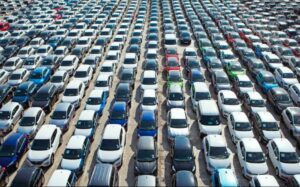
According to Open4business, the United States retained its status as the largest supplier of imported passenger cars to Ukraine in the first half of 2026, accounting for 43% of the total number of imported cars. According to data from the State Customs Service published on July 28, 73,200 passenger cars were imported from the U.S. to Ukraine between January and June.
Germany ranked second among supplier countries, accounting for 17,300 cars, or 10% of total imports. Poland ranked third with 14,600 cars, or 9%.
Collectively, the United States, Germany, and Poland supplied 105,100 passenger cars to Ukraine. These three countries accounted for about 62% of total imports.
Overall, in the first half of the year, cars were imported from more than 50 countries. The total volume of imports exceeded 169,000 vehicles, and their declared value amounted to nearly 96.6 billion UAH.
Customs revenues from passenger car imports reached 32.1 billion UAH.
According to estimates by the Experts Club analytical center, gasoline-powered cars led in terms of customs revenue. They contributed 14.6 billion UAH to the budget, or 45.5% of the total.
Diesel cars generated 8.4 billion UAH, hybrids—7.1 billion UAH, and electric cars—about 2 billion UAH.
Used cars accounted for over 70% of the total number of imported vehicles and generated 17.7 billion UAH in customs duties. New cars accounted for less than 30% of imports and 14.4 billion UAH in revenue.

Gasoline-powered passenger cars accounted for over 14.6 billion hryvnia in customs revenue for the state budget from passenger car imports, which totaled 32.1 billion hryvnia, the State Customs Service reported on its website.
At the same time, diesel cars generated 8.4 billion UAH in revenue, hybrids—7.1 billion UAH, and electric cars—2 billion UAH.
The State Customs Service notes that, overall, from January through June, Ukrainians imported over 169,000 passenger cars with a total value of nearly 96.6 billion hryvnias, 70% of which were used cars, generating 17.7 billion hryvnias in customs duties for the state budget, while new cars accounted for 14.4 billion UAH.
Gasoline-powered cars, which remain the most popular, accounted for 54.5% of total imports. In second place were diesel cars (20.3%), which not only significantly outpaced electric cars (13%) but also surpassed hybrids (12.1%).
Hybrids were the most expensive among imported cars, with an average price of nearly $27,000 per vehicle; diesel cars averaged $16,000; electric cars, over $10,000; and gasoline-powered cars, $9,000.
According to the State Customs Service, cars have been imported from more than 50 countries since the beginning of 2026, but the undisputed leaders are: the United States—73,200 (43% of the total number of imports); Germany—17,300 (10%); and Poland—14,600 (9%).
In total, nearly 105,100 cars were imported from these countries, accounting for 62% of the total.
As previously reported, according to the State Customs Service, the volume of passenger car imports into Ukraine—including cargo-passenger vans and race cars (UKT ZED code 8703)— amounted to $2.18 billion in January–June 2026, which is 14.6% less than the figure for the first half of 2025 ($2.554 billion).

Initial registrations of new domestically produced passenger car trailers in April–June of this year rose by 35% compared to the first quarter of 2026—to 6,753 units, which is also 6.8% higher than the figure for the first quarter of last year, according to the Automotive Market Research Institute (AMRI).
“The passenger car trailer segment (gross vehicle weight not exceeding 3,500 kg) is unique to the Ukrainian auto market. It is perhaps the only vehicle sector where imports have completely lost out to local manufacturers, who control 80% of the market, providing private owners, farmers, and small businesses with affordable trailer equipment,” the IDA’s website states.
According to their data, the remaining 20% of the market is divided among domestic resales of used trailers (16.2%), imports of used trailers (3.4%), while the share of new imports amounted to only 0.4%.
“Imports of new trailers are virtually nonexistent, as high logistics costs and customs duties make importing foreign equivalents economically unfeasible given the robust and affordable domestic supply,” experts note.
The most popular models in the second quarter were classic flatbed trailers, trailers for transporting boats and motorboats, platforms (car carriers) for transporting cars, construction materials, and oversized cargo, as well as flatbed-tented trailers and special-purpose trailers for motor vehicles (for ATVs, buggies, and motorcycles).
Trailers with a gross weight of up to 750 kg account for the lion’s share of domestic production (94%).
Experts attribute the popularity of this category to the simplicity of the paperwork (a basic Category B driver’s license is sufficient to tow a trailer), affordability and reliability (they do not require the installation of a complex and expensive braking system), and versatility (they cover 90% of private and small business needs).
In turn, the heavier class (from 750 kg to 3,500 kg), which accounted for 6% of the market, requires an inertia brake and a BE license—these are primarily commercial flatbed trailers for transporting vehicles and heavy specialized equipment.
The leader among Ukrainian manufacturers of passenger car trailers in April–June 2026 is MP “Trailer Plant” (Hlukhiv, Sumy Oblast), with sales of 1,868 thousand units, or more than 27% of the domestic trailer market.
Kyiv-based “NVP-Palych” ranks second with 1,185 thousand units, thanks to its broad model lineup and well-developed sales network.
According to IDA data, third place goes to LLC “Agromotorservice” (Starokostiantyniv, Khmelnytskyi Oblast), known for its “Starkon” models, with 751 trailers.
The top ten also includes manufacturers from Zaporizhzhia, Kremenchuk, Irpin (Kyiv Oblast), Lutsk, and the Vinnytsia and Chernihiv regions.
“The passenger trailer market in the second quarter of 2026 demonstrated complete independence from imports. Ukrainian companies provide consumers with products that are fully adapted to local operating conditions and outperform foreign counterparts in terms of price-to-durability ratio,” the post concludes.

Imports of trucks to Ukraine in January–June 2026 fell by 6.7% in monetary terms compared to the same period in 2025—to $446.1 million, according to statistics from the State Customs Service.
According to the published data, imports of these vehicles in June, in particular, rose by 4% compared to June 2025 and by 4% compared to May of this year—reaching $94.14 million.
As in the previous year, the largest number of trucks in January–June was imported from Poland, but imports from that country fell by 40.4%—to $58.06 million—and its share of total truck imports dropped to 13% from 20.4%.
Imports from Italy, which did not rank among the top three truck suppliers in the first half of the year, totaled $55.2 million (12.38%), while imports from France fell by 36.5% to $47.7 million (10.68%).
In January–June of last year, the top three truck suppliers were Poland, the United States, and France.
Truck imports from all other countries increased by 27% in the first half of the year, reaching $285.1 million.
At the same time, according to statistics, Ukraine exported only $1.85 million worth of trucks over the six-month period, mostly to Turkey, while a year ago, exports totaled nearly $3.5 million, also primarily to Turkey.
As previously reported, in 2025, imports of trucks into Ukraine increased by 5.5% compared to 2024—to $999.5 million, with the largest volumes coming from France—$169.2 million (42.8% more than the year before last), Poland—$162.7 million (-14.7%), and the U.S.—$109 million (+2%).

In January–June of this year, Ukraine’s ferroalloy exports decreased by 80.5% in volume terms compared to the same period last year—to 15,212 thousand metric tons from 54,771 thousand metric tons.
According to statistics released by the State Customs Service (SCS), 6,432 thousand metric tons of ferroalloys were exported in June, 4,851 thousand metric tons in May, 2,755 thousand metric tons in April, 337 metric tons in March, 72 metric tons in February, and 765 metric tons in January.
In monetary terms, ferroalloy exports for January–June fell by 70.2% to $18.220 million. The main export destinations were Poland (56.82% in monetary terms), Turkey (13.80%), and Romania (9.39%).
In addition, during the first six months of the year, Ukraine imported 13,097 thousand metric tons of these products—a 36.8% decrease compared to January–June 2025. In monetary terms, imports fell by 36.9% to $25.553 million. Imports came primarily from Kazakhstan (23.21%), India (13.61%), and France (11.52%).
As previously reported, the Pokrovsk Mining and Processing Plant (PGZK, formerly the Ordzhonikidze Mining and Processing Plant) and the Marganetsk Mining and Processing Plant (MGZK, both located in Dnipropetrovsk Oblast), which are part of the Privat Group, ceased the extraction and processing of raw manganese ore in late October–early November 2023, while the
NZF and ZZF plants halted ferroalloy smelting. In the summer of 2024, the ferroalloy plants resumed production at a minimal level.
Since January 19, 2026, due to problems with electricity supply and high electricity prices, NZF has been idle, while ZZF is operating at a minimal level.
In 2025, ferroalloy plants increased their exports of ferroalloys by 21.4% in volume terms compared to 2024—to 93,841 thousand metric tons—while revenue rose by 19% to $105.441 million. The main export destinations were Poland (28.69% of shipments in monetary terms), Turkey (21.62%), and Algeria (21.48%).
In 2025, Ukraine imported 38,434 thousand metric tons of this product—a 53.3% decrease compared to 2024. In monetary terms, imports fell by 47.5% to $73.839 million. Imports came primarily from Norway (16.11%), Kazakhstan (15.89%), and France (12.56%).
Prior to the nationalization of the financial institution, PrivatBank managed the operations of ZZF, NZF, the Stakhanov Ferroalloy Plant (located at NKT), and the Pokrovsk and Marganetsk Mining and Processing Plants. The Nikopol Ferroalloy Plant is controlled by the EastOne Group, formed in the fall of 2007 as a result of the restructuring of the Interpipe Group, as well as by the Privat Group.
EXPORT, FERROALLOY, IMPORT, POLAND, ДМС

The volume of passenger car imports to Ukraine, including cargo-passenger vans and race cars (UKT ZED code 8703), amounted to $2.18 billion in January–June 2026, which is 14.6% less than the figure for the first half of 2025 ($2.554 billion).
According to statistics released by the State Customs Service of Ukraine, imports of passenger cars in June, in particular, fell by 6.8% compared to June of last year, but rose by 16.9% compared to May 2026—to $468.12 million.
The top three suppliers of passenger cars to Ukraine for January–June have consistently been the United States, Germany, and Japan, while in the previous year these were the same countries, but Germany was the largest exporter, followed by the United States and Japan.
Specifically, car imports from the United States declined slightly to $417.9 million, while those from Germany fell by 26.7% to $347.6 million; imports from Japan, however, rose by 3.4% to $302.5 million.
Imports of passenger cars from other countries during this period totaled $1.11 billion—18.7% less than last year’s figure.
At the same time, over the six-month period, Ukraine exported only $1.38 million worth of such vehicles, whereas last year, total exports to the UAE, Poland, and the Czech Republic amounted to $3.49 million.
Passenger cars accounted for 4.43% of total goods imports into Ukraine in the first half of the year, compared to 6.67% during the same period last year; their share of total exports was 0.01% and 0.02%, respectively.
As previously reported, in 2025, passenger cars worth nearly $6.15 billion were imported into Ukraine, which is 40.2% more than in 2024. The top three exporters were the United States, Germany, and China. Car exports totaled $10.1 million (2.7 times less).
The significant increase in passenger car imports to Ukraine in the final months of 2025 was driven by news that VAT exemptions on electric vehicle imports would be abolished as of January 1, 2026, whereas imports had declined significantly since the beginning of the current year. However, starting in March, a slow but steady recovery of the passenger car market—including electric vehicles—began.



