
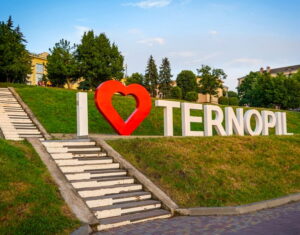
With support from the European Investment Bank (EIB), Ternopil has completed the energy-efficient modernization of four kindergartens at a cost of approximately EUR5 million and put 17 new Ukrainian-made trolleybuses into service, financed by the EIB to the tune of EUR5.5 million, the financial institution reported.
“Strong municipalities are crucial for Ukraine’s resilience and recovery. In Ternopil, our financing is delivering tangible improvements that make essential services greener, more efficient, and more accessible,” said EIB Vice President Karl Neghammer.
The modernization project covered kindergartens No. 1, No. 14, No. 20, and No. 21, which are attended by more than 1,100 children and employ 250 staff members.
In these facilities, buildings were insulated, windows and doors were replaced, heating and ventilation systems were modernized, energy-efficient lighting was installed, and accessibility was improved. This is expected to reduce energy consumption by at least 20%.
The work was funded under the Ukraine Municipal Infrastructure Development Program (UMIP).
In addition, with EIB support, Ternopil received 17 new trolleybuses manufactured by the Ukrainian company Elektronmash LLC. Their purchase, costing EUR 5.5 million, was funded under the “Urban Public Transport in Ukraine II” (UUPTP II) project.
The new trolleybuses are equipped with low floors, energy-efficient heating and air conditioning systems, passenger information systems, GPS, video surveillance, and ramps for passengers with limited mobility.
As previously reported, in late 2024, the Lviv-based “Elektron” Group, after winning the tender, signed a contract with the municipal enterprise “Ternopilelektrotrans” to supply 17 low-floor 12-meter trolleybuses worth EUR5.5 million, manufactured by its subsidiary, “Elektronmash” LLC.
Since the start of Russia’s full-scale invasion in 2022, the EIB has provided Ukraine with EUR4.5 billion in financing to support the country’s resilience and modernization.
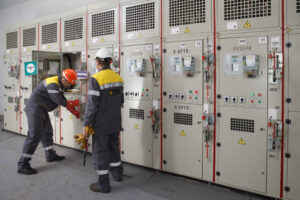
Distribution system operators (DSOs) at DTEK Networks reconstructed seven transformer stations and 17 substations between January and June 2026, and built 13 new transformer stations in Kyiv, Kyiv, Dnipropetrovsk, and Odesa regions.
“This is 1.5 times more than during the same period last year,” the operating holding company reported on Thursday.
Energy companies continue to upgrade infrastructure and prepare the grids for peak loads, particularly during the fall and winter months.
DTEK Networks noted that the scope of the investment program is approved annually by the state regulator, the NEURC, for all operators. At the same time, the holding’s distribution system operators repaired nearly 2,000 km of overhead lines and 4,600 km of underground cables in the first half of 2026, and restored nearly 3,000 power facilities.
In addition, to reduce the risk of accidents and ensure a reliable power supply for households, specialists cleared 5,000 km of overhead line corridors of trees and shrubs.
“In total, we plan to invest over 6.7 billion UAH in network upgrades in 2026. This will allow us to build a safety margin for the upcoming heating season,” said Alina Bondarenko, CEO of DTEK Networks.
The company added that the development and modernization of infrastructure also create the necessary technical capabilities for connecting new customers.
“DTEK Networks” operates in the electricity distribution and power grid operation sectors in Kyiv, Kyiv, Dnipropetrovsk, Donetsk, and Odesa regions. The DTEK Group’s distribution system operators serve 5.1 million households and 150,000 businesses.
Nibulon Joint Venture LLC invested $22.5 million in the modernization and digitization of agricultural production between 2023 and 2025, including securing EUR12.8 million in long-term financing from the Danish Export and Investment Fund (EIFO), the company’s press service reported.
As part of the modernization, the company upgraded its fleet of agricultural machinery, implemented digital solutions for managing production processes, and adopted a new soil cultivation model, which reduced the number of passes by machinery across the field—a practice that leads to soil compaction—and also lowered fuel consumption and production costs.
The company reported that as a result of the modernization, fuel consumption decreased by 10 liters per hectare, the use of crop protection products was reduced by up to 50%, seed usage was reduced by 10–20%, and nitrogen use efficiency (NUE) increased by 30%.
The report notes that the implemented measures led to a 50% increase in gross yield and a 65% increase in agricultural machinery productivity.
According to published data, the agricultural division’s EBITDA in 2025 amounted to $329/ha. At the same time, approximately 40% of the agricultural holding’s land bank is located in southern Ukraine, which has been hardest hit by climate change following the destruction of the Kakhovka Hydroelectric Power Plant. The financial results also include $4.6 million in losses from sunflower crop failures due to drought.
The company also reported that, as part of its efforts to adapt to climate change, it is reviewing its crop rotation structure and testing alternative drought-resistant crops, including sorghum, chickpeas, lentils, and flax.
In addition, during the 2025/26 marketing year, the agricultural holding launched a pilot project for contract farming of corn and sunflowers on an area of approximately 100 hectares, and is also working with seed material for other specialty crops.
It is also noted that the company is developing an irrigation model for the southern regions of Ukraine, which involves irrigating approximately 1,000 hectares of agricultural land.
Currently, Nibulon’s agricultural division cultivates 52,000 hectares of land, comprises 14 branches across four clusters, and operates 41 units of farm equipment.
Prior to the war, Nibulon Joint Venture LLC cultivated 82,000 hectares of land across 12 regions of Ukraine and exported agricultural products to more than 70 countries worldwide. In 2021, the grain trader exported 5.64 million metric tons of agricultural products—the highest volume in its history. After the war began, the company was forced to relocate its headquarters from Mykolaiv to Kyiv. In addition to 23 grain elevator complexes, Nibulon has its own road and rail transport capabilities, as well as a fleet built at its own shipyard. During wartime, this fleet continues to provide river transport services.
The company is also actively developing its own humanitarian demining unit to restore safety on leased lands and assist Ukraine’s agricultural sector. Nibulon is a certified mine action operator.
AGRICULTURAL PRODUCTION, EIFO, INVESTMENT, MODERNIZATION, NIBULON
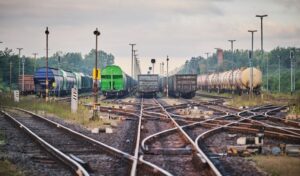
According to “Serbian Economist”, the Hungarian government plans to allocate 3.55 trillion forints, or about 9.8 billion euros, by 2035 for the modernization of the national railway network.
Hungarian Prime Minister Péter Magyar and Minister of Transport and Investment Dávid Vitézi presented the program on July 22 at the Rakospalota-Újpest station in Budapest. Authorities are calling it one of the largest railway projects in the country’s history.
The program is designed to be implemented in several phases. Its main objectives will be to improve the reliability of transportation, reduce travel times, reconstruct tracks and stations, modernize the rolling stock, and develop international rail routes.
The government intends to ensure competitive rail service to all administrative centers in Hungary, modernize regional lines, and expand commuter service around Budapest and other major cities. Specific areas of focus will include the development of freight transport, the establishment of a rail link to Budapest Airport, and the integration of national and urban transportation systems.
It is planned to allocate 1.1 trillion forints from EU Cohesion Funds and 700 billion forints from the European Recovery and Resilience Facility (RRF) to implement the program. An additional 400 billion forints is planned to be raised through loans from the European Investment Bank, with a similar amount to be secured through concession projects. Approximately 950 billion forints will be allocated to projects under the next EU budget cycle for 2028–2034.
The government plans to purchase at least 35 new InterCity trains and 42 commuter electric trains, as well as begin renovating the country’s ten busiest train stations. The average age of MÁV trains and HÉV commuter trains is currently about 43 years, and 42% of the rail network is subject to significant speed restrictions.
On major routes, the government aims to increase the average speed to 100 km/h. Certain sections are planned to be upgraded to accommodate trains traveling at speeds of 160–200 km/h.
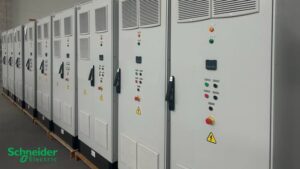
Schneider Electric has implemented a large-scale infrastructure project: 26 Ukrainian cities have received state-of-the-art equipment to improve the energy efficiency and operational reliability of their district heating systems.
Completing the project before the start of the 2025/2026 heating season allowed heating utilities to better prepare for peak loads. Thanks to the equipment provided, the cities were able to navigate the heating season more smoothly, reducing the risk of unscheduled outages and improving the overall efficiency of their systems.
As part of the project, Schneider Electric supplied control cabinets for pumps and blower mechanisms, equipped with state-of-the-art variable-frequency drives, to 26 cities in Ukraine across the Chernihiv, Cherkasy, Lviv, Ivano-Frankivsk, Ternopil, Rivne, Vinnytsia, Khmelnytskyi, Zhytomyr, Odesa, Kirovohrad, Kherson, Sumy, Poltava, and Kyiv regions.
A key element of the project was the implementation of variable-frequency drives to regulate the operation of pumping equipment at heat supply companies, which significantly improved the energy efficiency of the systems, reduced electricity consumption, optimized operating costs, and extended the service life of the equipment.
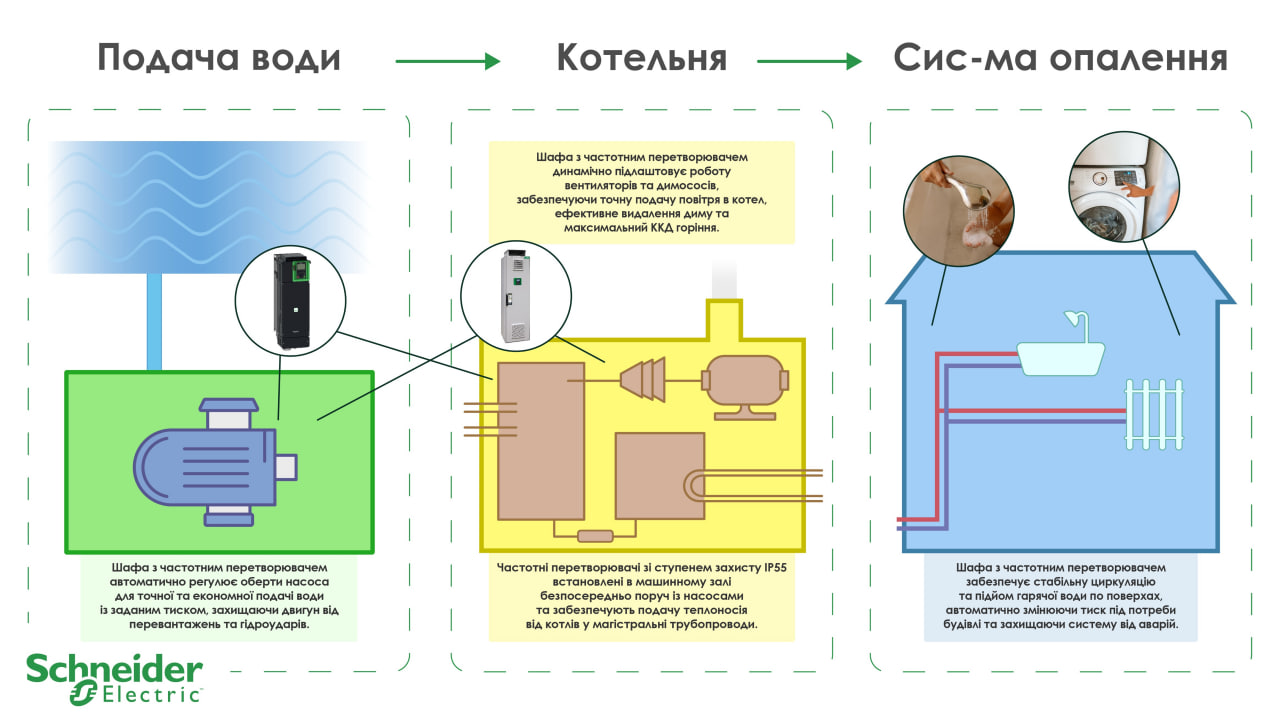
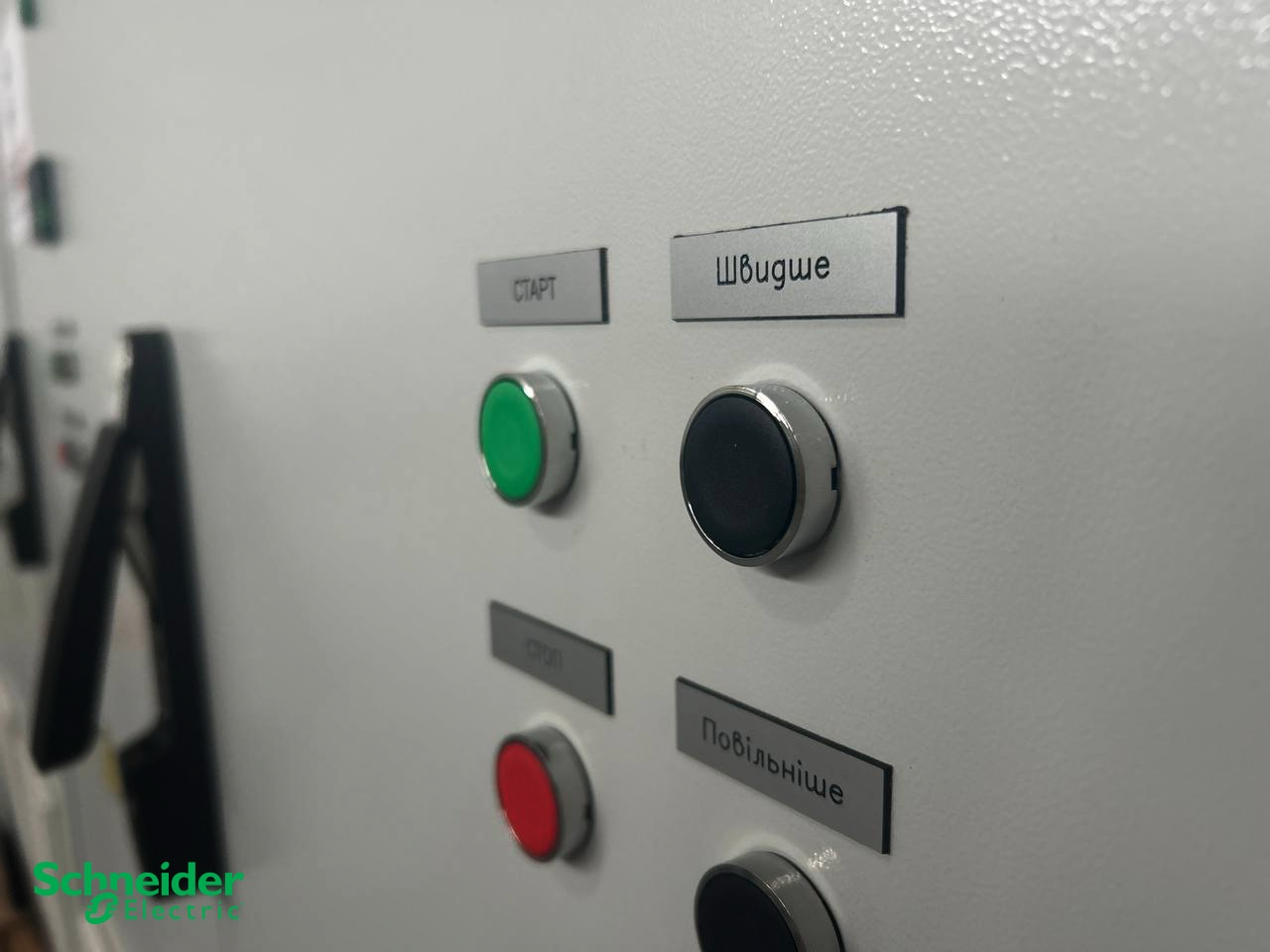
The solutions, based on Schneider Electric technologies, include fully equipped control cabinets for pumping equipment. The cabinets are protected against moisture and dust, allowing them to be installed directly in machine rooms, thereby reducing costs and simplifying installation.
The companies have gained tools for more flexible equipment management, reducing the load on the power grid, and improving the quality of heat supply services for consumers.
“This is not just about supplying equipment, but about a long-term investment in energy efficiency and the stability of heat supply in Ukraine. Already today, we are seeing how the implemented solutions are helping enterprises optimize energy consumption, improve system reliability, and lay the foundation for further modernization of the industry,” said Mykhailo Bubnov, CEO of Schneider Electric Ukraine.
The completed project serves as an example of collaboration aimed at implementing modern energy-efficient technologies and improving the operational efficiency of Ukraine’s utility companies.
Schneider Electric is a global leader in energy technologies that enhances efficiency and promotes sustainable development through the electrification, automation, and digitalization of industry, business, and residential spaces. The company’s technologies enable buildings, data centers, factories, infrastructure, and power grids to function as open, interconnected ecosystems, increasing productivity, resilience, and environmental sustainability. The company’s portfolio includes smart devices, software-defined architectures, artificial intelligence-based systems, digital services, and professional consulting services. With 160,000 employees and 1 million partners in over 100 countries, Schneider Electric consistently ranks among the world’s most sustainable companies.
ENERGY EFFICIENCY, EQUIPMENT, HEATING, MODERNIZATION, Schneider Electric

The “Yarich” confectionery group has raised $10 million from the Norwegian state investment fund Norfund, which it will use to modernize production and further develop the business, Norfund announced,
“Yarich’s impressive growth in recent years, despite the war, reflects the strength and dedication of its management and owners. Supporting strong teams and helping reliable companies achieve further growth is a key part of Norfund’s investment approach,” said Norfund Project Manager Anastasia Andriyevska.
According to the fund, the funds will be used to modernize production facilities, specifically to install a new pretzel production line, which will enable the company to expand its product range and enter new market segments.
“This investment is a strong signal of confidence in Ukrainian business and the resilience of our team. It will facilitate further expansion into new product categories and continued growth in both the Ukrainian and export markets,” said Tetyana Shermolovych, the company’s CEO.
Norfund noted that Yarych’s production site in the Lviv region, which employs about 500 people, is a key hub for export development. In recent years, the company has significantly increased its exports, primarily to Poland.
Yarych Holdings Limited is the parent company of the “Yarych” confectionery group, whose production facilities are located in the village of Staryi Yarychiv in the Lviv region. The group specializes in the production of long-lasting cookies and crackers under the Yarych brand. The holding company directly owns 84.94% of Yarych Confectionery Factory LLC, while another 15.06% is owned by Yarychiv LLC.
Norfund is Norway’s state-owned investment fund, which finances private companies and projects in developing countries with the aim of creating jobs and supporting sustainable economic development. In Ukraine, the fund operates through the Investment Fund for Ukraine, established in late 2024 to support Ukrainian businesses and attract private capital.
As previously reported, the Norwegian government allocated 250 million Norwegian kroner for Norfund’s investments in Ukraine as part of the Nansen Support Program.
In late 2025, the fund also invested $15 million in the Rebuild Ukraine Fund (REBUF), managed by Dragon Capital, and approximately EUR8.5 million in the expansion of the M10 industrial park in the Lviv region.
BUSINESS, confectionery industry, EXPORTS, INVESTMENTS, MODERNIZATION, Norfund, PRODUCTION, YARYCH



