
To Lam, General Secretary of the Central Committee of the Communist Party of Vietnam and President of Vietnam, while on a working visit to the United States, actively participated in high-level events as part of the 81st session of the UN General Assembly, whose general debate began on September 22, 2026.
This is his second high-level visit to the United States and the UN following the reshuffling of Vietnam’s leadership, which took place following the 14th National Party Congress and the elections to the National Assembly for the 2026–2031 term.
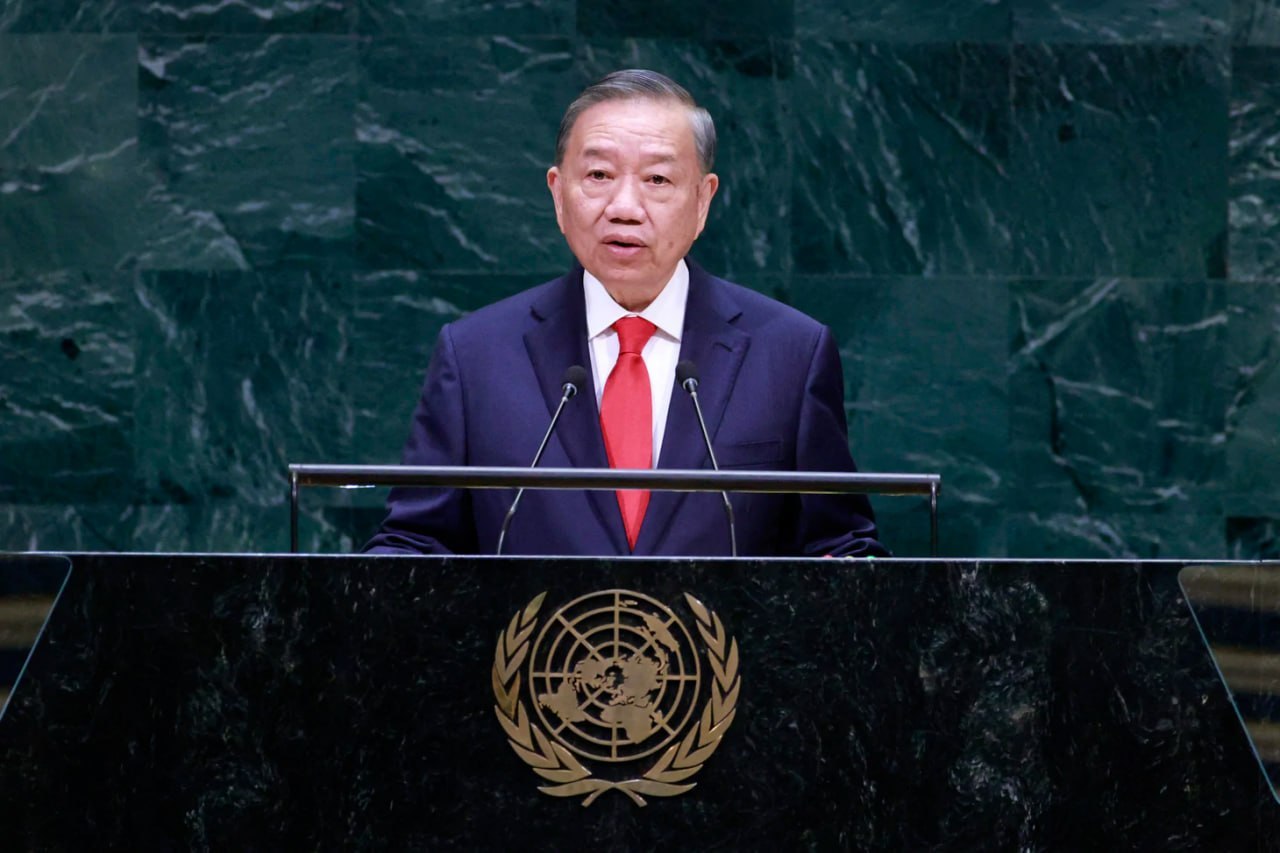
On the sidelines of the UN General Assembly, To Lam held a series of bilateral meetings with leaders of other countries, including Australian Prime Minister Anthony Albanese, Thai Prime Minister Anutin Charnvirakul, Turkish President Recep Tayyip Erdoğan, Fijian President Ratu
Naikama Lalabalavu, Timor-Leste President José Ramos-Horta, Swiss President Guy Parmelin, Finnish President Alexander Stubb, Ghanaian President John Mahama, Bhutanese Prime Minister Tsering Tobgay, President of Mongolia Ukhnaagiin Khurelsukh, as well as with representatives of Tanzania and the Holy See.
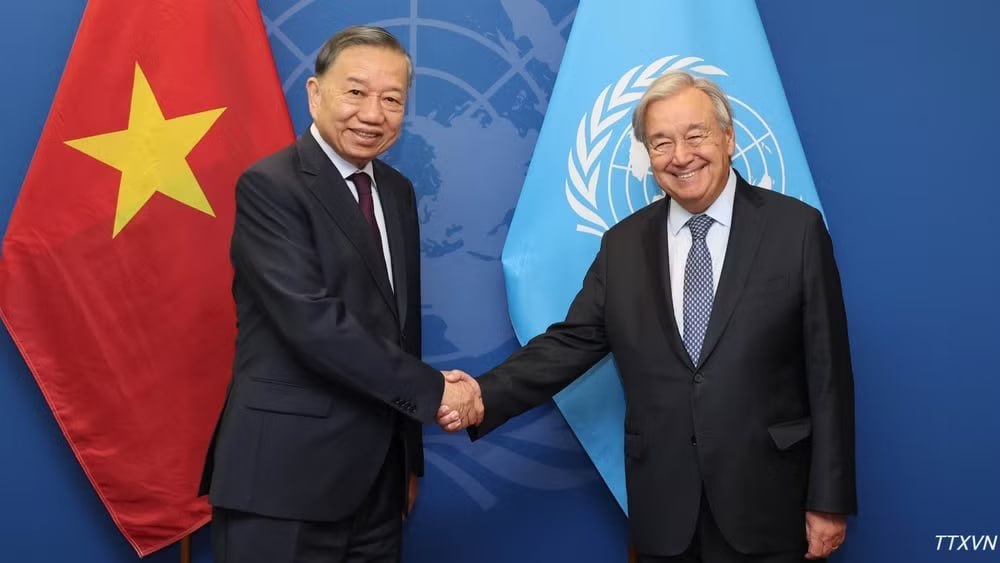
The Vietnamese leader also met with UN Secretary-General António Guterres and the President of the 81st session of the UN General Assembly, Khalilur Rahman.
This visit marked a historic milestone for Vietnamese diplomacy.
Since joining the UN in 1977, Vietnam has transformed from a country in need of international aid for post-war reconstruction into an active participant in multilateral diplomacy, increasingly engaging in the resolution of global issues.
The country has twice been elected as a non-permanent member of the UN Security Council (in 2008–2009 and 2020–2021) and is currently a member of the UN Human Rights Council (2026–2028).
A landmark event in 2026 was Vietnam’s first-ever chairmanship of the Review Conference of the Treaty on the Non-Proliferation of Nuclear Weapons and the 36th Meeting of States Parties to the United Nations Convention on the Law of the Sea.
Hanoi has reaffirmed its status as a reliable partner that makes a significant contribution to peacebuilding processes and regional integration, particularly through its active participation in ASEAN and preparations for its chairmanship of APEC in 2027.
According to Vietnam’s position, the United Nations must retain its central role in the international system, and international issues should be resolved through dialogue, cooperation, and in accordance with international law. It is precisely this support for multilateralism, along with the desire to become more actively involved in addressing global issues, that constitutes one of the key messages of To Lam’s current participation in the General Assembly.
Vietnam seeks to develop international cooperation and wants to have a more significant voice in addressing global challenges.
During his address at the general debate on September 22, To Lam articulated the country’s clear position on managing global change and strengthening the international order.
The Vietnamese leader identified building trust among nations, based on unconditional respect for the UN Charter and international law, as the top priority.
He emphasized the need to reject the use of force and called for resolving any disputes exclusively through peaceful means via dialogue.
The president noted that while changes in the world order are an objective historical process, conflicts and confrontations are not inevitable; at the same time, the main task of leaders is to channel competition so that it does not escalate into open war.
To Lam also supported efforts to modernize the UN’s structure (in particular, the General Assembly, the Security Council, and the Secretariat). He stressed that the reformed system must better take into account the interests of developing countries and give them a real voice in shaping international rules.
The Vietnamese leader expressed clear support for the principle of peaceful dispute resolution, particularly in the East (South China) Sea based on the 1982 UNCLOS Convention, and also expressed support for the “two-state” solution to the Palestinian-Israeli conflict and called on the U.S. to lift sanctions against Cuba.
In his speech, the Vietnamese head of state also emphasized equitable access to scientific advances, artificial intelligence, and digital technologies. According to him, a monopoly on data and digital infrastructure could create a new technological divide between wealthy and poor nations; therefore, technological progress must be accompanied by a culture of security and digital ethics.
He called for the establishment of inclusive and transparent principles for technology governance so that they would narrow the gap between countries rather than create new conflicts.
To Lam emphasized that any future strategies must place people at the center of development. Vietnam expressed its readiness to actively share its own successful experiences in the areas of poverty alleviation, sustainable agricultural development, and adaptation to climate change.
A particular focus of the trip was relations with the United States. Since the normalization of diplomatic relations in 1995, the two countries have evolved from former adversaries to a Comprehensive Strategic Partnership, established in September 2023. Cooperation today encompasses political dialogue, trade and investment, science and technology, education, defense and security, energy, as well as addressing the consequences of war and humanitarian issues.
During meetings in New York, To Lam reaffirmed that Vietnam views the United States as one of its strategically important partners and is committed to making the Comprehensive Strategic Partnership more stable, substantive, and practical. The current engagements—particularly with representatives of Congress, the trade and economic community, and the American business sector—demonstrate the parties’ commitment to filling this partnership with concrete projects in the areas of trade, investment, technology, and infrastructure.
Thus, To Lam’s participation in the 81st session of the UN General Assembly clearly demonstrates the combination of multilateral and bilateral approaches in Vietnamese diplomacy.
On the one hand, the country seeks active engagement in addressing global issues within the UN framework; on the other, it focuses on deepening practical cooperation with strategic partners, primarily the United States.

According to Experts Club, Vietnam is showing the highest growth rates in steel production among the world’s top ten countries, as evidenced by data published on September 24 by the World Steel Association.
In August 2026, the country produced approximately 2.7 million metric tons of steel, increasing output by 36.4% compared to August of last year.
From January through August, production reached 20.6 million metric tons, rising by approximately 29% year-over-year. This represents the highest growth rate among the world’s largest producers.
Based on cumulative results, Vietnam is already among the top ten global steel producers, closing in on Brazil in terms of production volume; Brazil produced 21.8 million metric tons over the same eight-month period.
By comparison, the world’s largest producer—China—reduced production by 3.1% to 651.9 million metric tons over the same period, while India increased its output by 6% to 115.9 million metric tons. The United States increased production by 5.5%, Turkey by 6.8%, and Germany by 6.3%.
As a result, the global steel market is becoming increasingly heterogeneous: despite an overall 0.7% decline in production from January through August, certain Asian markets continue to rapidly expand their capacity and production volumes.
The difference is particularly noticeable within Asia. In August, production across the Asia-Pacific region fell by 1.4% due to a decline in output in China, while India and Vietnam continued to grow.
As of the end of August, countries in Asia and Oceania accounted for 106.7 million metric tons of the 144.2 million metric tons of global output, or about 74% of global steel production.

Vietnam’s apartment market has cooled sharply following a period of rapid price growth: developers are facing a decline in transactions, buyer caution, and the need to stimulate sales.
According to local media reports, demand for apartments has dropped significantly amid high interest rates, inflationary pressures, and general geopolitical instability. Vietnam’s Ministry of Construction has also recorded a decline in transaction volumes nationwide, confirming the market’s shift from a phase of frenzied growth to more selective demand.
However, the market’s problem is not limited to a decline in buyer interest. An imbalance in supply persists in Vietnam: in the largest cities, primarily Hanoi and Ho Chi Minh City, there remains a shortage of affordable housing, while a significant portion of new projects falls into the higher-priced segment. Vietnam Investment Review notes that in the first quarter of 2026, Hanoi and Ho Chi Minh City continued to face a gap between supply and demand due to a shortage of affordable apartments.
The most pressing issue remains housing costs. In Hanoi, prices for new apartments continued to rise in the first quarter of 2026, reaching an average of approximately 128 million dong per square meter, while the secondary market has already begun to show signs of a price correction. Developers attribute the price increases to rising costs of construction materials, financing, and land.
In Ho Chi Minh City, the trend is different: after prices rose in 2025, the market began to cool, and in some areas, prices fell by 1–7%, which partially stimulated demand.
The Vietnamese government is trying to curb market overheating and expand the supply of affordable housing. Earlier, Prime Minister Pham Minh Chinh called for accelerating housing construction, simplifying administrative procedures, and developing social housing, as rising prices have made real estate purchases unaffordable for many families.
Additional pressure on the market is being created by the government’s plans to curb speculative demand. In January 2026, Reuters reported that Vietnam was preparing tax measures against speculation in the real estate market, where in 2025 apartment prices rose by 20–30% and land prices by 20–25%.
Thus, the Vietnamese apartment market is entering a more complex phase: prices remain high, there is a shortage of affordable supply, but demand is no longer ready to automatically absorb new properties at any price. For developers, this means the need to revise pricing policies, offer installment plans, discounts, and more realistic purchase terms. For buyers, it presents an opportunity for stronger bargaining positions, especially in the secondary market and in areas where supply is growing faster than demand.

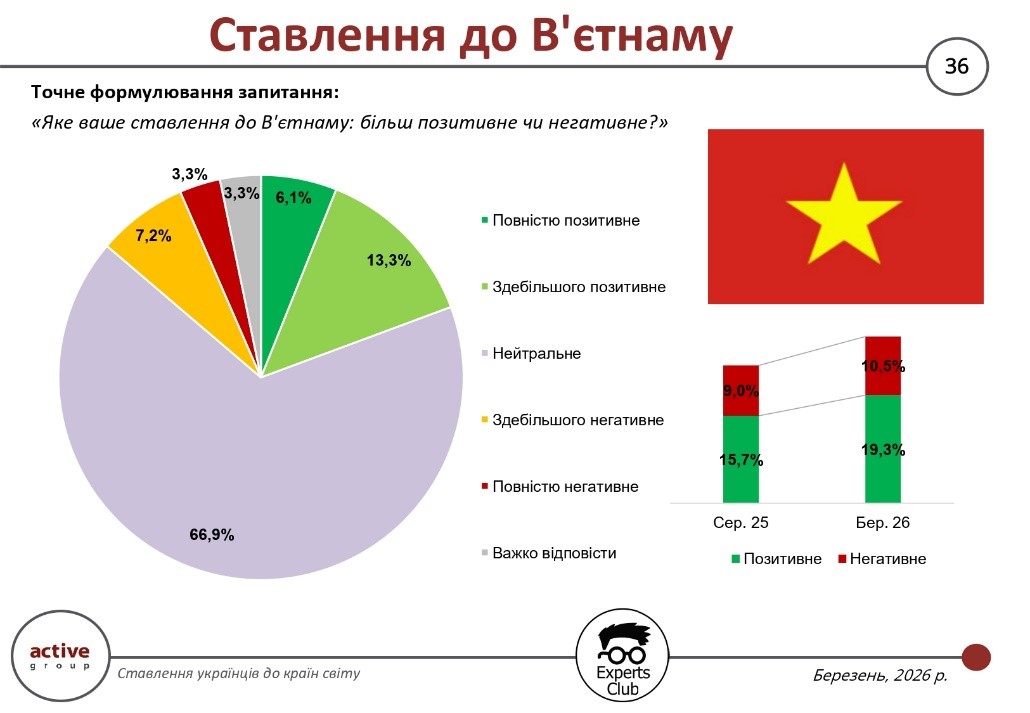
The results of a public opinion poll conducted in March 2026 by the research firm Active Group in collaboration with the Experts Club information and analytical center indicate that, for most Ukrainians, Vietnam remains a country with an undefined or neutral image. The largest share of respondents—66.9%—expressed a neutral attitude, which significantly distinguishes Vietnam from countries with a clearly formed positive or negative perception.
At the same time, the share of positive assessments has increased—to 19.3% compared to 15.7% in August 2025. Of these, 6.1% of respondents indicated a completely positive attitude, while another 13.3% described it as mostly positive. This indicates the gradual formation of a more defined positive image of the country, although this process is proceeding slowly.
Negative attitudes also increased slightly—from 9.0% to 10.5%. Specifically, 7.2% of respondents chose “mostly negative,” and 3.3% chose “completely negative.” The share of those who could not decide on an answer is 3.3%. Overall, these figures demonstrate a slight increase in the polarization of assessments while maintaining a high proportion of neutrality.
The dynamics of change indicate a gradual decrease in uncertainty: some respondents who previously had no formed opinion are beginning to lean toward either a positive or a negative assessment. At the same time, the absence of sharp changes in the structure of responses indicates that Vietnam does not yet occupy a prominent place in the focus of public opinion in Ukraine.
“When we see such a high level of neutral responses, it means that the country is effectively outside the active informational and social sphere. Ukrainians simply do not have enough contacts, experience, or cues to form a clear attitude. That is why any systematic presence—economic, cultural, or diplomatic—could quite quickly shift the balance of assessments in one direction or another,” noted Maksym Urakin, founder of the Experts Club information and analytical center.
Thus, Vietnam is currently characterized as a country with high potential for building a positive image in Ukraine; however, this potential largely depends on the intensity of interaction and the level of presence in the Ukrainian information space.
According to a study conducted by the Experts Club information and analytical center based on data from the State Customs Service, Vietnam ranks 23rd in total trade volume with Ukraine, with a figure of $1.16 billion. At the same time, imports of Vietnamese goods exceed exports from Ukraine by several times, resulting in a trade deficit of over $706 million.
The study was presented at the Interfax-Ukraine press center; the video can be viewed on the agency’s YouTube channel. The full version of the study can be found at this link on the Experts Club analytical center’s website.
ACTIVE GROUP, EXPERTS CLUB, Pozniy, SOCIOLOGY, SURVEY, UKRAINE, URAKIN, VIETNAM
The real estate markets of Vietnam, Thailand, Cambodia, and Bali will be in different phases of the cycle by 2026, but they share one common factor—the significant role of foreign demand. That said, the degree of dependence on foreign buyers, the supply structure, and price levels vary significantly across these markets.
Vietnam currently appears to be the most balanced of these markets. Here, the recovery is driven primarily by domestic demand, while foreigners play an important but not dominant role. In Hanoi, the average price of new apartments has already reached about $3,800 per square meter, while in the coastal city of Da Nang, the primary market stands at $2,200–2,300 per square meter. Foreigners can only purchase housing in approved commercial projects, cannot directly own land, and their share is limited by quotas, specifically to 30% of the apartments in a single condominium.
This is precisely why Vietnam remains largely a market for local buyers, while foreign demand is concentrated in the premium segment and in the largest cities. Among the key foreign groups in the market, citizens of South Korea, China, Singapore, Japan, and some overseas Vietnamese are typically cited. Russians are present mainly in resort locations, primarily in Nha Trang, while Ukrainians are also found among renters and individual buyers, but their share in publicly available statistics is not disclosed and remains niche.
Thailand, on the other hand, is much more dependent on external demand, especially in the condominium segment. According to REIC, in 2025, foreigners completed 14,899 condominium transactions, which is 2.2% more than the previous year. They accounted for 14.7% of all property transfers by volume and 25% by value. Chinese buyers retained the top spot among foreign buyers, Myanmar moved up to second place, and Russia remained among the largest groups.
In terms of prices, Thailand is significantly more expensive than Vietnam, especially in the capital and major resort areas. In Bangkok, the average price of condominiums in early 2026 was estimated at approximately $4,200–4,300 per square meter, and in central districts, the price was even higher. In Phuket, the median price of condominiums as of 2025 was about 144,000 baht per square meter, which corresponds to approximately $4,000 per square meter at the current exchange rate. The law allows foreigners to own units in condominiums but not the land, with the foreign quota in a project limited to 49% of the total area.
In Thailand, the role of foreigners is already directly influencing market dynamics in Bangkok, Pattaya, and especially Phuket. Russians remain one of the most prominent groups of buyers in resort regions, while Ukrainians, although not officially in the top 10, are considered by market estimates to be among the most active second-tier buyers and are primarily active in resort real estate.
Cambodia appears to be a riskier market, but also one more dependent on foreign capital. Following a boom and subsequent downturn, the market in Phnom Penh and Sihanoukville is recovering more slowly than in Thailand or Vietnam. In Phnom Penh, prices for condominiums in the business district are around $2,746 per square meter, and the market as a whole remains under pressure due to a high supply base and slower absorption.
The Cambodian market has historically been closely tied to Chinese capital, especially in Sihanoukville, and this dependence persists. Foreigners can purchase apartments but not land, making condominiums the primary vehicle for foreign investors. At the same time, there is virtually no comprehensive, up-to-date official breakdown of homebuyers by nationality available to the public. According to market reviews, the largest foreign groups remain the Chinese, as well as investors from South Korea, Singapore, and Malaysia. The presence of Russians and Ukrainians in this market remains limited and has no significant impact on the overall demand structure.
Bali occupies a special place among this quartet, as it is not a separate country but Indonesia’s most internationalized resort market. The driver here is not so much local demand as it is tourism, short-term rentals, digital nomads, and relocation. In 2025, Bali welcomed 6.33 million foreign tourists, a 9.7% increase from 2024, with Australia remaining the largest source market by visitor numbers.
Prices in Bali depend heavily on the property type and location. According to market surveys, the average selling price in 2025 was approximately $1,970 per square meter, and by early 2026, the average price in the villa market had risen to about $2,210 per square meter. At the same time, in the central areas of Badung, prices often exceeded $3,000 per square meter, and the average cost of villas, according to some surveys, rose from approximately $321,000 to $484,000 per property over 12 months. For foreigners, the primary option remains long-term leasehold, as direct land ownership is restricted.
Foreigners play a key role in Bali, but statistics on the nationalities of homebuyers here are less transparent than in Thailand. Based on tourism and market trends, Australians, British, Americans, and Russians are the most prominent. Since 2022, the market has also seen growing interest from Ukrainian citizens, primarily in the rental, relocation, and some investment purchase segments. However, as in Cambodia, there is no complete official breakdown by buyer nationality available to the public.
If we compare these four markets based on their market models, Vietnam currently appears to be the most internally stable and less dependent on foreigners. Thailand is the most transparent and institutionally developed market for foreign buyers, where the influence of foreign capital is already well-documented by statistics. Cambodia remains a more speculative market dependent on specific external groups. Bali, on the other hand, is a story of global mobility, tourism, and rental yields, where foreign demand effectively drives a significant portion of price dynamics.
In terms of price levels, capital cities and resorts also fall into different tiers. Bangkok and select projects in Phuket remain the most expensive in this group, followed by Hanoi. Da Nang and Phnom Penh fall within the mid-range price bracket, while in Bali the spread is particularly wide: from relatively affordable properties outside premium zones to expensive villas in Chang, Seminyak, and Bukit.
For an investor from Ukraine, this quartet looks like this: Thailand and Bali are the most straightforward markets for a resort strategy and rental income, but also the most dependent on external market conditions; Vietnam is more complex from a legal standpoint but has a strong domestic market; Cambodia is a potentially more profitable but also riskier market. At the same time, Ukrainians are already present in the Thai and Balinese markets, while in Vietnam they primarily operate as a niche group in resort locations.
Source: https://expertsclub.eu

In 2026, Vietnam’s real estate market is entering a phase of more sustained recovery following a period of correction, though growth no longer appears uniform across all segments. Key drivers remain the new legal framework for the market, the gradual removal of some administrative and financial restrictions, high domestic demand for housing, and sustained interest from foreign investors in specific projects. This is evidenced by data from Vietnam’s Ministry of Construction and assessments by market participants.
According to the Ministry of Construction, in 2025, apartment prices in Hanoi, Ho Chi Minh City, and a number of other major cities rose by 20–30% compared to 2024, and in some locations, growth exceeded 40%. The average primary price of apartments in Hanoi reached approximately $3,846 per square meter, making the capital one of the country’s most expensive markets. Selected market reviews at the end of 2025 also recorded a range of approximately $2,880–3,400 per square meter for new projects in Hanoi, and approximately $2,270–2,650 per square meter for the secondary market.
On the coast, the price picture is more varied. In Da Nang, considered one of the country’s key coastal markets, the average primary price of apartments in the first half of 2025 was around 58 million dong per square meter, equivalent to approximately $2,200–2,300 per square meter, while the secondary market was slightly lower—around $2,000–2,100 per square meter. At the same time, prices were significantly higher in certain premium seaside projects: for example, in Da Nang, at the Sun Symphony Residence project, they reached 115.6 million dong per square meter, or about $4,400–4,500 per square meter, and in Nha Trang, in the Grand Mark project, they were 38–47.2 million dong per square meter, or approximately $1,450–1,820 per square meter.
The overall market outlook remains mixed. On the one hand, the Ministry of Construction and industry experts expect the market to be more active in 2026, with end-consumer demand continuing to drive sales. On the other hand, the government and banks are tightening their approach to speculative lending, and rising mortgage rates and housing costs are limiting affordability, especially in the mass-market segment.
Legislative updates remain a key factor. New provisions of housing legislation took effect in Vietnam in August 2024, and by 2026, the market will already be operating under the new legal framework. For foreigners, this means more clearly defined—but still limited—rules for home ownership. Foreign nationals may purchase housing only in approved commercial projects, cannot own land directly, and the ownership limit for foreigners is up to 30% of apartments in a single building or block and up to 250 individual houses within an administrative unit of comparable level.
This is why the influence of foreigners on the Vietnamese market remains noticeable but not dominant. Local buyers drive the main demand, while foreigners are primarily focused on the premium segment, projects in major cities, and resort real estate. The most attractive locations for foreign buyers remain Ho Chi Minh City, Hanoi, Da Nang, and Nha Trang, where international demand is driven by business activity, tourism, and the expat community.
According to Vietnam News, foreign demand for housing in Hanoi in 2025 has grown significantly following the entry into force of the revised Housing Law 2023, with one contributing factor being the high concentration of foreign workers and businesses. Previously, government and industry sources also indicated that a significant portion of foreign demand in Vietnam is driven by citizens of South Korea, China, Singapore, Russia, and the United States.
However, no open and comprehensive official statistics on homebuyers in Vietnam broken down by nationality for the years 2025–2026 have been found in the public domain. As a result, it is currently impossible to compile a top 10 list of foreign nationalities of homebuyers based on government data. The most specific public data cited by the market pertains to individual projects and cities. In particular, CBRE previously reported that in Ho Chi Minh City, among foreign buyers who transacted through the company, Chinese buyers led with a 31% share, followed by South Koreans with 19%; while this is not nationwide statistics, it illustrates the demand structure in the most liquid segments.
Taking into account more recent market reports and the structure of foreign presence in Vietnam, it can be said that the main groups of foreign homebuyers include citizens of South Korea, China, Singapore, Taiwan, Japan, Hong Kong, the United States, as well as some overseas Vietnamese. Russians are present in the market primarily in resort locations, particularly in Nha Trang, where a significant Russian-speaking community has historically formed. Ukrainians are also among buyers and renters in resort areas; however, their share, like that of Russians, is not officially disclosed in national statistics and, according to available data, remains niche compared to the largest Asian groups.
Thus, Vietnam’s real estate market in 2026 is recovering primarily due to domestic demand, but foreigners continue to play an important role in the most expensive and liquid projects. An additional feature of the current cycle is the sharp gap between the capital and the coast: while in Hanoi the average price of new apartments has already approached $3,850 per square meter, in coastal markets such as Da Nang the average price remains at $2,200–2,300 per square meter, although the best coastal projects are already significantly more expensive.



