

Italian Foreign Minister Antonio Tajani confirmed that a new aid package for Ukraine is being prepared, as well as the continuation of the Italian government’s commitments regarding Ukraine’s security, recovery, and defense.
According to the website of the Italian Ministry of Foreign Affairs and International Cooperation, Tajani made these remarks during a phone call with Ukrainian Foreign Minister Andriy Sybiga on the occasion of the 35th anniversary of Ukraine’s restoration of independence.
During the conversation, Tajani condemned the ongoing Russian attacks on Ukrainian territory and reaffirmed the Italian government’s full support for the Ukrainian people.
“The minister reaffirmed the government’s commitment to maintaining maximum pressure on Moscow, as demonstrated by Prime Minister Giorgia Meloni’s participation today in the Coalition of the Willing. Tajani confirmed that the government’s commitment to Ukraine’s security, reconstruction, and defense remains firm, in particular thanks to a new Italian aid package currently being prepared, as well as support through EU sanctions,” the statement reads.
Separately, the parties discussed food security and maritime safety. Tajani emphasized the importance of the Black Sea and the entire Mediterranean for global food security and ensuring the continuity of Ukrainian grain exports.
He reaffirmed Italy’s readiness to cooperate with Kyiv, in particular by exploring avenues for collaboration with MED9+ initiatives regarding the Strait of Hormuz, underscoring the interconnection between maritime security, economic stability, energy flows, and food security.
The conversation also touched on Ukraine’s recovery. According to the Italian Ministry of Foreign Affairs, Italy has already allocated approximately 3.2 billion euros to support Ukraine’s recovery and reconstruction, in part through contributions from Italian companies.

Only 11 of the 103 criminal cases involving corporate raiding registered in Ukraine between January and July 2026 were referred to court, according to data from the Prosecutor General’s Office of Ukraine published by Opendatabot and analyzed by the Experts Club think tank.
Thus, approximately 10.7% of the cases reached the court stage—roughly one in nine cases.
In another 21 cases, law enforcement agencies issued notices of suspicion. This corresponds to roughly one in five cases registered since the beginning of the year.
All 11 cases that reached court relate to Article 205-1 of the Criminal Code of Ukraine—the forgery of documents submitted for state registration of legal entities and individual entrepreneurs.
In total, 74 cases were opened under this article between January and July, accounting for nearly 72% of all proceedings related to corporate raiding.
The prospects for court proceedings regarding categories that are more serious from a business perspective look significantly worse.
Over the course of seven months, law enforcement agencies registered 17 proceedings concerning the unlawful seizure of property belonging to an enterprise, institution, or organization under Article 206-2 of the Criminal Code and 12 proceedings concerning obstruction of lawful economic activity under Article 206.
None of these 29 proceedings had been referred to court as of the publication of this study.
At the same time, the number of cases involving the unlawful seizure of corporate property in just the first seven months of 2026 already exceeded the total for the entire previous year, and their share in the overall structure of raider-related cases rose from 7% in 2025 to approximately 17% this year.
Overall, the number of registered raider attacks continues to decline. From January through July, there were 103 such cases—36% fewer than during the same period in 2025, and approximately five times fewer than before the start of the full-scale war.
BUSINESS, COURT, PROSECUTOR'S OFFICE, raider attacks, UKRAINE
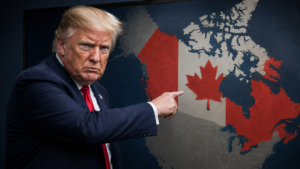
U.S. President Donald Trump has sharply stepped up pressure on Canada amid an escalating trade conflict between the two countries, calling Canadian leaders “clowns” and warning of significantly harsher economic consequences if Ottawa does not change its position.
Trump published the statement on Truth Social on August 24, 2026, following a new exchange of accusations with Canadian Prime Minister Mark Carney and Ontario Premier Doug Ford.
“America has carried Canada on its back for decades, but that will no longer happen,” the U.S. president wrote. At the end of his message, he called for the Canadian leadership to be made to “fall in line,” otherwise the consequences for the country would be “much worse.”
Trump spoke particularly harshly about Doug Ford, who had previously threatened to use electricity and critical mineral supplies to the United States as a retaliatory measure against U.S. tariffs.
The U.S. president also said that Canada was economically dependent on the United States and noted that a significant share of the electricity, oil and gas received by the country was transported through U.S. territory.
Official statistics, however, show a more complex picture. The two countries’ energy systems are indeed extremely closely interconnected, but Canada remains a major net exporter of energy resources to the United States.
According to the Canada Energy Regulator, in 2025 Canada exported CAD157.5 billion worth of oil, petroleum products, natural gas and gas condensate to the United States, while importing only CAD34.4 billion worth of similar products from the United States.
About 90.8% of Canadian hydrocarbon exports were sent specifically to the United States. In particular, Canada exported 4.3 million barrels of oil per day, of which about 3.9 million barrels went to the U.S. market.
In the opposite direction, Canada imported about 0.5 million barrels of oil per day, with approximately 76% of these supplies coming from the United States. Canada is also a major net exporter of natural gas: in 2025, it supplied about 8.6 billion cubic feet of gas per day, almost entirely to the United States, while simultaneously importing 2.5 billion cubic feet per day, predominantly from the United States.
The two countries’ electricity systems are also integrated. In 2025, Canada exported 32.7 TWh of electricity to the United States and imported 22.1 TWh. At the same time, all of Canada’s international electricity trade is conducted with the United States.
Thus, Trump’s statements have some basis in terms of the Canadian economy’s high dependence on U.S. transportation and energy infrastructure. At the same time, however, Canada is one of the most important suppliers of energy resources to the United States itself. In 2025, it accounted for 63.4% of U.S. crude oil imports, almost 100% of natural gas imports and 81.3% of electricity imported by the United States.
Trump’s statements followed the collapse of U.S.-Canadian trade negotiations.
The United States has already imposed 50% tariffs on approximately $20 billion worth of Canadian goods, while on August 24 Trump additionally threatened to raise tariffs on all cars, trucks and automotive components imported from Canada to 50% beginning January 1, 2027.
Washington had previously proposed reducing duties on Canadian passenger cars and light trucks from 25% to 15% and on steel and aluminum from 50% to 25% as part of an agreement. The negotiations collapsed, however, because of several disagreements.
Canada is preparing retaliatory measures. Ottawa announced that it would impose retaliatory tariffs on U.S. goods beginning September 8, while provincial authorities have not ruled out using energy and critical minerals as additional instruments of pressure.
Ontario Premier Doug Ford said that, in the event of further escalation, “everything is on the table,” including restrictions on supplies of electricity and strategic raw materials. According to him, electricity from Ontario supplies about 1.5 million homes and businesses in the United States.
Canadian Prime Minister Mark Carney, in turn, said that Ottawa was prepared to return to negotiations only if Canada was treated as a sovereign partner rather than as a territory dependent on the United States.
Trade relations between the two countries remain among the largest in the world. In 2025, trade in goods and services between the United States and Canada amounted to approximately $872.3 billion, with about three-quarters of Canadian merchandise exports going to the U.S. market.
Another claim made in Trump’s message is not supported by official statistics. The U.S. president said that unemployment in Canada had reached 10%, while the latest data from Statistics Canada showed that it stood at 6.4% in July 2026 — its lowest level in two years.

According to Experts.news, the United Kingdom could come close to the entire European Union market in terms of Ukrainian chicken meat purchases by 2027, while the importance of Middle Eastern countries for Ukrainian exporters will decline, according to a forecast by the Kyiv office of the U.S. Department of Agriculture (USDA FAS).
In the “Poultry and Products Annual” report, published on August 19, 2026, the United Kingdom is identified as one of the key drivers of growth in Ukrainian chicken meat production and exports in 2026–2027.
On January 16, 2026, Ukraine and the United Kingdom agreed to extend the duty-free trade regime for chicken meat and a number of other agricultural products until March 31, 2028. The United Kingdom will not impose a tariff quota on Ukrainian chicken until that date.
According to USDA estimates, this effectively provides Ukrainian producers with nearly two additional years of unrestricted access to one of the world’s most price-competitive markets. In some months, retail prices for Ukrainian chicken in the United Kingdom have even been higher than in the EU.
As a result, FAS/Kyiv expects a further sharp increase in shipments to the United Kingdom. By 2027, their volume could become comparable to Ukraine’s total chicken exports to the EU.
At the same time, the European Union remains the industry’s largest premium market; however, shipments are limited by a new permanent duty-free quota of 120,000 metric tons per year.
The new quota was agreed upon by Ukraine and the EU in October 2025. It replaced the pre-war permanent quota of 90,000 metric tons and the temporary regime of autonomous trade measures, which allowed for significantly larger volumes to be exported. The USDA expects that in 2026–2027, actual exports to the EU will remain at the established limit of 120,000 metric tons.
The expansion of shipments to the UK and the EU is already changing the geography of Ukrainian exports.
The shift is particularly noticeable in the Middle East. The USDA reports that in 2026, Ukrainian chicken exports to Saudi Arabia—which had previously been Ukraine’s largest single export market for this product—ceased entirely.
This occurred despite MHP’s long-standing relationship with Saudi Arabia and the Saudi Agricultural and Livestock Investment Company (SALIC), which owns 13% of MHP. At the same time, the USDA anticipates that Ukrainian products may return to the Saudi market in the coming years.
Exports to Iraq, on the other hand, continue. The USDA specifically notes that Ukraine was not included in Iraq’s ban on chicken imports from 39 major supplier countries due to risks associated with highly pathogenic avian influenza.
Ukrainian producers also maintain a presence in the markets of Africa and the former Soviet Union countries; however, the most profitable European markets are gradually drawing a portion of the production toward them.
Exports via Turkey are primarily of a transit nature: according to USDA industry sources, most of the Ukrainian poultry arriving there is subsequently re-exported to Asia or Africa. At the same time, the free trade agreement between Ukraine and Turkey, which will take effect in 2026, provides for a separate duty-free quota of 2,000 metric tons for raw and processed poultry products.
Overall, according to the latest estimate by FAS/Kyiv, chicken meat exports from Ukraine will increase from about 450,000 metric tons in 2025 to 490,000 metric tons in 2026 and 530,000 metric tons in 2027.
Thus, one of the key changes over the next two years will be the further reorientation of the Ukrainian poultry industry toward the United Kingdom and the EU, at the expense of some of its traditional markets in the Middle East and Asia.
Source: USDA Foreign Agricultural Service, Ukraine: Poultry and Products Annual, UP2026-0022, August 19, 2026.

According to Experts.news, amid an overall decline in the number of criminal proceedings related to corporate raiding, the proportion of cases involving the unlawful seizure of corporate assets has risen sharply in Ukraine: From January through July 2026, 17 such cases were already registered, exceeding the total for all of 2025, according to data from the Prosecutor General’s Office of Ukraine published by Opendatabot and analyzed by the Experts Club think tank.
In total, 103 criminal cases classified by Opendatabot as involving corporate raiding were registered in the first seven months of this year. Their total number decreased by 36% compared to the same period last year.
However, the nature of these crimes has changed significantly.
Cases under Article 206-2 of the Criminal Code of Ukraine—unlawful seizure of property belonging to an enterprise, institution, or organization—accounted for 17 proceedings, or about 16.5% of all raider attacks cases.
By comparison, in 2025, this category accounted for about 7%.
Thus, over the course of the year, the proportion of cases most directly related to the seizure of enterprise property more than doubled—from approximately 7% to 17%.
Another 12 cases were opened in January–July under Article 206 of the Criminal Code of Ukraine, which pertains to obstructing lawful economic activity.
At the same time, the majority of registered cases, as before, are related not to the direct seizure of assets but to documents. Under Article 205-1 of the Criminal Code of Ukraine, concerning the forgery of documents submitted for state registration of legal entities and individual entrepreneurs, 74 proceedings were initiated—nearly 72% of the total.
Despite the increase in the number of cases involving the unlawful seizure of property, none of the 17 such cases from January through July 2026 were referred to court. A similar situation arose with cases involving obstruction of lawful economic activity.
All 11 raiding cases referred to court since the beginning of the year involved document forgery.
Thus, official statistics reveal two opposing trends: the total number of registered raiding cases in Ukraine is declining, yet the proportion of proceedings directly related to the unlawful seizure of corporate assets is rising significantly.
BUSINESS, ENTERPRISE, EXPERTS CLUB, PROPERTY, RAIDING, UKRAINE

As of August 1, 2026, the cattle herd in Ukraine had decreased by 15,900 head, or 0.9%, compared to July 1—to 1.751 million head, while the number of cows decreased by 8,600 head, or 0.9%, to 932,600 head, according to the Association of Milk Producers (AMP), citing preliminary data from the State Statistics Service (SSS).
Compared to August 1, 2025, the cattle herd decreased by 400,000 head, or 19%, and the number of cows fell by 208,000 head, or 18%.
The industrial sector held 953,000 head of cattle, which is 2,000 head, or 0.2%, fewer than a month earlier, but 29,500 head, or 3%, more than a year ago. The number of cows on agricultural enterprises decreased by 3,800 head, or 1%, over the month—to 392,800 head—but increased by 11,200 head, or 3%, over the year.
Private households kept 798,100 head of cattle, which is 14,000 head, or 1.7%, fewer than a month earlier, and 430,000 head, or 35%, fewer than a year ago. The number of cows in this sector decreased by 5,000 head, or 0.9%, over the month—to 539,800 head—and by 219,000 head, or 29%, over the year.
“The cattle herd in Ukraine, including cows, continues to shrink, primarily due to the decline in the backyard farming sector. The commercial sector increased its cow herd compared to the same period last year. However, farmers sold off part of their cows in July,” the AVM noted.
According to the association, the recovery of the herd is being negatively affected by rising production costs for raw milk, low purchase prices, and the likely increase in feed costs. According to preliminary data from the State Statistics Service, cattle slaughter volumes in January–July 2026 totaled 79.24 thousand metric tons, which is 6% more than last year.
The largest number of cows in the commercial sector were kept in the Poltava region—52,400 head; Cherkasy—46,100; Chernihiv—38,000; Kyiv—35,400; and Khmelnytskyi and Vinnytsia—32,500 head each. In total, these six regions account for about 60% of the cows in Ukraine’s commercial sector.



