
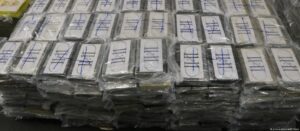
According to Serbian Economist, Hungarian law enforcement agencies seized a record 522 kg of cocaine, the Hungarian police reported following a press conference.
According to police, the shipment was discovered at the Csepel port in Budapest among a cargo of bananas. Investigators inspected approximately 7,000 boxes and found 438 blocks of cocaine weighing a total of 522 kg. The estimated black market value of the shipment is approximately 43 million euros. Hungarian authorities called this the largest cocaine seizure in the country’s history.
The operation involved the Hungarian National Bureau of Investigation, the Hungarian Tax and Customs Administration, German law enforcement agencies, as well as partners in the Czech Republic and Slovakia.
Police also reported the arrest of several suspects. Hungarian law enforcement officials believe the country is becoming one of the logistics hubs through which large shipments of drugs from South America are distributed further across the region.
International container shipments of cocaine have surged in recent years. While major flows previously passed through major ports in the Netherlands and Spain, shipments are now increasingly being routed to Southern and Central Europe as well, including ports in Montenegro. From there, shipments can be redirected to other countries in the region.
Hungary has no seaports, but it is actively used as a transit country thanks to its rail and road connections with Germany, Romania, Slovakia, the Czech Republic, and the Balkans. Montenegro, which has access to the Adriatic Sea, is also regularly cited in European investigations as one of the most frequent transit points for illicit shipments into the region.
https://t.me/relocationrs/2944
State-owned Oschadbank increased the loan portfolio of the MHP group of companies by UAH 500 million by providing a blanket credit line to replenish working capital, the financial institution announced on Wednesday.
According to a press release from the bank, taking into account the new financing, the total amount of funds provided to MHP under the general credit agreement exceeded UAH 2.66 billion.
“For companies demonstrating a high level of financial management, Oschadbank is ready to offer not only large credit lines but also flexible financing instruments without collateral,” said Serhiy Chernikov, director of the bank’s corporate business department.
It is noted that the new unsecured credit line will enable the company to finance its current operations, maintain production cycles, and fulfill its obligations to partners.
As reported, Oschadbank’s loan portfolio for the first quarter of 2026 increased by 2.5%, or by 3.14 billion UAH, to 130.59 billion UAH; specifically, loans to legal entities rose by 1.9% to 102.74 billion UAH.
According to the National Bank, as of April 1, 2026, the state-owned bank, with net assets of UAH 500.9 billion, ranked second among the country’s 58 banks.
MHP is the largest poultry producer in Ukraine and also produces grains, oil, and meat products. The agricultural holding’s production facilities are located in Ukraine and the countries of Southeast Europe.

Moldova may consider unification with Romania as an alternative scenario if negotiations on the country’s accession to the European Union after 2028 are blocked or significantly delayed, reports Euractiv, citing Moldova’s Deputy Prime Minister and Minister of Economic Development and Digitalisation, Eugen Osmochescu.
According to Osmochescu, Chisinau’s main objective remains unchanged – to sign an EU accession treaty by the end of 2028. He emphasised that unification with Romania is not the current official scenario, but could be considered a ‘plan B’ if Moldova’s European integration faces insurmountable political obstacles.
This statement reflects growing concern in Chisinau over a possible delay in the EU enlargement process. Moldova was granted EU candidate status in 2022 alongside Ukraine, and the negotiation process depends not only on the implementation of reforms but also on the political decisions of EU member states.
A potential union with Romania remains a sensitive issue in Moldovan politics. Supporters of such a scenario point to the common language, history and culture, as well as the fact that a significant proportion of Moldova’s citizens hold Romanian citizenship. Opponents believe that the issue could exacerbate internal political divisions, complicate relations with part of the population and intensify the Transnistria problem.
For Romania, any discussion of such a scenario also carries complex political and legal implications. Romania is a member of the EU and NATO, so any proposals for border changes, state unification or the incorporation of new territory would require not only decisions by Bucharest and Chisinau, but also consideration of the positions of the European Union, NATO and international partners.
The Transnistrian factor is of particular significance. The left-bank region of the Dniester has not been under the de facto control of Moldova’s central authorities since the early 1990s; a Russian military contingent is present on its territory, and a political settlement of the conflict remains frozen. Any scenario involving Moldova’s accelerated integration into the EU or unification with Romania will inevitably be linked to the question of Transnistria’s status.
That said, Osmochescu’s statement should for now be viewed more as a political signal to Brussels regarding the need to maintain a clear prospect of membership for Moldova, rather than as the start of an official process of unification with Romania. Chisinau is thus signalling that delays in EU enlargement could prompt a search for alternative paths to European integration.
Moldova covers an area of approximately 33,800 square kilometres and has a population of around 2.4–3.0 million people, depending on the methodology used to count and account for citizens living abroad. Romania is a country in South-Eastern Europe, a member of the EU and NATO, with an area of around 238,400 square kilometres and a population of around 18.8–19.1 million people.
Transnistria is an unrecognised entity on the left bank of the Dniester, which declared independence from Moldova in the early 1990s and is not de facto controlled by Chisinau. No UN member state recognises Transnistria’s independence. It is recognised only by other unrecognised or partially recognised entities – Abkhazia and South Ossetia; it was previously also recognised by Nagorno-Karabakh/Artsakh, which ceased to exist following the events of 2023. The international community regards Transnistria as part of the sovereign territory of Moldova.

According to the company’s annual report filed with the Warsaw Stock Exchange, the agricultural holding reported EBITDA of $1.27 million for the first quarter of 2025, a 26.6% decrease from the same period in 2026.
According to the document, the agricultural holding’s revenue for the reporting period decreased by 39.6% to $2.55 million, gross profit by 17.1% to $1.25 million, and operating profit by 24.1% to $1.01 million.
KSG Agro’s net profit for the first quarter was $0.14 million, compared to $3.04 million in the first quarter of last year, when the contribution from the sale of two of the holding’s assets amounted to $1.71 million.
In addition, in the first quarter of this year, the agricultural holding made $0.42 million in investments, which is 11 times more than in the first quarter of last year.
“The Group continues to implement its simple strategy, focusing on one winter crop, three spring crops, and a single breed of pigs… Overall, operating performance is considered satisfactory,” the report states.
According to the report, the crop production segment generated $0.81 million in revenue and a gross loss of $0.12 million in the first quarter, while the swine segment generated $1.66 million in revenue and a gross profit of $1.32 million,
As of the reporting date, KSG Agro had 1,900 hectares of winter wheat and 219 hectares of winter barley.
In 2025, the agricultural holding, which had previously decided to switch to Canadian genetics, purchased an additional 1,300 Canadian sows, enabling it to produce high-quality piglets to be sold as weaners and market hogs, the report states.
The document reiterates that the board of directors is developing a new growth strategy to expand the agricultural holding’s operations in the European Union with the clear goal of concentrating the majority of the group’s assets and revenues in the EU over the next 3–5 years. According to the company, this can be achieved through a series of mergers and acquisitions, as well as financed using equity and debt, including additional share issuances.
“The new strategy focuses primarily on expansion and investment, which reduces the potential risks of investing exclusively in Ukraine and mitigates the negative impact of the current macroeconomic situation in Ukraine on the Group’s business,” the report states.
The company’s net debt as of the end of March 2026 stood at $14.10 million, compared to $14.39 million at the beginning of the year, while equity remained at $8.94 million.
Olbis Investment LTD SA, owned by Serhiy Kasyanov, Chairman of the Board of Directors of KSG Agro, holds 47.83% of the holding company’s shares; 47.57% are in free float on the Warsaw Stock Exchange; and another 4.59% are treasury shares.
KSG Agro is a vertically integrated holding company engaged in pig farming, as well as the production, storage, processing, and sale of grains and oilseeds. Its land bank in the Dnipropetrovsk and Kherson regions totals approximately 21,000 hectares.
According to 2025 results, the agricultural holding increased its net profit by 5.4 times compared to 2024—to $4.23 million—while its revenue decreased by 14.3%—to $18.92 million.
During 2023 and 2024, one of KSG Agro’s main operating subsidiaries issued three series of foreign currency bonds at 7% per annum for a total of $4.38 million, maturing from September 2026 to February 2027.
AGRICULTURAL HOLDING, EBITDA, KSG AGRO, PIG FARMING, Warsaw Stock Exchange
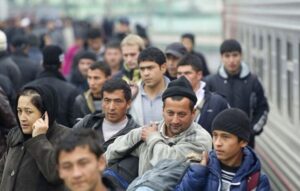
In 2025, 9,582 work permits were issued to foreign nationals and stateless persons, and 3,310 were revoked. Thus, 6,272 migrant workers remained in the country, accounting for 0.14% of the 4.5 million workers needed to fill the labor market, a well-informed government source told the Interfax-Ukraine news agency.
The State Employment Service also confirms the small share of foreigners in the domestic labor market. According to the agency’s statistics, prior to the full-scale invasion, employers received approximately 21,000 work permits for foreigners annually.
“After 2022, this figure decreased and has not yet reached pre-war levels. For example, 4,720 permits were issued in 2024, and 7,483 in 2025. This is more than half the number issued before the start of the full-scale war,” the Employment Service’s website states.
The State Migration Service provides slightly different statistics. As of December 31, 2025, there were 47,684 foreigners and stateless persons (temporary residents) registered in Ukraine. Of these, 8,440 temporary residence permits were issued for the first time in 2025.
However, all agencies agree that the share of foreigners in the domestic labor market is negligible. After all, when processing documents, aside from the employer’s consent, numerous issues arise regarding visas, SBU checks, residence permits, and other matters, which is why only a fraction of workers actually come to Ukraine.
Thus, despite labor migration, the labor market is increasingly feeling a shortage of workers.
“That is why it is now necessary to develop a new migration policy, taking as an example the legislation of countries that are successful in this regard, such as Canada, Australia, or Israel. Then there will be no speculation, and the problem of securing a workforce for Ukrainian businesses will be resolved,” the agency’s source emphasized.
Although, in his opinion, it is certainly best to focus on preserving the domestic labor force so that Ukrainians return from the EU rather than leave for it. And only after that, once we understand how many workers are lacking and in which sectors, should we attract foreign workers for specific projects, establishing rules for employer companies and ensuring oversight of them by the State Labor Service.

Metinvest Business Service LLC (MBS, Kryvyi Rih, Dnipropetrovsk Oblast), a multifunctional center providing accounting, tax, and other services, in January-March of this year, reported a net profit of UAH 10.567 million, compared to a net loss of UAH 27.437 million for the same period last year.
According to the company’s interim report, which is available to the agency “Interfax-Ukraine”, revenue from ordinary activities for this period decreased by 1.4% to UAH 158.587 million.
The accumulated deficit as of the end of March amounted to UAH 1.261 million.
In 2025, the company reported a net profit of UAH 9.674 million, compared to a net loss of UAH 8.495 million in the previous year, while revenue from ordinary activities for this period increased by 8.6%—to UAH 712.139 million from UAH 655.541 million.
The average number of employees at the end of 2025 was 1,050, and at the end of 2024, it was 1,279.
Metinvest Business Service LLC (Kryvyi Rih, Dnipropetrovsk Oblast) is a multifunctional service center providing accounting and tax services, treasury operations, human resources management services, legal services, and other services. The company was founded in 2014 and serves as the sole service center for Metinvest Group companies. MBS offices are located in Kryvyi Rih, Mariupol (prior to the war), and Zaporizhzhia.
Metinvest Holding LLC owns a 100% stake in MBS LLC.
The LLC’s authorized capital is UAH 71.125 million.
MBS LLC is part of the Metinvest Group, whose main shareholders are PJSC System Capital Management (SCM, Donetsk) (71.24%) and the Smart-Holding group of companies (23.76%). The management company of the Metinvest Group is Metinvest Holding LLC.



