

In its February report, the U.S. Department of Agriculture (USDA) raised its forecast for corn exports from Ukraine in 2022/2023 marketing year (MY, July-June) by 2 million tons, compared to January data, to 22.5 million tons from 20.5 million tons, and wheat exports by 0.5 million tons, to 13.5 million tons from 13 million tons.
According to a report on the U.S. Department of Agriculture website Thursday, the forecast for corn production in the current MY is maintained at 27 million tons and wheat at 21 million tons.
Also in the February forecast, the estimate of transitional corn balances in Ukraine at the end of 2022/2023 MY was reduced by 2 million tons to 3.39 million tons from 5.39 million tons, and by 0.5 million tons for wheat to 4.21 million tons from 4.71 million tons.
At the same time, the estimate of domestic consumption of corn in Ukraine in 2022/2023 MY remained at 5 million tons, and wheat – 4 million tons.
In general, the forecast of feed grain exports in Ukraine in 2022/23 MY in the February forecast was increased by 2 million tons – to 24.93 million tons from 22.93 million tons in January, and the forecast of its production was kept at 34.16 million tons.
As reported, Ukrainian agrarians by February 3, 2023 harvested 78.93 million tons of major crops from 18.46 million hectares, including 53.2 million tons of grain and leguminous crops. Wheat in 2022 harvested 20.2 million tons from 5 million hectares, and corn – 25.9 million tons from 3.9 million hectares.
Ukraine from the beginning of 2022/2023 MY to February 3, exported 27.46 million tons of crops, which is 29.8% less than the same period of the previous MY. External markets supplied 15.68 million tons of corn (-2.1% compared to the same period last year), 9.84 million tons of wheat (1.75 times less), 1.83 million tons of barley (3 times less), 12.8 thousand tons of rye (12.3 times less) and 85 tons of flour (+33%).

The Formula 1 cars of Michael Schumacher and Jean Alesi were sold for €1.3m and €3.66m respectively.
Both cars were sold at an auction in Paris. Schumacher’s Jordan 191 is not just the car in which the seven-times world champion drove – it was the first Formula 1 car he ever drove. In 1991, the German replaced Bertrand Gachot, who had been jailed for spraying in the face of a cab driver the year before.
Schumacher had never competed in a Formula 1 grand prix before, but managed to qualify seventh, beating teammate Andrea De Cesaris. The race itself was less successful, with him losing the race on the first lap due to technical problems, but it paved the way for the future champion to enter Formula 1.
The Jordan 191 was sold just 18 months ago, but earlier this year it was revealed that the car would return to auction.
Despite the historic value of the Jordan 191, the most expensive car at the auction was a Ferrari 643, which went under the hammer for 3.66 million euros. The car was driven by French racer Jean Alesi in 1991 and he only managed to win one Formula 1 grand prix during his career.
The Ferrari 643 was introduced mid-season and was not a car capable of winning the championship. Alesi’s teammate, four-time champion Alain Prost was even fired before the last race of the season because he publicly stated that driving this car was the same as driving a truck.
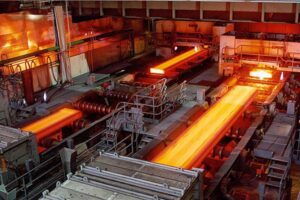
Ukrainian metallurgical enterprises in January this year reduced the production of total rolled steel, according to operational data, by 84.6% compared to the same period last year – to 257 thousand tons.
According to the association “Ukrmetallurgprom”, during the first month of 2023, steel production decreased by 84.7% compared to January 2022 – to 284 thousand tons, iron – by 86.6%, to 240 thousand tons.
In December 2022, the production of general products was 109 thousand tons (down by 58.8% against January 2023), steel – 106 thousand tons (down by 62.7%), iron – 247 thousand tons (an increase of 2.9%).
As reported, metallurgical enterprises in Ukraine in 2022, reduced the production of total products by 72% compared to last year – up to 5.350 million tons, steel – by 70.7% – to 6.263 million tons, cast iron – by 69.8%, to 6.391 million tons.
In 2021, the company produced 21.165 million tons of cast iron (103.6% by 2020), 21.366 million tons of steel (103.6%), 19.079 million tons of rolled steel (103.5%).

The negative balance of Ukraine’s foreign trade in goods in January-October 2022 increased 2.6 times compared to the same period in 2021 – to $7.050 billion from $2.691 billion, said the State Statistics Service. According to them, exports of goods from Ukraine during the reporting period compared to January-October 2021 decreased by 32.3% to $36.859 billion, imports – by 23.2% to $43.909 billion.
Ukraine’s state budget deficit in November rose to a record 170 billion UAH from 143.4 billion UAH a month earlier, including the general fund to 163.3 billion UAH from 147.1 billion UAH, the Ministry of Finance said on its website.
Total national debt of Ukraine in November 2022 increased by 4.2%: in dollar terms – by $4.34 billion, to $107.46 billion, in UAH – by 158.7 billion, to 3.930 trillion UAH, according to the Ministry of Finance website.
According to them, direct public debt last month increased by 4.5% to $97.69 billion, or 3.572 trillion UAH, mainly due to a loan from the European Union ($2.95 billion) and placement of government bonds ($0.56 billion, or 20.44 billion UAH).
International reserves of Ukraine as of December 1, 2022, according to preliminary data, amounted to $27 billion 422.2 million (in equivalent), which is 10.7% more than at the beginning of November ($25 billion 244.2 million), according to the National Bank of Ukraine.
One third (34%) of Ukrainian refugees in Germany want to stay in this country until the end of hostilities at home, while a quarter (26%) are planning to stay in Germany permanently, Deutsche Welle wrote on Thursday with reference to the results of a representative study conducted by three German sociological institutions together with the Federal Office for Migration and Refugees (BAMF).
Russian attacks on the energy infrastructure increased the rate of decline in Ukraine’s economy this November to roughly 41 percent last November, First Deputy Economy Minister Denis Kudin said. “Our expectation for November is minus 41%. That’s significantly deeper than what we forecasted before,” he said during a discussion at the Center for Economic Strategy (CES).
A month earlier, First Deputy Prime Minister and Economy Minister Yulia Sviridenko said at a meeting with U.S. media that Russia’s October energy slump increased the drop in GDP to 39% by October 2021, which is worse than the September-August figure of 35%.
Kudin also pointed out that for this year as a whole, the GDP decline forecast has been worsened to 33.2% from 32%.
Ukraine since the beginning of 2022/2023 marketing year (MY, July-June) and exported 19.66 million tons of crops, including 10.76 million tons of corn (54.7% of total supplies), 7.29 million tons of wheat (37%) and 1.53 million tons of barley (7.8%).
The total area of residential buildings with permits for construction work (new construction) in January-September 2022 halved compared to the same period in 2021 to 5.2 million square meters, said the State Statistics Service.
Commercial real estate operations and construction lead the list of sectors with the highest share of bad loans (NPLs) – 70.2% and 68%, respectively, according to the National Bank in the Report on Financial Stability on the analysis of the largest corporate borrowers on December 1, which accounted for 60% of the net loan portfolio of banks.
According to the document, the total share of NPL in the real estate sector is 62.8%, followed by mechanical engineering – 62.5%, while in the sectors of energy and utilities, as well as metallurgy, the figures are much lower – 46.8% and 45%, respectively (42.7% in the green energy sector).
Head of the project “Economic Monitoring” candidate of economic sciences Maksim Urakin

The construction of a building technology campus of Kingspan, an Irish manufacturer of energy-efficient insulation technology, is scheduled to start in 2024, and the company has already started looking for a site in the Lviv region because of its proximity to the border, according to a UkraineInvest press release on Thursday.
According to it, the campus will include six production areas, including the production of insulation materials and district heating solutions. The campus will produce construction products with high added value. The project includes a green, low-carbon manufacturing facility.
Kingspan is reportedly investing more than EUR200 million in the construction. Construction will take about five years. The implementation of the project will create 600-800 new jobs.
Kingspan was founded in 1965 in Ireland, specialized in production of building solutions for building envelopes (roofs, walls, facades), as well as protective walls, cold doors, high-tech solid urethane and solid phenolic thermal insulation for roofs, walls, floors and pipelines. It operates 200 production facilities around the world. The company came to Ukraine in 2005.
In April 2022, Kingspan announced the completion of its exit from the Russian business. Russia accounted for less than 1% of the company’s global operations. It also donated $750,000 to UNICEF to set up five Blue Dot centers to help refugees on the Ukrainian border.
UkraineInvest, the Investment Attraction and Support Office of the Cabinet of Ministers of Ukraine, provides organizational and advisory support for investors to prepare projects for implementation.

A 2007 smartphone with 8GB of memory that’s still sealed in the box could fetch its owner Karen Green quite a bit of money. The woman said the phone was a gift from her friends.
“In 2007, I got a new job, and my friends bought me the newest, first-generation iPhone. It had everything for the new job, like a calendar,” Green said.
But despite all the useful features of the new phone, she didn’t want to part with the old one. Green decided for herself that the iPhone would never get old.
Most likely, Greene’s friends bought the phone for $499 $599. At the LCG Auctions auction the starting price for the gadget was $2.5 thousand, but experts suggest that in the end the lot will go for $50 thousand.
This is not the first time, when the iPhone of the first generation goes under the hammer. In August, one such phone was sold for $35.4 thousand, and in October – for $39.3.



