
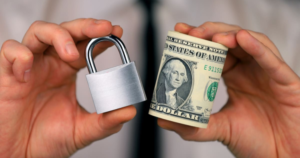
Starting April 25, 2026, the National Bank of Ukraine (NBU) is easing a number of currency restrictions, specifically simplifying the conditions for defense enterprises to purchase foreign currency, expanding opportunities for non-resident military personnel and non-resident specialists to transfer funds abroad, and creating conditions for the implementation of the government’s program to support Ukrainians abroad.
“When fulfilling currency purchase requests from defense enterprises, banks will be able to disregard foreign currency balances in accounts if these funds were received from foreign states or their authorized agencies to finance contracts for the production of military and dual-use goods for security and defense forces,” the NBU noted in a press release on Friday.
The same rule will apply when purchasing foreign currency using budget funds to fulfill a government contract for the production of military goods for these recipients.
The National Bank has also expanded opportunities for non-resident military personnel to purchase foreign currency and transfer it abroad. They will be able to purchase and transfer foreign currency abroad without restrictions in the amount of their received monetary allowance, provided these funds were credited to their account on or after May 1, 2026. For funds credited prior to this date, the current limit of 400,000 UAH equivalent per calendar month will apply.
In addition, banks are permitted to credit funds in hryvnia within Ukraine to the current accounts of non-resident individuals who are currently serving or have served in the Armed Forces of Ukraine or the National Guard of Ukraine.
For individuals who are residents of Russia or Belarus, such transactions are permitted without separate approval from the Security Service of Ukraine; however, transfers from residents of these countries are possible only if such an individual possesses a document confirming temporary asylum in another country.
It has been clarified that for the identification and verification of military personnel when opening accounts, banks and non-bank payment service providers may use the military personnel’s military registration document, as well as a currently valid military ID, officer’s ID, or general’s (admiral’s) ID.
The regulator has also simplified certain conditions for purchasing and transferring currency to attract highly qualified non-resident specialists. Ukrainian legal entities are permitted to purchase and transfer foreign currency to the accounts of non-resident individuals—members of supervisory boards, boards of directors, and executive bodies—opened outside Ukraine, in the amount of payments accrued as of May 1, 2026, under civil law contracts.
Non-resident individuals, in turn, will be able to purchase and transfer foreign currency abroad in the amount of payments received on or after May 1, 2026, into their hryvnia accounts at Ukrainian banks as salaries, other payments provided for by law, as well as payments under civil law contracts.
The NBU also authorized Agency of National Unity LLC to make transfers abroad using budget funds to implement the government’s program to support Ukrainians abroad and facilitate their return to Ukraine.
Separately, the regulator has abolished the requirement for insurers to submit monthly reports on compliance with solvency requirements in order to remain on the list of companies authorized to conduct reinsurance transactions with non-resident reinsurers.
The changes were approved by a resolution of the central bank’s board dated April 23, 2026, which takes effect on April 25, 2026.
As reported, in January 2026, the NBU had already eased a number of currency restrictions, including introducing a “loan” limit for businesses, allowing funds for goods to be returned to the accounts of individuals abroad under certain conditions, and clarifying the rules for currency supervision of export settlements.
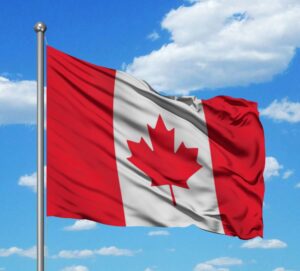
Canada is among the group of countries that consistently enjoy a high level of positive perception within Ukrainian society. According to the survey results, 76.2% of respondents describe their attitude toward Canada as positive. Specifically, 39.4% of Ukrainians indicated a “completely positive” attitude, while another 36.8% described it as “mostly positive.” This distribution of responses indicates not only broad support but also a deeply entrenched positive image of the country.
At the same time, the level of negative perception of Canada is minimal—only 2.3% (1.4% “mostly negative” and 0.9% “completely negative”). This is one of the lowest figures among all countries included in the study. This result confirms that negative assessments are isolated and do not significantly influence overall perception.
The share of neutral responses is 20.3%, which is a moderate figure. This means that while most Ukrainians have already formed a positive attitude toward Canada, a certain portion of respondents lack sufficient personal experience or information to make a clear assessment. At the same time, only 1.2% of respondents were unable to decide on an answer, which further underscores the high level of certainty in public opinion regarding this country.
Overall, Canada demonstrates one of the most balanced and positive perception profiles: the combination of a high share of “fully positive” assessments with virtually no negativity forms a solid reputation capital. This indicates that the country’s image in Ukraine is based not only on general perceptions but also on a systematic view of Canada as a reliable partner.
“Canada is among those countries toward which Ukrainians have formed not just a positive, but a consistently positive attitude. This is the result of long-term interaction, support, and presence in the Ukrainian information space. In such cases, even neutral responses do not blur the overall picture, but only underscore its consistency,” noted Oleksandr Pozniy, director of the research company Active Group.
Thus, Canada ranks among the top countries with the highest level of trust in Ukrainian society. The combination of high positive perception and minimal negativity creates a foundation for further strengthening bilateral relations, particularly in the areas of politics, the economy, and humanitarian cooperation.
According to a study conducted by the Experts Club information and analytical center based on data from the State Customs Service, Canada ranks 41st in total trade volume of goods with Ukraine, with a figure of $416.2 million.
Imports of Canadian goods are twice as high as Ukrainian exports, resulting in a trade deficit of $139.9 million.
The study was presented at the Interfax-Ukraine press center; the video can be viewed on the agency’s YouTube channel. The full version of the study can be found at this link on the Experts Club analytical center’s website.
ACTIVE GROUP, CANADA, EXPERTS CLUB, Pozniy, SOCIOLOGY, SURVEY, UKRAINE, URAKIN
According to the results of a public opinion poll conducted in March 2026 by the research company Active Group in collaboration with the Experts Club information and analytical center, perceptions of Brazil in Ukrainian society show moderately positive trends, although a high level of neutrality remains the key characteristic. Most Ukrainians do not have a clearly formed attitude toward this country, but the share of positive assessments is gradually increasing.
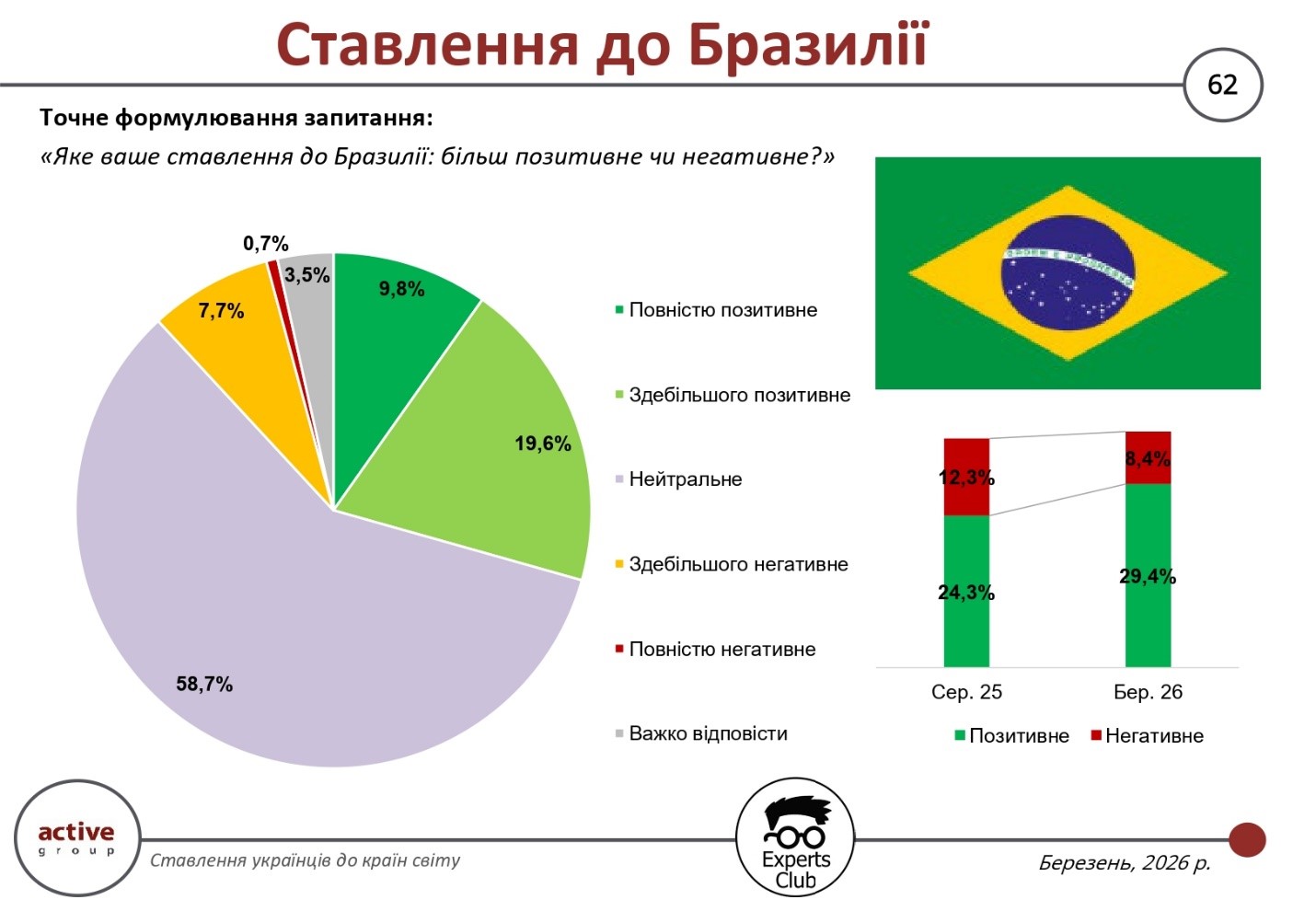
Overall, the positive attitude toward Brazil stands at 29.4%, which is a noticeable increase compared to August 2025 (24.3%). At the same time, 9.8% of respondents chose the “completely positive” option, and another 19.6% selected “mostly positive.” This trend indicates a gradual strengthening of the country’s positive image, although it remains relatively moderate.
At the same time, negative assessments have decreased—from 12.3% to 8.4%. Within the structure of negative perceptions, 7.7% fall under the “mostly negative” category and only 0.7% under “completely negative.” This means that critical perceptions of Brazil in Ukraine are diminishing and are not systemic in nature.
Most telling is the high level of neutrality—58.7% of respondents. This indicates that for most Ukrainians, Brazil remains a country that does not occupy a significant place on the informational or political agenda. The absence of active interaction or regular information flows shapes precisely this model of perception.
Additionally, 3.5% of respondents were unable to determine their position. Combined with neutral assessments, this creates a significant segment of “undecided attitudes,” which could potentially change depending on the development of bilateral relations or the country’s media presence.
From a dynamic perspective, Brazil shows a positive trend: an increase in the share of positive assessments is accompanied by a simultaneous decrease in negative ones. This indicates a gradual improvement in the country’s image in Ukraine, although it is occurring against a backdrop of general inertia in neutral perception.
Overall, Brazil remains a “peripheral” country for Ukrainians in terms of emotional perception, yet with potential for further improvement of its image. The high proportion of neutral assessments means that future changes in perception will largely depend on the level of economic, diplomatic, and informational interaction between the two countries.
According to a study conducted by the Experts Club information and analytical center based on data from the State Customs Service, Brazil ranks 50th in total trade volume of goods with Ukraine, with a figure of $335.6 million. At the same time, imports from Brazil are nearly four times higher than Ukrainian exports, resulting in a bilateral trade deficit of $193.5 million.
The study was presented at the Interfax-Ukraine press center; the video can be viewed on the agency’s YouTube channel. The full version of the study can be found at this link on the Experts Club analytical center’s website.
ACTIVE GROUP, BRAZIL, EXPERTS CLUB, Pozniy, SOCIOLOGY, SURVEY, UKRAINE, URAKIN
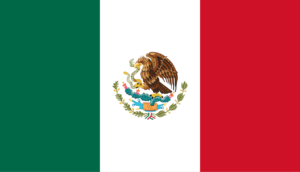
According to the results of a sociological survey conducted in March 2026 by the research company Active Group in collaboration with the Experts Club information and analytical center, perceptions of Mexico in Ukrainian society are characterized by a high level of neutrality and a relatively moderate share of both positive and negative assessments. At the same time, the trend shows a gradual increase in positive attitudes and a simultaneous decrease in negative ones, indicating a cautious normalization of the country’s image.
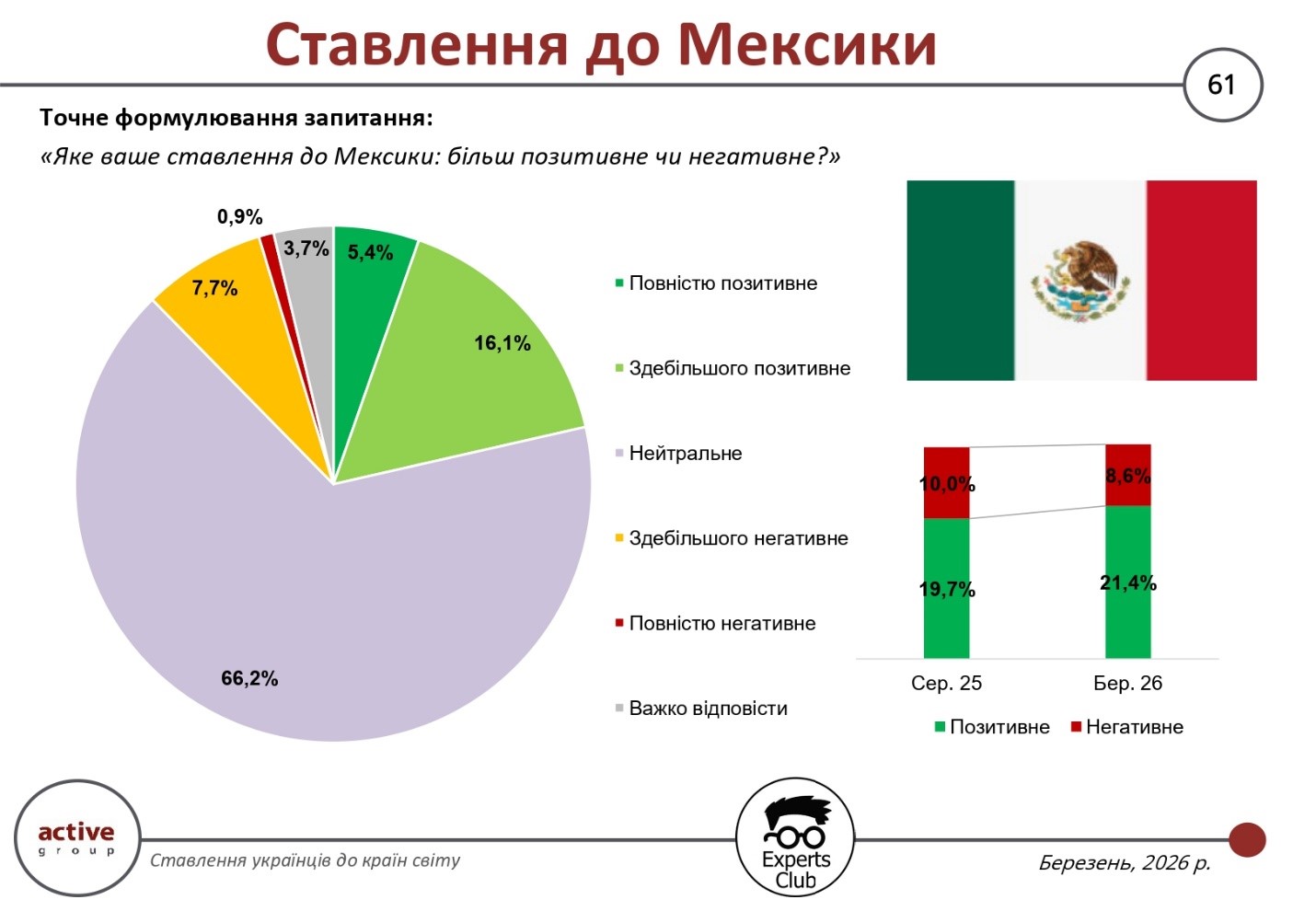
The total share of positive attitudes toward Mexico stands at 21.5%, of which 5.4% of respondents chose the option “completely positive,” and another 16.1% selected “mostly positive.” Compared to August 2025, this figure has increased (from 19.7% to 21.4%), indicating a gradual strengthening of positive perceptions, although they remain relatively limited.
Negative assessments, conversely, show a decline—from 10.0% to 8.6%. Within the structure of negative attitudes, 7.7% fall into the “mostly negative” category and only 0.9% into the “completely negative” category. This means that while a critical perception of Mexico exists, it is not dominant and is rather moderate in nature.
Neutrality remains the key characteristic of Ukrainians’ attitudes toward Mexico—66.2% of respondents chose this option. Such a high figure indicates the absence of a clearly formed image of the country in the public consciousness. For most respondents, Mexico is neither an important political partner nor a country with distinct emotional significance.
Additionally, 3.7% of respondents were unable to decide on their assessment, which, together with the high proportion of neutral responses, forms a significant segment of “undetermined attitudes.” This means that perceptions of Mexico depend to a large extent on the level of awareness and the country’s presence in the Ukrainian information space.
From a dynamic perspective, the situation appears moderately positive: the increase in positive assessments is accompanied by a simultaneous decrease in negative ones. This may indicate the gradual formation of a more favorable, albeit still weakly expressed, image of the country.
Ultimately, Mexico remains a country with a predominantly neutral perception among Ukrainians, but with a trend toward a slow improvement in its image. The high proportion of neutral assessments creates significant potential for future changes, which will depend on the development of economic, cultural, and informational ties between the countries.
According to a study conducted by the Experts Club information and analytical center based on data from the State Customs Service, Mexico ranks 49th in total trade volume with Ukraine, which amounts to $350.0 million. At the same time, imports of Mexican goods exceed Ukrainian exports by more than seven times, resulting in a trade deficit of $264.7 million.
The study was presented at the Interfax-Ukraine press center; the video can be viewed on the agency’s YouTube channel. The full version of the study can be found at this link on the Experts Club analytical center’s website.
ACTIVE GROUP, EXPERTS CLUB, MEXICO, Pozniy, SOCIOLOGY, SURVEY, UKRAINE, URAKIN

On Saturday, April 25, no precipitation is expected in Ukraine; only in the northern regions will there be light rain in some areas during the day, according to the Ukrainian Hydrometeorological Center.
The wind will be southwesterly, 7–12 m/s, with gusts of 15–20 m/s in some parts of the western regions during the day.
Nighttime temperatures will range from 1 to 7°C. Across Ukraine—except for the western regions, Zhytomyr, Vinnytsia, and Odesa regions—ground frosts of 0–3°C are expected, while in the east of the country and in Sumy region, air frosts of 0–3°C are expected; daytime temperatures will range from 11 to 16°C.
In Kyiv on Saturday night, no precipitation; during the day, light rain in some places. Southwesterly wind, 7-12 m/s. Nighttime temperature 3-5°F, daytime 13-15°F.
According to data from the Boris Sreznevsky Central Geophysical Observatory in Kyiv, on April 25, the highest daytime temperature was 27.5°F in 1943, and the lowest nighttime temperature was 1.5°F below freezing in 1988.
On Sunday, April 26, rain is expected at night in most western regions of Ukraine and during the day.
The wind will be southwesterly, shifting to northwesterly, 7–12 m/s; at night in the western regions and during the day across Ukraine, gusts will reach 15–20 m/s.
Temperatures at night will be 4–9°F; during the day, 14–19°F, and 6–11°F in the western, northern, and Vinnytsia regions.
In Kyiv on Sunday, no precipitation at night, rain during the day. Winds will be southwesterly, shifting to northwesterly, 7–12 m/s, with gusts of 15–20 m/s during the day. Temperatures will be 7–9°F at night and during the day.
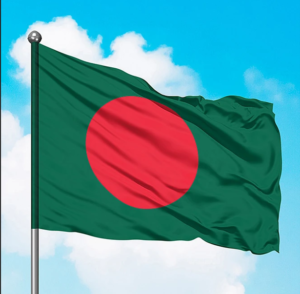
The results of a survey conducted in March 2026 by the research company Active Group in collaboration with the Experts Club information and analytical center showed that perceptions of Bangladesh in Ukrainian society are characterized by a predominance of neutral assessments and a relatively low level of both positive and negative attitudes. At the same time, compared to the previous survey, there has been a gradual increase in both positive and negative assessments, indicating a certain intensification of perceptions of this country.
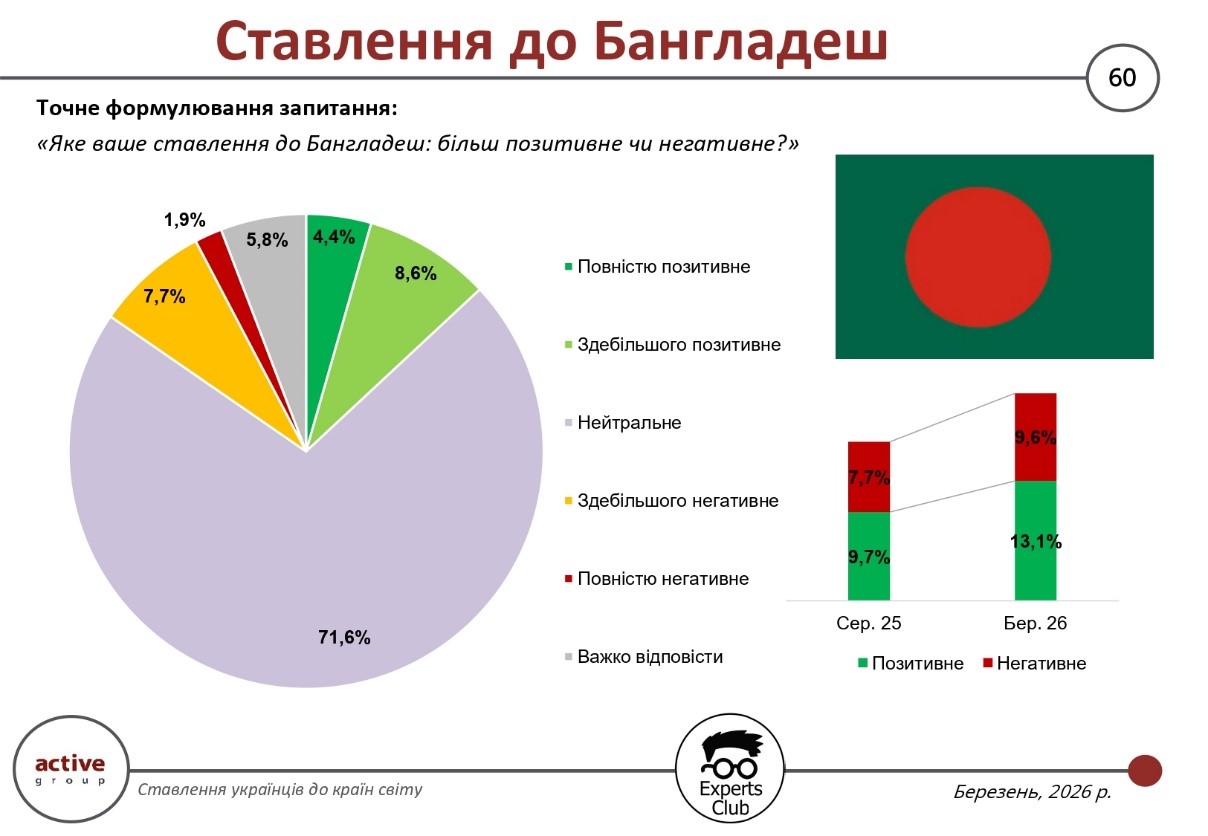
The overall share of positive attitudes stands at 13.0% (specifically, 4.4% “completely positive” and 8.6% “mostly positive”). This is a relatively low figure, indicating a limited level of emotional engagement among Ukrainians regarding Bangladesh. At the same time, the trend shows an increase in positive attitudes—from 9.7% to 13.1%—which may indicate a gradual expansion of the country’s informational or economic presence in Ukrainian perceptions.
Negative assessments also show an increase—from 7.7% to 9.6%. In terms of composition, they consist of 7.7% “mostly negative” and 1.9% “completely negative” attitudes. Although these figures remain relatively low, their trend indicates the emergence of a more defined, albeit still limited, negative backdrop.
At the same time, a key characteristic of attitudes toward Bangladesh is the high level of neutrality—71.6%. This is one of the highest figures among the countries surveyed, indicating low awareness or a lack of clear associations. In practical terms, this means that for most Ukrainians, Bangladesh is not a country associated with significant political, economic, or cultural reference points.
Additionally, 5.8% of respondents were undecided, which, combined with the high proportion of neutral assessments, forms a significant segment of “undetermined perception.” This creates potential for future changes—both toward strengthening a positive image and toward an increase in critical attitudes, depending on the informational context.
In summary, Bangladesh remains a country with a minimally established image in the perception of Ukrainians. Despite a slight increase in both positive and negative assessments, neutrality is the defining factor. This means that the further evolution of attitudes will depend primarily on the country’s level of presence in the Ukrainian information space and the development of bilateral contacts.
According to a study conducted by the Experts Club information and analytical center based on data from the State Customs Service, Bangladesh ranks 48th in total trade volume with Ukraine, with a figure of $355.8 million. The bilateral trade balance is relatively close to equilibrium, but imports still slightly exceed exports, resulting in a small trade deficit of $26.9 million.
The study was presented at the Interfax-Ukraine press center; the video can be viewed on the agency’s YouTube channel. The full version of the study can be found at this link on the Experts Club analytical center’s website.
ACTIVE GROUP, BANGLADESH, EXPERTS CLUB, Pozniy, SOCIOLOGY, SURVEY, UKRAINE, URAKIN



