

On Saturday, April 25, no precipitation is expected in Ukraine; only in the northern regions will there be light rain in some areas during the day, according to the Ukrainian Hydrometeorological Center.
The wind will be southwesterly, 7–12 m/s, with gusts of 15–20 m/s in some parts of the western regions during the day.
Nighttime temperatures will range from 1 to 7°C. Across Ukraine—except for the western regions, Zhytomyr, Vinnytsia, and Odesa regions—ground frosts of 0–3°C are expected, while in the east of the country and in Sumy region, air frosts of 0–3°C are expected; daytime temperatures will range from 11 to 16°C.
In Kyiv on Saturday night, no precipitation; during the day, light rain in some places. Southwesterly wind, 7-12 m/s. Nighttime temperature 3-5°F, daytime 13-15°F.
According to data from the Boris Sreznevsky Central Geophysical Observatory in Kyiv, on April 25, the highest daytime temperature was 27.5°F in 1943, and the lowest nighttime temperature was 1.5°F below freezing in 1988.
On Sunday, April 26, rain is expected at night in most western regions of Ukraine and during the day.
The wind will be southwesterly, shifting to northwesterly, 7–12 m/s; at night in the western regions and during the day across Ukraine, gusts will reach 15–20 m/s.
Temperatures at night will be 4–9°F; during the day, 14–19°F, and 6–11°F in the western, northern, and Vinnytsia regions.
In Kyiv on Sunday, no precipitation at night, rain during the day. Winds will be southwesterly, shifting to northwesterly, 7–12 m/s, with gusts of 15–20 m/s during the day. Temperatures will be 7–9°F at night and during the day.
The results of a survey conducted in March 2026 by the research company Active Group in collaboration with the Experts Club information and analytical center showed that perceptions of Bangladesh in Ukrainian society are characterized by a predominance of neutral assessments and a relatively low level of both positive and negative attitudes. At the same time, compared to the previous survey, there has been a gradual increase in both positive and negative assessments, indicating a certain intensification of perceptions of this country.
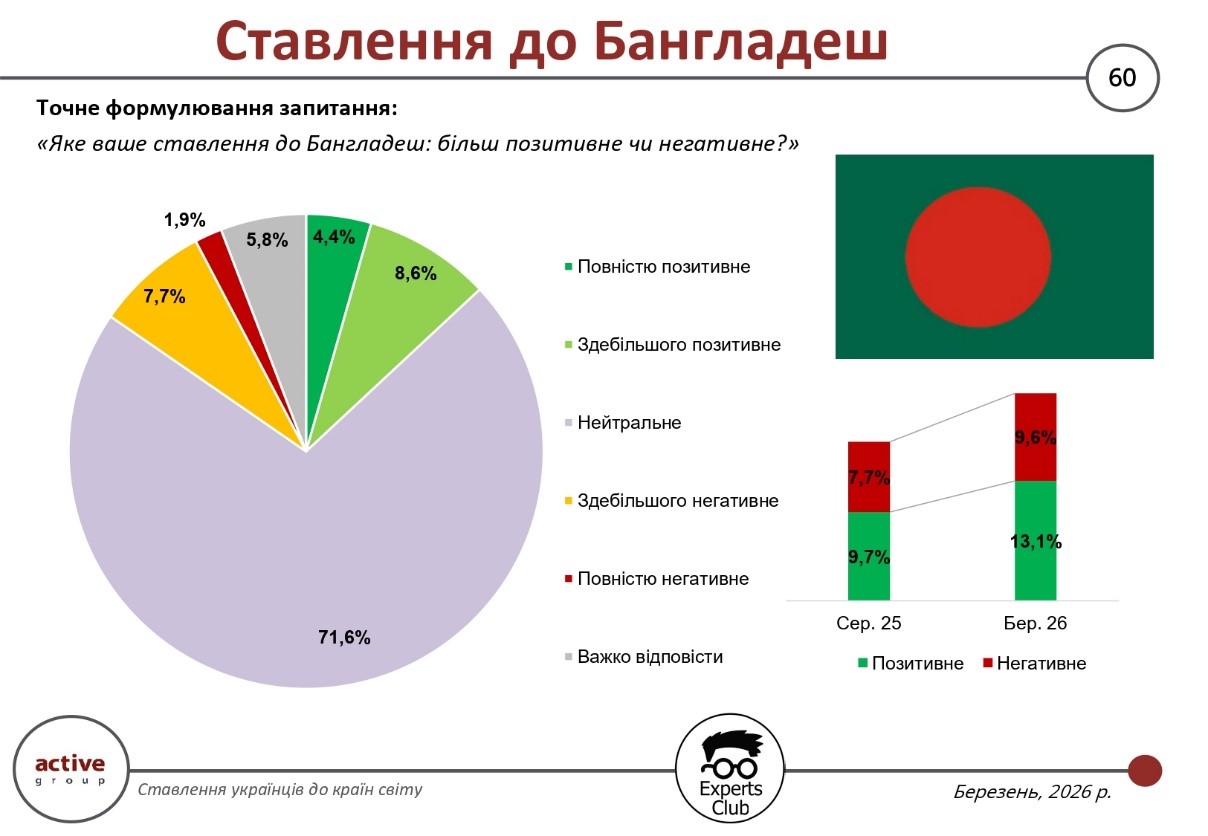
The overall share of positive attitudes stands at 13.0% (specifically, 4.4% “completely positive” and 8.6% “mostly positive”). This is a relatively low figure, indicating a limited level of emotional engagement among Ukrainians regarding Bangladesh. At the same time, the trend shows an increase in positive attitudes—from 9.7% to 13.1%—which may indicate a gradual expansion of the country’s informational or economic presence in Ukrainian perceptions.
Negative assessments also show an increase—from 7.7% to 9.6%. In terms of composition, they consist of 7.7% “mostly negative” and 1.9% “completely negative” attitudes. Although these figures remain relatively low, their trend indicates the emergence of a more defined, albeit still limited, negative backdrop.
At the same time, a key characteristic of attitudes toward Bangladesh is the high level of neutrality—71.6%. This is one of the highest figures among the countries surveyed, indicating low awareness or a lack of clear associations. In practical terms, this means that for most Ukrainians, Bangladesh is not a country associated with significant political, economic, or cultural reference points.
Additionally, 5.8% of respondents were undecided, which, combined with the high proportion of neutral assessments, forms a significant segment of “undetermined perception.” This creates potential for future changes—both toward strengthening a positive image and toward an increase in critical attitudes, depending on the informational context.
In summary, Bangladesh remains a country with a minimally established image in the perception of Ukrainians. Despite a slight increase in both positive and negative assessments, neutrality is the defining factor. This means that the further evolution of attitudes will depend primarily on the country’s level of presence in the Ukrainian information space and the development of bilateral contacts.
According to a study conducted by the Experts Club information and analytical center based on data from the State Customs Service, Bangladesh ranks 48th in total trade volume with Ukraine, with a figure of $355.8 million. The bilateral trade balance is relatively close to equilibrium, but imports still slightly exceed exports, resulting in a small trade deficit of $26.9 million.
The study was presented at the Interfax-Ukraine press center; the video can be viewed on the agency’s YouTube channel. The full version of the study can be found at this link on the Experts Club analytical center’s website.
ACTIVE GROUP, BANGLADESH, EXPERTS CLUB, Pozniy, SOCIOLOGY, SURVEY, UKRAINE, URAKIN

For the first time since the start of the full-scale war, the European Bank for Reconstruction and Development (EBRD) has provided the Kernel agricultural holding with $45 million in financing for a renewable energy project. The decision was approved by the bank’s Board of Directors and signed during the Ukraine-EU Business Summit in Brussels.
According to a statement from Kernel’s Communications, PR, and GR Department, the total cost of the project is estimated at $86 million. In addition to the EBRD, negotiations are ongoing with other international lenders, and Kernel will finance the remaining investment. The European Union will provide partial coverage of the first-loss risk under the Investment Facility for Ukraine (UIF).
The project involves the construction of a 106 MW solar power plant (SPP) in southern Ukraine and the installation of energy storage systems. The facility is expected to generate approximately 141 GWh of electricity from renewable sources annually and reduce carbon dioxide emissions by 82,500 tons. Once the transmission line is completed, the plant will be integrated into Ukraine’s Unified Energy System (UES) and will supply “green” electricity to the domestic market.
“The development of ‘green’ energy is one of Kernel’s key investment priorities. Today, Ukraine is acutely feeling a shortage of power generation, as large facilities remain vulnerable to attacks. Our response to these challenges is the development of distributed generation, particularly solar and wind power, as well as the implementation of energy storage systems. Connecting new capacity to the power grid is Kernel’s contribution to the stability and energy security of the entire country,” said Kernel CEO Yevgen Osipov.
Overall, Kernel’s strategy involves building a portfolio of green energy projects with a total capacity of up to 600 MW. The expected investment in this area is approximately $400 million.
The Ukraine Investment Framework (UIF) is an investment mechanism under the EU’s €50 billion Ukraine Facility program, aimed at rebuilding and modernizing Ukraine’s economy. Under the UIF, EBRD financing is backed by EU guarantees through the HI-BAR program, which reduces risks for investors and helps attract funding for renewable energy and climate technology projects.
Kernel Agri-Holding is the world’s largest producer and exporter of sunflower oil, Ukraine’s largest grain exporter, an operator of an extensive network of logistics assets, and a leading producer of grains and oilseeds in Ukraine. It is one of the largest producers and sellers of bottled oil in Ukraine. It is engaged in the cultivation and sale of agricultural products.
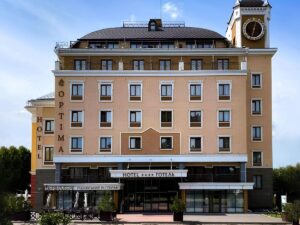
The Optima hotel chain is opening its fourth hotel in Zhytomyr, according to the operator’s press service.
It is specified that the “Zhytomyr by Optima” hotel will begin operations on June 1, 2026. It is located on the fifth through eighth floors of the renovated “Zhytomyr” business center at 6 Pobedy Square. The hotel has 105 rooms.
The four lower floors of the business center are designated for offices, with a total area of 4,000 square meters. In addition to offices ranging from 17 to 36 square meters, the complex includes conference spaces with a total area of over 500 square meters.
The Optima Hotels & Resorts chain comprises more than 60 hotels in Ukraine. Until 2023, the chain operated under the Reikartz Hotels & Resorts brand; since 2020, with the help of Turkish shareholders, it has also opened hotels in Kazakhstan, Georgia, and Uzbekistan. In the summer of 2023, Turkish shareholders acquired the Reikartz brand from the Ukrainian company to develop it in Turkey and Central Asia. In Ukraine, the hotel chain was rebranded in 2023 under the new name Optima Hotels & Resorts.
Optima Hotel Management LLC was established in 2008. According to Opendatabot, the company’s shareholders are Vladimir Kashutin (Lviv, 99.9%) and Andrey Dema (Kyiv, 0.1%). Kashutin is listed as the ultimate beneficiary. However, until 2019, the beneficiaries were listed as Russian citizens Yuri Vasin, Leonid Lavrentiev, and Timur Rodionov.
According to the financial results for 2025, the company’s net loss amounted to 40,097,000 UAH, compared to a net loss of 847,000 UAH in 2024. Meanwhile, revenue grew by 55.45% to 809.36 million UAH.
According to a survey conducted in March 2026 by the research firm Active Group in collaboration with the Experts Club information and analytical center, perceptions of Thailand within Ukrainian society are characterized by a high degree of neutrality and a moderately positive overall balance. The share of positive assessments stands at 29.2%, forming the basis of a cautiously favorable attitude; however, the dominant category is neutral responses—62.7%.
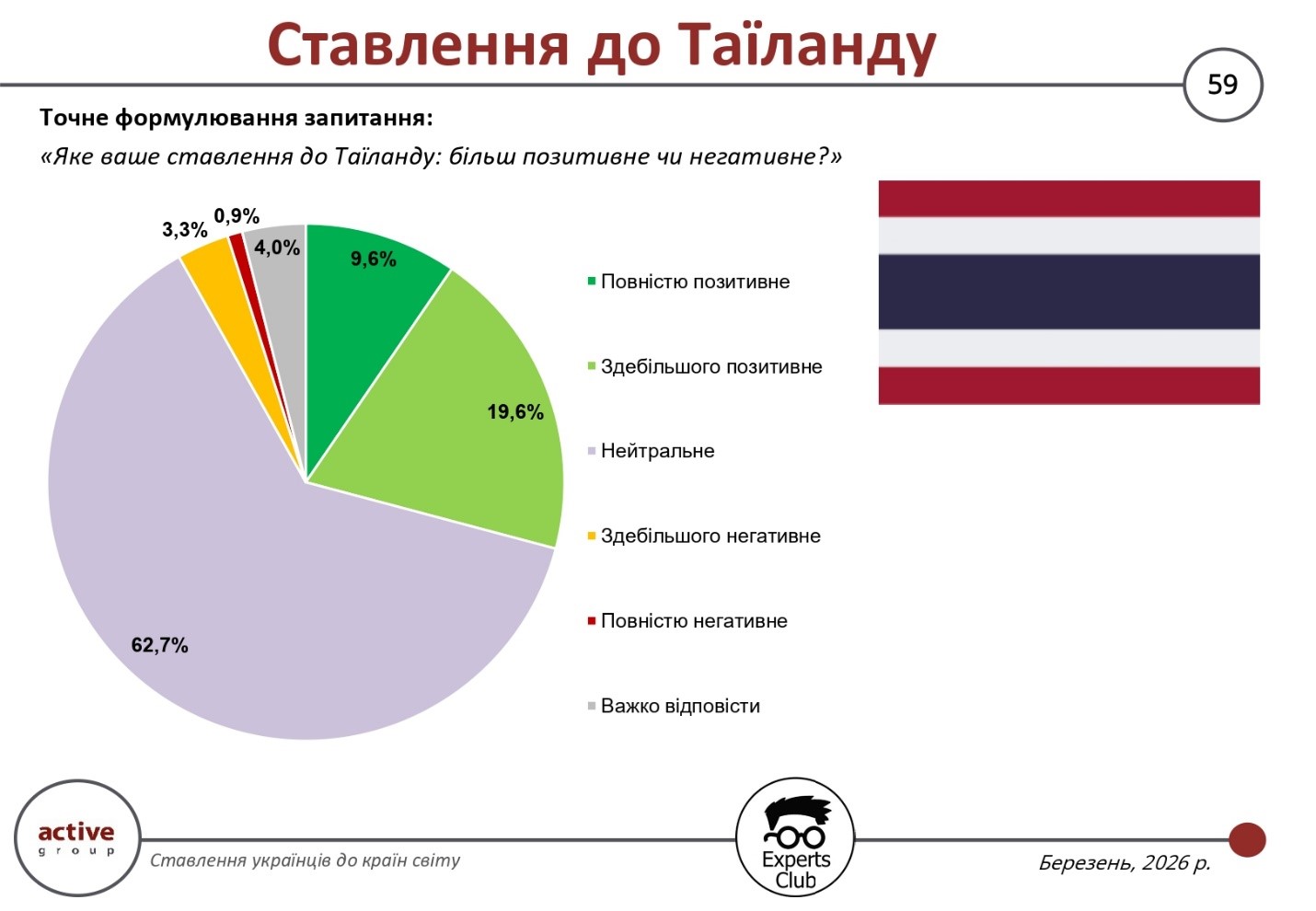
The structure of positive perceptions demonstrates that emotional engagement with Thailand is limited. Only 9.6% of respondents expressed a “completely positive” attitude, while 19.6% chose the “mostly positive” option. This indicates the presence of a generally positive backdrop, which, however, lacks a deep or lasting emotional foundation.
The key feature is the dominance of neutrality. The 62.7% figure means that for most Ukrainians, Thailand remains a country without a clearly formed image. This situation is typically associated with limited information exchange, a lack of active political or economic interaction, and the country’s weak presence in the Ukrainian media landscape.
Negative assessments are minimal—only 4.2% overall. Of these, 3.3% represent a “mostly negative” attitude and 0.9% a “completely negative” one. This indicates the absence of systemic factors shaping a negative image of the country and confirms the generally neutral-positive nature of perceptions.
Another 4.0% of respondents were undecided. Combined with the high proportion of neutral responses, this creates a significant segment of the audience that is sensitive to informational influences and potentially open to a change in attitude.
In summary, Thailand appears in the perception of Ukrainians as a country without a clearly defined emotional profile: with a low level of negativity, moderate positivity, and a dominant neutrality. This means that the country’s image in Ukraine is more of a “blank slate” that can change depending on the intensity of communication, cultural presence, and the development of bilateral contacts.
According to a study conducted by the Experts Club information and analytical center based on data from the State Customs Service, Thailand ranks 47th in total trade volume with Ukraine, which amounts to $368.4 million. At the same time, imports from Thailand exceed exports of Ukrainian goods by more than five times, resulting in a negative bilateral trade balance of $250.6 million.
The study was presented at the Interfax-Ukraine press center; the video can be viewed on the agency’s YouTube channel. The full version of the study can be found at this link on the Experts Club analytical center’s website.
ACTIVE GROUP, EXPERTS CLUB, Pozniy, SOCIOLOGY, SURVEY, THAILAND, UKRAINE, URAKIN
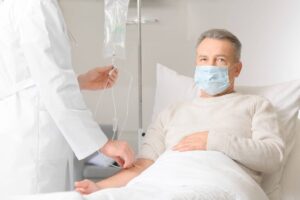
The first Ukrainian patients have begun treatment for prostate cancer with an innovative Bayer drug, which was approved in September 2025.
As the company told the “Interfax-Ukraine” news agency, the drug is currently available to patients. Its efficacy and safety profile have been confirmed by international clinical trials.
Prostate cancer remains one of the most common cancers among men.
As reported, Bayer forecasts growth in its pharmaceutical business starting in 2027, with an increase in operating margin to 30% by 2030. Additionally, the company plans to develop five key therapeutic areas, including cardiology—specifically secondary stroke prevention—comprehensive treatment of chronic kidney disease, oncology—including treatment of metastatic hormone-sensitive prostate cancer—women’s health, and menopause symptom management.
The international company Bayer operates in the healthcare and agriculture sectors. In fiscal year 2025, the Bayer Group employed over 88,000 people, and sales exceeded EUR 45.6 billion. R&D expenditures, excluding special items, reached over EUR 5.8 billion.
Bayer Ukraine is part of the global Bayer AG group, headquartered in Leverkusen, Germany. The company has been operating in Ukraine since 1992. It is represented by the following divisions: Pharmaceuticals, Consumer Health, and Agriculture.



