

Using artificial intelligence to manage building systems can reduce their overall energy consumption by 22% compared to traditional control systems, according to the results of a new study by Schneider Electric.
The company presented the study, “AI for Climate: Quantifying the Energy and Carbon Impact of Building Optimization,” on September 21 as part of Climate Week NYC 2026. Its findings show that artificial intelligence can use existing data on building operations to automatically manage energy consumption and reduce operating costs.
In particular, using artificial intelligence to optimize heating, ventilation, and air conditioning (HVAC) systems through an intelligent building management system delivers additional energy savings ranging from 7.2% to 12.7%.
In some simulated scenarios, total energy savings exceeded 200 MWh per year per building, and emissions reductions reached nearly 60 metric tons of CO₂ equivalent. According to Schneider Electric’s calculations, the volume of emissions avoided was more than 100 times greater than the carbon footprint of the AI system itself.
Based on current commercial rates in the markets used in the study, the potential cost savings ranged from $13,600 to $49,300 per year per building. The specific financial impact depends on the country, energy costs, building type, climatic conditions, and the existing management system.
The study was conducted using building energy modeling, with the results validated through real-world pilot projects. The analysis covered various operational scenarios for facilities in the United States, Australia, and India.
Artificial intelligence analyzes several types of information simultaneously—actual occupancy levels, weather forecasts, equipment status and performance, and other operational metrics. Based on this data, algorithms can adjust the operation of heating, ventilation, and air conditioning systems in real time.
“The future of building management will be determined by how effectively organizations can integrate and utilize data that was previously stored in siloed systems. The level of artificial intelligence integrated into existing business systems is capable of transforming complexity into intelligence, and intelligence into action, while simultaneously reducing emissions, cutting costs, and increasing efficiency,” said Pankaj Sharma, Executive Vice President of Software and Services at Schneider Electric.
A key finding of the study was the potential effectiveness of AI not only for large commercial complexes. Schneider Electric notes that buildings with an area of less than 100,000 square feet—or about 9,300 square meters—can also benefit significantly.
Previously, the implementation of complex energy management systems in relatively small facilities was often limited by cost and the need to maintain specialized staff. The use of AI allows for the automation of certain processes and makes intelligent energy management accessible to a wider range of facilities.
For Ukraine, improving the energy efficiency of buildings is particularly important due to damage to the energy infrastructure and the need to simultaneously rebuild the residential, commercial, and public building stock.
“For Ukraine, the issue of energy efficiency today is no longer just a matter of electricity costs or decarbonization. It is a matter of sustainable development. Every kilowatt-hour that a building can avoid consuming without compromising conditions for its occupants reduces the load on the energy system. Artificial intelligence makes it possible to move from simply tracking consumption to actively managing it—taking into account building occupancy, weather, and equipment operating modes to automatically select the most efficient scenario,” said Mykhailo Bubnov, CEO of Schneider Electric Ukraine.
According to him, this approach may be particularly promising for facilities with high and relatively complex energy consumption.
“In Ukraine, we see great potential in hospitals, universities, administrative and office buildings, shopping centers, hotels, and industrial facilities. But even more important is the ability to immediately implement modern management systems during renovations and new construction. If we incorporate digital infrastructure and energy efficiency right from the design stage, we can create buildings that consume less energy from the outset and are better able to adapt to changes in load and operating conditions,” emphasized Bubnov.
According to Schneider Electric Ukraine, the widespread adoption of smart building management systems has the potential to benefit more than just individual property owners. Reducing and more flexibly managing energy consumption across a large number of facilities can alleviate the strain on the power grid during periods of peak demand.
However, the results of international studies cannot be automatically applied to every Ukrainian facility. The actual savings potential depends on the condition of the building, its engineering systems, operating mode, climatic conditions, and the degree of automation.
The company notes that when restoring damaged facilities, it is advisable to implement digital management systems as early as the design phase. In this case, energy efficiency becomes an integral part of the building’s engineering infrastructure from the moment it is commissioned, rather than a separate, subsequent modernization.
Schneider Electric operates in the fields of energy technologies, electrification, automation, and digitalization of buildings, industry, data centers, infrastructure, and power grids. The company operates in over 100 countries worldwide.
artificial intelligence, BUILDING, ENERGY EFFICIENCY, Schneider Electric, UKRAINE, Бубнов

According to the Serbian business media outlet Parametar, the Ukrainian chain of frozen prepared foods stores, Multi Cook, has launched operations in Serbia. The first store opened in Belgrade at Dunavska 2.
The chain’s founder, Volodymyr Matviychuk, announced the entry into the Serbian market.
“Serbia is our newest country on the Multi Cook map. Today, Multi Cook is much more than just a franchise. It is a global Ukrainian product,” the entrepreneur wrote.
The Multi Cook product line features frozen, home-style semi-prepared foods: varenyky, pelmeni, pancakes, syrniki, cutlets, stuffed cabbage rolls, and other ready-to-cook dishes.
Multi Cook was launched in 2022 and is linked to the history of the well-known Ukrainian chain “Galya Baluvana.” It was founded in Lutsk in 2018. Later, the co-owners began developing international projects independently: Matviychuk focused on Multi Cook, while Alla and Oleksandr Teliga focused on the Wesoła Pani brand.
In 2025, Matviychuk announced his departure from the “Galya Baluvana” brand and the further development of his own brands: Multi Cook, GABAR, and MultiBar.
Currently, Multi Cook has over 270 stores in Europe, the U.S., Canada, the U.K., and other countries. Some locations operate under the MultiBar brand—in this format, customers can not only purchase products but also order ready-to-eat meals.
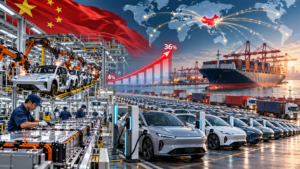
Over the past 25 years, China has increased its share of global automobile production approximately ninefold—from 4% in 2000 to 36% in 2025—transforming itself from a relatively small manufacturer into the world’s largest automotive hub. This was reported by the Experts Club information and analytical center, citing a study by the consulting firm Strategy Partners.
According to analysts’ estimates, around 2 million vehicles were produced in China in 2000, while by 2025 production exceeded 34 million vehicles per year. Thus, over a quarter of a century, the volume of Chinese automobile production increased approximately 17-fold.
China’s position strengthened particularly rapidly after 2010. The country not only formed the world’s largest domestic automobile market, but also created a large-scale manufacturing base covering virtually the entire value chain — from components and batteries to vehicle manufacturing and software.
One of the main factors behind the further growth of China’s automotive industry was the transition to electric vehicles and hybrid models. Chinese manufacturers gained strong positions in the new energy vehicle segment — NEV, which includes fully electric vehicles and plug-in hybrids.
At the same time, Chinese companies are actively increasing their presence abroad. China has become the world’s largest automobile exporter, while local manufacturers are expanding sales and creating their own production capacities in Europe, Asia, Latin America and other regions.
As a result, the structure of the global automobile market has also changed. While in the early 2000s it was shaped primarily by manufacturers from the United States, Japan and Western Europe, by the mid-2020s China had become the industry’s largest individual manufacturing hub.
The growth of China’s automotive industry is accompanied by the strengthening of its own national brands. BYD, Geely, Chery, SAIC, Great Wall Motor and other manufacturers are increasingly competing with European, American, Japanese and South Korean automotive groups not only in China’s domestic market but also in export markets.
China’s own battery manufacturing base has become a significant competitive advantage. Chinese companies hold leading positions in the global production of traction batteries, while the country controls a significant share of global production chains related to raw material processing and the manufacture of components for electric vehicles.
According to Strategy Partners, the transformation of China’s automotive industry demonstrates the country’s transition from a model of catching-up industrial development to technological leadership in certain segments of the industry.
If current trends continue, competition between Chinese and traditional global automakers will increasingly shift into the areas of electric vehicles, battery technologies, software, autonomous driving and production costs.
auto industry, AUTOMOBILE, CHINA, Electric vehicle, PRODUCTION

A one-time check of a counterparty before concluding a contract does not make it possible to fully control commercial risks: a company’s financial condition, its owners, management and payment discipline may change already in the course of cooperation. Therefore, Ukrainian businesses should move from one-time checks to continuous monitoring of key partners.
International business information systems, including Dun & Bradstreet (D&B), make it possible not only to obtain information about a company before starting cooperation, but also to track changes in its profile.
According to Maksym Urakin, Director of Development and Marketing at Interfax-Ukraine and head of the D&B-Interfax-Ukraine business unit, monitoring is particularly important for companies to which a Ukrainian supplier regularly provides deferred payment terms or with which a significant volume of turnover is associated.
“A counterparty may have looked absolutely reliable at the time the contract was signed, but six months later the situation may be different. The company’s debt burden may increase, its owner or management may change, or its payment discipline may deteriorate. If the supplier learns about this only after an overdue payment, managing the risk becomes significantly more difficult,” Urakin noted.
International D&B databases are used to track changes in corporate data and assess business risks. Depending on the information available for a particular jurisdiction, a user can analyze changes in an enterprise’s financial condition, its corporate structure and other characteristics.
This approach is particularly relevant for companies with a large number of customers and suppliers. With hundreds or thousands of counterparties, regularly checking each of them manually is practically impossible.
“Businesses need to identify critically important partners. The greater a counterparty’s debt to the company, or the more strongly the supply chain depends on it, the higher the frequency and depth of monitoring should be,” Urakin believes.
A change in risk indicators does not necessarily require the immediate termination of cooperation. It may serve as a signal to revise the credit limit, shorten the payment deferral period, request additional collateral or conduct a more in-depth check.
A separate area is supplier monitoring. Financial problems at a raw-material producer, carrier or another critically important partner can lead to a halt in supplies even when the Ukrainian company’s own financial position remains stable.
According to Experts Club, Ukrainian enterprises should divide counterparties at least according to their level of financial significance and the potential damage from default or termination of supplies, while the most critical partners should be monitored continuously.
“In a modern risk management system, the question should be not only ‘whom did we check before concluding the contract,’ but also ‘what has changed with our largest counterparties since the check.’ It is monitoring that makes it possible to identify a problem before it turns into a direct financial loss,” Urakin emphasized.
Dun & Bradstreet is an international provider of business data and analytical solutions whose history began in 1841. The company provides tools for business identification, counterparty checks, assessment of credit and commercial risks, compliance, supply chain management and work with corporate data.
The official representative of Dun & Bradstreet in Ukraine is the Interfax-Ukraine news agency. The specialized D&B-Interfax-Ukraine unit helps Ukrainian companies work with international business data, check foreign partners and obtain a D-U-N-S Number.

Ukrainian President Volodymyr Zelenskyy held a conversation with Polish Prime Minister Donald Tusk.
“I informed the prime minister about preparations for possible trilateral meetings at the technical level between Ukraine, the United States, and Russia. There are no obstacles on our part, but it is important that the American side prepare on its end and ensure the Russian side’s readiness,” Zelenskyy wrote on his Telegram channel.
The parties also discussed preparations for the Ukrainian power grid ahead of winter and other sensitive issues.
“Not everything can be discussed in detail over the phone—we agreed to meet in person in the near future. I am grateful to Donald and Poland for their support. Only by joining forces across Europe can we stop Russia and prevent this insane war from continuing,” the president concluded.

According to Experts.news, the European Commission has proposed new rules for the recognition of professional qualifications, which are expected to significantly simplify the process of finding employment in the EU for professionals with degrees obtained outside the European Union, particularly in Ukraine.
The changes are part of the Fair Labor Mobility Package, presented on September 15, 2026, which aims to increase worker mobility and reduce the shortage of skilled workers in EU countries.
One of the key innovations is the introduction of uniform rules for third-country nationals and EU citizens who have obtained professional qualifications outside the European Union. Currently, such professionals must go through procedures in accordance with the national rules of a specific EU country.
The European Commission proposes setting clear deadlines for processing documents, digitizing procedures, and creating a single European access point available in all EU languages. New and recently obtained qualifications are planned to be issued in a standardized digital format with the option to store them in the European Digital Identity Wallet.
A separate, free Europass tool will allow employers to compare qualifications obtained in different countries.
The proposed directive on the recognition of third-country nationals’ qualifications may be of particular importance to Ukrainians. It is intended to make procedures for such professionals faster and more transparent, regardless of where the qualification was obtained.
For seven regulated professions for which common minimum training standards already exist in the EU, the proposal provides for the automatic recognition of diplomas issued by educational institutions outside the EU, provided these institutions are accredited by European quality assurance bodies.
These professions include doctors, nurses, dentists, midwives, pharmacists, veterinarians, and architects.
However, automatic recognition will not apply to just any foreign diploma: the curriculum and the institution must meet established European requirements.
The European Commission also plans to shorten the timeframes for professional recognition. Under the new system, the procedure should take no more than 11 weeks, and for the automatic recognition of regulated professions, up to five weeks.
At the same time, simplified diploma recognition will not, in and of itself, grant the right to enter or reside in the EU. Member states will retain control over immigration rules and requirements for admitting foreigners to professional practice.
The package also provides for the creation of a European Social Security Pass, the strengthening of the European Labor Authority, and the wider use of digital documents when workers move between EU countries.
According to the European Commission’s estimates, once fully implemented, the reform could generate an economic impact of approximately €5 billion by 2040 by streamlining procedures, reducing administrative costs, and combating fraud.
The proposals still need to go through the EU legislative process. Simplified recognition of qualifications obtained outside the European Union is planned to be introduced within two years after the adoption of the relevant legislation, while digital qualifications and simplified procedures for regulated professions are to be implemented within three years.
For Ukraine, these changes are potentially of particular significance due to the large number of Ukrainian citizens currently living and working in EU countries. The difficulty of verifying education and professional qualifications remains one of the barriers to migrants finding employment in their field of expertise.



