

According to the Relocation project, Greece has proposed discontinuing the granting of residence permits to foreign investors for the purchase of real estate and refocusing the “Golden Visa” program on direct investments in the country’s economy.
This initiative was put forward by Nikos Androulakis, leader of the main opposition party PASOK, amid the ongoing housing crisis. Androulakis believes that the current model effectively encourages the sale of Greek real estate to foreign investors and further impacts housing affordability for the local population.
However, PASOK’s proposal does not call for Greece to completely stop granting residence permits in exchange for investment. The party proposes removing real estate from the list of assets eligible for a “Golden Visa” and redirecting foreign capital toward investment instruments that promote economic growth.
For now, this is solely a political initiative by the opposition. PASOK holds 34 seats in Greece’s 300-seat parliament, so the proposal does not automatically mean a change to the current program.
Currently, the minimum real estate investment required to obtain a Greek Golden Visa depends on the region and the type of property.
In Attica, Thessaloniki, Mykonos, and Santorini, as well as on islands with a population of over 3,100, the minimum threshold is 800,000 euros. In most other regions of the country, it is set at 400,000 euros.
A reduced threshold of 250,000 euros applies to certain categories of properties, including real estate being converted from commercial to residential use and certain buildings requiring restoration. For standard investments of 400,000 euros and 800,000 euros, there is a requirement to purchase a single property with an area of at least 120 square meters.
Greek authorities have tightened the conditions of the Golden Visa program several times in recent years amid rising housing costs. In addition to raising the minimum investment thresholds, real estate purchased under the program can no longer be used for short-term rentals.
The stricter rules have already affected demand. According to the Greek Ministry of Migration and Asylum, in the first half of 2026, foreign investors submitted 2,551 new applications for the Golden Visa—44% fewer than the 4,553 applications filed during the same period in 2025.
At the end of the first half of the year, there were 32,702 active investor residence permits in Greece, issued under the program since its launch. Another 7,368 applications from previous periods remained pending.
The decline in interest in the Golden Visa has not yet led to an overall drop in foreign investment in Greek real estate. In the first quarter of 2026, the inflow of foreign capital into the real estate market reached 511.6 million euros, an increase of 43.4% compared to 356.8 million euros a year earlier. This indicates that demand for Greek properties among foreigners remains strong even without the incentive of obtaining a residence permit.
Between 2019 and 2025, foreign investors poured approximately €12.4 billion into Greek real estate. In 2025, the volume of foreign investment totaled €2.05 billion, compared to €2.75 billion in 2024.
The Golden Visa program has been in effect in Greece since 2014 and allows citizens of non-EU countries to obtain a five-year renewable residence permit provided they meet the investment requirements. The question of the future role of real estate in this program takes on particular significance against the backdrop of rising housing costs and the government’s efforts to increase the supply of properties available for long-term rent.
https://relocation.com.ua/greece-proposes-to-exclude-real-estate-from-the-golden-visa-program/
golden visa, GREECE, INVESTMENTS, REAL ESTATE, RESIDENCE PERMIT

JSC “Ukrzaliznytsia” has launched 18 additional Kyiv City Express shuttle trips between the capital’s left and right banks, the company’s press service reported.
“From October 5 to 9, we are scheduling 18 additional Kyiv City Express shuttle trips on the Vydubychi–Darnitsa–Vydubychi route so that you can quickly and without traffic jams get to work, run errands, or return home amid the difficult traffic conditions on Kyiv’s bridges,” the Telegram message states.
As noted, the 18 shuttle trips will run during the morning and evening rush hours: from 6:00 a.m. to 9:00 a.m. and from 4:00 p.m. to 9:00 p.m. At the Vydubychi station, boarding and alighting will take place on three tracks. At the Darnytsia station, boarding and alighting will take place on one or two tracks (please listen carefully to station announcements). Additional trips will stop at the Bereznyaky station.
“In addition to the KSE shuttle trains, for trips between the right and left banks, you can use scheduled commuter and regional trains running to and from Nizhyn, Hrebinka, Konotop, and Slavutych. They make mandatory stops at the Vydubychi and Darnytsia stations, and commuter trains will also stop at the Bereznyaky station,” added Ukrzaliznytsia.
It is explained that thanks to the combination of additional shuttle services and scheduled trains with Kyiv City Express (KSE) trains, up to six trips will run between the two banks during peak hours, so passengers won’t have to wait long for the next train.
The company noted that tickets are available with just a few clicks in the UZ app.
KYIV, KYIV CITY EXPRESS, RAILROAD, TRANSPORTATION, UKRZALIZNYTSIA

According to Experts.news, gasoline imports to Ukraine in September 2026 totaled 145,000 metric tons, which is 5% less than in August but 3% higher than in September of last year, the A-95 Consulting Group reported based on the results of a special study.
From January through September, Ukraine imported 1.26 million metric tons of gasoline—15% more than during the same period in 2025.
“The decline in gasoline supplies in September occurred against the backdrop of a seasonal drop in consumption. Demand was also weighed down by this year’s record-high retail prices, which prompted car owners to conserve fuel,” the A-95 Consulting Group reported.
Lithuania remained the largest source of gasoline supplies in September, accounting for 46,400 metric tons, or 32% of the total volume. Compared to August, supplies fell by 10.4%.
Poland ranked second with 36,800 metric tons, or 25% of Ukraine’s imports. A month earlier, 40,100 metric tons were supplied from that country.
Thus, the combined share of Lithuania and Poland in September fell from 60% to 57%. Supplies from the largest supplier—the ORLEN Group—from these two countries decreased from 78,800 to 67,800 metric tons. Despite the decline, ORLEN accounted for about 47% of all Ukrainian gasoline imports.
At the same time, the geography of supplies changed. Imports from Germany fell by 25% compared to August—to 13,600 metric tons. Of this volume, 8,300 metric tons, or 61%, were imported by the UPG network.
At the same time, the share of southern supplies increased. Gasoline shipments from Romania rose by 29%—from 23.4 thousand to 30.1 thousand metric tons. As a result, Romania moved into third place among supplier countries and accounted for over 20% of September’s imports.
Supplies from Greece, on the other hand, fell by 28%—from 15,000 to 10,800 metric tons. Imports from Moldova more than doubled—from 1,900 to 4,100 metric tons.
Thus, despite the decline in total imports in September, shipments remain higher than last year’s level, and in the first nine months of 2026, Ukraine imported 15% more gasoline than in the same period a year earlier.
Source: A-95 Consulting Group.

The “Podorozhnik” pharmacy chain (Lviv) has topped the ranking of the country’s pharmacy chains by number of locations and sales.
According to the publication “Apteka,” second in the ranking of the largest chains by number of locations is the “Apteka 9-1-1” chain (Kharkiv), which operates under the “9-1-1” and “Apteka Wholesale Prices” brands; in third place is “Apteka-Magnolia” LLC (Zaporizhzhia), known for the brands ANC, “Kopiyka,” “Shara,” and “Blagodiya”; in fourth place is “Sirius-95” LLC (Kyiv), which operates under the “We Wish You Health” brand; in fifth place is “Pharmastor” LLC (Kyiv, “Good Day Pharmacy”).
In terms of sales volume, “Apteka-Magnolia” ranks second in the top 5, third place goes to the “Apteka 9-1-1” chain, and fourth and fifth places are held by “Sirius-95” and “Farmastor” (“Bazhaemo Zdorov’ya” and “Apteka Dobrogo Dnya”).
The publication does not report the number of retail locations, but media outlets cite varying numbers depending on the calculation method.
As the “Podorozhnik” chain clarified to the Interfax-Ukraine news agency, as of the end of August 2026, this pharmacy chain’s turnover reached 3.814 billion UAH, with approximately 2,400 retail locations.
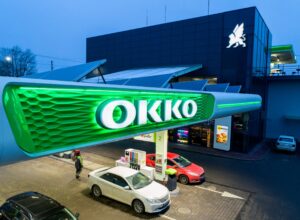
OKKO maintained its leadership among the largest importers of automotive gasoline into Ukraine, importing 51,000 metric tons of fuel in September 2026, according to data from a special study by the A-95 Consulting Group and calculations by the Experts Club analytical center.
Thus, OKKO accounted for about 35% of total gasoline imports in September, which amounted to 145,000 metric tons.
From January through September, the company imported 375,000 metric tons of gasoline—about 30% of the total volume of shipments to Ukraine since the beginning of the year, which reached 1.26 million metric tons.
Ukrnafta took second place among importers in September with a volume of 19,500 metric tons. WOG recorded virtually the same figure—19,000 metric tons.
UPG imported 15,900 metric tons of gasoline. Thus, the four largest companies—OKKO, Ukrnafta, WOG, and UPG—accounted for a total of 105,400 metric tons, or nearly 73% of all gasoline imports into the country for the month.
Next came BRSM-Nafta with 5,300 metric tons, Avantage with 3,400 metric tons, BVS and SOCAR with 2,600 metric tons each, KLO with 2,300 metric tons, and VST with 1,900 metric tons. Other companies collectively imported 21,300 metric tons.
In September, gasoline imports into Ukraine fell by 5% compared to August—to 145,000 metric tons. The A-95 Consulting Group attributes the decline in supplies to a seasonal drop in consumption and this year’s record-high retail gasoline prices, which encouraged drivers to conserve fuel.
At the same time, compared to September 2025, imports rose by 3%, and over the first nine months of this year—by 15%, to 1.26 million metric tons.
Source: “A-95” Consulting Group.

In September 2026, 1,457 new trucks and specialty vehicles were added to Ukraine’s fleet, which is 31% more than in September of last year, according to a report by “Ukravtoprom” on its Telegram channel.
Compared to August of this year, demand for these vehicles increased by 39%.
“This is a record monthly result for this market segment since January 2022,” the association noted.
Renault remains the market leader with 422 units, a 69% increase from a month ago.
Fiat took second place, increasing sales by 76% compared to August 2026—to 118 units—while Mercedes-Benz came in third, with 114 registrations compared to 121 in August.
Next were Hyundai with 93 units and Volkswagen with 90 units (neither was among the top five in August).
As previously reported, in September of last year, the top five were Renault, Ford, Citroën, MAN, and Scania, with sales rising by 6% compared to September 2024—to 1,068 units.
According to data from “Ukravtoprom,” over the first nine months of 2026, the growth rate of sales of trucks and specialty vehicles accelerated to 17% compared to the same period last year, reaching 10,083 thousand new vehicles (for January–August, the sales growth rate was 14%).
As reported, citing data from “Ukravtoprom,” registrations of new trucks and specialty vehicles in 2025 fell by 5% compared to 2024—to nearly 12,300 vehicles.



