

According to Fixygen, participants in the National Depository of Ukraine (NDU) used a ranked voting system to determine the composition of the NDU Depository System Participants’ Council for the next two years, and the resulting composition was identical to the current council.
According to a statement by the National Depository on its website, 18 applications were submitted to participate in the election: 9 from depository institutions and 9 from issuers, and the 14 members elected to the council are the same individuals as two years ago.
Representing depository institutions on the Participants’ Council are Oleksandr Panchenko of Univer Capital LLC, who currently chairs the council; Ninel German of PUMB; Bogdana Yefremova from Raiffeisen Bank, Iryna Nesterenko from Injur Capital LLC, Oksana Danylyuk from VST Bank, Oleksandr Storozhuk from Smart Bond.UA LLC, and Olesya Pyatchanina from Citibank.
From issuers that are not depository institutions and asset management companies acting on behalf of corporate funds, the board includes Saad Shadi Muhammad from PJSC “Bakhmatske Beet Receiving Enterprise,” Serhiy Likhodid from the closed-end, non-diversified venture corporate investment fund (ZNVKIF) “Garant Capital,” managed by the asset management company “Trust Capital”; Serhiy Biryuk from “Yagotyn Butter Plant” LLC; Bohdan Lupiy from the PFTS Stock Exchange, Serhiy Rumpa from PJSC “Yuzhkokss,” Oksana Zaika from JSC “DTEK Zapadenenergo,” and Svitlana Yushchenko from JSC “Chernihivgaz Gas Distribution System Operator.”
It is noted that the first meeting of the newly elected body is scheduled for September 17. At that meeting, the chair of the council will be elected and the council’s future areas of focus will be determined.
The Participants’ Council is an advisory body established to protect and represent the interests of participants in the depository system. It consists of 14 members: seven representatives of depository institutions and seven representatives of issuers (other than depository institutions) and asset management companies acting on behalf of corporate investment funds.
Individuals nominated by participants in the depository system with whom they have an employment or contractual relationship may be elected to the Council with voting rights (one representative per legal entity). Members of other bodies of the Central Securities Depository, with the exception of the National Bank of Ukraine (NBU), may not serve on the Council.

According to Experts.news, in 2024 Ukraine ranked 35th in the world in terms of the number of patent applications filed, with 2,559 applications, while China remains the undisputed global leader with 1.828 million applications, according to an analysis of global patent activity prepared by Volodymyr Khaustov, scientific secretary of the State Institution “Institute of Economics and Forecasting of the National Academy of Sciences of Ukraine,” and published by the Experts Club Information and Analytical Center.
Ranking of Countries by Number of Patent Applications in 2024
Source: World Intellectual Property Organization (WIPO), World Intellectual Property Indicators, Table A60 “Patent applications by office and origin, 2024”; calculations and systematization are presented in a study by Volodymyr Khaustov and the Experts Club analytical center.

Paper and cardboard production by major enterprises in Ukraine’s pulp and paper industry in January–July 2026 fell by 2.9–3% compared to the same period in 2025, despite improved performance in July.
This is according to data from the UkrPapir association.
Paper production alone fell by 8.2% over the seven-month period, while cardboard production fell by 1.2%.
Production of corrugated cardboard boxes fell by 1.6%, while wallpaper production decreased by 6.3%.
At the same time, production of toilet paper rolls increased by 7% compared to January–July of last year.
Production of certain types of sanitary and hygiene products grew even faster. Production of 100% cellulose toilet paper rose by approximately 20.4% over the seven-month period, while production of paper towels in rolls increased by 9.5%.
Notebook production also showed positive growth. Over the seven-month period, it increased by 11%.
Meanwhile, the industry’s largest segment—cardboard and packaging materials—already shifted to significant growth in July. Cardboard output for the month increased by 11.2% year-over-year, including a 16% increase in containerboard.
The total monetary value of commercial output by companies in the industry for January–July increased by 19.3% compared to the same period in 2025.
Thus, while physical production volumes of paper and cardboard for the first seven months remain below last year’s levels, the industry’s revenue is growing significantly faster. At the same time, July statistics point to a recovery in the production of cardboard and certain categories of consumer paper products.
Among the largest enterprises providing statistics to the association are the Kyiv Cardboard and Paper Mill, the Trypillya Packaging Plant, the Kokhavyn Paper Mill, “VGP” (TM “Ruta”), “Poninkivska KPF-Ukraine,” and the Lviv-based “Cardboard and Paper Company.”
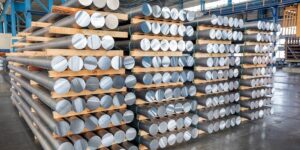
Primary aluminum production in the Gulf countries totaled 293,000 metric tons in July, down 44% from the same month in 2025, according to preliminary estimates by the International Aluminum Institute (IAI).
Production volumes continue to remain near their lowest level in more than fifteen years due to the impact of the military conflict in the Middle East on plant operations in the region. Two plants in the Gulf countries, which account for about 9% of global primary aluminum production capacity, were attacked by Iran in late March.
However, production has risen slightly from the local low of 274,000 metric tons recorded in April. In May, production totaled 281,000 metric tons, and in June, 276,000 metric tons, according to revised IAI data.
Emirates Global Aluminium reported in August that the resumption of operations at its Al-Tawil plant (Abu Dhabi) following an emergency shutdown in March is proceeding faster than expected. However, a return to previous production levels may not occur until early 2027 at the earliest. The plant, which has an annual capacity of 1.5 million metric tons, is currently operating at approximately 18% of capacity.
Global primary aluminum production in July fell by 1.7% year-over-year to 6.16 million metric tons. In particular, production in China rose by 2.7% to 3.866 million metric tons. In North America, the figure remained unchanged (330,000 metric tons); in Europe, it rose by 7.5% (to 643,000 metric tons); and in Asia, excluding China, it increased by 2.7% (to 422,000 metric tons).
For a more detailed overview of global aluminum production from 1970 to 2024, watch the video on the Experts Club YouTube channel.

In January–July 2026, Ukraine imported 28,300 metric tons of cheese, which is 24.7% more than during the same period last year, while exports of Ukrainian cheese rose by only 1.2%—to 8,200 metric tons.
This is according to data from the State Customs Service, cited by the Association of Milk Producers (AMP) in a publication dated August 26.
Thus, according to calculations based on AMM data, the physical volume of cheese imports was approximately 3.5 times greater than exports, and the difference between imports and exports reached about 20,100 metric tons.
The gap in monetary terms is even more pronounced. The value of cheese imports over the seven-month period totaled $168.8 million, an increase of 17.9%, while exports brought Ukraine $37.4 million, which is only 0.5% more than last year’s figure.
Thus, imports exceeded exports in monetary terms by approximately 4.5 times, and the trade deficit in cheese amounted to about $131.4 million.
The data provided by the APM also shows that the average estimated cost of imported cheese was about $6,000 per metric ton, while that of exported cheese was about $4,600 per metric ton.
At the same time, imports in physical terms are growing significantly faster than their value: the volume increased by 24.7%, while procurement costs rose by 17.9%. This indicates a decrease in the average calculated import value per metric ton by approximately 5% compared to January–July of last year.
For comparison: Ukraine’s total merchandise imports in January–July 2026 amounted to $58.1 billion, while exports totaled $24.1 billion, according to the State Customs Service.
Poland, Germany, and the Netherlands remain the main suppliers of cheese to the Ukrainian market, while Ukrainian products are mainly exported to Moldova, Kazakhstan, and Germany.
Original source: Association of Milk Producers, citing data from the State Customs Service.

In July 2026, Ukrainian pulp and paper companies increased paper and cardboard production by 5.2% compared to July of last year, reaching 55,300 metric tons, according to data from the UkrPapir association.
Compared to June of this year, production rose by 5.3%.
The main driver was cardboard production, which increased by 11.2% year-over-year to 43,560 metric tons. In particular, the output of packaging cardboard, including paper for corrugating, rose by 16% to 36,360 metric tons.
At the same time, paper production in July fell by 12.5% compared to July 2025, to 11,740 metric tons.
The bulk of this was base paper for sanitary and hygiene products—10,620 metric tons, which is 9.2% less than a year earlier. Production of writing and printing paper nearly halved, falling to 64 metric tons.
Production of corrugated cardboard boxes totaled 50.06 million square meters, which is 2.5% less than in July of last year.
Despite mixed trends in individual product categories, the industry continued to grow in monetary terms. The value of commercial output from enterprises that submitted data to the association reached 3.056 billion UAH in July, an increase of 28.8% year-over-year and 3.3% compared to June.
The “UkrPapir” statistics include, in particular, the Kyiv Cardboard and Paper Mill, the Trypillya Packaging Plant, the Kokhavyn Paper Mill, “VGP” (TM “Ruta”), “Poninkivska KPF-Ukraine,” and the Lviv-based “Cardboard and Paper Company.” The association does not publish figures for individual enterprises due to wartime risks.



