Issue No. 1 – August 2026
Analysis of the Current Situation in Ukraine’s Foreign Exchange Market
In the first half of August, the dollar exchange rate in Ukraine was influenced by the National Bank of Ukraine’s flexible exchange rate strategy, which involves participating in trading on the interbank foreign exchange market through foreign currency interventions. As a result, the exchange rate—which had been attempting to break through the 44.83 UAH/USD mark—returned to the level seen at the beginning of the month—44.70 UAH/USD—by the end of the second week of August. The cost of this exchange rate stability was $2.11 billion, which the NBU sold to importers through foreign exchange interventions in the first half of August. This is nearly equivalent to the amount of foreign currency sold by the NBU during the last two weeks of July ($2.15 billion). Demand for foreign currency in August remains high, and the NBU is the market’s primary market maker. There is absolute stability in this regard. Thanks to the National Bank’s active participation in trading, the exchange rate remains virtually unchanged.
One of the main problems affecting the country’s economy and foreign exchange earnings is the difficult situation regarding the transport of Ukrainian goods by sea. In July and early August, Russia carried out more than 70 attacks on Ukraine’s port infrastructure and 62 strikes on ships. This effectively halted agricultural exports, which fell by 75% year-over-year in the first two weeks of August. In the long term, the halt in agricultural exports threatens to lead to a buildup of grain in warehouses, as well as multimillion losses for agricultural companies. However, this is unlikely to affect exchange rate fluctuations, as the National Bank continues to keep the situation fully under control.
Global Context
Global capital markets are awaiting the September meeting of the Federal Reserve Committee, where a decision to change the benchmark interest rate could be made on September 16. However, there is currently no certainty regarding this. Analysts even predict that the Fed may leave rates unchanged in September, as recently published data showed a decline in U.S. inflation for the second consecutive month. The U.S. Consumer Price Index rose 3.4% year-over-year in July, compared to 3.5% in June. This was reported by the Bureau of Labor Statistics. However, there remains some chance of a rate hike—some financial experts have already expressed the view that the central bank should raise rates by the end of 2026 to bring inflation, which exceeds the 2% target, under control.
Meanwhile, tensions are rising in the Middle East, and oil prices are highly volatile: on August 17, Brent crude reached $88.44 per barrel. As before, oil prices are being influenced by the situation in the Strait of Hormuz. Last week, Iran stated that it had no intention of lifting its blockade of the strait following remarks by U.S. President Donald Trump regarding the possibility of establishing control over this strategic waterway.
The EUR/USD pair has been trending toward a weaker dollar in August—as of August 17, the exchange rate stands at $1.1594 per euro, whereas the month began at $1.1485 per euro.
Domestic Ukrainian Context
The domestic foreign exchange market has seen high demand for foreign currency in August. While the NBU sold $4.1 billion through interventions over the four weeks of July, the volume of currency sold exceeded $2.11 billion in the first two weeks of August.
International reserves are currently at a high level, which is important for macrofinancial stability and, of course, for the NBU’s ability to meet demand for foreign currency. According to the regulator, international reserves stood at $51.2 billion at the beginning of August; in July, they decreased by 0.1%. The NBU explained that this trend is due to the National Bank’s foreign exchange interventions and the country’s debt payments in foreign currency: these transactions slightly exceeded inflows from international partners, the issuance of foreign currency bonds, and the conversion into hryvnia of funds received under the Ukraine Support Loan program. According to the NBU’s balance sheet data, in July the bank sold $4.76 billion on the foreign exchange market and purchased $1.8 million.
In August, the NBU announced a major package of easing measures for foreign exchange restrictions on individuals, which took effect on August 11. Among the key changes is an increase in the limit on non-cash foreign currency purchases by individuals from 50,000 UAH to 200,000 UAH per month. The daily limit on cash withdrawals by individuals from foreign currency accounts in Ukraine and abroad is also being raised from 100,000 UAH to 200,000 UAH. In addition, the NBU has expanded Ukrainians’ ability to pay for goods, work, and services abroad using hryvnia accounts. The National Bank expects that the new package of foreign exchange liberalizations will generate only moderate additional demand for foreign currency, which will be insignificant relative to the size of the foreign exchange market.
Meanwhile, Ukraine continues to receive international financial support, and at the end of July, it was announced that the EU would provide a tranche of 3.47 billion euros as part of the Ukraine Support Loan. These funds are intended to finance Ukraine’s defense needs, specifically for missiles, air defense systems, fighter jets, and drones. As for the IMF loan, the volume of disbursements and the frequency of tranches depend on compliance with the conditions of the EFF program. Two more reviews of the program’s implementation with the IMF are scheduled for 2026—in September and December. If all conditions are met on time, Ukraine will be able to secure over $2.4 billion from the Fund.
Among the pressing economic challenges facing the country as it confronts Russian aggression is exports. As a result of Russian strikes on port infrastructure, maritime shipments have nearly ground to a halt, and the Ministry of Agriculture reports that losses in the agricultural sector could reach $3 billion this year. Meanwhile, the government has already lowered the minimum export prices for certain types of agricultural products to prevent a halt in exports of grains and oilseeds. However, negative trends are not limited to the agricultural sector, as the enemy is targeting major logistics hubs, which is disrupting food supplies to supermarket chains; moreover, rerouting logistics routes could lead to increased costs for producers and retailers. All of this points to a possible rapid rise in food prices, particularly for dairy products, vegetables, and fruits. As a reminder, in July 2026, inflation accelerated to 7.7% year-over-year, while prices in Ukraine rose by 0.3% month-over-month.
U.S. Dollar Exchange Rate: Trends and Analysis
Devaluation expectations have not disappeared, but in August the exchange rate remains under the full control of the NBU; consequently, temporary stability is ensured by the regulator fulfilling importers’ orders on the interbank foreign exchange market. In early August, the official exchange rate stood at 44.64 UAH per dollar, and on August 17, the NBU’s exchange rate reached 44.70 UAH per dollar. On the interbank market in mid-August, trading took place at a rate of 44.70–44.78 UAH/USD. In the cash market, the exchange rate changed only slightly: in mid-August, at banks and currency exchange offices, the buying rate ranged from 44.30 to 44.55 UAH/USD, and the selling rate ranged from 44.90 to 45.10 UAH/USD. Spreads narrowed in August to 0.4–0.6 UAH/USD.
Key influencing factors:
• Rising demand for foreign currency is offset by an increase in the volume of foreign exchange interventions by the NBU. The National Bank acts as the main seller of foreign currency and, through its supply of foreign currency, prevents the hryvnia from further devaluation.
• International factors: The protracted conflict in the Middle East is leading to erratic fluctuations in the oil market and rising prices for petroleum products. U.S. President Donald Trump stated that he intends to declare the Strait of Hormuz U.S. territory.
Tehran has emphasized that the strait will be closed or opened solely at Iran’s discretion.
• The hryvnia has strengthened on Ukraine’s cash foreign exchange market. In mid-July, the selling rate for the dollar at bank teller windows and currency exchange offices remains within the range of 44.90–45.10 UAH/USD.
• Market expectations: The main focus is on the Federal Reserve’s September meeting, when a decision to raise the benchmark interest rate is possible. However, recent inflation reports indicate a slowdown in the pace of price growth, which could well influence the Committee’s decision to leave the rate unchanged. In Ukraine, the authorities are focused on ensuring the country’s defense and thoroughly preparing for winter. The government’s main priority is protecting critical infrastructure and building up reserve stocks of fuel and equipment needed for the rapid restoration of damaged facilities.
Forecast
• Short term (1–2 weeks): base range of 44.80–45.10 UAH/USD; the NBU will attempt to keep the exchange rate within the range of 44.70–44.85 UAH/USD through interventions.
• Medium term (2–3 months): 44.95–45.30 UAH/$. The Federal Reserve’s September decision on the federal funds rate and clear signals of an impending peace in the Middle East may, in the long run, contribute to the strengthening of the dollar on the international stage. In Ukraine, the dollar will also strengthen.
• Long term (6+ months): In the baseline scenario, the depreciation trend remains the main factor, and the exchange rate could range between 45.40–46.20 UAH/USD by the end of the year. Key factors influencing the exchange rate will continue to include the volume of international reserves, new multimillion-dollar inflows of financial aid from partners, and the fulfillment of the state budget revenue plan; the situation in the energy sector and the level of protection of critical infrastructure facilities against destruction resulting from massive attacks by the Russian Armed Forces will also play a role.
Euro Exchange Rate: Trends and Analysis
Throughout July, the euro strengthened on the domestic market against the backdrop of the international market, where the dollar was weakening while the euro was gaining ground. The official euro exchange rate in Ukraine stood at 51.27 UAH/euro in early August and reached 51.71 UAH/euro by August 17. On Ukraine’s cash market, the euro has been strengthening throughout August. On August 17, the buying rate ranged from 51.05 to 51.65 UAH/euro, while the selling rate ranged from 51.85 to 52.15 UAH/euro. The spreads between the buying and selling rates for the euro widened in August and ranged from 0.45 UAH/euro to 1 UAH/euro.
Key influencing factors:
• On the international market, the euro is strengthening against the backdrop of a weaker dollar. Currency quotes are influenced by factors such as expectations of a Fed rate hike in September and rising tensions in the Middle East.
• The ECB may raise rates in September. The basis for such a decision will be rising prices in the EU: inflation in the eurozone rose to 2.9% in July.
• After a prolonged period of stability, the euro exchange rate in Ukraine began to rise sharply in August. There is no frenzied demand for the euro, and banks and currency exchange offices have sufficient cash reserves to meet demand.
Forecast:
• Short term (2–4 weeks): On the Ukrainian market, the euro may remain within the range of 51.80–52.45 UAH/€.
• Medium term (2–4 months): if the euro continues to strengthen on the international market, the exchange rate in Ukraine will reach the range of 52.20–52.90 UAH/€.
• Long term (6+ months): By the end of the year, the euro exchange rate may be within the range of 52.50–53.60 UAH/€. The main factors influencing the euro exchange rate remain unchanged: the U.S. Federal Reserve’s decision on the benchmark interest rate, the ECB’s decision on interest rate changes, the inflation rate in the EU, oil prices, and developments in the conflict in the Middle East.
Recommendations for Businesses and Investors
The dollar is losing ground against the euro on the international market. The downward trend in the U.S. currency is driven by investors’ expectations of a benchmark rate hike in September, as well as the escalation of the conflict between the U.S. and Iran. A further decline in the dollar’s exchange rate could help slow the hryvnia’s depreciation.
The Fed may adjust key interest rates. A rate hike as early as September could support the dollar in the global market, as the value of Treasury bonds will rise, which is likely to increase demand for U.S. securities, boosting the dollar.
Focus on liquid currencies. Global geopolitics is causing currency rates to fluctuate, but the dollar and the euro remain the base currencies for investors when formulating an effective currency strategy.
A war in Iran can no longer shake the dollar’s position. The acute phase of the conflict in the Middle East is not a reason to abandon investments in dollars.
Buying dollars is a timely and profitable strategy. While the domestic market is experiencing temporary, fragile stability, it makes sense to invest in the U.S. currency as part of both medium- and long-term currency strategies.
Currency savings aren’t limited to cash.
The National Bank of Ukraine’s (NBU) increase, effective August 11, of the permitted limit for purchasing non-cash foreign currency to 200,000 UAH allows investors to increase their holdings in foreign currency accounts at banks. However, cash savings will remain the key component.
Investments in precious metals and stocks are possible, but they will not be the main focus of a foreign exchange strategy. As of August 11, the NBU has allowed the unimpeded transfer of 200,000 UAH from a bank account to non-cash bank metals and securities issued by foreign entities. However, such investments should constitute only a small portion of savings—within 15%—while the dollar and the euro should remain the core components of a foreign exchange strategy.
Safe investments—a guarantee of capital preservation. In various financial scenarios, it is important to identify stable sources of income and ensure the reliability of your asset allocations.
The euro is an important part of an investment portfolio. The euro’s appreciation to 51.70 UAH/EUR opens up new opportunities for investors: either to make a quick profit by selling a portion of their euro-denominated savings, or to purchase additional euros to expand their portfolio in this currency.
Keep an eye on decisions by the U.S. and EU central banks, as well as on inflation and labor market statistics in the U.S. and EU. Since both the Fed and the ECB are preparing to consider rate hikes in September, key statistical data on inflation and employment levels in August will serve as the basis for regulators when making major decisions.
Diversification is the key to investment security. Investors should build currency portfolios across various currencies, and while the liquid U.S. dollar and euro remain the core holdings, it is advisable to periodically allocate a portion of funds to other reliable European currencies, including the British pound and the Swiss franc. It is also advisable to monitor Poland’s economic forecasts to consider potentially converting 5% of your savings into Polish zlotys.
Deposits in hryvnia—only for savings intended for purchasing foreign currency. It is advisable to choose hryvnia deposits with a term of 3–6 months and a mandatory rollover option. The interest rate on the deposit is not critical in this case, since the savings will eventually be converted into foreign currency.
What’s important in the news. Investors should monitor news from the White House regarding the prospects for the U.S.-Iran conflict. Information on U.S. Treasury bond yields will also be important. Major currency news will emerge in September—following the meetings of the Federal Reserve and ECB committees, it will become clear whether key interest rates are rising in Europe and the U.S. In Ukraine, the main indicators of the situation on the foreign exchange market will be the receipt of financial aid from partners, the level of international reserves, the situation with grain exports, developments on the front lines, information on the state of the energy sector and preparations for winter, as well as the volume of natural gas injected by Naftogaz into underground gas storage facilities.
This material was prepared by analysts at KYT Group, an international multi-service product-based FinTech platform, and reflects their expert, analytical, and professional judgment. The information presented in this review is for informational purposes only and should not be construed as a recommendation for action.
The company and its analysts make no representations and assume no liability for any consequences arising from the use of this information. All information is provided “as is,” without any additional warranties of completeness, obligations regarding timeliness, or updates or additions.
Users of this material should independently assess risks and make informed decisions based on their own evaluation and analysis of the situation using various available sources that they themselves deem sufficiently reliable. We recommend consulting with an independent financial advisor before making any investment decisions.
REFERENCE
KYT Group is an international, multi-service, marketplace-style FinTech platform that provides financial companies with access to services for promoting their offerings, as well as advertising and consulting services.

The number of applications for Armenian citizenship in 2025 exceeded 32,000, marking the highest figure in the history of the independent republic, with a significant portion of the increase attributed to Russian citizens of Armenian descent. This was reported by Armen Gazaryan, Acting Deputy Minister of Internal Affairs of Armenia.
By comparison, in 2023 and 2024, the number of applications exceeded 20,000 per year, whereas previously the average was about 7,000–8,000 applications annually. Thus, over the course of a few years, the number of people seeking Armenian citizenship has increased approximately fourfold compared to the previous average.
Gazaryan directly linked this shift in trend to the start of the war in Ukraine and the subsequent travel restrictions imposed on Russian citizens. According to him, the majority of Russian citizens applying for Armenian citizenship are ethnic Armenians, so the increase primarily concerns the large Armenian diaspora in the Russian Federation.
However, the data published by the Ministry of Internal Affairs does not mean that all 32,000 applications were submitted by Russians. During the press conference, the Ministry of Internal Affairs did not disclose a detailed breakdown of the 32,000 applications by current citizenship.
Gazaryan cited obtaining a second document for international travel as one of the main reasons for the increased interest. In his assessment, in some cases, Armenian citizenship is effectively used as an additional tool for mobility by people who maintain their primary residence and vital interests outside of Armenia. This is particularly true for Russian citizens of Armenian descent following the introduction of visa and other restrictions on Russian passports.
Armenia permits dual citizenship, so obtaining an Armenian passport does not in itself require a Russian citizen to renounce their Russian citizenship.
Against the backdrop of a record number of applications, the Armenian Ministry of Internal Affairs intends to amend the current rules. Gazaryan noted that the requirements for individuals of Armenian descent are now significantly simpler than the standard naturalization procedure for foreigners. In fact, the main condition for this category of applicants is to provide documentary proof of Armenian descent.
On the official portal of the Migration and Citizenship Service, the documents listed as proof of origin include, in particular, birth certificates and documents belonging to parents, grandparents, brothers, or sisters that indicate Armenian nationality, as well as properly executed documents from religious or foreign government authorities.
Gazaryan considers the near-total absence of additional requirements to be a problem for the institution of citizenship itself.
The Ministry of Internal Affairs is already preparing a draft of legislative changes; however, specific new conditions—such as mandatory residence in Armenia, knowledge of the language, or other requirements—have not yet been officially announced. Therefore, it is premature to say that restrictions have already been introduced.
The revision of the rules is also taking place against the backdrop of Armenia’s dialogue with the European Union regarding visa liberalization. Gazaryan noted that citizenship issues are part of a broader list of institutional reforms that Yerevan is discussing with the EU.
At the same time, the number of foreigners who wish not to obtain a passport but to officially reside in Armenia is growing. According to Nelli Davtyan, head of the Migration and Citizenship Service, 9,534 applications for one-year temporary residence permits were received, of which 6,059 were approved. The number of applications and permits issued is nearly three times higher than in previous periods.
Demand for three-year residency status is also growing: in the first half of 2026 alone, 2,085 applications were submitted, whereas previously the number for an entire year typically ranged from 1,500 to 1,700.
At the same time, in the first half of 2026, Armenia recorded a positive net migration balance for its own citizens: the number of arrivals exceeded the number of departures by 1,347 people, whereas in previous years, a negative balance of approximately 20,000–22,000 people was recorded for the same period.
The Ministry of Internal Affairs’ figure reflects the number of applications, not the number of passports already issued. An application may still be under review, may require additional documents, or may result in a different decision.
In addition, the statistics include various categories of applicants. For example, the process of obtaining Armenian citizenship by displaced persons from Karabakh remains a separate, large-scale process. At the same press conference, the Ministry of Internal Affairs reported that tens of thousands of such individuals have already received Armenian citizenship.
The volume of cash inflows to banks’ teller windows in the first half of 2026 increased by 8.9% compared to the same period in 2025—to 1 trillion 554.8 billion UAH, while the volume of cash disbursements rose by 8.7% to 1 trillion 602.4 billion hryvnias, according to statistics from the National Bank of Ukraine (NBU).
“The increase in cash inflows to bank teller windows was driven by a revival in economic activity starting in the second quarter of this year and sustained consumer demand amid rising household incomes, particularly wages and pensions,” the National Bank noted on its Telegram channel on Monday.
The regulator attributes the rise in hryvnia cash withdrawals from bank teller windows to heightened security risks caused by airstrikes and the destruction of industrial, energy, and residential infrastructure, which sustained public demand for cash.
In the first half of 2026, the largest share of cash withdrawals from bank teller windows, as before, came from customer transactions using payment cards—85.5%, or 1 trillion 369.7 billion hryvnias.
Banks’ purchases of foreign currency from customers accounted for 4.9%, or 78.9 billion UAH; cash replenishments for postal operators accounted for 3.4%, or 54.9 billion UAH; and payments of salaries and scholarships accounted for 2.2%, or 34.6 billion UAH.
The main sources of cash inflows to bank teller windows remained retail sales proceeds—31.4%, or 488 billion UAH—and customer transactions using payment cards—28.0%, or 435.7 billion UAH.
Foreign currency sales accounted for another 15.3%, or 238.1 billion UAH, while revenue from all types of services accounted for 12.2%, or 188.9 billion UAH.

According to Interfax-Ukraine, the Ministry of Energy is working to prepare state-owned coal mining enterprises for transfer to the State Property Fund (SPF) and subsequent privatization, Deputy Minister of Energy Valentina Moskalenko said.
“The Ministry of Energy has indeed prepared our proposals for the government’s action plan, and we are indeed working to prepare all (coal) enterprises for transfer to the State Property Fund, with a view to their subsequent privatization and the search for an effective private investor for them,” Moskalenko said during an online meeting of the Verkhovna Rada’s Energy Committee on Monday.
She also added that the Ministry of Energy, together with the Ministry of Finance, has resolved the issue of compensation for wage arrears, unused vacation time, and all other payments required by law to employees of the two mines being liquidated: “Mine No. 9” (Volyn Oblast) and the “Nadiya” mine (Lviv Oblast).
“The draft plans for the liquidation of the mines are ready, funds are available to carry out the liquidation work, and everyone who wished to transfer to other enterprises has done so,” noted the deputy head of the Ministry of Energy.
At the same time, Moskalenko emphasized that the operations of the state-owned enterprise “Lvivvuhillia” have always been accompanied by debts, and this issue must be resolved.
“Lvivvuhillya has always had debts, with varying trends, and they have never gone away; now all the debts remain with the state-owned mines. We must do everything possible to restore the health of the state-owned coal mining sector,” Moskalenko emphasized.
COAL, INVESTOR, Mine, MINISTRY OF ENERGY, State Property Fund of Ukraine

Dmytro Lashin, director of Lavina Mall in Kyiv, is leaving Mandarin Plaza Group after eight years in the position.
“Today marks exactly eight years since I started working at Mandarin Plaza Group. And I want to let you know that my contract has ended,” Lashin announced on LinkedIn.
The Lavina Mall, with a total leasable area of 127,000 square meters, opened in early December 2016.
According to the YouControl analytics system, the authorized capital of Lavina Shopping Center LLC (Kyiv), established in 2013 and owner of the Lavina Mall in the capital, amounts to 279 million UAH. As of August 2026, the owners of Lavina Shopping Center LLC are the Cypriot company Ixoria Business Limited (90%) and JSC ZNVKIF “Asborn” (10%), with Marina Dorokhina listed as the ultimate beneficial owner.
According to its 2025 financial results, the company generated 1.5 billion UAH in revenue, a 14.68% increase compared to 2024, with net profit totaling 43,857,000 UAH—238 times higher than the previous year.

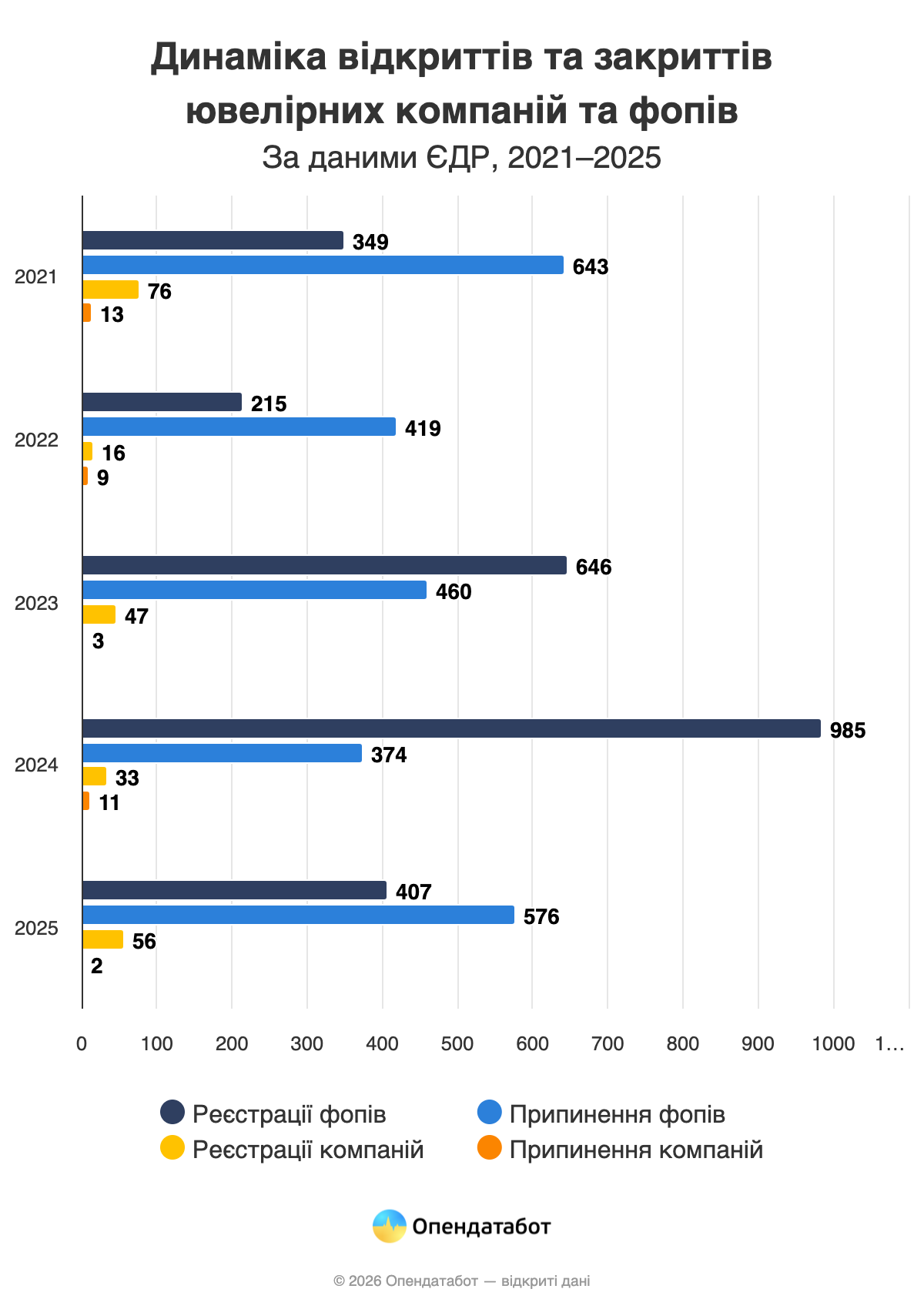
Zlata Estate became the largest among Ukrainian companies with jewelry-related KEVD codes that published financial statements for 2025, with revenue of 1.261 billion UAH, according to an Opendatabot study and its analysis by Experts Club dated August 17, 2026.
Resurs+ took second place with revenue of 1.019 billion UAH, while Weiss King came in third with 955.4 million UAH.
Amadeo, the official distributor of Pandora in Ukraine, generated 830.4 million UAH in revenue and ranked fourth. Rounding out the top five is “Opti Gold” with 620.4 million UAH.
Overall, the top 10 jewelry companies in Ukraine by revenue for 2025 are as follows:
“Zlata Estate” — 1.261 billion UAH
“Resurs+” — 1.019 billion UAH
“Weiss King” — 955.4 million UAH
“Amadeo” — 830.4 million UAH
“Opti Gold” — 620.4 million UAH
“Golden Hit” — 618.3 million UAH
“Parity+” — 608.5 million UAH
“Silver Tears” — 586.3 million UAH
“Silver Spectrum” — 471.1 million UAH
“Kipsayk” — 445.1 million UAH.
The combined revenue of the top five companies alone exceeded 4.68 billion UAH.
However, Opendatabot cautions that the ranking does not provide a complete picture of Ukraine’s jewelry market. Of the 1,282 active companies with the relevant KVED codes, only 358—less than one-third—submitted financial statements for 2025. Therefore, the ranking presented reflects the performance of companies for which financial data is available, rather than that of all industry participants.
In total, as of the end of July, there were 7,865 jewelry businesses in Ukraine, including 1,282 companies and 6,583 sole proprietorships.