
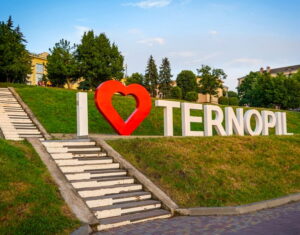
With support from the European Investment Bank (EIB), Ternopil has completed the energy-efficient modernization of four kindergartens at a cost of approximately EUR5 million and put 17 new Ukrainian-made trolleybuses into service, financed by the EIB to the tune of EUR5.5 million, the financial institution reported.
“Strong municipalities are crucial for Ukraine’s resilience and recovery. In Ternopil, our financing is delivering tangible improvements that make essential services greener, more efficient, and more accessible,” said EIB Vice President Karl Neghammer.
The modernization project covered kindergartens No. 1, No. 14, No. 20, and No. 21, which are attended by more than 1,100 children and employ 250 staff members.
In these facilities, buildings were insulated, windows and doors were replaced, heating and ventilation systems were modernized, energy-efficient lighting was installed, and accessibility was improved. This is expected to reduce energy consumption by at least 20%.
The work was funded under the Ukraine Municipal Infrastructure Development Program (UMIP).
In addition, with EIB support, Ternopil received 17 new trolleybuses manufactured by the Ukrainian company Elektronmash LLC. Their purchase, costing EUR 5.5 million, was funded under the “Urban Public Transport in Ukraine II” (UUPTP II) project.
The new trolleybuses are equipped with low floors, energy-efficient heating and air conditioning systems, passenger information systems, GPS, video surveillance, and ramps for passengers with limited mobility.
As previously reported, in late 2024, the Lviv-based “Elektron” Group, after winning the tender, signed a contract with the municipal enterprise “Ternopilelektrotrans” to supply 17 low-floor 12-meter trolleybuses worth EUR5.5 million, manufactured by its subsidiary, “Elektronmash” LLC.
Since the start of Russia’s full-scale invasion in 2022, the EIB has provided Ukraine with EUR4.5 billion in financing to support the country’s resilience and modernization.

During her one-day visit on August 15, the Secretary-General of UN Tourism, Sheikha Nasser Al-Nuwais, expressed her support for the Ukrainian people and announced a series of international initiatives to support tourism in Ukraine; She cited medical tourism, IT, and digital technologies as promising areas for development, according to a statement from the press service of the State Agency for Tourism Development of Ukraine (SATD) to the Interfax-Ukraine news agency.
“Ukraine should leverage its strengths, such as medical tourism, IT, and digital technologies, as these are precisely what will enable it to establish a solid foundation for attracting foreign tourists in the future. Bringing together all stakeholders in the tourism sector and the government under one roof can offer great potential,” noted Sheikha Al-Nuwais, whose remarks were quoted in the statement.
She noted that ten years have passed since the Secretary-General of UN Tourism last visited Ukraine, and this visit is an opportunity to renew the partnership “and look to the future together.”
“Recovery efforts cannot wait for peace to arrive. They begin right now. UNESCO and UN Tourism. Culture and tourism. Side by side with Ukraine. The path to the future belongs to Ukraine. But Ukraine will not walk it alone. UN Tourism will be by its side. And our work begins right now,” emphasized Sheikha Al-Nuwais.
During the meeting with representatives of the industry and the innovation and technology community, the Secretary-General of UN Tourism paid special attention to international coordination and the exchange of experiences regarding the recovery of the tourism sectors after the crisis. Potential areas of cooperation include the safety of tourist destinations, accessibility, barrier-free travel, and inclusivity.
In turn, GART Chairwoman Natalia Tabaka noted that this visit demonstrates that Ukraine remains on the global tourism radar and that its recovery is a key focus of the international agenda.
“For us today, tourism is first and foremost about preserving and restoring people—their emotional and physical well-being—strengthening identity, and supporting communities. And we are grateful for the support shown to Ukraine and for the willingness to stand by us during this historic time for us,” Tabaka said.
During the visit, UNWTO announced a special category of its “Safe Destinations Challenge” initiative for Ukraine. This initiative provides technical support to member states in five different regions, one of which is Ukraine. The initiative aims to find innovative solutions for the safety, resilience, and recovery of tourist destinations, especially following periods of crisis and disasters, according to the statement.
“Amid a full-scale war, the Ukrainian tourism sector has learned to operate under constant risks—from air raid alerts and missile attacks to evacuations, crisis communications, and ensuring people’s safety. It is precisely this extensive experience that can serve as the foundation for new international solutions in the field of safe and sustainable tourism,” noted Sheikha Al-Nuwais.
As part of her visit, the UN Tourism Secretary-General visited two UNESCO World Heritage sites—St. Sophia Cathedral and the Kyiv-Pechersk Lavra—where she took part in celebrations marking the Lavra’s 975th anniversary.
Sheikha Al-Nuwais also presented awards to the winners of the UN Tourism “Best Tourist Villages of Ukraine” competition for 2024 and 2025. Specifically, the awards went to the Kolochava community (Zakarpattia Oblast) and the Urych community (Lviv Oblast).
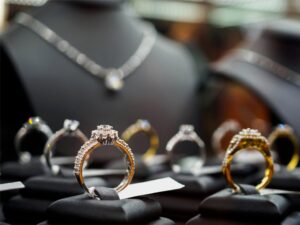
As of the end of July 2026, there were 7,865 businesses and entrepreneurs operating in the jewelry sector in Ukraine, 84% of which are registered as sole proprietors, according to data from the Unified State Register analyzed by Opendatabot. The study was published on August 17, 2026.
In total, there are 6,583 sole proprietors and 1,282 companies operating in the market, engaged in the production and sale of jewelry, as well as the repair of jewelry and watches.
However, the trends in these two segments differ significantly. The number of legal entities in the jewelry industry has been growing for five consecutive years, including after the start of the full-scale war. By the end of 2025, 54 more jewelry companies were registered than ceased operations.
Among sole proprietors, the situation is less stable. In 2021–2022, the number of closures exceeded the number of registrations by 498. In 2023, the segment returned to growth, and in 2024, the net increase reached a record 611 entrepreneurs. However, by 2025, the trend had shifted again—there were 169 more sole proprietorships that ceased operations than new ones.
Kyiv remains the main hub of the jewelry business, with 1,365 registered manufacturers, retailers, and other industry participants.
In second place is the Zaporizhzhia region with 679 enterprises, followed by the Kyiv region with 585, the Kharkiv region with 548, and the Dnipropetrovsk region with 484.
Thus, despite the dominance of small businesses, the structure of Ukraine’s jewelry market is gradually changing: the number of sole proprietorships is declining, while the number of companies continues to grow.
entrepreneur, jewelry business, KYIV, Sole proprietorship, UKRAINE
On the Ukrainian grain and oilseed market, prices showed mixed trends over the week: wheat remained at the previous level, sunflower seed prices fell significantly, while rapeseed prices for export rose, according to the brokerage firm Spike Brokers.
According to data from analysts published on their Telegram channel, wheat with 11.5% protein on CPT Odessa terms was priced at $195 per metric ton, while feed wheat was priced at $185 per metric ton. On FCA Chop terms, wheat traded mainly at EUR180–185/metric ton for loading onto a European train.
The price of corn on CPT Odessa terms fell by $5 per metric ton over the week to $190 per metric ton, while on FCA Chop terms it remained at $220 per metric ton. The new October–March crop was trading at EUR188–193 per metric ton FCA Chop at the western border.
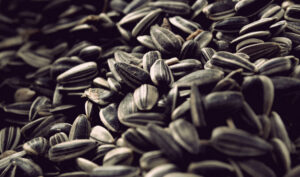
The price of sunflower seeds on CPT mill terms fell by $110 per metric ton over the week to $440 per metric ton. According to the broker, the market continues to transition to pricing for the new crop, and the external rise in prices for soybean oil and crude oil has not yet been reflected in Ukrainian raw material prices.
In the rapeseed market, the price on CPT port terms remained at $500 per metric ton, while on FCA Chop terms it rose by $5 per metric ton to $550 per metric ton. At the same time, the price of rapeseed for domestic processing fell by $15/metric ton to $485/metric ton. Thus, the difference between the FCA Chop export price and the price for domestic processing is $65/metric ton.
As of August 10, Ukraine had harvested 3.22 million metric tons of rapeseed from 1.191 million hectares—or 89% of the planted area—with a yield of 2.71 metric tons per hectare. Current pricing is determined by the distribution of supply among the western border, ports, and domestic processing.
The price of GMO soybeans on CPT port terms was $420 per metric ton, FCA Chop – $435 per metric ton, and non-GMO soybeans – $440 per metric ton and $470 per metric ton, respectively. The price of GMO soybeans for domestic processing rose by $5 per metric ton over the week, reaching $425 per metric ton.
“Thus, sunflower seeds are adjusting to the purchase price of the new crop; competition is intensifying in rapeseed between FCA Chop and processing; and soybeans are receiving an external boost from the CBOT and Chinese demand, which is not yet being strongly reflected in the Ukrainian physical market,” analysts note.
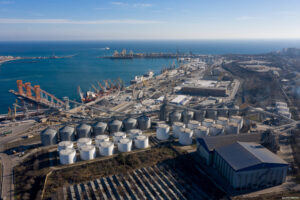
From August 1–13, Ukraine exported 790,700 metric tons of agricultural products, compared to 1.849 million metric tons during the same period in July—a decrease of 57.2%, according to the brokerage firm Spike Brokers.
According to the firm, the value of exports fell by 37.3% to $478.8 million, compared to $763.8 million during the corresponding period in July.
“The main factor limiting August’s pace is concentrated in the grain segment. At the same time, the geography of logistics is changing: the flow through seaports is significantly lower than in July, while road crossings and western rail corridors are operating at a higher intensity,” the report notes.
From August 1–13, 130,100 metric tons of agricultural products were exported via road border crossings, compared to 119,500 metric tons during the corresponding 13 days in July—an increase of 8.9%. Exports via Hungary saw the largest increase—32.9%—followed by Slovakia (28%), Romania (14.1%), and Poland (3.7%). The flow through Moldova was close to July’s level, declining by approximately 1.9%.
At the same time, as of August 12, 435,800 metric tons of grain cargo had been transported by rail, which is 46.9% less than during the corresponding period in July and 52.1% less than in August 2025. The average daily load for the first 11 days of August was 31.3 thousand metric tons—38% lower than in July and 49% less than a year ago.
The export component of grain rail shipments fell by 72% compared to July, to 201.7 thousand metric tons. Of this volume, 63% passed through border crossings, and 29% went through the ports of Odesa. During the reporting period, only 75,200 metric tons of grain were transported through the ports of Odesa, compared to 656,400 metric tons during the corresponding period in July (-88.5%).
At the same time, the average daily throughput of grain railcars through western border crossings during the first 11 days of August rose to 139.6 railcars, compared to 71.3 railcars in July—an increase of 96%.
According to Spike Brokers, the main growth came from the Romanian and Polish routes—up to 44.7 and 44.4 railcars per day, respectively. Transit to Slovakia increased to 26.9 railcars per day, while transit to Hungary decreased to 23.6 railcars.
As of August 12, there were 8,718 thousand railcars at border crossings, compared to 7,858 thousand previously. In particular, the number of grain cars rose from 369 to 693, or by 87.8%.
Railway exports of vegetable oil totaled 41.5 thousand metric tons, which is 0.9% more than the corresponding July figure, with 89% of the volume passing through land border crossings.
Spike Brokers notes that the sea-rail corridor remains the weakest link in the current logistics chain. As of August 13, the average daily unloading rate bound for the ports of Greater Odesa had dropped to 146 railcars, while 262 grain cars were en route to the ports. There were 1.32 thousand grain cars heading toward the Danube ports.
Ukrainian Minister of Internal Affairs Ivan Vygivsky held a telephone conversation with Azerbaijani Minister of Internal Affairs Vilayat Eyvazov, according to the press service of the Ukrainian Ministry of Internal Affairs.
“We discussed our partnership in the field of law enforcement. The key areas of cooperation are combating organized and transnational crime, cybersecurity, and the fight against fraud, as well as strengthening practical cooperation,” Vygivsky said following the conversation.
During the talks, the head of the Ukrainian ministry also briefed his counterpart on the current situation in the country, particularly regarding the latest Russian shelling of civilian infrastructure and attacks on the civilian population.
The parties paid special attention to joint humanitarian initiatives, particularly in the areas of healthcare, rehabilitation, and social support for the families of Ukrainian defenders.
“In the past year alone, the Republic of Azerbaijan has hosted two groups of high school students from the Ministry of Internal Affairs. The students had the opportunity to learn about the country’s culture and history and broaden their horizons. In recent years, our units have also received humanitarian demining equipment and technology from Azerbaijan that ensures uninterrupted operations during power outages. We are grateful to the Government of the Republic of Azerbaijan for its support of Ukraine and assistance to the Ministry of Internal Affairs. We agreed to strengthen our partnership,” Vygivsky concluded.
AZERBAIJAN, COOPERATION, Ministry of Internal Affairs, SECURITY, UKRAINE



