
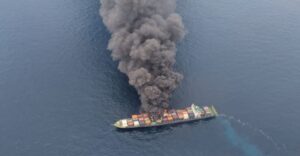
Turkey has called on Russia and Ukraine to agree to a moratorium on attacks on ships and maritime-related facilities in the Black Sea amid a sharp increase in attacks on the commercial fleet.
Turkish Foreign Minister Hakan Fidan stated on August 8 that Ankara is proposing that the parties establish a special mechanism to halt mutual attacks in the Black Sea.
“We have called on both sides to establish a mechanism for declaring a moratorium,” Fidan said in an interview with the Turkish state news agency Anadolu. According to him, Ukraine had previously put forward a similar proposal, after which Turkey conveyed it to the Russian side and is now awaiting Moscow’s response.
The Turkish foreign minister noted that the war has effectively spread to the entire Black Sea. While the attacks initially targeted mainly military ports and warships, commercial vessels are now increasingly coming under fire.
Ankara is particularly concerned about attacks on vessels linked to Turkey—those flying the Turkish flag, owned by Turkish companies, or carrying Turkish crew members.
According to Fidan, Russia and Ukraine are also attacking logistics facilities of strategic importance to the opposing side, and the further escalation of such actions is becoming “extremely dangerous.”
Ankara’s statement came after a sharp deterioration in the security situation for commercial shipping.
According to data from Ukraine’s Ministry of Community and Territorial Development, as cited by Reuters, in July alone, Ukraine recorded 35 attacks on ships in ports, 22 attacks on ships at sea, and 67 strikes on port infrastructure.
By comparison, Reuters counted 14 attacks on ships in the Ukrainian sector of the Black Sea throughout all of 2025. At the same time, Ukraine has intensified its strikes on tankers linked to the Russian oil trade. Both Moscow and Kyiv claim that their targets are facilities associated with military activities.
The escalation is already affecting global trade in grain and oil. More than 90% of the country’s agricultural exports pass through Ukrainian Black Sea ports, while the Russian ports of Novorossiysk and Tuapse remain major export hubs for grain and petroleum products.
The cost of war risk insurance for ships calling at Black Sea ports has risen to approximately 2% of a ship’s value, up from about 1% two weeks earlier, while the cost of chartering oil tankers on certain routes has exceeded $300,000 per day.
Amid rising risks, reports emerged that Turkey had begun restricting the passage of certain commercial vessels into the Black Sea. However, on August 9, two Turkish officials told Reuters that traffic through the Bosphorus and the Dardanelles was proceeding as usual. Ankara has indeed implemented temporary additional security measures, but these do not mean that the straits are closed to commercial shipping.
Passage is governed by the 1936 Montreux Convention, which grants Turkey control over the Bosphorus and the Dardanelles and special powers regarding military vessels, while ensuring freedom of passage for civilian vessels.
For Ankara, the security of the Black Sea is of fundamental economic importance. Large volumes of Russian and Ukrainian agricultural products, oil, and petroleum products pass through this region, and Turkish shipowners are actively engaged in these routes.
Since the start of the full-scale war, Turkey has maintained contacts with both Kyiv and Moscow and has sought to play the role of mediator. Ankara has not joined Western sanctions against Russia, yet it continues to cooperate with Ukraine and has repeatedly acted as a mediator on issues related to Black Sea shipping.
Only eight of the 29 European countries that have a national minimum wage raised it in their national currency between January and July 2026, according to Eurostat data.
The largest increase over the six-month period was recorded in North Macedonia—6.9%.
Next were Romania and Estonia—both at 6.8%—followed by Belgium at 5.8%, Greece at 4.5%, Luxembourg at 2.5%, France at 2.4%, and the Netherlands at 1.9%.
In the remaining 21 countries, the minimum wage in national currency remained unchanged between January 1 and July 1. This group includes, in particular, Serbia, Croatia, Slovenia, Poland, Germany, Spain, Portugal, Bulgaria, Hungary, and Ukraine.
At the same time, the absence of an increase in the nominal minimum wage effectively means a decline in its purchasing power in countries where consumer prices continued to rise during this period.
Eurostat publishes comparative data on minimum wages twice a year—as of January 1 and July 1. Changes that occur between these dates are reflected in the next semi-annual update of the statistics.
As of July 1, 2026, the minimum wage among EU countries ranged from 620 euros in Bulgaria to 2,771 euros in Luxembourg. When candidate countries are included, the lowest figure was recorded in Ukraine—169 euros.
In July 2026, the National Bank of Ukraine imposed a fine of 16.1 million UAH on Raiffeisen Bank JSC for a series of violations of anti-money laundering and counter-terrorism financing laws.
Among the violations identified by the regulator were inadequate customer due diligence and failure to apply a risk-based approach, as well as deficiencies in risk management during the implementation and use of information products and technologies, particularly when conducting transactions without direct contact with the customer.
The NBU also identified instances of untimely reporting of threshold financial transactions to the authorized state body and shortcomings in providing information and documents in response to the regulator’s requests.
In addition to the fine, Raiffeisen Bank received a written warning. It pertains, in particular, to the verification of customers and ultimate beneficial owners falling under the PEP category, internal documents regarding financial monitoring, updating information in customer questionnaires, and the transmission of information about payers.
Raiffeisen Bank has been operating in Ukraine since 1992, initially under the name Bank Aval. Since 2005, the bank has been part of the Austrian Raiffeisen Group. According to the ownership structure as of January 1, 2026, Raiffeisen Bank International AG holds 68.21% of the Ukrainian bank’s shares, while the European Bank for Reconstruction and Development holds 30%. Natalia Gurina is the chair of the bank’s board of directors.

The National Bank of Ukraine fined “FC Royal Finance 1” LLC 391,000 UAH for a series of violations of financial monitoring laws.
According to the NBU, the violations involved the untimely updating of the company’s internal documents, the performance of the employee responsible for financial monitoring, and the improper application of a risk-based approach.
The regulator also pointed out violations in the preparation of statistical reports, the incomplete provision of requested information and documents, as well as shortcomings in providing an up-to-date list of clients with their assigned risk levels.
LLC “FC ‘Royal Finance 1’” was registered in Kyiv in July 2019. The company received financial institution status in November of that same year. In January 2025, at the company’s request, the NBU excluded financial leasing from its license, after which it retained the right to provide loans and factoring services. The company’s director is Vitaliy Lysenko, and “Finance Royal Invest” LLC is listed as the holder of a significant stake.
In July 2026, the National Bank of Ukraine fined FC “Groovey” LLC 799,000 UAH for violations of financial monitoring legislation. According to the NBU, the company failed to properly update its internal documents on the prevention of money laundering and terrorist financing and had shortcomings in its customer verification procedures.
The regulator also identified violations of requirements for storing documents and information on customers and financial transactions—which must be retained for at least five years—as well as the incomplete provision of information requested by the NBU. Certain violations concerned data on the classification of customers by risk level and statistical reporting on financial monitoring.
The fine imposed on “Growway” was the largest among the sanctions imposed by the NBU in July on non-bank financial institutions.
FC “Growway” LLC was registered in August 2018 in Kyiv. The company specializes, among other things, in financing enterprises in the pharmaceutical and medical industries, as well as suppliers of medical equipment, medications, and services. Kira Gorbik serves as the company’s director. Its main activities involve the provision of financial services and lending.

Over 1.4 million metric tons of grain have already been harvested in Vinnytsia Oblast, according to Natalia Zabolotna, head of the regional military administration.
“The harvest campaign in the region is ongoing. Farmers have already harvested 246,000 hectares of early grain and legume crops—that’s 60% of the planned area. The average yield is 59.6 centners per hectare—1.9 centners per hectare more than during the same period last year,” she wrote on Telegram on Saturday.
According to the Regional State Administration, winter wheat currently accounts for the largest portion of the harvest at 1.2 million metric tons. Its average yield is also higher than last year’s. The harvest of winter barley and peas has already been completed. The harvest of spring barley, spring wheat, and rye is in full swing. At the same time, farmers are finishing the harvest of winter rapeseed. 80% of the area has already been threshed.



