

As of July 31, 2026, Ukraine had exported, since the start of the 2026/27 marketing year (MY, July–June), 2.601 million metric tons of grains and legumes, which is 54.9% more than on the same date a year ago, when this figure stood at 1.679 million metric tons.
According to the Ministry of Agrarian Policy and Food, citing data from the State Customs Service, total exports of grains, legumes, and flour reached 2.603 million metric tons, compared to 1.684 million metric tons on the same date last marketing year.
Specifically, wheat exports totaled 1.059 million metric tons, compared to 744,000 metric tons a year ago; corn exports totaled 1.244 million metric tons, compared to 627,000 metric tons; and barley exports totaled 294,000 metric tons, compared to 267,000 metric tons. As was the case last year, no rye was exported.
Flour exports since the start of the 2026/27 marketing year totaled 1,800 metric tons, which is half the volume recorded on the same date last marketing year (3,600 metric tons). In particular, wheat flour exports also halved—to 1,700 metric tons from 3,400 metric tons a year ago.
In January–June 2026, Ukraine recorded a merchandise trade deficit with 37 of its 50 largest trading partners, according to calculations by the Experts Club information and analytical center based on foreign trade data.
Total trade turnover with the TOP 50 countries amounted to $66.97 billion. Imports reached $47.35 billion, exports totaled $19.62 billion, and the overall trade deficit stood at $27.73 billion.
The combined deficit in trade with the 37 countries from which imports exceeded exports amounted to $30.72 billion. A surplus of $2.99 billion with the remaining 13 partners partially offset this gap.
For comparison, according to official data from the State Customs Service, Ukraine’s total trade turnover in the first half of the year amounted to $70.3 billion, including $49.3 billion in imports and $21 billion in exports. Thus, the TOP 50 partners accounted for more than 95% of Ukraine’s foreign trade in goods.
The ten largest deficit-generating trade routes accounted for $41.78 billion in trade turnover. Ukraine imported $32.95 billion worth of goods from these countries while exporting only $8.83 billion. The deficit amounted to $24.12 billion, or approximately 87% of the net trade deficit with the TOP 50 partners.
The import coverage ratio by exports in this group was 26.8%. In other words, every dollar of Ukrainian exports corresponded to approximately $3.73 in imports.
The top five countries—China, Poland, Germany, the United States, and Türkiye—generated a deficit of $20.59 billion. This represented 74.3% of the net trade deficit with the TOP 50 partners.
China ranked first by a wide margin. Imports of Chinese products amounted to $13.9 billion, while exports of Ukrainian goods totaled only $778.4 million. The deficit reached $13.12 billion, or 47.3% of the total trade deficit with the TOP 50.
Exports covered only 5.6% of imports. Thus, the volume of Chinese supplies to Ukraine was almost 18 times greater than the flow of goods in the opposite direction.
According to the State Customs Service’s publicly available commodity breakdown, the leading categories of Chinese imports were electric batteries at $1.62 billion, transmission, television, and video equipment at $1.11 billion, fiber-optic products at $770.5 million, transformers and chokes at $720.8 million, and unmanned aerial vehicles at $684.4 million.
Significant volumes also included telephone and telecommunications equipment at $620.8 million, electric motors and generators at $589.8 million, computer equipment at $363.7 million, and semiconductor devices at $347.8 million.
Thus, the deficit with China is generated not by a single category but by a broad range of technological, energy, electronic, and consumer products.
Poland ranked second in terms of the trade deficit, at $2.29 billion. At the same time, trade with Poland was considerably more balanced than trade with China: Ukrainian exports covered 51% of imports, while Poland remained the largest individual market for Ukrainian products.
The largest disclosed category of imports of Polish origin was oil and petroleum products, totaling $904.6 million. These were followed by petroleum gases at $205.6 million, aircraft parts at $192 million, unmanned aerial vehicles at $133.9 million, compound fertilizers at $121.6 million, electricity at $114.4 million, and coke and semi-coke at $111 million.
The structure of these supplies indicates that Poland serves Ukraine not only as a trading partner but also as an important energy, industrial, and logistics hub.
Germany generated the third-largest deficit, at $1.94 billion. Ukrainian exports covered 39.5% of imports.
The main disclosed categories of German products were passenger cars at $347.6 million, medicines at $220.2 million, petroleum products at $151.9 million, crop-harvesting machinery at $115.3 million, soil cultivation equipment at $97.1 million, plant protection products at $93.5 million, and tractors at $84.3 million.
The trade deficit with the United States amounted to $1.9 billion, while exports covered only 23.6% of imports. The largest publicly available categories of US supplies were petroleum products at $436.6 million, passenger cars at $417.9 million, coal at $182.2 million, and telecommunications equipment at $155.3 million.
Imports from the United States also included tractors, ethylene polymers, petroleum gases, medicines, frozen fish, and electronic equipment. Production, transport, and energy goods accounted for a significant share of both US and German imports.
Türkiye ranked fifth, with a deficit of $1.34 billion. At the same time, the import coverage ratio by exports stood at 57.1%, the highest figure among the top five countries.
Radar and radio navigation instruments and remote-control apparatus, totaling $332.8 million, stood out in the publicly available commodity structure. Significant supplies also included rolled steel products, petroleum products at $110.1 million, citrus fruits at $83.3 million, electric generator sets at $73.1 million, sunflower seeds at $59.2 million, automotive components, vegetables, and other food products. Trade with Türkiye combines industrial products, technological equipment, metals, and foodstuffs, while the country remains one of the largest markets for Ukrainian exports.
The trade deficit with Greece amounted to $861.5 million. Oil and petroleum products accounted for almost $809 million in the publicly available commodity breakdown. Other categories included petroleum coke and bitumen at $38.1 million, petroleum gases at $36.4 million, and fertilizers at $35.1 million. The structure of the deficit with Lithuania, which reached $607.7 million, was similar. Petroleum products accounted for $576.1 million of disclosed imports, while petroleum gases accounted for $46.4 million. Ukraine also imported passenger cars, freight vehicles, petroleum coke, fertilizers, polymers, and animal feed.
Unlike China, where the deficit is distributed among numerous technological categories, the imbalance with Greece and Lithuania is largely associated with energy purchases.
The trade deficit with the Czech Republic amounted to $752.4 million. The main import categories included aircraft parts at $101.8 million, passenger cars at $101 million, electric generator sets at $96.6 million, batteries at $44.5 million, telecommunications equipment at $34.3 million, and coal at $32.3 million.
The trade deficit with Hungary reached $658.1 million. The publicly available structure of supplies was dominated by electricity at $349.9 million, petroleum gases at $157.4 million, passenger cars at $113.2 million, and cable products at $87.8 million.
The deficit with France amounted to $648.9 million. The largest categories were plant protection products at $120 million, medicines at $76.1 million, passenger cars at $72.5 million, trucks at $47.7 million, tractors at $39.9 million, and automotive components at $35.3 million. Supplies of sunflower and corn seeds, as well as cosmetic products, were also significant.
Immediately outside the top ten was Sweden, with a deficit of $606.9 million. Exports covered only 8.3% of imports. The main publicly available categories included petroleum products, passenger cars, medicines, and agricultural machinery.
The deficit with Taiwan amounted to $563.8 million, with Vietnam to $544.2 million, and with Japan to $496.9 million. The import coverage ratio by exports in trade with these countries ranged from only 3.8% to 5.8%. Supplies from Taiwan included unmanned aerial vehicles at $205.3 million, radar and navigation equipment at $58.4 million, integrated electronic circuits at $55 million, and navigation instruments at $47.6 million.
Imports from Vietnam included unmanned aerial vehicles at $132.7 million, telecommunications equipment at $108.7 million, computer equipment, rolled steel products, footwear, coffee, and fish products. Japanese imports were dominated by passenger cars at $302.5 million, as well as motorcycles, automotive components, printing, medical, and construction equipment.
The overall structure of purchases explains a significant part of the trade gap. According to the State Customs Service, machinery, equipment, and transport accounted for $21.3 billion of imports in the first half of 2026, fuel and energy products for $7.4 billion, and chemical industry products for $6.9 billion. Together, these three categories accounted for 72% of imported goods.
Thus, the deficit is not associated solely with the consumption of finished foreign products. A significant part of it is generated by purchases of energy resources, passenger cars, production equipment, electronics, batteries, generators, pharmaceutical products, agricultural machinery, and components.
“The trade deficit cannot be assessed exclusively as a negative indicator. Amid the war and large-scale reconstruction, a significant share of imports serves a critical or investment purpose. Ukraine purchases energy resources, generators, batteries, transport, industrial equipment, electronics, medicines, and components without which it would be impossible to maintain the functioning of the economy, energy sector, and infrastructure,” emphasized Maksym Urakin, founder of the Experts Club information and analytical center.
At the same time, according to him, the concentration of the deficit creates risks of dependence on individual suppliers, increases demand for foreign currency, and demonstrates the insufficient presence of Ukrainian producers in key foreign markets.
“The problem arises when imports of finished products grow systematically while Ukrainian exports and domestic production fail to develop at a corresponding pace. Trade with China is particularly indicative, as Ukrainian exports cover less than 6% of imports. Such a disparity increases dependence on a single supplier and creates constant additional demand for foreign currency,” the economist stressed.
According to Urakin, the most realistic response lies not in mechanically restricting imports but in localizing the production of goods for which Ukraine has the necessary technological and resource prerequisites, developing industrial cooperation, expanding exports of processed goods, and encouraging foreign suppliers to establish production capacity within the country.
The production of energy equipment, battery systems, electrical equipment, automotive components, construction materials, agricultural machinery, highly processed food products, and certain types of chemical products holds particular potential.

September Fest 2026, Ukraine’s largest urban festival, will take place on September 18–19 at the A-Station complex near the “Arsenalska” metro station in Kyiv, according to the DMNTR media group, which is organizing the event.
A Development has become the festival’s general partner.
According to the organizers, in 2026, September Fest will be held over two full days for the first time. More than 10,000 guests are expected to attend the event, and over 150 speakers will participate in the discussions.
The festival program includes four parallel discussion panels, presentations of urban, architectural, and investment projects, professional networking, and an evening cultural program.
The main audience for September Fest will consist of mayors, chief city architects, owners and executives of development companies, representatives of investment funds, architectural firms, government agencies, and international organizations.
In 2025, the festival attracted over 3,500 participants in a single day, exceeding its initially projected attendance of 2,500–3,000 people.
Participants in last year’s event included representatives from A Development, “Creator-Bud,” RIEL, SAGA Development, DIM, UDP, Avalon, Taryan Group, “Vlasne Misto,” “Metinvest,” and other Ukrainian companies.
International architects and urban planners also took part in the previous festival, including Christos Passas from Zaha Hadid Architects, Italian architect and designer Carlo Colombo, and architect Hiroki Matsuura.
The Ukrainian professional community was represented by Oleksiy Baranov, founder of A Development; Ihor Huda, founder of “Creator-Bud”; Anton Kolomiytsev, chief architect of Lviv; architect and urban planner Julian Chaplinsky; Dmytro Vasilyev, co-founder of Archimatika; and other experts.
The organizers note that the festival is intended to serve as a platform for discussing the development of Ukrainian cities, urban renewal, attracting investment, implementing real estate development projects, and exploring new formats for cooperation between business, the state, and local authorities.
Festival partners will have the opportunity to present their companies and projects to a professional audience, hold negotiations with representatives from the real estate development, investment, and architectural sectors, and participate in the business and evening programs.
The evening program of September Fest will feature performances by pianist Yevhen Khmara and a jazz band led by Oleksiy Kogan.
The festival will take place on September 18–19 from 11:00 a.m. to 9:00 p.m. at A-Station. The main entrance is through the Mykilski Gates.
The event is organized by the DMNTR media group, which has 25 years of experience in hosting professional events for representatives of the architecture, construction, real estate development, and investment sectors.
Detailed information and registration are available on the September Fest website. The organizers’ contact numbers are 044 461 91 28 and 077 777 25 47.
The Interfax-Ukraine agency is the media partner for September Fest 2026.
Open4business – media partner
ARCHITECTURE, KYIV, real estate development, September Fest, urban planning

A resume can be translated without any grammatical errors and still come across as weaker. Company names will be correct, job titles will be clear, and dates will match. But the document will read like a chronological work history rather than a compelling case for the candidate.
This is where a literal translation often falls short. The Ukrainian text is translated into English not only word for word but also with the same underlying logic: where the candidate worked, what they were responsible for, and what duties they performed. This isn’t enough for a recruiter. They need to quickly see whether the candidate’s experience matches the specific role and what value the person has already brought in similar situations.
A resume isn’t read like an autobiography. It’s compared to the job opening.
It’s Not About the English—It’s About Positioning
Before translating, it’s worth answering a simple question: what job is the candidate applying for?
A generic resume usually covers a little bit of everything. It includes experience, skills, courses, and a few paragraphs about personal qualities. The problem is that it’s equally vague for ten different job openings.
A strong resume tailors the information to a specific role. For a project manager, the budget, team, deadlines, and client relations may be important. For an analyst, the tools, volume of data, and decisions made based on analysis are key. For a salesperson, what matters are numbers, markets, the sales cycle, and meeting targets.
The same experience can be described in different ways, and that’s not manipulation. The candidate simply highlights what’s most relevant to the job opening.
Responsibilities provide context; results give meaning
The phrase “Was responsible for sales” merely indicates the scope of responsibility. It does not show the scale of the work or explain whether the candidate was successful in that role.
Specifics sound more impactful:
“Increased annual sales by 18% across three regional accounts.”
Or:
“Built a pipeline of 40 qualified leads within six months.”
Numbers are useful, but they shouldn’t be included just for the sake of sounding impressive. If a result can’t be measured in percentages or monetary terms, you can highlight another type of change: a reduction in time, the launch of a process, the number of participants, the scope of responsibility, the correction of an error, or an improvement in quality.
For example:
Introduced a weekly reporting process for a team of 12 people.
Reduced the average response time from two days to six hours.
Coordinated the launch of a new service in two markets.
A strong verb at the beginning helps, but it doesn’t do the trick on its own. “Managed,” “developed,” or “implemented” sound professional only when it’s clear from the context what actually happened.
Not every Ukrainian job title should be translated literally
Job titles vary across companies, even within the same language. A “manager” might lead a team, be responsible for a specific area, or simply be part of the job title. The Ukrainian term “development manager” can also refer to sales, partnerships, operations, or new product launches.
Therefore, a literal translation sometimes only adds to the confusion.
It’s better to check the title against the actual responsibilities and terminology used in job postings for the target market. If necessary, you can keep the official title and provide a clear equivalent in parentheses next to it.
Don’t inflate your job title through translation. If you didn’t manage a function or a team, the word “Head” can create false expectations. During an interview, you’ll have to explain this linguistic career leap without the help of a dictionary.
Literal translations stand out not because recruiters are looking for mistakes
Literal constructions are often grammatically correct but atypical for a resume. They force the reader to pause and piece together the meaning.
For example, the phrase “I was engaged in the development of…” is usually replaced by the simpler “Developed…”. The construction “Worked on the position of…” also sounds like a translation rather than a natural description of experience.
A resume in English generally doesn’t require full first-person sentences. In the work experience section, the pronoun “I” is omitted, and each bullet point begins with an action.
Old version:
“I was responsible for communication with foreign clients.”
Better:
“Managed communication with clients across the UK and Germany.”
Even more precise:
“Led weekly project calls with five clients across the UK and Germany.”
The last version highlights the nature of the work and its scope, rather than just general “communication.”
A resume must pass through more than just a person
Large employers often use applicant tracking systems. These systems store applications, organize information, and can search documents for keywords related to the job requirements.
For this reason, it’s worth tailoring your resume to the wording of the job posting. If an employer is looking for experience in “stakeholder management,” but the candidate describes the same skill as “communication with different departments,” neither automated nor human reviewers may see an exact match.
This doesn’t mean you should copy the entire job description. Keywords must correspond to your actual experience. Otherwise, the document will pass the initial filter but will fall short at the first follow-up question.
Formatting is also important for machine readability. Complex tables, text embedded in images, decorative skill scales, and unusual section titles may be processed less effectively than a simple structure.
The safe option looks almost boring:
● standard headings;
● plain text;
● clear dates;
● consistent job titles;
● bulleted points;
● a file in the format requested by the employer.
A design-oriented resume may be appropriate for creative professions, but it’s best not to disguise a portfolio as a document intended to pass a technical screening.
One or two pages
There is no universal rule that applies to all countries and professions. In the U.S. context, the term “résumé” often refers to a short document tailored to a specific job opening, whereas an academic CV can be significantly longer. In the United Kingdom and many European countries, “CV” is the standard term for a job application document.
For most professionals with a few years of experience, one or two pages are sufficient. But it’s also not worth cutting out strong, relevant experience just to fit the “magic” one-page limit.
The key question isn’t “how many pages are allowed,” but “does each section work for this job opening?”
Fifteen years of experience doesn’t need to be condensed into a few lines. At the same time, your first job—which is no longer related to your current field—doesn’t deserve the same amount of space as your most recent major project.
What the recruiter is trying to understand
During the initial review, they aren’t looking for literary quality or a complete picture of your personality. They need to quickly answer a few practical questions:
● Does the candidate have the required experience?
● Is the scope of their work clear?
● Is there evidence of results?
● Do their skills match the role’s requirements?
● Are there any inconsistencies in dates and job titles?
● Is it worth moving on to an interview?
That’s exactly why a practical guide to preparing a resume in English shouldn’t start with translating every sentence. First, you need to define your goal, select relevant experience, and only then articulate it in natural, professional English.
A good resume doesn’t tell the recruiter everything about you. It gives the recruiter enough reasons to invite you for an interview. Fortunately, you still have the chance to explain the rest in person.

The booking rate for vacation rentals along Spain’s coast for August 2026 reached 85.5%, which is 1 percentage point higher than the figure for the same period last year, according to a study by the Rentalia platform published on July 29. The study is based on an analysis of availability calendars for apartments and vacation homes located no more than 15 km from Spanish beaches. In August 2025, the share of booked properties stood at 84.5%.
The highest occupancy rate was recorded in Mallorca, where 99% of vacation rentals were booked for the last month of summer. Next are the Asturian coast at 95.6%, Menorca at 94.6%, Lanzarote at 93.5%, and the province of Alicante at 92.2%.
In Murcia, the booking rate reached 89.1%; in Cantabria, 88.3%; in Cádiz, 87.5%; on the Costa del Sol in the province of Málaga, 86.8%; and in Almería, 86.5%. In Fuerteventura, the figure matches the national average at 85.5%, and on the Costa Brava, it stands at 85%.
The greatest number of available last-minute booking options remains on the coast of the province of Huelva, where 44.7% of accommodations are occupied. Relatively low occupancy rates were also recorded in Tenerife (72.4%), the province of Valencia (72.6%), the Costa Dorada in Tarragona (76.7%), and the Barcelona coast (77.9%).
Almudena Ucha, director of Rentalia, attributes the rise in demand for northern regions of Spain to the intense summer heat. Occupancy rates for vacation rentals in Asturias rose by 4.7 percentage points over the year, and in Cantabria by 4 points, as tourists are increasingly opting for cooler destinations. Among properties with air conditioning, 86.7% were booked for August, and among those with a pool, 85% were booked. The booking rate for rural homes in Spain’s inland regions was even higher, reaching 87.6%.
Data source: a study by Rentalia, a vacation rental platform on Idealista

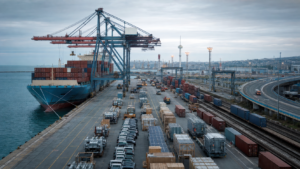
At the end of July, Ukraine’s Danube port cluster sharply increased its intake of grain carriers amid a slowdown in operations at the Greater Odessa ports; however, a critical drop in water levels on the Danube could limit the capacity of this alternative export route.
According to the brokerage firm Spike Brokers, the number of grain railcars heading to the Danube ports increased nearly sevenfold over the week—from 167 to 1,141 thousand railcars. The average daily unloading rate rose by 17 railcars to 51 railcars per day.
At the same time, the number of grain railcars heading toward the ports of Greater Odessa fell by approximately 70%—to a record low of 1,356 railcars, compared to 4,525 railcars a week earlier. Average daily unloading decreased by 160 railcars to 690, while loading decreased by 203 railcars to 580 railcars per day.
In July, 1.38 million metric tons of grain were transported by rail to Ukrainian seaports, which is 37% less than in June. Additional constraints included overcrowding at certain port terminals and delays in transshipping grain from railcars to ships.
Thus, the increase in railcar deliveries to the Danube currently appears to be an immediate market response to the slowdown in operations in the Greater Odessa area. However, the capacity of the Danube route is also under pressure due to the rapid shallowing of the river.
At the end of July, the water flow in the Danube at the entrance to Romania dropped to 1,650 cubic meters per second, compared to an average July level of about 4,750 cubic meters. By August 4, according to forecasts, the figure could drop to 1,500 cubic meters per second, approaching the historic low of 1,400 cubic meters set in 1985.
Back in July, the Romanian Lower Danube Administration recorded a sharp drop in water levels across virtually the entire navigable stretch from Băziaș to Sulina. Near Corabia, several barges ran aground, and actual depths in certain critical sections decreased to 1.5–1.7 meters. Dredging operations are being carried out to maintain depths of at least 1.8–2 meters.
The main risk for Ukraine lies not necessarily in a complete shutdown of the Danube ports, but in a reduction in the permissible draft of vessels. Barges and river-sea hybrid vessels will be forced to carry less grain, which will increase the number of voyages, transportation costs, and fleet turnaround time.
Even if the terminals in Reni and Izmail retain the capacity to receive railcars, the slowdown in loading grain onto vessels could lead to a buildup of rolling stock at stations near the ports. The disparity is already evident: 1,141 railcars are heading toward the Danube ports, while the average daily unloading rate is only 51 railcars.
If this ratio persists, the terminals may once again face overcrowding, after which Ukrzaliznytsia will have to impose restrictions on the shipment of certain cargoes or implement temporary measures.
The second risk is related to the increase in queues on the Romanian sections of the Danube and the Sulina Canal. The ports of Reni and Izmail depend not only on the water depths directly at the Ukrainian berths but also on the condition of the entire Lower Danube route. As the Danube Commission notes, a single shallow section can become a “weak link” and restrict traffic along the entire international corridor.
Silting also complicates the transport of Ukrainian grain by barge to Constanta, Romania. A reduction in the load capacity of a single barge means that more vessels must be deployed to transport the same volume of cargo. This increases freight rates, transshipment costs, and the risk of fines for vessel downtime.
The third risk is the simultaneous decline in the reliability of the two main maritime routes. The ports of Greater Odessa are currently operating more slowly due to terminal congestion and delays in loading ships, while the Danube—which is supposed to serve as a backup route—faces a natural limitation on its throughput capacity.
This factor becomes particularly critical during the arrival of the new grain harvest. Rising logistics costs could lower purchase prices within Ukraine, delay the fulfillment of export contracts, and widen the price gap between Ukrainian ports and the global market.
On June 24, the Ukrainian Sea Ports Authority began operational dredging in the waters of the Port of Izmail. The work is intended to restore the design depths near the berths and allow for the maximum possible draft and cargo capacity of vessels. It was planned to be completed within two months.
However, dredging within the Ukrainian port alone cannot fully compensate for the drop in water levels in the Romanian and transboundary sections of the Danube. To maintain stable traffic flow, Ukraine and Romania will need to work in sync, promptly mark the fairway, conduct regular depth soundings, dredge critical sections, and regulate vessel queues.
The Ministry of Infrastructure had previously identified dredging as one of the main “bottlenecks” in Danube logistics and discussed with the European Commission and Romania the coordination of traffic, the use of the PRIMUS digital system, and measures to address a potential reduction in the capacity of the Odessa-Danube route.
The Danube ports remain a strategic reserve for Ukraine’s foreign trade.
After the start of the full-scale war, their throughput capacity was increased to 35 million metric tons per year. However, actual transshipment volumes fell from 17.4 million metric tons in 2024 to 8.9 million metric tons in 2025, and authorities had previously forecast approximately 5 million metric tons for 2026.
The current increase in grain ship traffic indicates that businesses are ready to quickly return to the Danube route should problems arise in the Greater Odessa area. However, record-low water levels in the river may prevent the ports from fully accommodating this additional traffic, potentially turning the rerouting of cargo by rail into a new logistical bottleneck.



