

Kyiv remains near the bottom of the European ranking for rental costs, despite a recovery in demand for high-quality apartments in the Ukrainian capital, according to data from Global Property Guide.
According to the table of median asking rental rates for June 2026, the rent for a one-bedroom apartment in Kyiv is approximately EUR550 per month. Based on this metric, the Ukrainian capital ranks roughly 34th among the 40 European and European-adjacent cities featured in the publicly available section of the Global Property Guide table, when cities are sorted from highest to lowest rent.
Kyiv shares this position with Podgorica, where the median rent for a one-bedroom apartment is also around EUR550. Meanwhile, Belgrade is significantly more expensive—around EUR800 per month—while Bucharest and Athens are around EUR650, and Sofia and Zagreb are around EUR600. Below Kyiv in the table are Chisinau, Tbilisi, Sarajevo, and Skopje.
This is an important signal for the Ukrainian market. On the one hand, Kyiv is no longer among the cheapest cities in the region. On the other hand, rental costs in the Ukrainian capital are still lower than in most capitals of Central and Southeastern Europe, including Belgrade, Budapest, Warsaw, Prague, Bratislava, Bucharest, Zagreb, and Sofia.
Against the backdrop of Global Property Guide data showing rapid growth in rental rates in Russia, Montenegro, Serbia, Hungary, Brazil, and Ireland, Kyiv appears to be a more subdued market. This is not due to a lack of demand, but rather to the impact of the war, migration, security risks, limited effective demand, and high uncertainty for tenants and investors.
According to Global Property Guide, the median asking rent for a 2-room apartment in Kyiv is about EUR850 per month, and for a three-room apartment, it is about EUR1,690. At the same time, Kyiv remains relatively affordable in the one- and two-room apartment segments, but in the three-room apartment segment, it is already comparable to Budapest, Riga, and Vilnius and significantly exceeds Belgrade, Sofia, Zagreb, Podgorica, and Chisinau.
For investors, Kyiv remains a market with elevated risks but also with potential for recovery. Future rental trends will depend on security, the return of residents, the state of the economy, the supply of new housing, mortgage availability, infrastructure, and demand from internally displaced persons, foreign professionals, and businesses.
If the security situation improves and business activity recovers, rental rates could receive an additional boost.

On June 25, the “Delta-Lotzman” branch of the state-owned enterprise “Ukrainian Sea Ports Authority” announced a tender for voluntary health insurance services.
According to the Prozorro electronic government procurement system, the estimated cost is 8.360 million UAH.
Documents for participation in the tender will be accepted until July 10.
The state-owned enterprise “Delta-Lotzman” was established by order of the Ministry of Transport of Ukraine in 1998 with the aim of improving conditions for ensuring the safety of navigation, protecting human life at sea and the environment, in Ukraine’s territorial waters in accordance with the requirements of international agreements and conventions, as well as to streamline the structure of maritime pilotage services in the northwest.
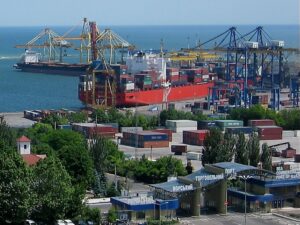
On June 25, the state-owned enterprise “Chernomorsk Sea Trade Port” (Chernomorsk, Odesa Oblast) announced a tender for the procurement of voluntary comprehensive auto insurance services.
According to a notice posted on the “Prozorro” electronic government procurement system, the estimated cost of the services is 82,400 UAH.
Documents will be accepted until July 3.
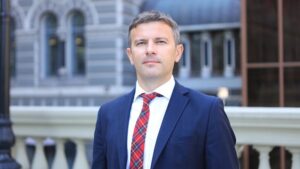
The private insurance market collected nearly 1 billion hryvnia in premiums for products covering military risks in January–March 2026, said Serhiy Mykolaychuk, First Deputy Head of the National Bank of Ukraine (NBU), at a press briefing on Monday dedicated to the presentation of the Financial Stability Report.
He emphasized that the majority of these premiums came from comprehensive auto insurance (CASCO), but there are also offerings for businesses, and the government has already launched a mechanism to compensate for losses in high-risk areas and to reimburse insurance premiums in other areas.
As noted in the Report, citing data from the National Association of Insurers of Ukraine, in the first quarter of 2026, premiums collected under risk insurance policies covering military risks accounted for 11% of all risk insurance premiums collected and exceeded the total for the entire previous year.
“While we used to talk a lot about how to build a military risk insurance system practically from scratch, we are now effectively discussing the expansion of existing areas and projects, and in this report we highlight that the range of military insurance products is constantly growing,” explained the first head of the NBU.
According to him, the NBU sees significant potential in the further development and expansion of cooperation with international reinsurers, as well as with international financial institutions operating in this market.

Shareholders of the industrial and technical company ‘Agromat’ decided to issue Series “J” bonds worth 100 million UAH for public offering, the company reported in the NSSMC system.
According to the announcement, the bond offering is being conducted to optimize the company’s debt portfolio.
It is noted that the bonds are planned to be placed through a public offering exclusively to qualified investors (without a prospectus) via an investment firm acting as a placement agent without providing a guarantee.
AgroMat corporate bonds of Series “H” and “I,” each with a total face value of 100 million UAH, are currently in circulation.
The announcement states that the company’s co-owners, each holding a 28.65% stake, are CEO Serhiy Voitenko, Oksana Reva, and Anatoliy Taday; an additional 10.05% is owned by Olga Bashota, and 4% by Nadiya Rushelyuk.
As previously reported, in September 2024, “Agromat” issued three-year Series “H” bonds worth 100 million UAH for public offering, and in November of the same year, it issued Series “I” bonds for the same amount. The funds raised are planned to be used to expand the retail network.
“Agromat” manufactures and sells ceramic tiles and bathroom fixtures; it was founded in 1993. The company operates through 33 retail locations in 21 cities across Ukraine and online at agromat.ua.
According to information on the company’s website, based on 2025 results, PTK LLC “Agromat” increased its net revenue by 5.2% compared to the previous year—to 3.59 billion UAH—and its net profit by 91.4%, to 148 million UAH. In the first quarter of 2026, net revenue grew by 10.4% compared to the same period last year—to 788.5 million UAH—while net profit decreased from 47.5 million UAH to 199 thousand UAH.
As of the end of 2025, Kredobank was the Agromat Group’s main long-term lender, with loans totaling 34.8 million UAH at interest rates of 15.5% and 24.68%. An additional 3.9 million UAH was accounted for by ProCredit Bank at a rate of 3.77%.
The short-term loan portfolio, totaling 524.5 млн грн as of the end of 2025, consisted of loans from six banks at interest rates ranging from 3.77% to 24.68%: Raiffeisen – 199 млн грн, ProCredit – 153.9 млн грн, OTP – 20 млн грн, Crédit Agricole – 65.6 млн грн, Pivdenny – 19 млн грн, and Kredobank – 66.9 млн грн.
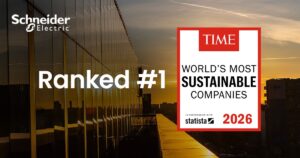
Schneider Electric, a global leader in energy technologies, has been named the world’s most sustainable company for the third consecutive year by TIME magazine and Statista. The award is based on a ranking of the world’s 5,000 largest and most influential companies and reflects Schneider Electric’s long-standing commitment to integrating sustainability principles into its business strategy, corporate governance, and operations.
In pursuing its vision of advancing energy technologies to drive progress for all, Schneider Electric leverages its leadership in electrification, energy efficiency, and digitalization to create a positive impact on a global scale.
“We are honored to receive this recognition from TIME and Statista for the third consecutive year,” said Olivier Blum, CEO of Schneider Electric. “As energy becomes an increasingly important driver of economic growth, competitiveness, and social development, the need for smarter energy use continues to grow. We are convinced that intelligent energy management is a key driver of efficiency and decarbonization, helping our customers create long-term value while reducing emissions. It is this conviction that has guided Schneider Electric’s development for many years and continues to underpin our innovations, operations, and the advancement of energy technologies.”
This year’s recognition is particularly significant, as Schneider Electric recently unveiled its new sustainability program, Impact 2030. It is built around four strategic pillars: electrifying the world, transforming industry, unlocking human potential, and empowering local communities. The company assesses progress quarterly using measurable metrics, ensuring transparency and accountability at all levels.
In the first quarter of 2026, Schneider Electric reported an 82.5% reduction in Scope 1 and Scope 2 CO₂ emissions compared to the 2017 baseline, confirming the increased sustainability and efficiency of the company’s own operations.
Schneider Electric also reported the following results:
As part of the Impact 2030 program, Schneider Electric is also strengthening collaboration with its partner ecosystem, as the company is convinced that large-scale change can only be achieved through joint efforts. This applies first and foremost to collaboration with suppliers:
in the first quarter, more than 1,100 suppliers joined the Zero Carbon Pathway initiative, aimed at reducing the carbon footprint and strengthening climate responsibility at all stages of the value chain.
Amid growing global uncertainty and fragmentation, Schneider Electric also believes that long-term sustainable development is only possible with a strong local foundation. It is communities and people who are the driving force behind sustainable change, helping to translate global goals into tangible results at the local level. In the first quarter of 2026:
“As we embark on a new phase of implementing our sustainability strategy, we are combining ambition with responsibility. This third consecutive recognition confirms that we are moving in the right direction, and at the same time commits us to achieving even more,” said Esther Finidori, Director of Sustainability at Schneider Electric. “Impact 2030 lays the foundation for scaling our positive impact, and we are committed to accelerating this progress quarter after quarter.”
In addition to being named the world’s most sustainable company by TIME and Statista for the third consecutive year, Schneider Electric is also the only company to have ranked first on the Corporate Knights Global 100 list twice—in 2021 and 2025. Furthermore, Schneider Electric has been included on the Climate A List of the international environmental organization CDP for 15 consecutive years, confirming its consistent leadership in the fight against climate change.
DECARBONIZATION, Schneider Electric, Statista, SUSTAINABLE DEVELOPMENT, TIME



