
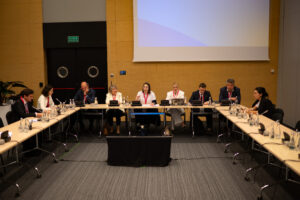
The funds directed toward the recovery of Ukrainian business must simultaneously perform a second function — preparing companies to work in the EU single market, participants said during a discussion held as part of the Ukraine Recovery Conference in Gdańsk.
The key issue of the panel was whether current instruments for supporting Ukrainian business sufficiently combine short-term recovery with long-term preparation for European integration. Participants discussed how to ensure that every euro of recovery not only helps companies survive the consequences of the war, but also brings them closer to the standards, rules and practices of the EU single market.
The discussion focused on the results of regional business dialogues conducted by the Office of the Deputy Prime Minister and the Ukraine2EU program. Over six months, more than 600 companies from six sectors of the economy joined the dialogues. One of the main conclusions was that the companies best prepared for the EU market often achieved this not thanks to separate recovery programs, but due to the requirements of European buyers.
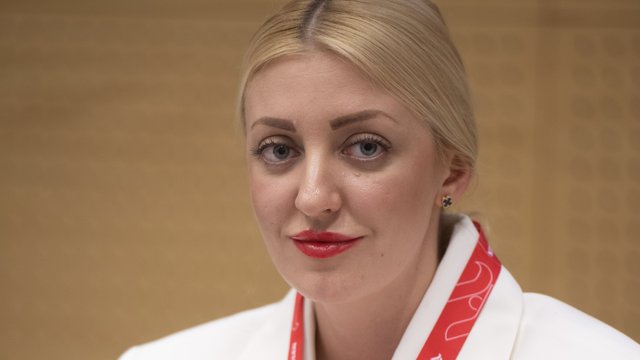
“For business, European integration is not an abstract political process, but a very practical set of requirements: European standards, certification, proper corporate governance, transparent financial reporting, compliance with regulatory requirements and the ability to be a reliable partner for European buyers and investors. Our regional dialogues with business showed that the biggest gap today lies not in attitudes toward European integration — Ukrainian business predominantly supports this course — but in insufficient understanding of specific requirements, future changes and practical tools that will help prepare for integration into the EU single market. That is why our task is to make this process as understandable, practical and accessible as possible for Ukrainian entrepreneurs,” said Viktoriia Lobun, adviser to the Deputy Prime Minister for European and Euro-Atlantic Integration of Ukraine.
According to Ukraine2EU program manager Mante Makauskaite, regional dialogues are only one element of broader work to prepare the Ukrainian economy for EU membership.
“Preparing business for EU accession cannot be reduced only to informing companies about the rules. Companies need practical tools: consultations, sectoral road maps, support in implementing standards, access to partnerships and an understanding of how the single market works. It is precisely this comprehensive preparation that allows the economy not only to adapt to EU requirements, but also to use accession as an opportunity for growth,” Makauskaite said.
Participants in the discussion emphasized that for some Ukrainian enterprises, it was the buyer from Germany, Poland or another EU country who became the main incentive for introducing standards, improving the quality of reporting, auditing, internal procedures and compliance. At the same time, this creates a risk that companies without direct access to buyers in the EU remain outside the process of practical preparation for the European market.
Gabriel Blanc, head of the European Commission’s Ukraine Investment Framework, noted that existing instruments for supporting Ukraine already take into account the connection between recovery and European integration, but their effect must be even more targeted for business.
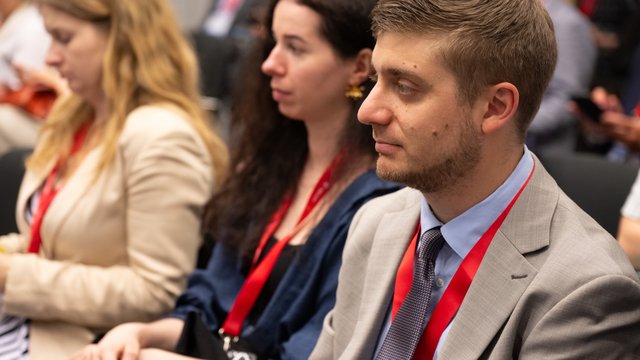
“The Ukraine Facility, Ukraine Investment Framework and instruments of international financial institutions already create a foundation for recovery to be linked to Ukraine’s future EU membership. But our task is to make this link as practical as possible for companies. Support must help not only restore assets, but also improve the managerial, financial and regulatory readiness of business to operate in the single market,” Blanc stressed.
The issue of access to financing was discussed separately. For banks and financial institutions, what matters is not only the political context of Ukraine’s future accession to the EU, but also the existence of a bankable, understandable and transparent project. High-quality accounting, clean financial data, reliable audit and corporate governance were considered elements that simultaneously make a company more attractive for investment and closer to the requirements of the EU single market.
“A bank does not finance the calendar of a country’s accession to the EU, but a specific project that can be assessed, structured and supported. Transparent financial data, high-quality reporting, a clear business model, audit and the company’s ability to meet its obligations are important to us. But these very things are also part of the homework that business must do for integration into the single market,” said Karol Tofil, director for international partnerships at the Polish state development bank.
According to him, preparation for the single market and preparation for attracting financing are often one and the same process.
“When a company brings order to its reporting, management, data and compliance, it simultaneously becomes more understandable to the bank and stronger as a potential participant in European supply chains. These are not two separate tracks, but one logic of increasing trust in business,” Tofil added.
Participants in the discussion noted that the most vulnerable group remains regional small and medium-sized enterprises, medium-scale producers and companies focused mainly on the domestic market. It is they who may feel the future approximation to EU rules most strongly, but at the same time they have the least access to cheaper financing, advisory support, buyers from the EU and programs for preparing for standards.
Kateryna Havrys, director for strategic development of international markets, regulatory policy and government relations at Epicentr K LLC, noted that for large business, the issues of recovery, investment and preparation for the EU market are already connected at a practical level.
“For a company that works in retail, the agricultural sector, manufacturing and energy, European standards are not theory, but daily operational work. Recovery requires capital, but capital itself does not solve the problem if the company does not have access to equipment, technologies, specialists, certification and long-term planning. Business needs instruments that simultaneously help rebuild and become competitive in the EU,” Havrys said.
According to her, from the point of view of companies, support must be more comprehensive.
“Business lacks not only access to money. Often it lacks the right type of financing, guarantees, advisory support, assistance with project preparation and an understanding of exactly how to turn an investment into compliance with EU standards. This is what needs to be changed in support instruments,” the representative of Epicentr K emphasized.
Another challenge named was that some Ukrainian owners are already investing in production directly in EU countries, where financing is cheaper and the rules of the single market are already in force. This process is a form of integration of Ukrainian capital into the European space, but at the same time it raises the question of how to reduce the risk gap between investments in Ukraine and in EU countries.
In this context, participants discussed the role of guarantees, risk-sharing mechanisms, blended financing and advisory support. The point was that a Ukrainian project must become no less bankable and understandable for financial institutions than a similar project in Poland or Lithuania.
Lesia Kuzmenko, associate director and deputy head of the EBRD in Ukraine, stressed that business support must begin even before the moment when a project becomes fully bankable.
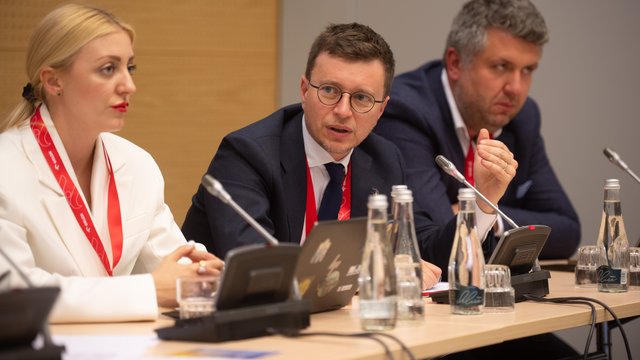
“The most difficult task is to help a company go from a potentially interesting idea to a project that can be financed. This requires not only loans, but also guarantees, risk sharing, advisory support, work on corporate governance, financial reporting, standards and business resilience. In many cases, precisely such preparation simultaneously makes a company attractive for investment and closer to the EU market,” Kuzmenko said.
A separate part of the discussion was devoted to the EBRD as one of the largest investors in Ukraine’s real economy. According to data presented during the panel, as of June 1, 2026, the total amount of EBRD financing for Ukraine stood at EUR 23.74 billion in 696 projects. It was also noted that for the second year in a row, more than 90% of EBRD projects and 57% of its investments were in the private sector.
Participants of the panel also considered Ukraine’s integration into the EU not only as a matter of assistance to Ukraine, but also as an element of strengthening European competitiveness. Ukrainian companies that comply with EU standards can become part of production chains, agricultural and industrial potential, biomass, logistics corridors and the skilled labor market needed for an enlarged single market.
The Polish direction of cooperation was considered as one example of practical integration. During the discussion, it was noted that more than 3,600 companies with Polish capital operate in Ukraine, while almost 27,000 companies with Ukrainian capital operate in Poland. They constitute the largest group of foreign companies in Poland — almost 28% of all foreign enterprises.
Maciej Legutko, director of the international cooperation department at the Employers of Poland association, noted that Ukrainian-Polish production ties already have a significant scale, but moving to a new level requires removing barriers in standards, financing and risk perception.
“Polish business sees Ukraine not only as a market, but also as a partner for joint value-added chains. But for a Ukrainian supplier to enter a Polish or broader European production chain as an equal partner, it must confirm standards, stability, quality of management and the ability to fulfill contractual obligations. Poland’s experience before joining the EU shows that precisely this preparation opens business access to scaling,” Legutko said.
At the same time, standards, financing, the risk profile of Ukrainian projects and the ability of companies to confirm their compliance with customer requirements remain barriers to the full entry of Ukrainian suppliers into Polish and broader European production chains.
Darius Skusevičius, ambassador-at-large for the coordination of Ukraine’s recovery and reconstruction at the Ministry of Foreign Affairs of Lithuania, stressed that support for Ukrainian business is an investment in Europe’s future economic architecture.
“For Lithuania, the logic of early engagement is very simple: Ukraine is already part of European economic security, even if the membership process is still ongoing. By investing in preparing Ukrainian companies for EU standards, we are investing not in charity, but in the future competitiveness, resilience and strategic autonomy of Europe,” Skusevičius said.
As part of the discussion, Lithuania’s bilateral business partnership program was announced, which is intended to become an example of a practical approach to preparing Ukrainian companies. Its logic lies in partnership with a company from the EU, which finances not only a specific operation, but also the preparation of business for the standards and requirements of the single market.
“Partnership with a company from the EU should help Ukrainian business not just sell a product, but also learn to work according to the rules of the market it is entering. This is a model in which the standard is embedded from the very beginning, and preparation becomes part of the investment,” Skusevičius added.
Participants in the discussion concluded that the recovery of Ukrainian business must be linked to investment readiness, access to financing, EU standards and inclusion in European value-added chains. Recovery without preparation for the single market may help companies survive the crisis, but does not guarantee their competitiveness after Ukraine joins the EU.
Ukraine Recovery Conference is an international conference on Ukraine’s recovery that brings together governments, international financial institutions, business, local self-government bodies and civil society to mobilize support for reconstruction, investment and Ukraine’s economic resilience. URC 2026 took place on June 25–26 in Gdańsk under the joint chairmanship of Poland and Ukraine. The forum focused on supporting Ukraine’s reconstruction, attracting investment for Ukrainian business, as well as on the sectors most affected by Russian aggression, in particular energy, critical infrastructure and logistics.
BLANC, EU, HAVRYS, MAKAUSKAITE, SKUSEVIČIUS, UKRAINE, UKRAINE RECOVERY CONFERENCE, urc, КУЗЬМЕНКО, ЛЕГУТКО, ЛОБУНЬ, ТОФІЛЬ
At a meeting on June 29, the shareholders of VUSO Insurance Company (Kyiv) decided to allocate 20.013 million UAH from the net retained earnings for 2025—which total 279.7 million UAH—for the payment of dividends.
As the company reported in the National Securities and Stock Market Commission’s (NSSMC) disclosure system, the remaining portion of retained earnings, amounting to 259.7 million UAH, will remain undistributed.
It is noted that dividends will be paid at a rate of 0.73 UAH per share. Dividends will be paid in full directly to shareholders in accordance with the procedure established by law within six months from the date of the relevant resolution by the general meeting of shareholders.
VUSO Insurance Company was founded in 2001. It is a member of the Motor Transport Insurance Bureau of Ukraine (MTIBU) and the Ukrainian Insurance Federation (UIF), a participant in the Direct Loss Settlement Agreement, and a member of the Nuclear Insurance Pool.
The company’s gross premiums for 2025 amounted to 5.136 billion UAH, which is 48.36% more than in 2024; net premiums grew by 47.92% to 4.593 billion UAH, and net earned premiums rose by 48.74% to 4.071 billion UAH.
The share of individual policyholders in the insurer’s gross premiums at the end of 2025 was 60.56%, while the share of reinsurers was 0.84%.
In 2025, VUSO Insurance Company paid out UAH 1.791 billion to its clients, which is 26.64% higher than the volume of insurance payments and reimbursements for 2024; the payout ratio decreased by 5.98 percentage points to 34.87%.
As of January 1, 2026, the insurer’s assets grew by 63.43% to 3.133 billion UAH; equity increased by 32.49% to 1.001 billion UAH; liabilities rose by 83.57% to 2.132 billion UAH; and cash and cash equivalents by 59.50%, to 1.210 billion UAH.

The ban on crayfish fishing in Ukraine’s water bodies, which had been in effect since the end of last year, has ended, the State Fisheries Agency’s press service reported on Wednesday.
“The lifting of the ban on crayfish fishing is a long-awaited event for many fishing enthusiasts. However, when heading to a body of water, please remember to treat river inhabitants with respect and strictly comply with environmental protection laws,” the press service quoted agency head Ihor Klymenko as saying.
As noted in the statement, each person is allowed to catch no more than 30 crayfish. Crayfish may be caught by hand or using a single crayfish trap meeting the specified parameters, a landing net, or a “spider” trap in accordance with the requirements of the Recreational Fishing Rules.
At the same time, it is prohibited to catch crayfish by hand after dark using artificial lighting.
The minimum size of crayfish permitted for catch is 11 cm in the Dnipro reservoirs, 10 cm in other inland water bodies and the Black Sea region, and 9 cm in the Azov region.
Illegal crayfish harvesting is subject to administrative or criminal liability, as well as compensation for damages to the fisheries sector. Compensation for each illegally caught crayfish amounts to 3,332 UAH.
body of water, CATCH, crayfish, State Fisheries Agency, фишинг

Starting July 1, 2026, Ukraine will begin accepting applications through the State Agrarian Registry (DAR) for participation in the open rapeseed export program, according to a press release from the Ministry of Economy, Environment, and Agriculture.
“The launch of the open export program for soybeans and rapeseed is another step toward creating transparent and clear rules for the agricultural sector. We have digitized the process as much as possible so that producers can quickly submit an application through the SAR, and the government has an effective tool for administering exports,” the press service quoted Taras Vysotsky, Deputy Minister of Economy, Environment, and Agriculture, as saying.
As noted in the announcement, legal entities and individual entrepreneurs who are agricultural producers may participate in the program. Applications will be submitted exclusively through the DAR system.
For rapeseed, applications will be accepted from July 1 of this year through April 1 of next year; for soybeans, from September 1 through June 1 of next year.
The program sets a maximum export volume of 5 metric tons of rapeseed per hectare of farmland and 3.5 metric tons of soybeans per hectare. During the application period, producers will have the right to adjust information regarding their planned or actual harvest once.
According to Vysotsky, the mechanism provides for maximum automation of the process without additional bureaucratic procedures or the need to obtain opinions from the Chamber of Commerce and Industry.
As previously reported, in May 2026, the Cabinet of Ministers amended the procedure for confirming the right of agricultural producers and agricultural cooperatives to be exempt from export duties when exporting their own soybeans and rapeseed. The new mechanism provides for automatic verification through the State Agrarian Register instead of obtaining opinions from the Chamber of Commerce and Industry.
agricultural producer, EXPORT, RAPESEED, SOYBEANS, State Agrarian Register
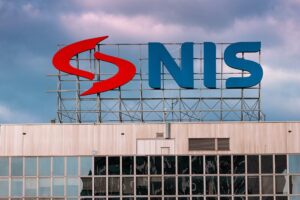
According to “Serbian Economist”, the Serbian company NIS has been granted another month to operate without restrictions from the U.S. OFAC has extended the company’s special license until July 31, said Serbia’s Minister of Mining and Energy Dubravka Jedović-Khandanović.
The previous license was valid until July 1. For Serbia, this means that the country’s key oil company will continue its normal operations for the time being, including the operation of the refinery in Pančevo and its network of gas stations.
At the same time, negotiations are ongoing between Hungary’s MOL and Gazprom Neft regarding the purchase of a stake in NIS. Earlier reports indicated that the deal involves a 56.15% stake. Additional regulatory approvals are required to finalize the deal, the most important of which remains approval from the U.S. Office of Foreign Assets Control (OFAC).
Serbia and MOL have already signed a shareholders’ agreement regarding the future management of NIS. The potential deal structure may also include the subsequent sale of a minority stake held by ADNOC of the UAE and the possibility for Serbia to increase its stake in the company by 5%.
Currently, Gazprom Neft remains NIS’s largest shareholder with 44.85%, while another 11.3% is held by an entity managed by Gazprom Capital. The Serbian government owns 29.87%.
NIS’s problems arose after the company, as a subsidiary of Gazprom Neft, was added to the U.S. SDN List in early 2025. President Aleksandar Vučić stated at the time that the U.S. was demanding the complete withdrawal of Russian capital from the company.
For Serbia, NIS is not just a major business but a strategic asset. The company is the only one in the country engaged in the exploration and production of hydrocarbons; it owns an oil refinery in Pančevo with a capacity of 4.8 million metric tons per year and dominates the petroleum products market. Its network includes more than 400 gas stations in Serbia and neighboring countries.
The extension of the license until July 31 eliminates the short-term risk to the fuel market, but does not resolve the main issue—who will control NIS after Russian capital withdraws, and under what conditions Serbia will retain influence over the country’s key energy company.
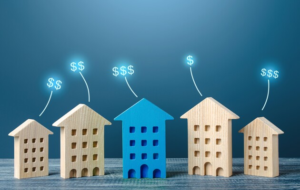
Количество сделок купли-продажи на рынке жилья в январе–марте 2026 года существенно снизилось по сравнению с предыдущим кварталом, спрос остается волатильным, говорится в отчете о финансовой стабильности Национального банка Украины (НБУ) за июнь 2026 года.
«Спрос на рынке жилья в течение последних шести месяцев был волатильным. В четвёртом квартале прошлого года было заключено наибольшее количество сделок купли-продажи с 2022 года, а вот в первом квартале 2026 года их количество существенно сократилось. В совокупности за последние четыре квартала количество сделок выросло на 11% по сравнению с аналогичным периодом прошлого года», — сообщил НБУ.
По его данным, в первом квартале 2026 года было заключено около 70 тыс. договоров купли-продажи на рынке жилья против 71,5 тыс. договоров за аналогичный период прошлого года. Из них налогооблагаемых договоров – около 40 тыс. против 45,8 тыс. в первом квартале прошлого года.
Почти половина всех сделок с октября 2025 года по март 2026 года заключена в Киеве, Киевской, Днепропетровской, Харьковской и Львовской областях, отмечается в документе. Покупатели отдают предпочтение квартирам в городах. Средняя площадь приобретенной квартиры остается на уровне 48 кв. м, дома — 70 кв. м.
Впрочем, в структуре предложения по-прежнему преобладают более просторные квартиры — средняя площадь свыше 65 кв. м. Кроме того, расхождения между спросом и предложением наблюдаются и в разрезе возраста жилья. Так, в объявлениях преобладает более новое жилье – почти две трети квартир предлагаются в зданиях, построенных менее 15 лет назад, тогда как медианный возраст приобретенной в Киеве квартиры вырос до 33 лет, в западных регионах – до 39 лет.
Несоответствие характеристик спроса и предложения продолжает сдерживать активность на рынке, считает регулятор. Также на спрос продолжают влиять существенные перебои в поставках электроэнергии и тепла, вызванные российским террором, и подорожание недвижимости из-за ослабления гривны по отношению к доллару. Инвестиционный спрос на жилье в большинстве регионов остается неизменно слабым из-за высоких рисков для безопасности.
После относительного затишья цены на жилье снова растут, отмечается в отчете. На рост повлияли как ослабление гривны по отношению к доллару, так и резкое повышение себестоимости строительства вследствие скачка цен на топливо. По данным НБУ, стоимость жилья по объявлениям на первичном рынке за полгода выросла соразмерно девальвации, тогда как на вторичном — на 5–10 процентных пунктов быстрее. Динамика средних цен в объявлениях и фактических сделках схожа, прирост цен между регионами практически не различается.
Как отмечает регулятор, цены на жилье остаются исторически низкими по отношению к доходам домохозяйств — для первичного жилья показатель соотношения в первом квартале составил 8,7х, для вторичного — 8,6х.
Кроме того, Нацбанк сравнил обновленные индексы цен на жилую недвижимость с динамикой цен фактических сделок по приобретению жилья. По его данным, индексы на основе сделок были более волатильными, но расхождение между показателями несущественно.
Из-за зимних обстрелов энергоинфраструктуры рост цен на рынке аренды жилья замедлился. В Киеве, на юге и в центре страны стоимость аренды практически не изменилась с прошлой осени, только в западных областях продолжалось подорожание аренды. Соотношение цены на вторичное жилье и аренды в первом квартале несколько повысилось и составило 10,4х, однако все еще не превысило долгосрочный средний показатель, отмечается в отчете.
NBU, ЖИЛЬЕ, НЕДВИЖИМОСТЬ, СДЕЛКА, СПРОС



